LUCY BURDETTE: I should be traveling home today and hopefully I am, but I asked my pal Barbara Ross if I could share her wonderful post about the Key West cemetery for your reading pleasure. You'll remember her as the author of the delightful Maine Clambake mystery series, but she also shares my love for Key West. Welcome back Barb!
BARBARA ROSS: The cemetery in Key West is a spot most tourists visit. It’s best known for its above-ground graves, like in New Orleans, and the light-hearted epitaphs of some its inhabitants, including the tombstones that say, “I told you I was sick,” “I’m just resting my eyes,” “If you’re reading this, you desperately need a hobby,” “I always wanted a little plot of land in Key West,” and “Devoted fan of singer Julio Iglesais.”
The cemetery was founded in 1847, after the previous burial grounds were washed away in a hurricane, though some of the graves, brought there from the earlier cemeteries, are older. Containing approximately 100,000 graves, more than three times the living population of Key West, the still-active cemetery is the only game in town, the final resting place for people of all religions, races, occupations and classes.
In addition to the regular walking tours, three times a year, the Historic Florida Keys Foundation offers a “Cemetery Stroll,” as a fundraiser. Living interpreters, often with a connection to the dead, tell the stories of some of the people buried there. Bill and I took one of those tours in March. There are so many interesting people buried in the cemetery, you can take these tours multiple times.
Here are just a few of the fascinating people whose stories we heard on our tour..
Sandy Cornish
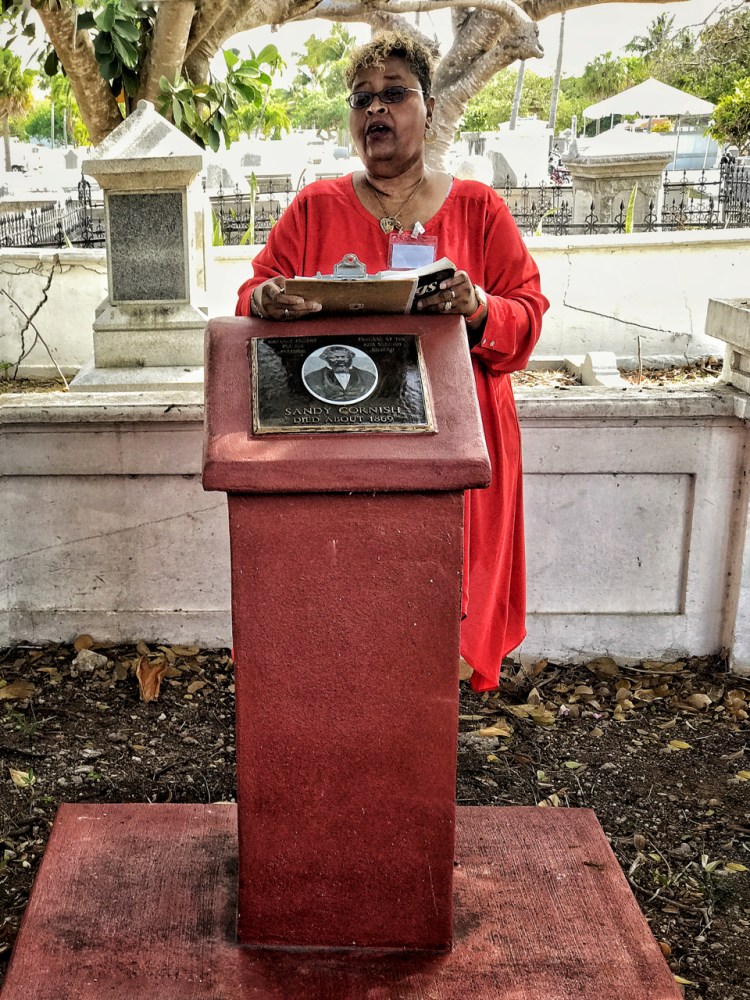
Sandy Cornish was born a slave in 1793. In 1839, he was able to buy his freedom for $3000. His emancipation papers were burned in a fire that swept through the wooden buildings of the city of Port Leon in the Florida panhandle where he lived and worked. Unable to prove his status as a free man, when slave traders tried to take him to the market in New Orleans, he gathered a crowd in a square in Port Leon and publicly maimed himself, cutting his Achilles tendon, stabbing himself in the hip with a knife, and cutting off a finger. Worthless as a slave, he and his wife Lillah, whose freedom they had also purchased, moved to Key West. They founded a farm and orchard on the land where our rented house now stands and prospered, becoming one of the wealthiest couples in the city. Sandy Cornish founded the Cornish Chapel of the AME Methodist Church. The church houses a thriving congregation today.
The exact location of Sandy Cornish’s grave in the Key West Cemetery has been lost to history, so a memorial was recently erected. The story of Cornish’s life was told by well-known local singer Wilhelmina Lopez-Martin, who sang the intro and the outro.
William Curry
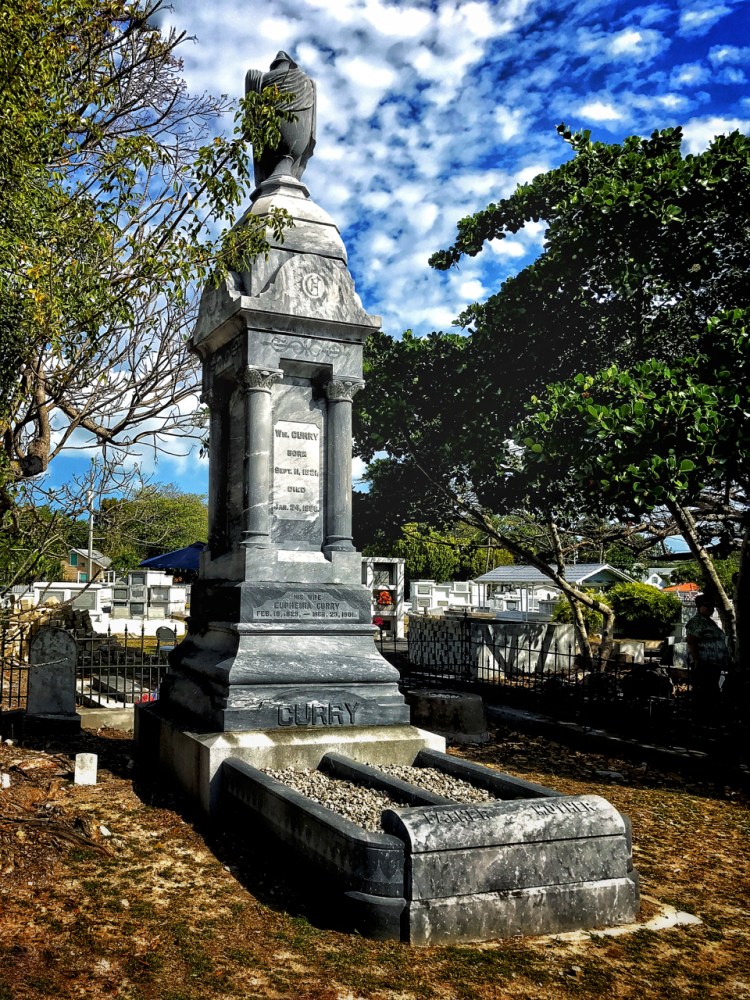
William Curry arrived in Key West penniless from Green Turtle Cay in the Bahamas in 1837. He died as Florida’s first millionaire. He had many enterprises, but made the bulk of his fortune wrecking, salvaging goods from ships that wrecked in the treacherous waters of the Keys. This is how many early Key West fortunes were made. You can tour and even stay in The Curry Mansion, which is a Bed and Breakfast today.
On the Cemetery Stroll, William Curry’s story was told by Clinton Curry, a distant relative who still lives in Key West.
The Watlington Family Plot

Captain Francis Watlington and his wife Emeline raised their nine daughters in the house that is now the Oldest House Museum in Key West. Though Key West stayed with the Union in the Civil War, Captain Watlington joined the Confederate Navy. After the war, he lived principally in New York City, though he returned to Key West in his final years to be nursed by his youngest daughter, Lily, who had similarly cared for her mother and two of her sisters. She died in 1936. Earl Johnson was the last descendant to live in the house until his death in 1972, meaning the house was continuously lived in by one family for around a hundred and forty years.
The Watlington family’s story was told by Karl Reutling, a docent and historian at the Oldest House.
The Adderlys

George and Olivia Adderly immigrated separately from the Bahamas in 1890 and married soon after. They purchased land on Vaca Key which is now part of the City of Marathon. They built their home out of tabby, a kind of concrete made by burning shells to extract the lime. Incredibly the home still stands today, despite hurricanes and the punishing tropical climate, and you can tour it. The Adderlys attracted a Bahamanian community around them that thrived on sponge-fishing. When Henry Flagler built his railroad to Key West and needed a right of way over the Adderly land, George Adderly, a literate, but otherwise unadvantaged black man, went toe-to-toe with the richest and most powerful man in Florida, and demanded a station stop at Vaca Key in return. Flagler acquiesced. The stop meant the men of the little settlement could more easily move their sponges to market in Key West, while the women made money selling garden produce and baked goods to rail workers and travelers at the stop.
The Adderly’s stories were told by Key West City Commissioner Clayton Lopez and Phyllis LeConte.
Rosa and Mary Navarro
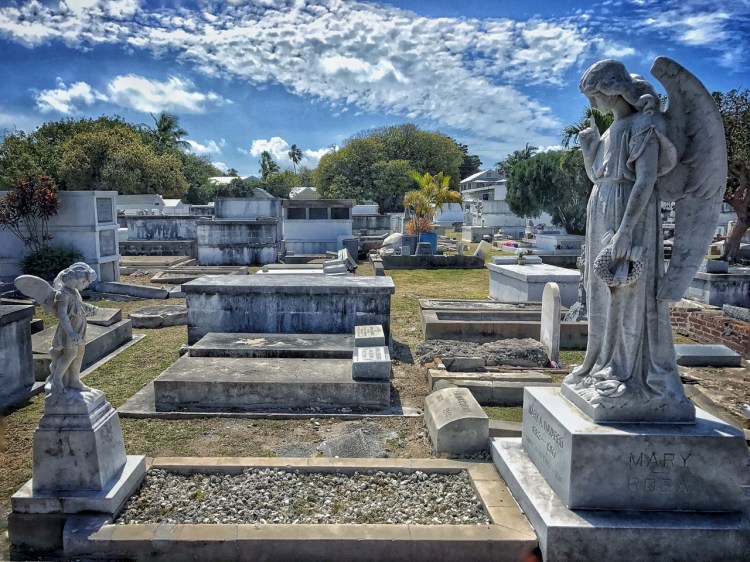
One of the most photographed graves in the Key West Cemetery are the mother and child angels at the graves of Mary and Rosa Navarro, which have recently been beautifully restored. The inscription on Mary Navarro’s statue says, “To the sacred memory of a brokenhearted mother.” The Navarros made their money in cigar-making and at the turn of the twentieth century, their interests took them to Manhattan. Rosa Navarro died in a fall from their apartment window when she was nine. Though her mother lived four years longer, she never recovered, following her daughter in death in 1907.
The Navarro’s story was told by Ron Wampler, and Diane Silvia, Executive Director of the Historic Florida Keys Foundation which is responsible for the restoration.
The stories in the Key West Cemetery, of fortunes made and lost in wrecking, farming, sponging, and cigar-making, of lives of triumph and tragedy, are the stories of the history of Key West. Even the tongue-in-cheek inscriptions I quoted at the top are a part of the irreverent atmosphere of the island. I’ve included just a few of the fascinating lives we learned about on the tour.
Readers: Do you ever walk in or visit cemeteries? What have you seen and learned?
[All photos in this post are by Bill Carito. If you like them and want to see more, you can friend him on Facebook at https://www.facebook.com/bcarito and follow him on Instagram at billcarito and bill.carito.colorphotos.]
Generally, I only go to the cemetery to visit a loved one's grave . . . . I certainly never thought of a cemetery as a tourist attraction . . . this is fascinating.
ReplyDeleteI took a tour of the Eastern Cemetery in Portland, Maine, right across from my home. I've looked out at it while eating breakfast for years. It was similarly fascinating.
DeleteI've been to three cemeteries in New Orleans - one where I saw a woman wave to me as I walked by her family plot; Marie Laveau plot and Nicolas Cage's tomb.
ReplyDeleteFor a moment I thought--was it a living woman?
DeleteBarb, thanks for sharing the terrific photos and stories!
ReplyDeleteLucy's octogenarian character, Miss Gloria leads cemetery tours and Lucy has described several of the graves in her books. I find it fascinating.
Like Joan, I usually only visit the Graves of loved ones, but would consider taking a Key West Cemetery tour if I ever get down there again.
Safe travels home, Roberta!
I hope you make it to Key West again!
DeleteWaving hi to my good friends Barb and Bill! What a wonderful post. As Judy mentions, Lucy's scenes with Miss Gloria in the cemetery are vividly drawn.
ReplyDeleteI love wandering in cemeteries. There's one across the street from my son's house, where I have walked many times with my granddaughter. The cemetery behind the Quaker Meetinghouse in West Falmouth was the source of many of my character names for the Quaker Midwife Mysteries. Long ago I frequently walked and birded in Mount Auburn Cemetery in Cambridge. All have history imbued: couples of wildly varying ages. Babies who died. People who died in great numbers in wars or from pandemics.
Edith, your walks with IdaRose remind me of cemetery walks with my Grammy. She knew so many of the people buried there…lovely stories. Thank you. Elisabeth
DeleteI remember that cemetery in West Falmouth. A wonderful inspiration.
DeleteBesides Arlington Cemetery, I have visited two others as a tourist. Calvary Cemetery in Rochester, Minnesota to see the grave of Archibald “Moonlight” Graham. You might know of him from the Field of Dreams movie. The other one is Evergreen Cemetery in New Haven , Connecticut to see the grave of Daniel Lucius “Doc” Adams. Doc Adams was an important figure in the early days of baseball in the nineteenth century. I have had the pleasure of meeting two of his descendants who sadly have now also both died. You can learn more about Doc Adams at docadamsbaseball.org
ReplyDeleteThat's a different and more specific kind of graveyard touristing. Fascinating.
DeleteBarbara, welcome to Jungle Reds! I remember you from Malice Domestic in 2016! These stories about the Key West cemetery are amazing! I was going to ask you about the Civil War because the cemetery was established before the Civil War, then the answers appeared as I read further into your stories.
ReplyDeleteHave I visited Cemeteries? Yes. I visited the grave of the first teacher of the Deaf, Laurent Clerc, at a Cemetery in New Haven, Connecticut. Here is a trivial fact: The actor James Spader is great great grandson of Laurent Clerc. Another cemetery, which I visited, was the Arlington Cemetery where JFK is buried.
I've been to Arlington, though decades ago. I've also been to the American cemetery in Normandy. I expected to be moved--but I underestimated how keenly I would feel it.
DeleteThanks Barbara for this excellent historical biographies of the cemetery on Key West. So interesting.
ReplyDeleteMy pleasure!
DeleteI've visited Old Bennington Cemetery in Vermont to see Robert Frost's grave and Hope Cemetery in Barre Vermont (which is a a center for stone masons and the monuments they built for themselves are funny, moving, and simply remarkable. I do wander through nearby cemeteries to find names for characters.
ReplyDeleteI would like to go to Hope Cemetery. It sounds fascinating.
DeleteIn Massachusetts, there is a tradition of visiting family graves and planting (often geraniums because they are hardy but I think they are ugly so I now plant petunias and red Diplodenia flowers) on or just before Memorial Day. However, I went on a wonderful evening cemetery tour on Halloween in New Orleans once at a Phantom Friends conference. They told us cemeteries there are dangerous to visit at night there so there was a frisson of fear about the expedition!
ReplyDeleteI've never toured a cemetery at night. I image I would be a little edgy.
DeleteMy grandmother always went to several cemeteries on Memorial Day and laid ferns and peonies cut from her garden on family members’ graves. My older sister remembers these outings better than I do, especially since her birthday was on Memorial Day until they made it a Monday holiday in 1971.
DeleteLucy, I hope your travel home is easy and uneventful! Looking forward to posts and photos about New Zealand! I have been to Key West once, and we did not do a cemetery tour, alas! I think it’s time for another trip!
ReplyDeleteCome again!
DeleteFascinating article. Some cemeteries are also arboretums - Lexington, KY, Louisville, KY, for example, so we have been to a number of them. If we are touring around we will sometimes visit a cemetery to see some historic monuments. The saddest ones, however, are some of those in very small towns, where you can see how most of a family was struck down by an illness within days of each other. Maren is right about names. But also related to this idea is visiting churches (something we'd be doing in England, for example). The monuments in Bath cathedral reminded me of visiting a cemetery.
ReplyDeleteI will add that I always spend too much time when visiting the cemeteries of small churches when we're traveling in England. Since I read so much English lit, I treasure seeing the names, some of which are unusual to me, and also getting a sense of families of various generations.
DeleteBeth Glixon, your “too much time” reminds me of Saint Exupery’s line in The Little Prince— it is the time you have wasted on your rose that is important. Elisabeth
DeleteThank you for this history! The stories are fascinating. When I think of cemeteries, I think of the tradition of Dia de los Muertos. I was lucky enough to experience it in Mexico a few times. Families spend the day at the cemetery, cleaning and decorating the graves of their loved ones. Mass is held, and mariachi band play music. It's such a fun celebration.
ReplyDeleteI love the tradition of Dia de los Muertos (which is celebrated yearly around the end of October/early November) because it is a time to remember loved ones who have passed and by remembering them the belief is they never truly die. It is a way to pass on family genealogy to the younger generations.
DeleteI wrote a short story that incorporated the Dia de los Muertos, as well as quarries in Vermont, and a cemetery visit--tying together lots of comments on this blog.
DeleteThank you for explaining what tabby is! I am currently reading The Fabled Earth by Kimberly Brock and she has called a house in an island the tabby house a few times. I had no idea what that meant. My best guess was that she was referring to the color of the house. It makes so much more sense now!
ReplyDeleteYes, so interesting about tabby houses. I thought it was related to the tabby cats!
DeleteI love that this house is still standing. Before 1942 the only source of fresh water in the Keys was cisterns and other capture methods. Therefore a lot of the early concrete was made with salt water and has since crumbled to dust or required extensive repairs.
DeleteHi, Barb! Thanks for the informative essay, with Bob's great photos. Looks like a fun way to spend a day in the Keys.
ReplyDeleteI have always loved cemeteries, since my maternal grandparents lived at and Grandpa was the sexton of the Catholic cemetery in my hometown. Across the street from St. Stephen's is the secular Greenwood Cemetery, and we lived on the other side of it. Many of my high school memories include walking through Greenwood to get to the pool and baseball fields on the other side of St. Stephen's. My favorite spot in Greenwood was the lovely pond, situated next the white crosses of the war fallen, with overarching shrubs where a sore-hearted teenager could sit out of sight and be still.
Beth mentions arboretums, which is what our Cincinnati Spring Grove Cemetery is, in addition to being the final resting place of many famous individuals. Salmon P. Chase, for instance, who not only was one of the only politicians to serve in all three branches of government, but he was the founder of the IRS. Both William Procter and James Gamble, who started Procter & Gamble to manufacture Ivory Soap, are buried there. Spring Grove holds the patent to at least one type of tree, too.
When my youngest was at The Citadel she and I took a cemetery tour one mild evening. The guide was speaking in quiet and dramatic sonorous tones about the cemetery we were standing in front of, which had a locked gate. One of the party accidentally leaned against it, causing the iron to creak loudly, and everyone, including the guide, jumped a foot.
We have a small family cemetery at our farm, dating back to the early 1800's, which used to be tended by a surviving family member, but he has sadly passed on awhile back. It's fascinating to see the site, high on the hill, overlooking a lovely creek valley. It would be a soothing last place to lay one's self down.
Yes, we very much enjoyed our visit to the Cincinnati cemetery. I find the family cemeteries so moving - there's nothing like that in my family! The roots don't go back long enough.
DeleteMy in-laws are buried at Mount Auburn Cemetery in Cambridge, MA, which Edith mentions above. It is an arboretum and a glorious one.
DeleteThanks for the post, Barb. Next year when we’re in Key West I want to revisit the cemetery with your post in mind.
ReplyDeleteEnjoy!
Deletehi Barb! Missing you! this is so fascinating and thought-provoking… Such proof that everyone has a story. And I am so intrigued by the names. They are so of a time and place… Thank you for this!
ReplyDeleteAren't they, though? The Keys have always attracted a fascinating cross-section of people, and the cemetery bears that out.
DeleteThere is a beautiful cemetery in Halifax Nova Scotia that is more like a park with all its beautiful trees, and is treated both with respect and as a Sunday morning walk. No running, no ball playing, but you can be escorted by your dog. This is separate from the beautiful Halifax Public Gardens, but dates its origin to about the same time. This cemetery, known as Camp Hill was opened after the Old Burying Ground which is closer to the waterfront, but unlike OBG and two others does not contain any of the people from the Titanic. For those who are unaware, there are 140 burial stones for the victims of the marine disaster in April 15, 1912. Eash stone has a blurb about the deceased. Camp Hill is where you would go to find people who were involved in both World Wars, as well as the cities elite, and a separate section for Black Canadians (not our best history.) All are beautifully maintained and very peaceful. They are worth a walk, even if you are not searching for someone or a history buff.
ReplyDeleteAs for visiting family now residing in graveyards – nope. They are planted and done. After that they reside in my memories and the day-to-day things that trigger a memory – they just float on the wind.
Speaking of cemeteries, Jack’s namesake died in WW2 just inside Emmerich, Germany and is buried in Nijmegan (Groesbeek) Cemetery in the Netherlands. The people of the country have maintained the graves with dignity over all this time. For many years, a family wrote letters to his family, talking to them about visiting Jack’s site. What a wonderful, thoughtful gesture. My Jack goes on line to view the site quite frequently, and just remarked that the trees by his grave are getting much bigger!
ReplyDeleteI love visiting cemeteries. So much history of a region. The Forest Lawn Cemetery in Buffalo has many tours and holds the last resting place of many souls from Red Jacket, Millard Fillmore, Shirley Chisholm to Rick James. It has some amazing mausoleums including one designed by Frank Lloyd Wright
ReplyDeleteThat is lovely. I am glad they remember. I wish, in this country, we remember the sacrifices of the entire populations during both world wars a little more.
DeleteApparently Blogger has put me on the disappearing list this morning. Here is my original post. Ignore it if I miraculously appear. Speaking of appearing - any sign of the ducks???
ReplyDeleteThere is a beautiful cemetery in Halifax Nova Scotia that is more like a park with all its beautiful trees, and is treated both with respect and as a Sunday morning walk. No running, no ball playing, but you can be escorted by your dog. This is separate from the beautiful Halifax Public Gardens, but dates its origin to about the same time. This cemetery, known as Camp Hill was opened after the Old Burying Ground which is closer to the waterfront, but unlike OBG and two others does not contain any of the people from the Titanic. For those who are unaware, there are 140 burial stones for the victims of the marine disaster in April 15, 1912. Eash stone has a blurb about the deceased. Camp Hill is where you would go to find people who were involved in both World Wars, as well as the cities elite, and a separate section for Black Canadians (not our best history.) All are beautifully maintained and very peaceful. They are worth a walk, even if you are not searching for someone or a history buff.
As for visiting family now residing in graveyards – nope. They are planted and done. After that they reside in my memories and the day-to-day things that trigger a memory – they just float on the wind.
Fascinating, Barb. I've done a tour of Allegheny Cemetery here in Pittsburgh. Lots of stories there - most of which are escaping my memory right now.
ReplyDeleteEscaping my memory--familiar with the concept.
DeleteOne of the best Mother's days that I had was when my adult son and I went to a book store and then walked around a local cemetery.
ReplyDeleteThat does sound like a lovely Mother's Day.
DeleteLove old cemeteries. And I could go on and on about Pere La Chaise (sp) in Paris. But the fav is couple of miles from our house. Mt Hope is huge, old, and beautifully situated on hills.
ReplyDeleteFredrick Douglass is buried there. People leave small change, flowers, tee shirts and prayers there daily. What a gentleman, former slave, abolitionist and orator. Nearby is the grave of his friend and co-conspirator, Susan B Anthony. They were contemporaries fighting the battles for equality and freedom. This is evident still today. Hordes of people visit their graves each year, especially on Election Day. Susan B Anthony’s head stone is covered in “I voted” stickers by those visitors, so much that it has to be covered in plexiglass to make clean up easier.
Come see me one day and we’ll take the tour
Thank you, Ann. Would love to walk your cemetery with you. Elisabeth
DeleteAny time Elisabeth.!
DeleteI think it so lovely people leave remembrances there.
DeleteThanks Barbara!
ReplyDeleteOne of the most interesting graves we came upon quite by accident. We were walking around in a small church cemetery in St. Martin's Church in the Oxford, England area and what a surprise to see the nondescript very modest headstone of Winston Churchill. According to Google "it is located just outside the grounds of his birthplace, Blenheim Palace, this quiet country churchyard was chosen by Churchill himself rather than a grander location like Westminster."
I did not know this--and wouldn't have guessed!
DeleteBarb, thank you so much for sharing this! What an amazing variety of people and histories; it seems Key West has always attracted the stubborn and single-minded. I do wonder about the Curry's marriage - all the other wives have an equal place at their husband's sides, and poor Euphemia Curry looks like a footnote to William's story.
ReplyDeleteI should know this Julia, and I'll find out. The Currys are a big part of the Key West Woman's Club history...
DeleteCemeteries are such a wealth of historical information. I enjoy wandering around there. In addition to visiting family grave sites, I have been to the one in Boston where Cotton Mather is buried, along with several in old mining towns in Colorado, one in New Orleans and one in Ireland. So many great stories often missed otherwise.
ReplyDeleteI know the one in Boston!
DeleteI find cemeteries to be the most peaceful places. One of my favorites is Arlington National Cemetery. All those white markers in soldiers' formations of columns and rows. The Tomb of the Unknown. JFK's eternal flame. Bobby Kenney's simple cross on a hill. The Space Shuttle Challenger Memorial. The Maine. The resting places of RBG as well as Dashiell Hammett. Heart-breaking and yet soul-restorative.
ReplyDeleteJohn's Aunt Snow is buried in Arlington, and we visited for the first time last year. It was a very moving experience for all--we arrived in time to watch the changing of the guards too.
DeleteThank you, Barbara, for the essay and Lucy for inviting Barbara. Too many years have passed since my last cemetery visits. When I was growing up, Mother and Grammy always took me to the cemetery to place geraniums for “Decoration Day” (now Memorial Day), mums in the fall, greens for Christmas, and spring flowers at Easter. While they were doing this I explored nearby graves “the baby in the half shell”, the big black marble, and as I got to be a reader all the inscriptions. Lived next to a cemetery in graduate school and again at a short term job in Ashland OR. The monuments and the inscriptions…always interesting. Elisabeth
ReplyDeleteAlways interesting...
DeleteI was lucky enough to do a bike tour of the cemetery with Lucy and her hubs on my recent visit. Absolutely, fascinating! Love this post, Barb!
ReplyDeleteIt was so great to see you in Key West, Jenn. However briefly! (Which was all on me.)
DeleteI love this story and it makes me want to visit the Key West Cemetery. My husband and I recently took a cemetery tour around our hometown of Ridgefield, CT and we've taken many tours in places like England. There's a great cemetery in Savannah, Georgia. And a tiny little still active one stuck in the middle of Hilton Head Plantation that you can barely access unless walking for biking. Not sure how they bury people there, but they still do. It dates way back to early Hilton Head Island days. I love wandering reading the tributes on the plots.
ReplyDeleteI would like to do the Savannah and Hilton Head ones someday.
DeleteThe Key West Cemetery is a favorite of mine. I visit it whenever I'm in town on my own. I admit to being a cemetery hound and highly recommend the Miami Cemetery and any cemetery in Charleston, SC. Lots of history lessons.
ReplyDeleteThe Colon Cemetery in Havana is a highlight of any trip. (Maybe not right now.)
DeleteRose City Cemetery and River View in Portland, Oregon are where my family members are buried. In the Rose City Cemetery I was fascinated by all the separate areas of burial: Baby, Gypsy, Chinese, Jewish and more. My mother and grandmother would visit graves several times a year, clean them, and bring flower to decorate them. I was allowed to choose the headstone for my maternal grandfather. I chose an opened book!
ReplyDeleteThat's a sweet story!
DeleteThe Key West cemetery started out with different quadrants for different religions and races. Then basically in the 70s all order was lost and nobody was even keeping track of who was buried there, much less where.
DeleteWonderful stories about the Key West Cemetery. Here in Bern, I often include our neighborhood cemetery on my regular walk, not for what's written on the graves, but for its beautiful trees and flowers.
ReplyDelete