Tuesday, March 31, 2026

Mark Pryor--Fact or Fiction

DEBORAH CROMBIE: I'm very happy to have our Jungle Red friend Mark Pryor back on the blog today! His new book, THE MOST MYSTERIOUS BOOKSHOP IN PARIS, is out today, and not only does it feature one of my favorite fictional detectives, Hugo Marston, but it's the first book in a spin-off series! How can you beat bookshop, Paris, and a handsome ex-FBI profiler? Oh, add chocolate! And Mark's special expertise, as he will explain.


Mark Pryor:  Fact or fiction? If it's really weird, it's probably true...


I will be doing a fair few book events over the next month or so, and I can guarantee one question will be asked of me at each one. And, to be clear, it's a question I love answering because I'd ask it, too:

"Do you use any of your real-life criminal experiences in your books?"

Oh, let me back up and be clear: those "criminal experiences" do not involve me committing crimes (not that I'd admit to, anyway!), but refer to my sixteen years as a prosecutor and my current profession, a criminal defense attorney.

In that time, I've handled dozens of murder cases, and thousands of other criminal cases, everything from the theft of a watch from Target to gang-related robberies and assaults and... well, if you can think of a type of crime, it's probably landed on my desk. 

So what's my answer? Well, I'm a lawyer so it's not a straight Yes or No, of course. It's both, and here's what I mean.

Yes: what I use is my knowledge of the investigative process. When a crime happens, usually murder in the case of my books, I know what steps the police take to secure the scene and collect evidence. This lets me set a genuinely accurate process in place but also, if I choose, allows me to insert mistakes (or clues) by whoever is investigating. I don't have to call a detective or rely on Google (or, heaven forfend, AI) to get it right. Or wrong, if that's what I'm going for.

No: the truth about most real-world crime, murder included, is that it is one of two things, either (1) grubby, sordid, and "unsexy" in the sense that it wouldn't be at all interesting to read about. For example, a man strangling or beating his wife to death in a drunken, jealous rage. Horrific and tragic, and I don't mean to minimize that, but novel-worthy? Probably not. If not in that category then those few cases that aren't dismal and gross, well, to be honest they are (2) often so weird and bizarre that if I tried to put them in a fictional story, you'd throw that book across the room with an anguished cry of "Ridiculous! That could never happen!"

Two quick examples of this: Picture a recycling plant and the large conveyor where people are sorting the types of recycling, when someone ponders aloud, "Would you look at that - why would someone recycle a mannequin?" and someone closer to this odd sight hits the "Stop" button while pointing out that it's not a mannequin at all. The investigation was quick - mail and papers around the body led police to a specific street address, where blood in a recycling can matched that of the victim, and a nearby surveillance camera captured the killer dumping the body. It also captured what was beside the recycling bin: a trashcan. And in case you didn't know, if you put a body in a trashcan, it goes to the dump and is never seen again.

Which is to say, if I write a novel where my murderer is standing there, a body over his shoulder while deciding whether to use the trash can or the recycling bin, and he goes for the recycling, you would be understandably irritated and incredulous. But it happened. And is why he was caught. 

Second example: a 1985 murder of a beautiful young mother, beaten in her apartment by a person or persons unknown. Here are some of the oddities associated with that case, and why writing it as fiction would render a story contrived and unbelievable:
  • At the time, the police collected a written alibi statement from the jealous ex-boyfriend (and as we all know, it's always the jealous ex-boyfriend!), but never checked it;
  • Twenty-five years later, a phone call out of the blue pointed police to that ex-boyfriend, the call coming from his current jealous wife (!);
  • The cold case detective, Tom, and I visited the scene of the crime, and the woman living there was an absolute carbon copy of the victim, she looked startlingly like her;
  • Tom then found the alibi witness, still living in her same neighborhood in Austin;
  • That witness remembered the suspect, but not if she was with him at the time of the attack, but told Tom she used to keep a diary of her life;
  • She literally went up to her attic and found the diary for that week, and busted the alibi (helping lead to a conviction at trial);
  • The suspect's wife then did an about-face and sided with her husband at trial, throwing a dramatic fit when the guilty verdict was read.
All of that was pretty interesting and exciting to be involved in, no question, but if I stitched that sequence of events and coincidences into a novel, you'd be rightly skeptical. 

Which, I suppose, brings us to that famous saying, that truth is stranger than fiction. Is it? Not always... but when it is, it's too strange even for mystery novelists and our ever-discerning readers!

DEBS: Mark, these are great stories! But I agree, not very good for book plots. My husband is a former cop and would agree with you that in real life most criminals are really dumb. Fortunately for us, if not for fiction.

I'd much rather read about fictional crimes, especially ones set in Paris!


Hugo Marston, former head of security at the U.S. embassy in Paris, has retired and is ready to realize his lifelong dream of owning a mystery and antiquarian bookshop. But when a blackmail scheme targeting a chocolatier leads to murder, Hugo is again called to investigate in the first Paris Bookshop Mystery.

And more about Mark:

Mark Pryor is the author of the Hugo Marston series, set in Paris, London, and Barcelona. With nine books in the series thus far, THE MOST MYSTERIOUS BOOKSHOP IN PARIS is the first in a new spin-off series. It sees Hugo Marston still in Paris, and with the same characters around him, but instead of working at the US Embassy Hugo has opened his own mystery bookshop!

Mark also authored the Henri Lefort trilogy, historical mystery novels set in 1940s Paris, and has two books set right here in Austin, the psychological thrillers HOLLOW MAN and DOMINIC.

Away from books Mark is a former prosecutor, and now a partner at a criminal defense firm in Austin, Texas. He began his career as a journalist in England, where his beat was also crime-related - the police blotter. He has been a guest analyst on CourtTV, and appeared on CBS News's 48 Hours, NBC's Dateline, and Discovery Channel's Discovery ID: Cold Blood


Monday, March 30, 2026

What We're Reading

DEBORAH CROMBIE: Lucy was kind enough to hand off one of our favorite regular chats to me, and I am particularly appreciative because I seem to have been reading a lot lately!

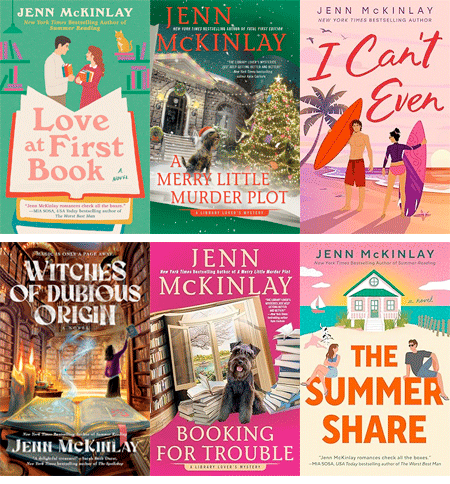
First off, our wonderful Jenn McKinlay's latest (and maybe last?) entry in her Library Lovers series, BOOKING FOR TROUBLE, When I finished it I had to seriously resist going back and rereading the whole series. I'm glad Jenn has said "never say never" on future installments, as I do love the setting and the delightful characters.


Then my daughter gave me her copy of Niall Williams' TIME OF THE CHILD, because she couldn't get past twenty pages. Most of the time we like or dislike the same books, but I have to differ on this one. I will agree that this look at Irish village life in the early 1960s is a bit slow in the beginning, but it reads like poetry, and once I got into it, I could NOT put it down. I adored this book. I sobbed my way through the ending (in a good way) then read the last few chapters again. Twice. I also listened to Williams' THIS IS HAPPINESS, his previous book, which is also set in the small Irish village of Faha. I would recommend reading Williams' books in the order in which they were written, as they feature many of the same characters. Lovely books, exquisite writing. You can see why Williams' THE HISTORY OF RAIN (now on my TBR) was longlisted for the Booker Prize.


Here's one Kayti and I did agree on: She thrust Matt Haig's THE LIFE IMPOSSIBLE into my hands with a must read directive. I liked it so much I dug out my unread copies of Haig's THE MIDNIGHT LIBRARY and HOW TO STOP TIME which I really enjoyed, but THE LIFE IMPOSSIBLE was definitely my fave. We have tickets to see Haig here in Dallas when he is touring for his upcoming book, THE MIDNIGHT TRAIN, and I'm very excited about that. On my birthday, no less!


From our local bookstore, I picked up a copy of Fredrik Backman's MY FRIENDS. I did like this, but what an odd book it is. I think it would make a great book club selection, because when I finished it I was dying to discuss it with someone! I can't say more because spoilers!


Except for Jenn's book, you will have noticed there are no mysteries in my little list, but never fear. I read Rhys and Clare's new Molly Murphy, VANISHED IN THE CROWD, and I enjoyed it so much! Such wonderful historical detail, and I especially liked this one as it dealt with early women in science, as well as women's suffrage, which felt very timely.


One more, and a mystery, Andrea Penrose's latest in her Wrexford and Sloan Regency series, MURDER AT SOMERSET HOUSE. These are fun, and usually deal with early 18th century science and economics. Some of this one, which centered on the development of the London Stock Exchange, went a bit over my head, but I loved the adventures of "the Weasels," the young wards of the main characters, and the introduction of a new young person to the family. I think these books would be great YA reads.


How about it, dear REDS? What's been on your nightstand since last we checked in?


LUCY BURDETTE: I was asked to read POPPY MONTGOMERY GETS EVEN, a new book coming out from Mysterious Press in June. Poppy is a woman of a certain age who becomes suspicious of two deaths in a retirement community where her dear friend lives. They decide to investigate, and she enlists her computer hacker grandson to assist with developing false profiles for older women on a dating site. The book is delightful, with wonderful character development and a good mystery too. Reminds me of Richard Osmond‘s murder club characters and Spencer Quinn‘s Mrs. Plansky.


I also read an old favorite Arnaldur Indridason’s The Quiet Mother, a story about a murder in Reykjavík. I love this description from the back cover: a masterful blend of human tragedy and relentless suspense, where every discovery comes at a cost. So dark and so well written.


And finally, I was encouraged by many readers to catch up with those who have read and adored Remarkably Bright Creatures by Shelby van Pelt. Loved, loved, loved this book! Wonderful characters from the grandmother to a lost teenage boy to a small town in Washington to the octopus himself. I raved so much that John immediately read it too, and loved it just as much.


HALLIE EPHRON: I just finished two terrific mystery novels. First, RAVEN BLACK by Ann Cleeves. She is so great at creating a sense of place the Shetland Islands), complicated victims, and interesting suspects. And of course her detective Inspector Jimmy Perez is so humane.

After that I chomped through Anthony Horowitz’s doorstop of a book, MARBLE HALL MURDERS. With his usual high wire act of metafiction (a novel within the novel, several casts of characters from present/past in the novel and the meta-novel). Not a book you’d ever fall asleep reading (it’s nearly 600 pages long). 


I’m looking forward to the dramatization (this is the third book, after MAGPIE MURDERS and MOONFLOWER MURDERS in a series) with Lesley Manville returning as editor Susan Ryeland. Again, she’s editing a novel within the novel and trying to figure out who the fictional characters (villain, victims, …) in a murder mystery and who they map to in real life.

And I’ve just dipped my toe into THE CORRESPONDENT. A break from crime fiction, it’s written in letters. Absolutely fascinating just figuring out how the author Virginia Evans pulls it off. So far it reminds me (character-wise) of OLIVE KITTERIDGE and has me queuing up OLIVE AGAIN to read next.


DEBS: Hallie, Kayti just read THE CORRESSPONDENT and loved it! She's loaned it to a friend but I am getting it next!


JULIA SPENCER-FLEMING: Are they doing the third book, Hallie? I’m so excited! I loved the two seasons of MAGPIE and MOONFLOWER.


I just finished (and blurbed) Dick Cass’s HARDER THAN A HEADSTONE, a deeply-Maine mystery starring a “I amd NOT a PI” hero. I love Dick’s spare, evocotive prose; he reminds me of Steve Hamilton.


I’m currently enjoying FAMILY DRAMA by Rebecca Fallon, a tale of “love, grief, motherhood and the different versions of ourselves we share with the world and with each other,” to quote the flap copy. It ranges from 1986 to 2012, and it’s beautifully written. PS, is anyone else freaked out by the fact the late 80s and early 90s are now historical fiction?!?


Next up, THE FOUND OBJECT SOCIETY by Michelle Maryk. I picked it up after reading the dynamite first chapter and the premise: an ultra-secret society of, yes, found objects that enable anyone holding one to experience the moment of the last owner’s death - and come back safe. 


Finally, non-fiction: PLANET MONEY, A Guide to the Economic Forces That Shape Your Life. I’m a HUGE Planet Money podcast nerd, and if you are too, the book is coming out on April 7. 


HANK PHILLIPPI RYAN:  Well, I say drop everything and read YESTERYEAR by Caro Claire Burke. It is truly amazing, and it’s about a trad-wife influencer who has a much better life than you, just ask her, and she advocates churning her own butter and oh, I just realized I wrote a whole JRW blog about this. So you already know.  It’s fantastic. (I almost gave up after page one. But  I persevered. ANd SO happy I did!)


And I just finished THE ENIGMA CHALLENGE  by S.C. Godfrey,  which I know sounds like one thing but it isn’t that–it’s truly a contemporary  Romancing the Stone with codes and puzzles, and I adored it. (The heroine is even named Zoe Wilder, who knows the author meant it to be an updated Joan.)


And I am in the midst of two books: Anthony Horowitz’s new  A DEADLY EPISODE, his latest Horowitz and Hawthorne mystery, which is of course hilarious and meta and clever and perfect, and THE MORTONS by Justine Larbalestier and Scottt Westerfeld,  which, hold on to your hats, is the wildest most unhinged family drama thriller mystery thing you can imagine.  I dare you, look at the cover. YIKES.


RHYS BOWEN:  I love it when books I’ve enjoyed are mentioned. Remarkably Bright Creatures and The Midnight Library were both favorites of mine. I’ve had so little time for reading, what with all the doctor appointments, books I have to blurb, and my own writing. But when I do read it has to be calming. I just re-read Rosamund Pilcher’s The Shell Seekers. Nothing dramatic, just family dynamics, and now I’ve just started on Lucy Foley’s Book of Lost and Found which looks delicious. I’m also reading, and really enjoying a book that’s coming out later this year called The Pilgrimage of Primrose Honeychurch, by Laura Walker. Watch out for it, it has a really interestingly different main character.


JENN McKINLAY: I have been reading mostly for endorsements as I have no time (deadline 4/1!!!), but I have IN THE MIDNIGHT RAIN by Barbara O’Neal, which Lucy gave me when I visited her in Key West and BECOMING DUCHESS GOLDBLATT by Anonymous on audio which Pat Kennedy recommended while I visited her. Come on 4/1 so I can read again! 


DEBS: I forgot to mention my current read, THE LIBRARY BOOK by Susan Orlean. This is non-fiction, about the disasterous fire in the Los Angelos central library in 1986, and it is fascinating, as well as a love letter to books and libraries everywhere.


Now, what's in your stacks, dear Reddies?


Sunday, March 29, 2026

New Zealand, a Few Fun Facts and an Idea


LUCY BURDETTE: Kia Ora! As you’ve no doubt heard by now, I’m just back from a two-week trip to New Zealand. I’m certain you don’t want the full slideshow but I’ll share a few reactions from our whirlwind voyage.


1. New Zealanders are crazy in the sense of tackling physical challenges. Probably because the landscape lends itself to challenge? For example, we heard stories of men hunting deer from a helicopter with no doors. There is a road race along the length of the Milford track every year, 33 1/2 miles of mountainous terrain. It sells out in 22 seconds and has a long waiting list. We did a four hour hike at the end of the trail, which was plenty for me!


2. New Zealand is an island—the closest land point from another country about 1000 miles away. They are very protective of their land and creatures. The country has no natural mammals, other than two bats, which means no predators. That means many of the birds native to New Zealand evolved into land birds without the ability to fly. When people arrived on ships from other countries, they brought with them pests such as stoats, rats, and cats. Also, the Maori people hunted the larger land birds, often to extinction. All this means New Zealanders are very focused on conservation, sustainability, and increasing the population of native species, from birds to people.


3. New Zealand was the last major land mass to be settled. The Maori tribe arrived after 1300, and the British declared sovereignty in the 1840’s. Since the 1970’s, the Maori and other ethnic groups have pushed to take land and power back, which they consider stolen by the British. Maori is a second language for the country—our guide was pleased to tell us that former prime minister Jacinta Arden began her messages to parliament and the people in the Maori language.


Circling back to the question discussed on Monday, I did not do a lot of work on vacation. But as a long-time mystery writer, it’s hard not to think about murder and mayhem in a new setting! The people in our travel group were game to point out poisonous plants and murder methods that I might enjoy using as we toured. If I was going to write a story, I thought I might have opened it in the dark sky night reserve. After a chance to view the southern hemisphere constellations, we herded into the changing areas and given white robes before heading to a warm pool. (Keep in mind that this all happened in darkness so our eyes could acclimate.) We floated in that pool on individual hammocks listening to a guide tell stories about the stars. I could imagine most of the guests exiting the pool, but leaving one behind—quite dead. It would have been too dark to see much of anything, a detecting challenge!


But then, on our last day hike on the Routeburn track, I began to chat with one of our guides, Olivia, who turned out to be a wonderful story brainstormer. She was fascinated with the idea of setting a mystery in New Zealand. She suggested either the Lake Marion or Gertrude Saddle routes, which are very popular  with Instagram influencers. Supposing there was a couple hiking together, each of them with an active account. Supposing their tracking device was lost or malfunctioned, and one or both disappeared on the trail. A professional guide, like Olivia, might have been one of the last people to have seen them on the trail. What might she have noticed? If someone did meet an unsavory end, was it a push and a fall? 


Or perhaps a dish prepared with New Zealand’s most poisonous plant, the tutu with its delicious looking berries? 


Or the stinging nettle, the ongoanga?


Who knows if I’ll use any of this, but what fun to think about it. Honestly, it helped pass the time when I was trudging up a steep and rocky path. Fortunately, there was an incredible view at the top. I’m sure that that’s a good metaphor for writing as well. (Here's one version of trouble I forgot--the Waiotapu hot springs and bubbling mud pools...)


Do you think about murder mysteries when you travel? What's the most exotic setting you've enjoyed in a mystery?

PS, If you'd like to hear more about the itinerary we took without the murderous commentary, here's John's version...

Saturday, March 28, 2026

On Family History by Christine Falcone

 LUCY BURDETTE: Today’s guest has been one of my writers group friends for years (many!) I know you’ll enjoy the fourth book in her Melanie Bass mystery series, Ruff’d Up. Take it away Chris!

CHRISTINE FALCONE: Thank you Lucy and Reds for inviting me back.


Some writers do elaborate biographies for each of their characters where they know what kind of childhood they had, where they went to college, if they went to college, who their first boyfriend or girlfriend was, and what they eat for breakfast each morning. I am not one of those writers. This came into play in book four in the series when one of my long- time writing group partners (thank you Lucy!) asked “What about Melanie’s family? We don’t really know anything about them.” She was right. I had briefly mentioned a cousin in book two, but nothing about her nuclear family. I decided Melanie’s parents were no longer alive, but she has an older sister, Meridith who became a large part of Melanie’s story in RUFF’D UP.


Meridith is a bit overbearing at times, and the dynamic between her and Melanie shed light on parts of Melanie’s character I had never explored before. Those of us who have siblings know that they know exactly how to press our buttons (and we, theirs!) Your sibs know all about your childhood, your less perfect moments as well as your shining achievements. And they don’t let you forget them, especially the ones you would most like to. Meridith is the older sister; I was the eldest of eight, so I used that experience in developing some of the hurt and long-buried resentments both Melanie and Meridith felt toward each other. 

Another thing I thought about as I wrote the interactions between the sisters was how differently they remembered aspects of their childhood. I know in talking to my own siblings I sometimes wonder if we are talking about the same events and occurrences.

I found I really enjoyed writing the scenes between the sisters, and in spite of being the eldest in growing up I had feelings both sisters felt.

If you have siblings, do you find that you have different memories of childhood occurrences than they do? Do you agree with those birth order profiles that you find in magazines and online?


RUFF’D Up is the fourth book in Christine Falcone’s Melanie Bass Mystery series. Her short stories have appeared in the past in Imagine, Lancom Review, and Deadfall: Crime stories by New England Writers. Prior to her retirement she worked for nearly forty years as an RN in a Neonatal Intensive Care Unit. She lives on the Connecticut Shoreline with her family and her dog Toby who is not nearly as well behaved as Bruno, the beloved canine in her mystery series.

About the book: As she looks forward to the return of warm summer days in her native Connecticut, visiting nurse Melanie Bass has more than difficult patients to contend with. She is haunted by guilt over a home invasion she feels she could have prevented, struggles to reconnect with her difficult -and until now distant- older sister, and faces complications in her personal life when an attractive new veterinarian seems to have designs on Melanie’s boyfriend. Just when she thinks things can’t get any worse, there is another brutal attack – this time on someone close to her. As the stakes mount Melanie struggles to deal with her complicated personal life and find and stop those threatening the ones she loves before she is the next victim.

Friday, March 27, 2026

Jessica Everett: Last Summer at Maine Chance

LUCY BURDETTE: You may know today's guest as Jessie Crockett or Jessica Ellicott and also as a former member of the Wicked Author blog. She's also a brilliant brainstormer and I can't wait to read this newest book!

 JESSICA EVERETT: I’ve adored reading mysteries ever since I cracked open The Bobbsey Twins at the Seaside when I was six. I’ve also loved writing them, nineteen so far. The architecture of crime novels, the requirement to simultaneously reveal and conceal information from readers, the examination of societal values all intrigue me as both a consumer and a creator. 


And although all of that is true, at some point in the last few years an idea for a novel that inexplicably did not include a dead body began to prod me. I simply could not get the thought of a story set during the summer at Elizabeth Arden’s Maine Chance resort out of my mind. Plot points suggested themselves while I walked my dog. Setting descriptions whispered me to sleep at night. Lines of dialogue slipped into my brain as I prepared dinner or ran errands. Before I knew it, the novel had gotten its way, and I threw myself headlong into the research portion of the project. 

I read every newspaper article at Newspapers.com covering Elizabeth Arden or the Maine Chance Farm in Mount Vernon from 1929 until 1970. I scoured the internet for images of the spa, of Maine in the 1950s, and of Red Door Salon advertisements from years gone by. I spent countless hours in Maine soaking up the atmosphere. In time, I had a draft written, and then another, and another. The words stacked up, the characters fleshed out, and the story came into its own. 

I was delighted to discover that although Last Summer at Maine Chance does not center around a crime to be solved, like all my others it revolves around friendships between women. It is as much about what society values and celebrates as all my previous novels. It is once again filled with characters I would like to know as well as those I definitely would not. It still explores finding one’s way in the world when traditional paths don’t lead to the right destination.  And, like my other works, and my own life, it is also about being open to trying new things. 


Readers, is there something new you have always wanted to try? Do you read novels that aren’t mysteries? Have you ever been to Maine? 


ABOUT Jessica Everett

Jessica is the author of twenty novels. Last Summer at Maine Chance is her historical fiction debut. She lives with her exuberant family and preposterously privileged poodle, Sam. She splits her time between a tiny New Hampshire village, and the coast of Maine, a place her family has called home for generations. When not dreaming up her next novel she can usually be found walking barefoot on her favorite Maine beach, even in the dead of winter. 

Jessica's website: https://jessicaeverett.com/ 


Thursday, March 26, 2026

A House. Three Sisters. A Lot of Secrets. By Ivy Cassidy (aka Melissa Bourbon)


LUCY BURDETTE: I'm delighted to welcome Ivy aka Melissa Bourbon to the blog today! Aside from writing cozy mysteries, she teaches many wonderful online classes and is a whiz at explaining Pinterest to writers. Welcome Ivy!

IVY CASSIDY: First, let me just say how happy I am to be here with the Jungle Red Writers. Truly. If you’d told me years ago that I’d be talking about magical houses and ancestral secrets on this blog, I would have said, “Heck yeah! Sign me up!”


When I started writing House of Spells and Secrets, I thought I was writing a story about three sisters coming home after their mother’s death. And I was. But I also knew I wanted a house that had almost equal billing and opinions of its own because I love an old house with history. 

Swallow Hall sits on the Chesapeake Bay on fictional Bird Island. It's crumbling a bit, it’s moody, and it's watchful. As I was writing it, I kind of envisioned the Winchester Mystery House in Santa Clara, California, a place where doorways lead to nowhere, windows are upside down, and everything is topsy-turvy. Swallow Hall is the kind of place that holds drafts in its hallways and secrets in its walls. It’s not haunted in a “boo!” kind of way. It’s haunted in the way families are haunted…by what was never said, by what was buried for protection, and by love that inevitably led to loss.

The novel follows triplets—Rowan, Caraline, and Saoirse—who return to their mother’s childhood home…a home they never even knew about, complete with a grandmother they'd never met. 

There they discover inherited magic.

This isn't a cauldron-stirring, sparkly wand kind of magic. It's the kind of magic that exists deep inside. It's inherited magic that comes from Biddy Early, who was a real person and the last woman tried for witchcraft in Ireland in the 1850s. It's the kind of magic that shows up as intuition…as knowing. It's like that tightening in your chest when something is wrong.

Rowan (my point-of-view sister) hasn't discovered her magic yet. She tastes things,… but what kind of magic is that? Caraline is a kitchen witch. She processes life through flour and fire. And Saoirse, a green witch, is most at home in her apothecary and with her plants.

Together, the three sisters are stronger. Apart, they’re…complicated. 

At its heart, this book is about inheritance, not just of a mysterious house, but of expectation, of legacy, and of power you didn’t ask for but can’t turn your back on.

I didn’t grow up in a magical manor on the Bay (sadly), but I do understand what it feels like to come back to a place and see it differently. To realize that the stories you were told as a child were edited versions. To recognize that the women who came before you were carrying more than they let on.

That’s the space I love to write in.

My Ivy Cassidy books lean into magical realism, which for me means the magic never overwhelms the emotion. Rather, it supports it. Maybe grief feels bigger or love feels more layered. And in the case of House of Spells and Secrets, the past doesn’t stay politely tucked away. It breathes and pulses with life. 

And then there's the Chesapeake Bay setting! I think that water keeps secrets. Tides pull things out and drag other things under. There's a real island on the Chesapeake Bay that's sinking (Tangier Island in Virginia) and that was a great inspiration for Bird Island and Swallow Hall. It felt like the perfect backdrop for a story about these sisters discovering their truth, whether they're ready for it or not.

Ultimately, House of Spells and Secrets is about three sisters coming home and discovering  family, history, magic, and themselves. 

I’m curious. Do you love a house with a little personality? Do you believe places remember us? Or are we the ones doing the remembering?

I can’t wait to hear what you think and for you to dig into House of Spells and Secrets!


About Ivy Cassidy: 

Ivy Cassidy writes stories steeped in whispered legends, ancestral secrets, and the quiet magic, all woven into the threads of everyday life. Her novels explore generational bonds, intuitive women, and the unseen forces that shape who we become.

Also known as Melissa Bourbon, Ivy leans more deeply into magical realism and emotional resonance, crafting stories where the past meets the present and long-buried secrets rise, steady and inevitable.

When she’s not writing, she’s walking her dogs, sipping something warm, and dreaming up stories with a soft shimmer around the edges.


Wednesday, March 25, 2026

Breakfast

 LUCY BURDETTE: Most days I eat a bowl of cereal for breakfast--with oat milk and sometimes bananas. Or blueberries if they are in season.


I certainly don't order cereal if I'm out to eat. On New Year's day, this was my fried chicken and gravy on waffles, bloody Mary in the background. Once a year, I figure I can get away that.


But on vacation, I cut loose and eat large. 

Croissants in Paris...


Eggs benedict in Dublin...


In Australia, breakfast was really large. Here's the plate we were served in one of our B and B's:


Isn't that gorgeous? In case you can't tell, it includes fried tomatoes, English bacon, sauteed mushrooms, and eggs on wilted spinach and toast. This turned out to be the standard "brekkie" combination in Australia, and one of the best I've ever had.

There was a stretch of a few days when John and I decided we must cut back. We ate corn flakes until we ran out of them, and then bought a box of Australian granola. 

John to me the next morning: "This is the worst cereal I've ever eaten."

I took a mouthful--chewy like a cud, and pasty, too. We ground our way through our bowls, but I had to agree.

Then I thought to read the directions on the box: Cook for five minutes in water to cover

Imagine eating raw steel cut oatmeal and you'll get the picture. We threw that out and went back to bacon and eggs.

What's for breakfast at your house Reds? Do you change the menu and step out when you're traveling?

Tuesday, March 24, 2026

The Key West Cemetery by Barbara Ross


LUCY BURDETTE: I should be traveling home today and hopefully I am, but I asked my pal Barbara Ross if I could share her wonderful post about the Key West cemetery for your reading pleasure. You'll remember her as the author of the delightful Maine Clambake mystery series, but she also shares my love for Key West. Welcome back Barb!

BARBARA ROSS: The cemetery in Key West is a spot most tourists visit. It’s best known for its above-ground graves, like in New Orleans, and the light-hearted epitaphs of some its inhabitants, including the tombstones that say, “I told you I was sick,” “I’m just resting my eyes,” “If you’re reading this, you desperately need a hobby,” “I always wanted a little plot of land in Key West,” and “Devoted fan of singer Julio Iglesais.”

The cemetery was founded in 1847, after the previous burial grounds were washed away in a hurricane, though some of the graves, brought there from the earlier cemeteries, are older. Containing approximately 100,000 graves, more than three times the living population of Key West, the still-active cemetery is the only game in town, the final resting place for people of all religions, races, occupations and classes.

In addition to the regular walking tours, three times a year, the Historic Florida Keys Foundation offers a “Cemetery Stroll,” as a fundraiser. Living interpreters, often with a connection to the dead, tell the stories of some of the people buried there. Bill and I took one of those tours in March. There are so many interesting people buried in the cemetery, you can take these tours multiple times.

Here are just a few of the fascinating people whose stories we heard on our tour..

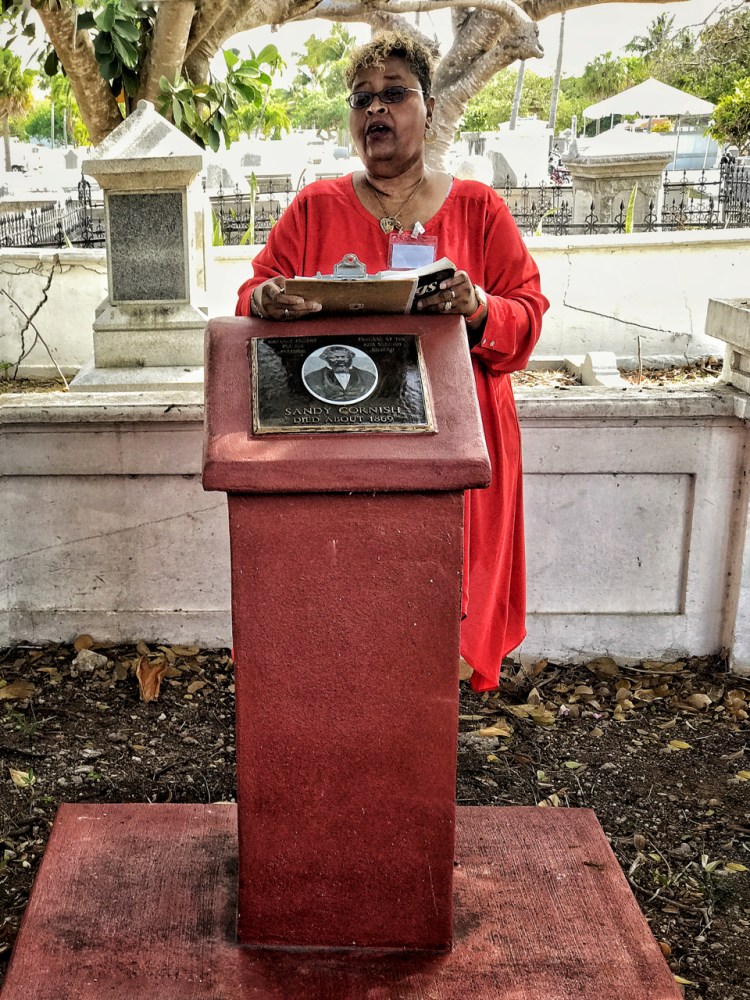
Sandy Cornish


Sandy Cornish was born a slave in 1793. In 1839, he was able to buy his freedom for $3000. His emancipation papers were burned in a fire that swept through the wooden buildings of the city of Port Leon in the Florida panhandle where he lived and worked. Unable to prove his status as a free man, when slave traders tried to take him to the market in New Orleans, he gathered a crowd in a square in Port Leon and publicly maimed himself, cutting his Achilles tendon, stabbing himself in the hip with a knife, and cutting off a finger. Worthless as a slave, he and his wife Lillah, whose freedom they had also purchased, moved to Key West. They founded a farm and orchard on the land where our rented house now stands and prospered, becoming one of the wealthiest couples in the city. Sandy Cornish founded the Cornish Chapel of the AME Methodist Church. The church houses a thriving congregation today.

The exact location of Sandy Cornish’s grave in the Key West Cemetery has been lost to history, so a memorial was recently erected. The story of Cornish’s life was told by well-known local singer Wilhelmina Lopez-Martin, who sang the intro and the outro.

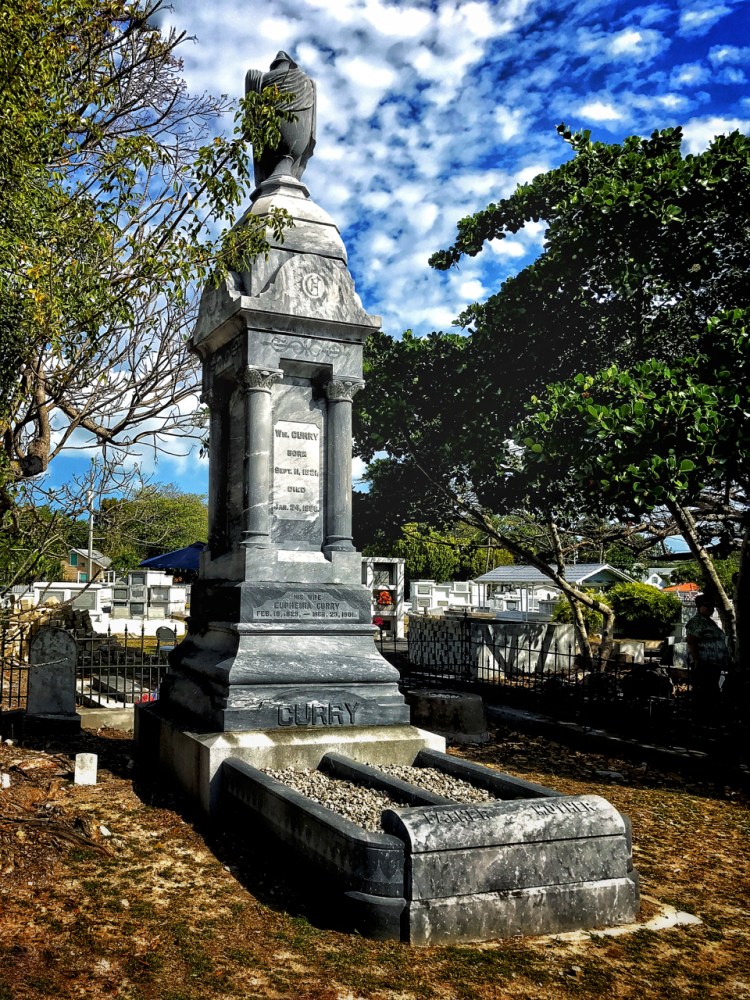
William Curry


William Curry arrived in Key West penniless from Green Turtle Cay in the Bahamas in 1837. He died as Florida’s first millionaire. He had many enterprises, but made the bulk of his fortune wrecking, salvaging goods from ships that wrecked in the treacherous waters of the Keys. This is how many early Key West fortunes were made. You can tour and even stay in The Curry Mansion, which is a Bed and Breakfast today.

On the Cemetery Stroll, William Curry’s story was told by Clinton Curry, a distant relative who still lives in Key West.

The Watlington Family Plot


Captain Francis Watlington and his wife Emeline raised their nine daughters in the house that is now the Oldest House Museum in Key West. Though Key West stayed with the Union in the Civil War, Captain Watlington joined the Confederate Navy. After the war, he lived principally in New York City, though he returned to Key West in his final years to be nursed by his youngest daughter, Lily, who had similarly cared for her mother and two of her sisters. She died in 1936. Earl Johnson was the last descendant to live in the house until his death in 1972, meaning the house was continuously lived in by one family for around a hundred and forty years.

The Watlington family’s story was told by Karl Reutling, a docent and historian at the Oldest House.

The Adderlys


George and Olivia Adderly immigrated separately from the Bahamas in 1890 and married soon after. They purchased land on Vaca Key which is now part of the City of Marathon. They built their home out of tabby, a kind of concrete made by burning shells to extract the lime. Incredibly the home still stands today, despite hurricanes and the punishing tropical climate, and you can tour it. The Adderlys attracted a Bahamanian community around them that thrived on sponge-fishing. When Henry Flagler built his railroad to Key West and needed a right of way over the Adderly land, George Adderly, a literate, but otherwise unadvantaged black man, went toe-to-toe with the richest and most powerful man in Florida, and demanded a station stop at Vaca Key in return. Flagler acquiesced. The stop meant the men of the little settlement could more easily move their sponges to market in Key West, while the women made money selling garden produce and baked goods to rail workers and travelers at the stop.

The Adderly’s stories were told by Key West City Commissioner Clayton Lopez and Phyllis LeConte.

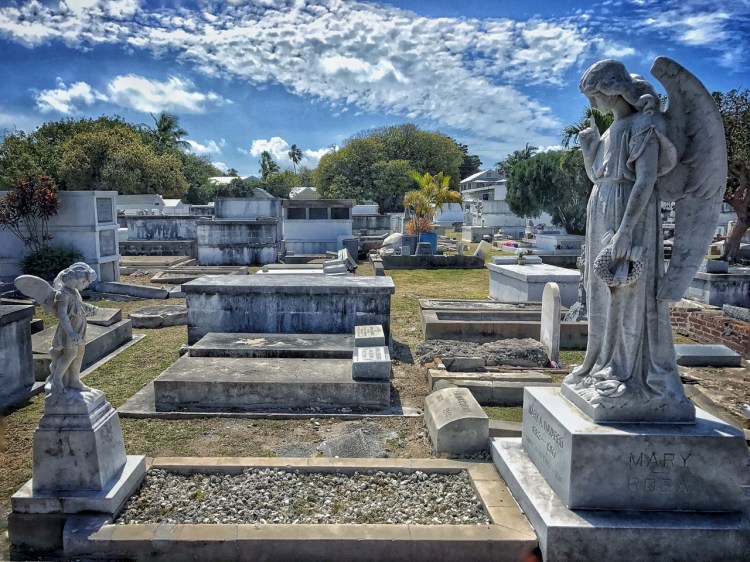
Rosa and Mary Navarro


One of the most photographed graves in the Key West Cemetery are the mother and child angels at the graves of Mary and Rosa Navarro, which have recently been beautifully restored. The inscription on Mary Navarro’s statue says, “To the sacred memory of a brokenhearted mother.” The Navarros made their money in cigar-making and at the turn of the twentieth century, their interests took them to Manhattan. Rosa Navarro died in a fall from their apartment window when she was nine. Though her mother lived four years longer, she never recovered, following her daughter in death in 1907.

The Navarro’s story was told by Ron Wampler, and Diane Silvia, Executive Director of the Historic Florida Keys Foundation which is responsible for the restoration.

The stories in the Key West Cemetery, of fortunes made and lost in wrecking, farming, sponging, and cigar-making, of lives of triumph and tragedy, are the stories of the history of Key West. Even the tongue-in-cheek inscriptions I quoted at the top are a part of the irreverent atmosphere of the island. I’ve included just a few of the fascinating lives we learned about on the tour.

Readers: Do you ever walk in or visit cemeteries? What have you seen and learned?

[All photos in this post are by Bill Carito. If you like them and want to see more, you can friend him on Facebook at https://www.facebook.com/bcarito and follow him on Instagram at billcarito and bill.carito.colorphotos.]

Monday, March 23, 2026

This is the Writer's Brain on Vacation


 LUCY BURDETTE: As I’m writing this, it’s early March and I’m frantically wrapping things up with several projects and starting to pack for New Zealand. This has made me think–is there ever a vacation during which I can turn my writing brain off completely? I doubt I will be setting a book or story in New Zealand, though never say never! We went to Australia about ten years ago and I’ve not written anything about that, aside from a blog post. I did start a short story about a crime on Lord Howe Island off the coast of Australia, but I realized quickly that I didn’t know enough to continue. I didn’t understand the local culture or how the police would behave–I’d be flying in the dark and subject to making  mistakes and garnering criticism. Maybe this trip will be different? Maybe I’ll write nothing and only relax. What are the chances Reds? Have you ever done that?


JENN McKINLAY: No. I don’t think I’ve ever been on vacation (since I got published) when I didn’t work. That is a very sad statement. I remember when the Hooligans were little and we’d go on our annual beach vacation to San Diego, I’d get up at 5 in the morning and work in the bathroom - usually sitting on towels in an empty bath tub - just to get the day’s pages done so I could be on vacation during the day with the fam. Most of my vacations - Florence, London, Paris, Ring of Kerry, etc. have been because I needed to research the area of the place I was writing about. Maybe someday I will travel without my laptop…someday!

HALLIE EPHRON: I do think that, if you’re a writer, your “writing brain” never turns off. I can be in the bathtub and still seeing myself as a character. Or go somewhere and imagine the words I’d use to describe its essence. I think every trip I’ve taken in the last ten years has generated a setting or a situation or a feeling that’s turned up in a story I’ve written. It’s an occupational hazard.

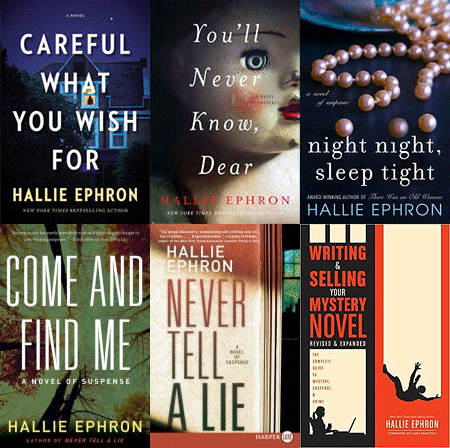
I confess, I’m the least fond of the Agatha Christie novels that she obviously set somewhere she vacationed or visited. Take me back to London or St. Mary Meade I want to beg of her. And Roberta you are so wise to NOT write a story set someplace you don’t know well enough. I started setting YOU’LL NEVER KNOW, DEAR in Beauford, South Carolina, and realized I didn’t know enough about its amazing history, so I created a fictional town nearby that I could have my way with.


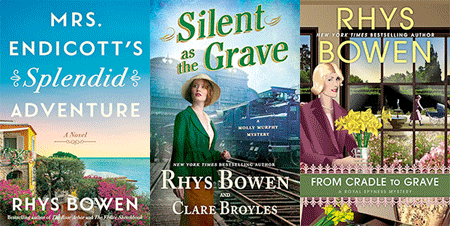
RHYS BOWEN: I have taken some vacations with the express purpose of writing about the place where I am staying. This was true for Mrs. Endicott in Cassis. Also Tuscany and Venice. I never set a book in a place I am visiting for the first time, but somewhere I am familiar with. I go back knowing what details i want to reassure myself about.

If I am not writing I am always jotting down ideas for future reference.I find airports, trains, cafes are wonderful sources of inspiration. As Hallie said, you cannot turn off a writer’s brain.

DEBORAH CROMBIE: The only non-England trips I’ve taken in ages have been my yearly jaunts to the Round Top antiques fair with my daughter, and even though I am not “writing” writing, I am always looking at things and people and thinking about my books. I don’t think it’s possible for writers to ever really turn their writer’s brains off–and I’m not sure I’d want to. Nevertheless, Lucy, I hope you have a lovely vacation and come back refreshed and ready to dig into your book!


JULIA SPENCER-FLEMING: I agree with Hallie, writer’s brain never switches off. And I also agree with the idea that you need some familiarity with a place in order to write well about it - They’re all large cities on the water with lots of snow and cold weather, but Boston is different from NY which is different from Chicago in so many small ways that you can get wrong if you’re not reasonably well-versed in the area!

As for vacations, since I started writing professionally at the turn of the century, 98% of all “vacations” have either involved writing (Nantucket,) research (anyplace in New York State,) meetings with agents and the publisher (NYC) or conferences. The latter has been great - my kids have accompanied me to Alaska, California, Alabama, Chicago, Florida, Michigan… they and their Dad got to have fun while Mom taught or spoke!

HANK PHILLIPPI RYAN: Hmm, so interesting! I have never gone anywhere for the sole purpose of research (except for my entire TV career, which I did not realize was research at the time.), but wow, everything is possibly something. And it's not only setting, of course, it’s how people behave, or what they do or say or eat. Or, for example, the sign we saw in Nevis when we had to go to the police station to get a drivers license. (They make tourists buy them :-)) There was a big sign, warning that houses were being broken into across the island, and to especially beware, because the perpetrator “might be disguised as a vicar or a meter man.”

It makes me laugh even to type that.

I have never ever not taken my laptop.


Red readers and writers, do you take your work on vacation, or are you able to switch gears completely?