LUCY BURDETTE: Today it's a pleasure to introduce Rochelle Weinstein with some absolutely wonderful advice for surviving the writing and publishing rat race. But it also goes for life! Welcome Rochelle...
ROCHELLE WEINSTEIN: The date was June 29, 2017. I had dinner with a fellow author at a lovely restaurant in Banner Elk, North Carolina. My third novel had released the year before and my fourth was slated to release in 2018. Before that, my self-published works released in 2012 and 2013. Dinner with Rebecca Warner is always brimming with author talk—sharing tidbits about the business, our latest reads, the ups and downs of the industry. Upon returning home that evening, I ventured onto Publisher’s Marketplace in search of something I now have the faintest idea what. As a lark, I did what we tend to do online, searched for myself, clicking on the Bestseller tab, which was sure to say: no bestseller status available. But there it was. What We Leave Behind, my first self-published work featured on the USA Today Bestseller list. #145. But I was only finding this out three years later. Talk about an epic Throwback Thursday.
I tell this story because it highlights my journey to publishing and some of the best of advice in the business: never giving up. Backtrack. When I sat down to write What We Leave Behind, I had no formal training (unless voracious reader counts) and I was merely filling time during a year-long severance. Doors didn’t open for me—they slammed—and when I made the decision to self-publish, I had specific goals for my work. The Mourning After followed a similar path, and with robust sales and a community of readers and fans, I sought an agent for my third novel, Where We Fall. They say the third time’s the charm, and I secured an agent and a publishing deal. Never during that time of disappointment and hustle did I know about the bestseller status. I had been diligently working on Somebody’s Daughter (my fourth novel) doing what I loved, going going going. And it raises the question: What if I had given up? What if I had walked away after that first door closed? Rebecca texted me the next day. “The puzzling thing is, Rochelle, you didn’t have this accomplishment to bolster you through some tough times, and you pushed through. What does that say about your capacity to go to great heights?”
There. That.
Yes. My self-published title, my little engine that could, hit a bestseller list. I didn’t have that to hold onto. I didn’t know what I was capable of. But I kept going. Moving. Writing. Listening. Learning. Trusting. Dusting off the bruises.
Anyone who has been in the trenches knows the sting of rejection, the vulnerability (or stigma) associated with self-publishing, and the vast challenges we face as writers competing in an over-saturated market. Many writers don’t have accolades or career milestones boosting them through the rough patches, so what I’ve learned from this experience is that it’s what we do with the hard times, how we handle the pitfalls, that ultimately measure our success. If you’re a writer in the trenches, focus on your goal and ignore the voices saying you can’t. It’s a wild ride with highs and lows, but if you stay the course you are bound to land where you were supposed to. And soar.
How do you react to rejection? Do you easily get frustrated and give up? Or do you let the misery in, experience it, and get back on the saddle? Do you know why you write? The goals you have for your work? The best advice I can give: the difference between success and failure is the never giving up. Onward.
About the Author
Rochelle B. Weinstein is the USA Today and Amazon bestselling author of emotionally driven women’s fiction, including When We Let Go, This Is Not How It Ends, Somebody’s Daughter, Where We Fall, The Mourning After, and What We Leave Behind. Rochelle spent her early years, always with a book in hand, raised by the likes of Sidney Sheldon and Judy Blume. A former entertainment industry executive, she splits her time between sunny South Florida and the mountains of North Carolina. When she’s not writing, Rochelle can be found hiking, reading, and searching for the world’s best nachos. She is currently working on her seventh novel. Please visit her at rochelleweinstein.com.
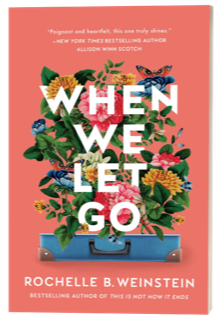
About WHEN WE LET GO: When Avery Beckett is proposed to by Jude Masters, a widowed father and the man she loves, it should be a time of great joy. Instead, Avery is on edge. She’s wary of the idea of family, doubtful of happy endings, and too afraid to take the leap. It’s the kind of fear that comes from having secrets. Before Avery commits to a new life, she must reconcile with the one she left behind.
When Avery returns to her childhood farm in the North Carolina mountains, she’s surprised to be saddled with a companion: Jude’s teenage daughter, Elle, who’s grappling with the loss of her mother and the complicated emotions of first love. On a path of mending wounds and breaking down walls, Avery and Elle form an unexpected alliance. It’s giving them the courage to move forward. And for Avery, everything she needs to confront the past.
An emotional tale of mothers and daughters, loss and acceptance, When We Let Go is about the lessons that come from heartbreak and the healing it takes to embrace the joy of a second chance.


%20(1).jpg)