Showing posts with label Book Passage Mystery Conference. Show all posts

Thursday, July 11, 2024

Exciting Times Ahead!

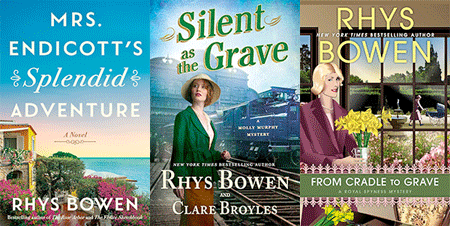
 RHYS BOWEN: EXCITING times ahead in the Bowen camp!  This time next month I'll be celebrating the release of my new stand alone novel, THE ROSE ARBOR. Lots of good things are planned for that, including a Friends and Fiction interview and ads on everything from Tiktok to AARP (how's that for covering the bases?)

And...This time next week I’ll be chatting with one of my dearest friends, Louise Penny. Unfortunately the chat won’t be in person but via Zoom and it is a prequel to the mystery writers conference at Book Passage bookstore near my home in Corte Madera, California.

 I haven’t seen Louise in person for a year as she lives in Canada (and sometimes in London).  I hope to see her again in September when we’re both in England, but I’m really looking forward to catching up, albeit from long distance. When Louise and I do these chats we never plan anything in advance. They are completely unscripted and yet we always find lots of interesting things to discuss.


 We have chatted in front of an audience at several mystery conferences, mostly with our own dear Deb Crombie. We were billed as a conversation with three goddesses. We liked that description. Definitely suited us! On the first occasion there were just three arm chairs on the stage and we sat and talked. All sorts of interesting and surprising things came out: that Louise and I had both thought we were royal when we were young. ( Louise thought that her royal family had left her with peasants for her own protection until she was old enough to be claimed. She waited but the royals never came! I pretended that I was queen of my village and would ride around on my bike, greeting my subjects. They must have thought I was quite bonkers, waving graciously as I bicycled past). We learned that Deborah had always had a fascination with Britain growing up and gone there as soon as she could. Again no script. The room was packed with people sitting on the floor. I have to say it was one of my favorite conference moments ever.


Obviously the organizers thought so too as we were asked to repeat it on several occasions. Then I was asked to interview Louise when she was guest of honor at Malice Domestic and I asked her to interview me when I was. It’s always such fun. We laugh a lot. The audience laughs too.

 So I’m really looking forward to next week. It is open to attendees at the mystery conference but other people can sign up to join the Zoom online (I believe there is a fee). Bookpassage.com.  Events page.


 I have been on the faculty of the Book Passage Mystery Conference for many years and I always enjoy it, especially because Hallie is also on the faculty so we get a chance to catch up. It is three days of intense workshops with mystery writers, agents, editors and experts like FBI alum George Fong, a San Francisco judge and a forensic examiner. Participants have a chance to meet one on one with a seasoned writer and get feed back on a manuscript in progress. Hallie gives an all morning intensive, and as you know, she is the best teacher you’ll ever come across.

 Over the years the conference has discovered and nurtured several mystery writers who have gone on to stellar careers: Cara Black, Susan Shea, Tony Broadbent, Tim Maleney… and one of the highlights is a party at agent Kimberley Cameron’s stunning house overlooking the San Francisco Bay.  Here are Hallie and I last year.


 I’ll report back this year and try to remember to take pictures!

 And FYI Book Passage is a unique book store. Anybody who has written a book wants to speak there. Sometimes I find my event is sandwiched between Hillary Clinton and John Grisham. Guess who doesn’t get the biggest crowd? It is always sobering.

Thursday, January 14, 2016

David Hewson on Writing


DEBORAH CROMBIE: You would think I'd know how to do what I do, right? Having written a few
books, I'd have it all down pat. 

Oh, so, wrong. I'm always looking for ways to write better, write smarter, and, um, write faster... 

It's not that I don't know that the main ingredient to all those things is butt in chair, but--there are ways to do it better. My friend David Hewson, whose novels I adore, has written a non-fiction book on writing that I think is simply the best book on writing out there--and believe me, I've read quite a few. But I don't think I've ever read one cover to cover, until this one. I literally could not put it down, and I refer back to it regularly.

This is not just a book for beginners (although it would be my top recommendation for someone wanting to write a first novel) but a great resource for established writers, as well. But I can't tell you about WRITING: A USER'S MANUAL, nearly as well as David, so here he is--


DAVID HEWSON: I used to teach at writing schools quite a bit. One of my favourites — and where I first met Deborah — is the annual mystery writers’ conference at that wonderful store Book Passage in Corte Madera. It’s an incredible event gathering writers and would-be authors for a long weekend of chat and learning about publishing, the business, the craft.


But I don’t do writing schools any more. For one thing I don’t have the time. But I also have to admit it got wearing to discover how many enthusiastic wannabes turned up at these occasions, sometimes at great expense to themselves, without even a basic grasp of the tools required for the job. They seemed to want instant enlightenment, an attitude which misunderstands the writing process quite fundamentally. No one ever learns to write. We’re always fumbling towards perfection, changing constantly, struggling to make the next book better than the last.

A large part of that process hangs around practical matters: craft, management, work. So instead of trying to cram all that essential knowledge into a few sessions over a single weekend I came up with Writing: A User Manual. What’s it meant to be? Simple: all the things I wish someone had told me before I first started out in this business twenty years ago. As I say out the outset ‘a guide to practical craft not cerebral art’.

It’s all very well understanding character arcs, three-act structures and Joseph Campbell. But if you don’t have the chops to get the damned book written in the first place all that comes to nothing at all.

Let me stress what this book isn’t.
-            A how-to guide. I’m not sure you can teach writing but you can certainly teach people how to think about writing which is what I hoped to do here. In other words I wanted to set out some starting points then challenge readers to find their own way to meet them.
-             A set of writing rules. Something in my nature means whenever someone tells me there’s a rule for something I want to break it. I hate the idea that anything as individual as writing can be broken down into cogs and components as if a book were a business plan or a spreadsheet.
-            A template to follow. There are structures to modern mainstream narrative fiction. But I don’t believe the old adage that there are only three-four-five-or-more stories in existence and every new one is simply a rewrite of something old.
So this entire work is just my opinion — the approaches I’ve developed to writing over more than two decades in this business. What I’m trying to do is prod people into finding what works for them.

I break the manual down into the three stages I use for my own projects — planning, writing and delivery. To help people try to see how things develop I begin with a very rough idea for a story called Charlie and the Mermaid. In the planning area I try to work out what kind of story this is going to be — and that could be anything from horror to fantasy or crime.

Then when I’ve settled on the approach I go through the writing process, research, background and story planning. Finally in the delivery section I cover the business of rewrites and editing. There’s no career advice — how find an agent and that stuff. All I’m focusing on is getting together the best manuscript you possibly can.

People who know me won’t be surprised to find a few rants along the way. I pop off on the subject of cruelty to adverbs (it’s that rule thing again). I’ve a few words to say about overuse of sex and violence too. You may disagree. I rather hope you do. That’s why I’m saying these things.

I also focus quite a bit on writing tools — in particular software and how it should be used. Not for a millisecond do I believe snake oil stories about how a certain fiction app can ‘unlock your creativity’. If you need a computer to do that you’re really in trouble. But computers — and now phones and tablets — are wonderful things for helping you make the most of your time, and time is something we’re always short of.

So I cover apps like Scrivener, Microsoft Word and OneNote and try to suggest ways in which you can focus on their best features to get words down on screen, which is what this game is all about.
The book was written four years ago so a fair bit of that is now out of date. Software’s moved on and so have I. Back then I was a dedicated Scrivener fan. Now all of my writing happens in a different Mac app, Ulysses, which has the power I need with none of the complexity. Ulysses is also cloud-friendly, something that was meaningless four years ago. Now all my work — every last scene, chapter, book and article like this — syncs automatically through the web to my desktop, laptop and, with Ulysses, my iPad too. So I can edit it anywhere, on a plane, train, in a hotel, where I like, and know that the changes are updated automatically everywhere without any effort on my part.

Now that is truly magic. I only use two other tools. Google Keep for storing notes and references, a wonderful free app that works on my Mac and syncs to a great phone app too so I can jot down ideas anywhere. And a diary app, Journey, which again works on a phone as easily as a desktop and is a great way for keeping the essential book diary, something I outline in the book. Then, at the end, Ulysses outputs a properly formatted Microsoft Word file for my publisher and I’m done.

Even with a foreword from Lee Child this book is not exactly easy to find in book stores, largely because it was published as an academic tome, not a mainstream non-fiction work. But people who’ve found it seem to have found it useful.

I hope so because the way the diary stands my teaching days are over. That said if you have a quick question you’d like answered here — one I can deal with in a single sentence — fire away and I’ll do my best. 

DEBS: REDS and readers, if you have questions for David, now's your chance! 

David, I don't suppose you'll tell me how Charlie and the Mermaid turns out...

For more about David and his novels check out davidhewson.com, and don't miss his terrific blog.

(And can I just say how happy I am to have someone challenge the "no adverb" rule???? Who else thinks adverbs rock??) 

Wednesday, January 28, 2015

Cindy Brown Has Fun with Research

RHYS: One of the things I always look forward to in the summer is being on the faculty at the Book Passage Mystery Writers Conference. This is the one place where the craft of mystery writing is really taught intensely and well by top level faculty. It has produced a whole bevy of published writers--among them Cara Black, Sheldon Siegel, Susan Shea.  And now Cindy Brown. I mentored Cindy at the conference and saw great promise in the story that is now about to become her first published book.
I told her when she was about to be published she should be our guest on Jungle Red Writers, and I'm delighted to welcome her today.  You'll love her quirky humor.  So Cindy, it's all yours:

CINDY BROWN:

 Learned how to build a letter bomb.
 Conducted an experiment to see if Diet Coke would dissolve a nail (nope).
 Cajoled my husband into posing as a dead body so I could see how a corpse

In the name of research, I have:
 Attended an Alcoholic Anonymous Back-to-Basics meeting.
 Hung out at my auto mechanic’s shop, spit-balling ideas about car fires.
 Gone on a ride-along with a member of the Sun City West Posse (yep, posses
still exist, at least in Arizona, though they now use cars instead of horses).

As you may able to tell, I LOVE research. And being a mystery writer gives me a
certain liberty. A few months ago, I was standing in line at a store behind a man who
wore an athletic shirt with a pocket on the back (it’s designed so cyclists don’t have
to sit on their wallets). I asked him if he’d ever lost anything out of it. He hadn’t. I got
to my real question: did he think someone could pick that pocket more easily than a
traditional pocket? “Why don’t you try?” he said, putting his wallet in the pocket. He
learned that he might not want to wear that shirt in a crowd, and I learned that I
possess a certain skill that could be useful if I decide to become a criminal.

One of the things I really love about research is the fascinating stuff I run across
during the process. For instance, I wanted one of my characters to buy something in
Costco that could be used in a crime. But what? In researching the idea, I not only
learned about dangerous office products (stay away from paper shredders and
staple removers), but also that Costco sells home monitoring kits, caskets and
I love to look up words and phrases, too. I now know “forty Yiddish words everyone
should know.” I have an online map of the U.S. that tells me where people say “soda”
and where they say “pop.” And I now know that if you are researching current
teenage slang and decide to look up “sex” in the Urban Dictionary, you will get this
message: “What kind of moron are you that you look up sex in the urban
dictionary?” Yes, it really says that.

And though I’m really looking for details to include in my books, I find that my
research often proves to be practically useful. I’ve learned that powdered lemonade
cleans toilet bowls, that Doritos are good fire starters, and that a wooden spoon
placed on top of a pot of boiling water will keep the liquid from boiling over. I’ve
also learned how to make a duct tape bra (I haven’t tried it, as I think I’m a little old
for strapless bras, and besides, it sounds really uncomfortable).

Truth be told, I’m even treating this guest post (thank you Rhys!) as a bit of research,
because I’d love to know what wacky things you have learned while writing. And to
sweeten the pot, I’ll give away a signed copy of Macdeath to one lucky commenter!

###

Macdeath, a madcap mystery set in the off, off, off Broadway word of theater, was
just released by Henery Press on January 20th. The lovely Rhys Bowen calls it “ a
delicious romp with plenty of humor and suspense.”

Cindy Brown has been a theater geek (musician, actor, director, producer, and
playwright) since her first professional gig at age 14. Now a full-time writer, she’s
lucky enough to have garnered several awards (including 3rd place in the 2013
international Words With Jam First Page Competition, judged by Sue Grafton!) and is
an alumnus of the Squaw Valley Writers Workshop. Though Cindy and her husband
now live in Portland, Oregon, she made her home in Phoenix, Arizona, for more than
25 years and knows all the good places to hide dead bodies in both cities.

RHYS: So thank you, Cindy. I'm dying to hear what kind of insane things others have done in the name of research. I've wrestled on the floor, found where to push someone out of a train, thus terrifying everyone else in the carriage and suffered for my art by having to spend time in Nice and Paris!

Saturday, July 16, 2011

JAN BURKE VISITS JUNGLE REDS


RHYS: Jan Burke was supposed to be my Wednesday guest, but alas, various factors, including my disappearing internet, did not cooperate, so I'm giving her the whole weekend to shine.

So welcome to JRW Jan.
I was at ALA and saw great piles of the new Jan Burke book DISTURBANCE, Obviously Simon and Shuster are excited about this and when I eard that it was a follow up to Bones, I was too.
So tell a little about the new book, Jan:

JAN:Disturbance is essentially a sequel to Bones. If you haven't read
Bones, don't worry — Disturbance's plot is separate. It won't spoil
Bones for you, and you don't need to have read Bones to know what's
going on in Disturbance. But if you are someone who like to read a
series in order, you may want to read Bones first.

In Disturbance, Nicholas Parrish, the serial killer who pursued Irene
in Bones, has recovered from injuries he sustained when she escaped
him. Although others remind Irene that he's in prison, she isn't much
comforted by that — he has a group of supporters who call themselves
the Moths and they threaten revenge on his behalf. She is unnerved by
an increasingly disturbing series of events, events that she sees as
the Moths' way of letting her know they can reach her.

Disturbance is also about reinvention. In addition to her problems
with Parrish and the Moths, Irene has other troubles. The Express,
the newspaper where she has worked for most of her adult life is on
the verge of closing. Irene, who has identified herself with the
Express and newspaper reporting on a bone-deep level, may soon be
forced to say goodbye not just to a job, but work that brought meaning
to her life and provided her with an extended family.


RHYS. Was Irene Kelly an alter ego when the series started? Is she still?

JAN: No, never. I imagine her as a completely separate individual, one with
whom I enjoy spending time.

RHYS:You write about very dark subjects, darker than most women writers.
How do you handle the darkness? I know I once had to murder a child in
a book and in the end I couldn't do it. Have you learned to distance
yourself from your subjectmatter? Or are you just super tough?

JAN:You are determined that I won't get to demonstrate how funny I am,
aren't you? Okay seriously, then --

First, for anyone who may wonder if I inspired your example, I should
quickly point out that there are no dead children in Disturbance.

It's interesting to me that you say I write about very dark subjects,
because I don't view my books as especially dark. Irene is not a
depressed and brooding loner detective — unlike at least a dozen
others who quickly come to mind — and although she has to struggle
with understandable fears, she is ultimately resilient, an optimist
with a sense of humor and strong loyalties. I see most of my books as
having themes related to hope, justice, and forgiveness.

All of that said, like 99% of writers of crime fiction, I do write
about violence. The smaller subset of writers I belong to are those
who write about the emotional impact of violence, and sometimes, that
is difficult.

It has been extremely important to me, though, even from the time I
wrote my first novel, to not emotionally distance the characters in my
books from the crimes that take place in them. In Goodnight, Irene,
it was important to me that she grieve the loss of O'Connor, rather
than merely set out to avenge him. Again, she's doesn't spend the
book crying in a corner, but you come to know O'Connor because she
misses him so much. Many books later, in Disturbance, although she's
moved on with her life, she still misses him.

By the time I started the second book, I was concerned about how
seldom I saw any representation of the emotional impact of violence on
protagonists. They'd get the hell beaten out of them, and then they'd
just knock back a shot of whiskey and go out after their attackers.
They were about as emotionally affected by the beating as someone who
had nicked himself shaving. But in real life, if you or anyone you
know has been attacked, you know the cuts and bruises heal relatively
quickly — it's your state of mind that is never the same. Your
ability to feel safe — more important to many of us than we realize —
is altered forever. Some would say the tough guy shows us how a
courageous man acts. But to me, the kind of courage that is more
interesting is the kind we see in so-called ordinary people. People
who may need every ounce of courage they have just to step outside the
front door, but they do it. They feel afraid, but act anyway.

While my research on those who are violent has caused its share of my
nightmares, I suppose it is the example of courage and persistence in
the face of adversity that I've found in survivors and in those who
are working in law enforcement, criminal justice, and forensic science
that allows me to feel hopeful.

Oh I should add -- I'm not super tough. I probably cry more easily
than anyone you know. Do not whistle the theme to Lassie if I am
within earshot.

RHYS: We're going to be seeing each other in a couple of weeks at the Book
Passage Mystery Conference. Can you tell us a little about that?
What will you be teaching?

JAN:I first attended this wonderful conference as a keynote speaker, back
when Judy Greber and the late Marilyn Wallace were organizing it. I
love Book Passage, one of the Most Wonderful Bookstores on Earth, and
hope those of you who are not interested in writing conferences will
still take the time to browse its Website.

For those of you who are interested, you can't pick a better
conference. (Sign up soon, the conference is limited in size.) Why
do I like this conference so much? Part of it is the Book Passage
itself — while some bookstores do little more than temporarily house
writers' books, Book Passage has become a kind of home place for
writers and books. This store has a strong relationship with its
community, and also with its community of writers. That means they
can put together conferences with faculty members such as Daniel
Silva, John Lescroat, Rhys Bowen, Jacqueline Winspear, Gregg Hurwitz,
Martin Cruz Smith, and many others. They bring in experts, agents,
and editors. They give attendees the opportunity to have manuscript
consultations. And its all in beautiful Corte Madera, across the
Golden Gate Bridge from San Francisco.

That would all be enough for most folks, but I should add that the
Book Passage goes out of its way to ensure that the first concern of
the faculty is to teach. That may sound obvious to anyone who hasn't
been to a conference that was full of authors who do little more than
pitch their own wares.

As for what I'll be teaching -- I'm in a conversation with Jodi
Compton, and we'll be talking about our research styles and other
general topics. I'm also doing an advanced session with Tony
Broadbent on Developing Character and Dialogue.

RHYS: What's next? Do you enjoy Irene books more than standalones or the
other way around?

JAN: I've decided that I'm not going to say much about the next one yet.
I've found I can talk myself out of manuscripts if I talk too much
about them while they are in progress.
I enjoy standalone and series books equally -- each has its own
challenges and rewards.

RHYS: You've recently started an experiment called "Spoilerville." What
is Spoilerville? Why did you start it?

JAN: Spoilerville ( http://spoilerville.com ) is a place where readers who
have already read a book can comment on it or ask questions of
participating authors and feel free to give away plot -- you visit
Spoilerville *after* reading a book. For those of us who have wanted
to let an author know how much we liked a certain twist, or had a
question about something we read, or wanted to make a comment that
might get us lynched on a list or blog, Spoilerville is your new safe
haven!

Many writers get a lot of wonderful blog comments and good questions
from enthusiastic readers who -- if the post goes through --
unintentionally give away parts of the plot. Websites, Facebook,
author blogs, and email discussion lists are places where those who
haven't had a chance to read a book might have things spoiled for them
by such comments. Spoilerville is essentially marked by its name with
a giant spoiler alert -- it's a place where our readers will be able
to meet and discuss books they've finished reading, and ask
plot-specific questions in an environment where those who haven't yet
read the book are not be likely to accidently see them.

Books are on Spoilerville because authors are willing to place them
there -- I'm happy to see you're willing to be one of the pioneers
there, Rhys! I hope your readers will visit Spoilerville! I think we
can have some fun there.

RHYS: Thank you so much for taking the time to visit us, Jan. I know your readers will be lining up for the new book. See you next week!
Photo by Sheri McKinley Photography.

Tuesday, April 12, 2011

David Hewson and Rome's Fallen Angel


DEB: Today I'm especially pleased to be talking to one of my favorite writers, David Hewson, about his new Nic Costa novel, The Fallen Angel.

I first met David a few years ago when we were both on the guest faculty for the Book Passage Mystery Writers Conference, and I've been a huge fan ever since. David's books, set in present day Rome, are intelligent, articulate, evocative, and compelling. David is also an extremely nice guy, a talented photographer, and a foodie. No matter how disturbing the case, David's characters never lose sight of the really important things in life, and his descriptions of Roman food are enough to make you book your plane ticket. (David also--at least according to the photos on his blog--has the neatest desk of any writer I've ever seen. This is obviously a subject for future discussion...)

In The Fallen Angel, when British academic Malise Gabriel falls to his death from a Rome apartment, detective Nic Costa rapidly comes to realize that there is much more to the accident than he first thought. It also becomes apparent that Malise’s family — mysterious and tragic daughter Mina, stoic wife Cecilia and troubled son Robert — may be keeping vital information hidden.

Costa becomes obsessed with the case, intrigued by Mina’s story which seems to be linked to the sixteenth-century real-life tragedy of a young Italian noblewoman, Beatrice Cenci.

As the investigation deepens, Rome’s dark and seedy side is uncovered, revealing a tangle of deceit, treachery and corruption. Costa realizes that the key to the truth lies with the Gabriels. Why are they so unwilling to co-operate, and who, or what, is the reason for their silence?

Tess Gerritsen says, "Intricately plotted and gorgeously written, THE FALLEN ANGEL weaves a spell that will entrap you until the final page. David Hewson’s Rome is dark and tantalizing, seductive and dangerous, a place where present-day crimes ring with the echoes of history.
"

I wholeheartedly agree, and asked David to tell us more.

DEB: David, I was particularly intrigued by the fact that you, as a Brit, choose to set your books in Italy, a place neither your native country nor your home,although I understand that you spend considerable time there researching the books. And although your characters are Italian, you tell your stories from an insider's viewpoint. Do you find having an outsider's perspective an advantage?

DAVID: One of the daftest pieces of advice given to wannabe writers is 'write about what you know'. It works for some people but for a lot it doesn't. Most of us are bored with what we know and take it for granted. When you write about what you don't know you have to learn about it, see it in a different light and perspective, and build your image of it from scratch. To write these books I had to move to Rome for a while, learn Italian, build my Rome brick by brick.

I'm sure it's the same with your England, Debs. Books are work and setting them somewhere alien to us makes us work harder, which hopefully makes for a more vivid world when we come to create them. I think it also makes us more willing to be bold and creative with that world too, more than we would with the one we live in day-to-day.

DEB: We are all too familiar with the fictional male cop--middle-aged or past it, alcoholic, dysfunctional, unable to sustain relationships, lives only for his job . . . and yet in Nic Costa you've given us a policeman in his twenties. Nic is a complex and fascinating character, and although he's suffered loss in the course of the series, he is coping. Was the departure from the flawed anti-hero detective a deliberate choice on your part?

DAVID: It was a very deliberate decision. Most male crime characters have been handed down from the brilliantly-drawn template of Chandler. I wanted to move away from that to concentrate on an ordinary, decent guy struggling to come to terms with a fractured, corrupt world. That seems to me a much more modern and familiar dilemma than Chandler's lone wolf, damaged individual from the Forties. Not everyone gets it, of course, and occasionally people say, 'You don't write crime at all.' And maybe they're right. Can't say I know or care. The stories and the characters are what matter, not some genre tag stuck on the side.

DEB: One of the many things I love about your books is the well-drawn ensemble cast. Again, was this a deliberate choice? (I know in my case, I began with the two main characters, and over the series the continuing cast has grown a bit like topsy.)

DAVID: I wrote the first book as a standalone, and that is very much Costa's story. When it was finished my editor suggested very clearly - with the offer of a very enticing contract - that I turn this into a series. I had to think long and hard about that. I was worried I was going to go down the path to the Reichenbach Falls, where Conan Doyle shoved Holmes to his death because he was sick of him (only to revive him later).

Avoiding character fatigue was something I really wanted to work on. My secret was to think back to Ed McBain's wonderful 87th Precinct series and give Costa a family of similarly-decent people around him. It's that which has sustained the book as they grow, I think, and attracted the TV development deal too. But I've been very careful not to let the family grow too much. There are, and always will be, only four principal protagonists: Costa, Peroni, Teresa Lupo and Leo Falcone. No more - the rest are side characters.

DEB: How did you learn about Beatrice Cenci, and why did you decide to weave the novel around this haunting story?

DAVID: I spend a lot of time in Rome hanging round places, reading, talking to people. The Cenci story is well known in Rome but not much outside, even in Italy. I have a stack of story ideas waiting to be written. Beatrice was just one of them. One of the many things I love about Rome is the way the past informs the present. It's not history, it's a part of today.

Beatrice died more than five hundred years ago yet it doesn't take much to sense her presence still in the city today. With a little research I was able to see where she lived, where she was imprisoned, buried, executed, see the painting supposedly of her in the Barberini, then finally go into the black museum of the Ministry of Justice and see the sword historians believe was used by her executioner. She's a fascinating character, part saint, part something else perhaps, and her dilemma - how far can you go to defend your own identity - seemed to me a very modern one which is why I chose it. But there are plenty more Roman stories with that feel too. The problem is always picking one.


DEB: I, for one, hope you will pick many more, and I'm wondering what's next in the offing. What about you, JR readers? Any questions for David? He'll be dropping in throughout the day to answer them, although as he's on UK time we'll have to try not to keep him up too late!