Showing posts with label Diana Abu-Jaber. Show all posts

Friday, March 2, 2012

What are you reading?


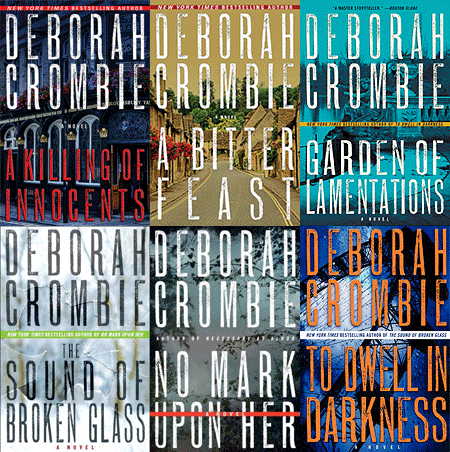
LUCY BURDETTE: I'm a little disgusted with myself this month because it feels like I'm reading at a snail's pace. Blame it on too much work or socializing or my very late discovery of Downton Abbey, but I've got a towering stack on my nightstand and I've barely made a dent. Right this minute, I'm devouring a book my friend Pat Kennedy loaned me called MY KOREAN DELI by Ben Ryder Howe. It's a story about his Korean wife and in-laws buying a deli in Brooklyn--he's a very, very funny and beautiful writer. And I'm also looking forward to Diana Abu-Jaber's newish novel, BIRDS OF PARADISE, along with Vanessa Diffenbaugh's THE LANGUAGE OF FLOWERS, our own Deborah Crombie's NO MARK UPON HER, and more books by Cleo Coyle, Miranda James, Avery Aames, and Diane Mott Davidson.

What are you reading and loving?

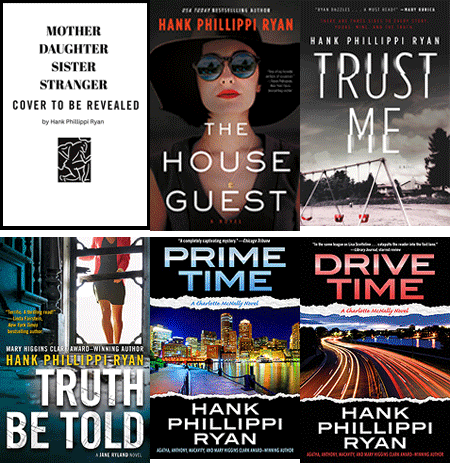
HANK PHILLIPPI RYAN: I'm so honored to a the moderator of the MWA symposium--so right now I'm reading all the nominees for Best First Novel! (That's a fun task, right?)
I must recommend DEFENDING JACOB, by William Landay. it's extraordinary. They're calling him the new Scott Turow, and I have to agree. And the amazing Carolyn Hart just sent me her new one, DEATH COMES SILENTLY. Whoo hoo.
Jonathan is reading Lisa Gardner's CATCH ME, and I can't even get his attention, he's so into it!

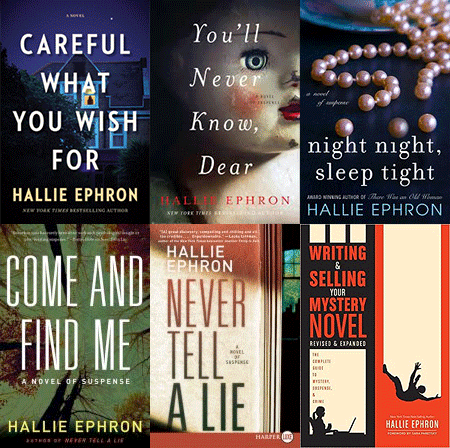
HALLIE EPHRON: I've been so flat out writing I've had no time to read. Once I turn it in, I shall luxuriate in other people's pages. I did read one book I loved -- same as Hank's, DEFENDING JACOB. And I loved the article in last week's New Yorker about training police dogs. (Roberta - did you read it??)

JAN BROGAN - I'm afraid my reading is all research-related. I am reading Captain Ahab Had a Wife by Lisa Norling and A Very Social Time (about antebellum New England) by Karen W. Hansen. They are both insightful and full of fascinating details, but not what you call page turners unless you are like me and totally fascinated with the era.

RHYS BOWEN: Like Hallie and Jan I'm in the throes of writing and find it impossible to read much when I'm working on a book. I've also had several books to blurb, which has taken up any reading time I have, but I've just picked up Oscar Wilde and a Game Called Murder and I'm really enjoying it. The writer has written a biography of Wilde and his wit sounds so genuine. AND it's in the right time period for the Molly book I'm writing.

ROSEMARY HARRIS: Having delivered my latest masterpiece at the end of January I took the month of February to catch up on some reading - LOVED Gone by Mo Hayder, Into the Darkest Corner by Elizabeth Haynes, Miss Peregrine's Home for Peculiar Children by Ransom Riggs, The Confession by Charles Todd and The Saddlemaker's Wife by Earlene Fowler. Currently reading Swann's Last Song by Charles Salzberg and Catherine by Robert Massie.

I think I should retire and just read and garden from now on...
(PS It didn't hurt that I logged about 50 hours worth of flying time in
February!)

DEBORAH CROMBIE: Ro, you'd better not retire from writing! But the idea of having nothing to do but read is very appealing, I must admit.

At the moment I'm devouring Craig Ferguson's memoir, American on Purpose, which is just brilliant. Laugh-out-loud funny, scathingly honest, and very touching. And I guess I can say it's kinda/sorta research since I do have a Scottish character in my WIP... Just read Cara Black's Murder at the Lanterne Rouge, and The Confession by Charles Todd, both of which I loved. Oh, and my first Lauren Willig, The Orchid Affair--ditto. Huge fun!

Next up, Imperial Scandal by Teresa Grant, and Rhys Bowen's new Molly Murphy, Hush Now, Don't You Cry. Can't wait!

LUCY BURDETTE: Wowie, zowie, that's a list that could last us ten years. But tell us, what are you all reading these days? And why do you love it?

Thursday, February 3, 2011

Diana Abu-Jaber on Shish Kabobs!


ROBERTA: We so enjoyed having Diana Abu-Jaber visit yesterday, that I asked if we could borrow one of the recipes from her memoir.

"This is one of the secrets of shish kabob: how quickly it dries and hardens on the skewer. Not like a roast leg of lamb or breasts of chicken that fall off the bone when you cook them long and ruthlessly enough. Shish kabob is fierce. It comes charred and crusty outside and pink, almost wet red inside, richly redolent, in its special way, of marrow and pepper. It sizzles in your mouth and tastes faintly of the earth." From THE LANGUAGE OF BAKLAVA by Diana Abu-Jaber

"EAT IT NOW" SHISH KABOB

4 Tablespoons olive oil
1/2 cup red wine
2 Tablespoons red vinegar
4 cloves garlic, crushed
2 teaspoons dried oregano
2 teaspoons dried rosemary
salt and freshly ground pepper
2 pounds boneless leg of lamb, cut into small cubes
1 large onion, cut into chunks
1 large tomato, cut into chunks

Whisk together the oil, wine, garlic, and spices in a large bowl. Add the meat and stir to coat it thoroughly. Cover and refrigerate overnight; turn occasionally. Thread the cubes of lamb on skewers, occasionally adding a piece of onion or tomato. Grill over hotcoals, turning once. Cook to medium rare and eat while still sizzling.

JRW: Thank you Diana--and readers, she'll stop by to today to check for any last questions on writing, family, or food!

Wednesday, February 2, 2011

The Language of Baklava: Diana Abu-Jaber


"The late afternoon swirls in the house with shadows, and in the kitchen it smells like onions frying in butter. There have been some changes at home since I've started school. For one thing, there's a new baby in the crib, grumbling, a big, loud complainer. One-year-old Monica has a special way of rocking her crib so it chugs through the room on its wheels like a train engine. And the other baby, my sister Suzy, has been displaced. She's nearly three, barely able to amble around, but she frequently points to the second baby and says, 'Get that kid outta here!'" From THE LANGUAGE OF BAKLAVA

ROBERTA: Today JRW welcomes writer Diana Abu-Jaber, one of the speakers I heard at the Key West Literary Seminar on food writing in January. She has written three well-received novels (one a mystery, ORIGIN) and a lovely memoir called THE LANGUAGE OF BAKLAVA. She is a writer-in-residence in the English Department at Portland State University in Oregon. Welcome Diana!

There are so many amazing moments in your memoir--your visit to the
Chinese restaurant with your grandmother, the desperate suicide
attempts by Mr. Basilovich, the lesson in pastry, adolescence, and
world peace given by another grandmother, the visits to your
extraordinary relatives in Jordan...I had to wonder as I read how you
could remember all these events in such detail? Are you a
journal-keeper?

DIANA: I've kept journals all my life, which helps enormously--especially when it comes to details. Beyond that, the truth is that I only tell the stories that I can actually remember-- the hazy stuff doesn't make it into my narratives. I think that the more funny or dramatic an experience is, the more clearly you're going to remember it, and the more you'll want to re-tell it in some fashion. In my case, that's especially true if there's some food component to it: that's such an important filter for me.

ROBERTA: In one of the sessions at the seminar, you were on a panel of writers discussing the process of writing a memoir and your families' reactions to what you'd written. I believe you made the comment that writing fiction doesn't work as a "cloak"--could you talk a little about how you manage to write your own story without impinging on the lives of relations and friends? How did your family feel about what you'd written?

DIANA: If you're going to tell your life story, unless you're a hermit, it's virtually impossible to do so without some sort of portrayal of others and interpretation of their experiences. And yes, even fiction tends to spring from the details and memories of real life experience. Once you accept that, you see the only way out is through, so to speak. You've got to go for it or risk shutting down completely. When I write in the memoir form, I strive to be emotionally honest, respectful, and to try and stay inside my own head. I might report on what others say and do, but, if possible, I try not to wildly project what I imagine they're thinking and feeling. I try to stay the butt of my own joke-- if that makes any sense. When I was writing The Language of Baklava, a therapist told me, "Everyone has the right to their own story. If they don't like yours, let them write their own!" I returned to those words frequently while I was writing.

ROBERTA: One of the themes in THE LANGUAGE OF BAKLAVA is how your
father and his family felt torn between their two countries, the US and Jordan. Your father came to the US impulsively, married an American woman, and moved you and your family to Jordan and then back to the US over the course of your childhood. Remarkably, you seem to
have been able to adapt to living wherever you moved. Could you tell us something about that experience. (And is this related to your two places of residence now??)

DIANA: When I was younger it wasn't too bad. My parents weren't the sort to "check in" with the kids a lot. They just kind of made their plans and then sprung them on us. One second we'd be living in Syracuse, the next, surprise! We'd be on a plane to the Middle East! I didn't have much choice but to swing with it all. And for a while it was even kind of fun--I was up for anything when I was 8, especially if ice cream was involved. But after I hit adolescence, the fun started to wear off-- I wanted to stay in one place and go to one school and I had a lot of fights with my parents about that (which I lost.) It is funny that once I grew up, I seem to have inherited some of that fever from my folks, though. I moved a lot as an academic and now I spend the fall in Oregon where I teach at Portland State University, then retreat to Miami for the rest of the year. I have to admit, it does keep things lively: my husband says that I'm a "genetic bedouin."

ROBERTA: I don't want to hog all the air time, but I would love to hear a little more about your mother. Your father is such a dramatic, expansive character. She must have been a remarkable woman to choose him and agree to follow him through some amazing adventures!

DIANA: Mom has the patience of an Irish-Catholic saint. She's patient and thoughtful where Dad is impulsive and zany, and I think my father was just really smart and/or lucky to have married someone who could keep him from spinning into outer space. Mom was the one who taught me to love books and the importance of listening. If you're always talking (like my father) you never really make very much progress. Dad was supposedly the creative genius in the family but Mom was the attentive audience-- which I believe is its own form of genius.

ROBERTA: And one last question, what's coming next?

DIANA
: My next novel, Birds of Paradise, is coming out this September from Norton. I'm very excited about it because it brings together several of my own literary obsessions-- French pastry, the lushness of Miami, and a family mystery-- a vanished daughter. And as for work in progress, I'm working on a follow up to The Language of Baklava, which I may call Cooking For Grace. It's about my own journey as a writer and the struggle to hang on to a creative life while taking my first steps into new motherhood. Baby steps.

ROBERTA: Thanks so much Diana! You all really must read this book. And now--your questions! (And come back tomorrow for part two, which involves shish kabobs...)