Showing posts with label E.J. Copperman. Show all posts

Wednesday, January 30, 2019

Words Matter, a guest post by E.J. Copperman

 One lucky commentor will win a hardcover copy of \
Bones Behind the Wheel by E.J. Copperman!


JULIA SPENCER-FLEMING: Mystery readers and writers are used to our genre getting sliced and diced (no pun intended) by agents, publishers and bookstores. Do you write dark psychological thrillers? Madcap historical mysteries? Police procedurals? Romantic suspense? Most of us - readers and writers alike - would prefer their mysteries classified in one of two ways: Will I like it? Or won't I?

 I know many, many JRW readers put E.J. Copperman's books in the first category. His Haunted Guesthouse series continues to grow in popularity (the newest one, BONES BEHIND THE WHEEL is now out!) and his Asperger Mystery series garners critical acclaim and five star reviews. So love Copperman, love his books - just please think twice about how you describe them...


Photo from Poison Pen Bookstore
Let us, for a moment, consider the term “humorous cozy mystery.”


I am, at least it says in some of the reviews of my books, a writer of humorous cozy mysteries. I have, for the past 17 or so years (but who’s counting?) been making my living as such. You could say, were you so inclined, that humorous cozy mysteries have been the main source of my income for a good portion of whatever career this is.


The problem is, I hate the term “humorous cozy mysteries.”


Now before you get out the torches and pitchforks, let me clarify: I don’t for one second dislike the genre (Subgenre? Sub-sub-genre?) itself. I like mystery novels. I like mystery novels that don’t rub my face in the gory details and try to get me to think that the world is a horrible, depraved, frightening place. There’s the newspaper for that.


I’m a particular fan of those novels – mystery, bloodless or otherwise – that exhibit a sense of humor. I am a comedy nerd. I have little patience for any form of entertainment (art, if you must) that has no sense of humor at all. It bores or irritates me. So I am not by any means suggesting that the type of books I and so many others (who tend to get nominated for awards, but am I bitter?) write are in any way a second-rate art form. Much to the contrary.


It’s the words “humorous cozy mysteries” that I object to. To which I object. Fine. Be a grammar cop. Because words do matter, and those are possibly the most terrible choices available for the kind of stories I tend to write. Let’s take them one at a time:


Humorous. If there’s a worse way to say “funny,” I’m not aware of it. Humorous has an almost sarcastic ring to it, like what you would say to someone who just tossed off an unusually bad joke or pretended an insult was just their way of kidding. There’s a scene in Silver Streak where Richard Pryor jokes that Gene Wilder is more or less acting in a racist fashion. Pryor doesn’t mean it but he makes the joke. Wilder looks at him and says, “Oh, that’s very humorous.” 
 

It’s the comedy version of pleasant. You might as well say that something is droll or whimsical. Even amusing is better than humorous. It makes comedy polite. Who needs that?


Cozy. Perhaps the worst culprit of the bunch. The word cozy in and of itself demeans the form it describes. If there’s a dead body on the floor and you feel cozy there is something deeply wrong with you, or you just killed that guy. There are no other explanations.

No, cozy was adopted to assure some readers that nothing nasty (sex) was going to happen in this novel and no unpleasant images (sex and violence) would be presented. Cozy says, You’ll be fine. Don’t be afraid. And once you’ve done that to a work of fiction you might as well just say that it’s toothless, pointless and free of any honest human emotion. It will be, at best, cute, a word which is mercifully left out of the phrase humorous cozy mysteries.


Cozy has led to a serious segregation of the form, too. Cozies are separated in the mystery section at the bookstore, they are generally left out of any awards discussion (except the Agatha, and no, I didn’t set out to write a piece about mystery awards), and they tend to feature crafts and baking over, in some cases (not all!) plot and character.


I was once having lunch with a group of cozy authors and discussing the trends of the day in that field. It was observed that the two big features publishers wanted at the time were crafts and supernatural beings, in particular vampires.


Joking, I said, “What about a knitting vampire?”


One of the authors didn’t look up from her soup. “I was offered that one,” she said.


Cozy.


Mysteries. That was a tease. I have no argument at all with the word mysteries.


We should call these things what they are: Funny Mysteries with No Sex or Graphic Violence. Granted, that’s not as catchy as humorous cozy mysteries, but it’s more accurate and less grating to the ear. I’d be happy to hear your suggestions for ways to banish those words from our mystery vocabulary. Ideas?

E.J. Copperman is the author of many funny mysteries with no sex or graphic violence. Wow. That took up a lot of words. Well, the latest one is the 10th (!) Haunted Guesthouse mystery, BONES BEHIND THE WHEEL. E.J. would greatly appreciate it if you’d pick up a copy. You can put it down again after that, but paying for it would be nice.


 E.J. Copperman, is on Twitter as @ejcop, has a web site and a blog, SLICED BREAD.  You can also learn more about his alter-ego Jeff Cohen at his web site,  friend him on Facebook and follow him on Twitter as @JeffCohenWriter.

Wednesday, June 15, 2016

Father's Day, a guest post and give-away by E.J. Copperman


JULIA SPENCER-FLEMING: If you're a regular reader of this blog, you know one of our absolute favorites is Jeff Cohen. I mean, E.J. Copperman. Copperman, the bestselling author of the Haunted Guesthouse series, has just debuted The Mysterious Detective Mysteries with WRITTEN OFF, a funny and fantastical book that you will love, which I know, because I loved it, and I have excellent taste. Here's the synopsis:

Rachel Goldman writes mysteries in which Duffy Madison, consultant to the county prosecutor’s office, helps find missing persons. Rachel is busy finishing up her next book, when a man calls out of the blue asking for help in a missing persons case. The caller's name? Duffy Madison.

Is this real or has she lost her mind? She doesn't have much time to find out because a serial killer is on the loose, kidnapping and murdering mystery authors. And Rachel may just be the next target.

Of course, Copperman being Jeff Copperman, this guest blog isn't about WRITTEN OFF. Instead, it's a meditation on... well, you'll see.


(Photo by Cathy Cole of Kittling: Books)
The recent post from Julia’s youngest (which I thought was touching and adorable and smart and insightful and other glowing adjectives I don’t often use) got me to thinking. I once interviewed my own youngest on the trials and tribulations of growing up with a midlist author and some of the answers surprised me. Julia’s and Youngest’s experience is different of course, but the idea of having a parent whose occupation is different resonated for me.
My mother was, until I was almost ready for college, what would now be called a stay-at-home mom. As a role model, this came in somewhat handy when I was the work-at-home dad (some people called me a stay-at-home dad or even worse, “Mr. Mom”), but my role model for work was my father, and he didn’t have that unusual a job at all.
My father owned a store that sold paint and wallpaper in Newark, NJ. He was out of the house in time to open the store at six in the morning and stayed there until six in the evening, and his only day off was Sunday.
He made sure that the hours he worked didn’t make my brother and me feel like he was a visitor. He was our dad the second he walked in that door and even though he had to go to sleep early for the next day, he made sure we were the center of his universe.

Occasionally one or the other of us (whichever, I’m sure, had been driving my mother crazy more that week) would be told he would be accompanying my father to his business that Saturday to “help in the store.” I don’t know about my brother, but I was definitely not that much help. Dad just liked to have us around and I loved seeing his world.
We’d get up at the crack of dawn (pretty much literally) and head down to my grandparents’ house, which happened to be next door, for breakfast. This was a treat since my grandparents were among the most loving and amiable people I knew, and even though they were always within walking distance, it was a rarity for one of the grandchildren to have them both to himself. Much attention was lavished.
Then it was off to Newark and West Market Street where the painters would gather in the early morning to stock up for the day’s work and mostly to hang around and joke with each other. I was too young to join in but the men (they were all men) would notice the little (and I mean that literally) boy in the room, clean up their acts and play to the audience. They made me feel like part of the club.
When the 1967 riots flared in Newark, my father went to his store because that’s what he did. But when he saw the violence headed in his direction he closed up and came home. The next day he found his store untouched on a block of devastation. Locals had taken bars of soap and written, “SOUL BROTHER” on the plate glass window at the front.
But the area was getting difficult for the business and the new University of Medicine and Dentistry of New Jersey needed some space for a parking lot. My father sold the building and moved the store closer to where we lived. “Helping out in the store” became something I could walk to, so I did it after school.
One day when I was about 13 or 14 I was in the back of the building, probably having a soda, when a woman walked into the store. It wasn’t often we got walk-in business from “civilians” but in this case my father looked at me and said, “Go take care of her.”
I don’t remember anything about the transaction, but I thought it went okay. When the woman walked out again I returned to the “office” in the back (it was a desk and a chair). I didn’t say a word.
My father, the kindest and gentlest man I have ever met, looked at me and said, “Don’t ever go into retail.”
So I didn’t. The man knew his business.
That didn’t have anything to do with WRITTEN OFF, the book of mine that is being published this week, in which a mystery author is confronted with a living version of her protagonist and pulled into a missing person investigation, but I just wanted to tell you about my dad.
After all, I’m a Youngest, myself.


JULIA: Dear Readers: did you learn about work from your dad? Your grandfather? Uncle Bob?  Join us in the back-blog for conversation, and one lucky commentor will win a $50 gift certificate to one of Jeff's Copperman's favorite independent bookstores, Murder By The Book in Houston, Texas. (Yes, they ship, so you don't have to live in the Lone Star state to win!) 

E.J.Copperman is the author of the Haunted Guesthouse mystery series and the co-author with Jeff Cohen of the Asperger’s Mystery series. On June 14 E.J. unveils the Mysterious Detective Mystery series in which a crime fiction author is confronted by the flesh-and-blood incarnation of her fictional sleuth. You can read more about E.J. Copperman and Jeff Cohen at their web sites; follow them on Twitter at @ejcop and @JeffCohenWriter; and friend them on Facebook. Copperman blogs at Sliced Bread, while Cohen can be found at Hey, There's a Dead Guy in the Living Room (a fabulous blog that's been around as long as the Jungle Reds!)

Wednesday, September 30, 2015

No Laughing Matter, a guest post by Jeff Cohen and E.J. Copperman

JULIA SPENCER-FLEMING: Most of you know by now that Jeff Cohen (and his elusive counterpart, E.J. Copperman) is a good friend of mine. What you may not know is that Jeff is also very close to my husband, Ross. They didn't bond over baseball - as respectively serious Yankees and Red Sox fans, it's surprising they haven't come to blows yet - instead, they connected over autism.

In the years since Ross started teaching special ed, he had seen a yearly rise in the number of kids diagnosed with autism and Asperger's syndrome (now redefined as autism spectrum disorder.) Ross had been attending continuing education classes on the subject and doing lots and lots of reading on the side. His experience influenced my third novel, where the mother of an autistic son refuses to have her younger child vaccinated.

Meanwhile, Jeff and his wife were raising their son Josh, who has Asperger's syndrome. (Autism spectrum disorder. Thanks a lot, DSM-5.) Not finding much out there in the early 2000s, Jeff wrote two well-regarded non-fiction books for Asperger parents and included an Asperger's kid in his Aaron Tucker comedic mystery series. Which Ross read for one of his classes, which he then passed on to me, which meant when I first met Jeff at the 2003Malice Domestic, I could tell him honestly that I had read his book and liked it. When Ross finally met him the next year, the two immediately began a conversation about autism. (NOT baseball, as the Yankees had beaten the Red Sox out of the World Series spot at the end of the previous season.)

When Jeff and Ross get together nowadays, they don't spend as much time talking shop - the autism spectrum kids in Ross's school are well-integrated into the programs, and Josh is a graduate of Drexel University's film and video program, looking for a full-time job like approximately 800,000 other twenty-five-year-olds.

But Jeff hasn't stopped writing about autism. He and the pseudonymous E.J. Copperman, author of the Haunted Guesthouse series, started the Asperger's Mystery series last year with The Question of the Missing Head, which Publisher's Weekly called "delightful and clever" and which contains the line “Who stole one of our frozen heads?” In his latest mystery, The Question of the Unfamiliar Husband, Samuel Hoening, proprietor of Questions Answered ("nothing like a detective agency") is called upon to answer the question, "Who is the man in my bed who calls himself my husband?”


Autism is no joke.
The numbers are staggering. Now it’s estimated that one in every 44 children born in America has behaviors that would identify somewhere on the autism spectrum. That’s a huge statistic. And the behaviors range from some mild social anxieties to an inability to communicate and beyond. There are so many shades of color on the autism spectrum that a rainbow is far too inadequate a metaphor.
But I/we write books I’m hoping will make people laugh, and in the Asperger’s mystery series (astonishingly about to continue with The Question of the Unfamiliar Husband), the narrator and central character has a form of autism called Asperger’s syndrome. Although he doesn’t have that at all because the American Psychological Association has decided there is no such thing as Asperger’s syndrome. So obviously Samuel Hoenig is cured and we need to change the name of the series.
Glad we cleared that right up.
Anyway, until the APA made its decision last year, Samuel had Asperger’s, and he was diagnosed with it when he was in his teens. He’s now in his early 30s, I believe, although I’d have to go back to the series bible to be absolutely sure, and you don’t want me to have to do that, do you?
I didn’t think so.
The point is, autism is not a laughing matter. Families are strained (and in some cases destroyed) by it, people who have it can experience innumerable difficulties and suffer anything from slights at school to clinical depression because of their differences. It is something that requires serious thought and consideration, research and empathy. Autism is not something to laugh at.
That presents something of a problem when trying to write a funny book with a narrator who has a form of autism (no matter what they’re calling it this week). But it’s important in the Asperger’sMystery series never to make fun of Samuel’s autism. Under no circumstances would that ever happen.
Of course, that doesn’t mean I can’t have some fun with the way some people react to Samuel’s autism.
The comedy in that series is to see how some characters will respond when Samuel insists on conducting an interview while striding the circumference of his office, thrusting his arms above his head and trying to work up a sweat. His regiment insists on exercise every twenty minutes during the working day, and nothing will dissuade Samuel from that activity. So I let him go and watch the other characters as he races around the room. Their reactions are (hopefully) funny. His “eccentricity” is not.
Samuel also notices idioms and turns of phrase that many of us take for granted and wonders either what they mean or why they came to be at all. Tell a person with Asperger’s (see previous parenthetical expression re: name of disorder) you’re “just pulling their leg,” and you’ll almost certainly be asked why someone would want to do such a thing.
The Asperger’s books are not intended to be joke machines, like some previous series I’ve written (and future ones I might write). Samuel’s point of view is the focus, not being hilarious. But if you think I’m going to deliver a serious, dark, depressing view of a man with a tragic disorder, you have come to the wrong place.
Samuel doesn’t think his little corner of the autism spectrum is a jail cell; he believes it to be his own haven from the madness that goes on around him (that’s most of us). While not an unrealistically upbeat or saccharine kind of guy, he will not wallow in self-pity. Frankly, he believes most people act in ridiculous, borderline psychotic fashions.
And if you read the daily newspaper, it’s hard to argue with him.

E.J. Copperman/Jeff Cohen, either or both, write(s) the Asperger’s Mystery series, which continues (from The Question of the Missing Head) on October 8 with The Question of the UnfamiliarHusband. It might make you laugh. But not at autism.
You can find out more about the Asperger's Mystery series, and read excerpts, at E.J. Copperman's website. You can also peruse his blog, Sliced Bread,  friend him on Facebook, and follow him on Twitter as @ejcop. You can explore all of Jeff Cohen's books at his website, friend him on Facebook, and follow him on Twitter as @jeffcohenwriter. Jeff also blogs at There's a Dead Guy in the Living Room, which, along with Jungle Red Writers, is one of the longest-running mystery blogs on the internet.

Wednesday, October 29, 2014

I Get By With A Little Help From My Friends; a guest post by E.J. Copperman and Jeff Cohen

JULIA SPENCER-FLEMING: This is a picture of Jeff Cohen, author of the Aaron Tucker comedy/mysteries and the Comedy Tonight mystery/comedies

Talented author, baseball connoisseur, father and husband.

This is a picture of E.J. Copperman, author of the Haunted Guesthouse series.


Prolific novelist, New Jersey booster, writing teacher and musician.

We here at JRW Love Jeff and E.J., and have had both on to talk about their latest novels. But never in our wildest dreams did we think they would get together to start another quirky, clever mystery series with such a protagonist who can only be described as a Sherlock Holmes for our age: Samuel Hoenig, a brilliant loner with a Questions Answered agency, an apartment in an old pizza restaurant, and Asperger's Syndrome. 

Not since Nora Roberts teamed up with JD Robb or Ed McBain wrote with Evan Hunter has the literary world seen such a tag team.  So let me introduce to you/ the one and only Jeff and E.J./ and THE QUESTION OF THE MISSING HEAD...


What’s your favorite Beatles song?
It’s not an idle question, nor, heaven forbid, one that doesn’t lead to a discussion of my (our) latest book. The song by the Fab Four you most enjoy is a key to your inner psychology, a way to determine whether you are trustworthy or un-, sincere or in-, mented or de-.
That’s the theory of Samuel Hoenig, the borderline genius with Asperger’s Syndrome who is the central character and narrator of THE QUESTION OFTHE MISSING HEAD.
Samuel has a “disorder” (he thinks of it merely as an element of his personality) called Asperger’s Syndrome, which used to be its own thing and is now a part of the autism spectrum and don’t get me started on how all that happened. One of the aspects of Asperger’s is that the person with it usually focuses on one or two subjects almost to the exclusion of all others.
In Samuel’s case, there are two “special interests”: New York Yankees baseball and the music of the Beatles.
But not to worry, Red Sox Nation—Samuel does not use his knowledge of pinstriped hardball in any way but to sometimes understand other issues in human interaction. He does, however, ask most people he meets what song by John, Paul, George and Ringo they most favor, and the answer can tell him a great deal. He believes.
So let’s take a quick sample and see what Samuel thinks is the hidden truth behind each Beatles response:
Eleanor Rigby: Pretentious. Terrified of death. Possibly believes him/herself to be lonely.
Help!: Energetic. Articulate. Possibly sees himself as a victim.
You Know My Name, Look Up the Number: Complete and utter lunatic.
There are others.
I conceived of the Beatles test as a way for Samuel to use his special interest in the Beatles (a subject I know well enough to at least usually avoid the dreaded Research) to understand the “neurotypical” better than he usually does. The world is something of a puzzle to Samuel, so having some pieces that are familiar helps smooth the way a little bit.
It also allows for people Samuel meets to respond in a variety of ways. Those who are going to see him as a freak will recoil at the question, as if he were asking what type of underwear they favor on first meeting (that’s not bad; I might have to use that one in an upcoming Samuel book). Those who “get” him, like his new associate Janet Washburn, will answer without hesitation and be interested in the type of information they might have just volunteered.
But it also is designed to help the reader see what Samuel sees and hopefully to understand him better. Samuel narrates the Asperger’s mystery series because I wanted the reader to get into his head and rummage around.
Full disclosure: I have a son who has Asperger’s, and try to cram some information about it into many of the books I write so those who aren’t looking for it might be confronted with some understanding of the disorder anyway. People have told me they enjoy the added value of information, and some with relatives or friends who have autism in the family have graciously said the inclusion of characters who are just a little bit different has helped. I hope that’s true.
The Beatles thing? I think it’s fun and it gives me the opportunity to show how Samuel thinks, and for the reader to decide if he’s right about the judgments he makes. Just because he says that loving Rain means that one is contemplative and intelligent doesn’t mean you have to agree. You might be one of those freaks who are crazy about Revolution 9. That’s your prerogative.
So. What’s your favorite Beatles song, and what do you think it says about you?

Jeff and E.J. have copies of THE QUESTION OF THE MISSING HEAD for some lucky commentors! Yeah, yeah, yeah!

E.J.Copperman and Jeff Cohen have collaborated on THE QUESTION OF THEMISSING HEAD, an Asperger’s Mystery from Midnight ink. If your local bookstore doesn’t have it, ask them to order it—they will.
You can find out more about Jeff Cohen at his website. You can friend him on Facebook ,  follow him on Twitter as @jeffcohenwriter, and enjoy his blogging at the fabulous Hey, There's a Dead Guy in the Living Room! You can get info and read about the Haunted Guesthouse series at E.J. Copperman's website. As you might expect, E.J. is on Facebook, Twitter (as @EJCop) and has a blog, Sliced Bread.

Friday, February 15, 2013

The Medium has a Message: a guest post by E.J. Copperman

eta: Jessica Brooks (coffelvnmom) is the winner of Sara J. Henry's A COLD AND LONELY PLACE! Jessica, please contact Sara with your info. Congratulations!


JULIA SPENCER-FLEMING: We here at Jungle Red love the elusive E.J. Copperman (most frequently seen in the company of notorious Barry-Award winning author Jeffrey Cohen.) The latest book in Copperman's Haunted Guesthouse series, Chance of a Ghost, has just hit the shelves, so of course E.J. is here to tell us all about...
 
...watching television. 

Which I guess leaves it to me to say you should all  check out Copperman's funny, fantastical mysteries. I know I'm going to pick up Chance of a Ghost. Just as soon as I finish this House of Cards marathon...


I love people who say they don’t watch television. I think they’re lying, but I just love them to pieces. They’re adorable.

People who say they don’t watch television (the really hardcore ones will tell you they don’t own a television) are subscribing to that hoary old notion that because television comes into your home and arrives on a screen smaller than the one in your local movie house, it is somehow an inferior, cheap, dirty conveyor of entertainment. They truly think that reading Mickey Spillane is a more highbrow experience than watching The West Wing. (I’m not discussing Downton Abbey, because I haven’t imbibed the Kool-Aid on that one yet.)

That’s just cute, is all. What decade is this?

I never disparage reading anything, because I think reading is an unparalleled form of entertainment and information gathering. I read for pleasure and I read for work. But I also go to movies and I surf the web and I play stupid games on my Kindle Fire (I read paper books almost exclusively, but you can’t play Scramble in a book).

And I watch television. Yeah, I said it. I watch television and I like it.

Indeed, as a student and (hopefully) practitioner of comedy, I think the best work being done today is on the old box (now really more a rectangle). You think Ted is higher class than the late lamented 30 Rock because the screen is bigger? I don’t.

Somewhere in this country (the USA, for our readers from elsewhere) is a household in which the author of such excellent crime novels as Every Secret Thing, I’d Know You Anywhere and By A Spider’s Thread is coexisting (one assumes peacefully) with the creative force behind such cheap television entertainment as The Wire, Treme, and Homicide: Life on the Street. Is one’s work by definition more worthy because it is presented on the printed page and not the small(ish) screen?


When I was a young and struggling writer, I went through a period of unexpected unemployment (that means I got fired from my job and couldn’t find work, kids). It was a very difficult six months, the closest I’ve come to honest-to-goodness depression in my life. Two diversions got me through that time: Robert B. Parker’s Spenser novels, which I had just discovered, and the television series M*A*S*H, brought to television by the genius writer/producer/director Larry Gelbart.

I don’t discount Parker for a moment—the man was a master at what he did—but I think the endless reruns of the Korean War dramedy did more to keep me sane. Seeing the cast go through their trials and maintain a sense of humor kept me grounded. Cheap entertainment? I’d have paid twice as much for it.

This is not a diatribe against books, movies or opera (although I’m not a fan if Groucho, Harpo and Chico aren’t on hand). This is a defense of that underdog of the entertainment business, the boob tube, or as a government functionary famously called it so long ago, the “vast wasteland of television.” 

And he said that in the era when the writer’s room at Sid Caesar’s weekly live program included the wonderful Gelbart (who became a long-distance friend of mine years after saving my sanity), Mel Brooks, Carl Reiner, Neil Simon, Danny Simon, Lucille Kallen, Sheldon Keller, and some kid who called himself Woody Allen.

That’s some wasteland.

(To be fair, it’s also the time when they told us watching TV was bad for our eyes, that radiation from sitting too close would give us some unspeakable disease, and that seeing all that suggestive material on the airwaves would turn us into a nation of depraved sex addicts. And only one of those things turned out to be true.)

So don’t feel inferior when your friend tells you he or she doesn’t watch television. Consider that means your friend isn’t seeing things like The Daily Show (the smartest comedy done anywhere in decades), Homeland, Mad Men, Arrested Development, The Newsroom, The Colbert Report, or if they subscribe to Netflix, reruns of The Dick Van Dyke Show, Star Trek, 30 Rock, The West Wing or… pretty much anything.

I watch television. I read books, too. Each has a great deal to offer. One night when you can’t find something you might enjoy on television, you might want to take a look at one of my books. I’d be grateful, and sincerely hope you’d enjoy it.

After all, you don’t want to watch TV all the time. That’s bad for your eyes.


I KNOW you have opinions on the boob tube, dear readers. Jump on the back blog to dish on your must-see TV, and one lucky winner will win all four of the Haunted Guesthouse books!

Newly divorced Alison Kerby wants a second chance for herself and her nine-year-old daughter. She's returned to her hometown on the Jersey Shore to transform a Victorian fixer-upper into a charming-and profitable-guest house. One small problem: the house is haunted, and the two ghosts insist Alison must find out who killed them...



Find out more, and read excerpts, at Copperman's website. You can also  friend E.J. on Facebook, follow E.J. on Twitter as @ejcop, and yes, there's even a blog: Sliced Bread.


Friday, January 27, 2012

The Best Writing Advice You'll Never Get: a guest blog by E.J. Copperman

Looks like the Jersey Shore, all right.
The elusive and mysterious E.J. Copperman has long been a friend of the Reds. Rare orchid collector, bon vivant, international curling champion (we won't mention the rumors which suggest the sport is merely a cover for espionage) Copperman still manages to pen type word process write the Haunted Guesthouse mysteries. Are the tales of a ghost-ridden manse on the Jersey Shore ripped from life? Copperman isn't telling. (Showing, sure, but not telling.) We feel fortunate to get Copperman's unique take on the ubiquitous Advice to Writers.


Nobody has ever given me writing advice.

Wait. No. One person has given me writing advice, but I haven't followed it (maybe that's why nobody else has offered).

I know; I'm shocked, too. You always hear authors talking about "the best writing advice someone ever gave me," or "the one piece of writing advice I wish I'd never heard," or "the one piece of writing advice I always pass on to young writers." It seems like every writer is absolutely inundated with tips and inside information on the best way to rearrange those 26 letters in the English alphabet to somehow tell a coherent story.

Not me. The one piece of advice I remember getting--and this was in response to a direct question--was from the late brilliant comedy writer and screenwriter Larry Gelbart, who once told me (in response to deciding what to write about), "Go where the pain is."

I believe Mr. Gelbart was a genius, an underappreciated master who could make you laugh and cry, sometimes at the same moment (he was also a ridiculously nice man and a gentleman). But I don't think I've ever heeded his advice. I haven't gone where the pain is. It's too painful.

Other than that, I've been on my own for quite some time now. And I don't really mind all that much. I mean, I haven't actually sought out any writing advice, although I haven't actively dissuaded anyone from offering it, either. I guess it's just never come up in conversation. I've met a good number of writers in my time, including many of the fantastically talented Jungle Reds, but I've never asked how they write, nor have they asked me. We just do what we do, and figure if anybody wants to know, they'll say so.

I really don't mind the lack of direct mentoring. I'm not sure I'd be able to implement any changes even a world-class writer might suggest. Writing is such a personal thing, after all. When an aspiring author asks, I will hand out two pieces of... I don't know that I'd call it "advice" so much as "products of experience":

1. Don't tell me about "Writer's Block." I don't believe there is such a thing. I believe writers are the best procrastinators on the planet, will do ANYTHING to avoid pulling the day's allotment of words out of their heads, and therefore have created a fictional disease that prevents them from writing. Nonsense. If you feel "blocked," write anything. It's easier to fix something you've written than to write something new.

2. Here's the exact style and method you should use in your writing: The one that works for you. If it entails getting up at 4 in the morning and working until 9, more power to you. Try not to make too much noise, because I'll be fast asleep. If your process is to write longhand with a quill pen on parchment, enjoy yourself. I am a Jobsian Mac maniac. I will avail myself of technology and write at 4 in the afternoon, when I'm awake. What works for me might not work for you, and vice versa. That's why there's more than one writer on the planet.

That's it. If you want more advice, you're going to have to ask questions. But I'll give you this for free, because it came from a genius: Go where the pain is.

Maybe it'll work for you.


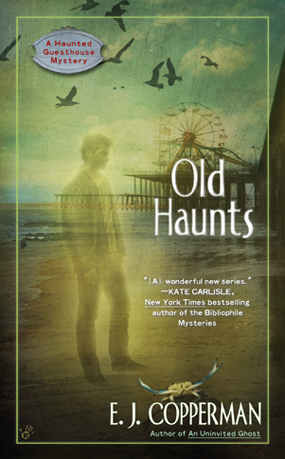
E.J. Copperman is the author of the Haunted Guesthouse series, in which a divorced mom tries to run a Jersey Shore guesthouse that happens to be inhabited by two ghosts. The latest in the series (which can be read out of order), OLD HAUNTS, publishes on February 7. You can also friend Copperman on Facebook, chat on Twitter, or catch Copperman's blog, Sliced Bread.

Usually, we'd ask you to tell us what writing advice you've used, dear Reader. How about we mix it up this time? Share with us the most ridiculous piece of writing lore you've read or heard!