Showing posts with label Georgette Heyer. Show all posts

Thursday, May 4, 2023

Kim Hays--Switzerland's Secret Aristocrats

DEBORAH CROMBIE: First up today, a REDS ALERT! The winners of Ellen Crosby's BLOW UP are Karen in Ohio and Bibliophile. Email Ellen at ellen.crosby@gmail.com with your details!

And, now, on to today's guest, Kim N. Hays, the author of one of last year's break-out debuts, PESTICIDE, set in Bern and featuring Swiss detectives Giuliana Linder and Renzo Donatelli. The second installment in Kim's police procedural series, SONS AND BROTHERS is out now! I raved about the first book and am now in the midst of SONS AND BROTHERS and loving this one, too. The characters are complex and empathetic, and the Swiss cultural details like the one Kim is sharing today are fascinating. Welcome, Kim!


Switzerland’s Secret Aristocrats

It’s confession time: I have a weakness for aristocrats.

My politics lean left, and I grew up with Democrat-voting parents descended from struggling immigrants. I believe in equality and despise snobbery. But strange things happen to you when you read countless fairytales about princesses and have an anglophile librarian mother who tells you tales of English kings and queens and introduces you to Lord Peter Wimsey books. My teenage passion (never outgrown) for Georgette Heyer’s Regency romances only made matters worse.  

Now I live in Switzerland, home of the original castle of the Hapsburgs, a dynasty founded a thousand years ago that ruled great chunks of Europe for centuries. I’m finally surrounded by dukes, countesses, and barons, right?

Well, no. Back in the days of that eleventh-century Hapsburg castle, there were titled nobles galore, including Berthold, fifth Duke of Zähringen, who set off from his castle near the German city of Freiburg to conquer a good part of what was then Burgundy, including my home city of Bern in 1191. But you can’t have nobles without a king or queen to bestow titles on their favorites, and after the confederated cantons that became Switzerland liberated themselves from their Hapsburg overlords, they didn’t want a monarchy. So today there are no titled families pulling the strings in various Swiss cities and cantons.

Notice that word “titled.” In fact, the Swiss cities are home to an untitled elite who wield the influence of an aristocracy. These men and women, whose families were dominant for centuries in their regions of origin, carry names that are instantly recognizable today to anyone who lives where their ancestors once held authority. Members of the Escher family in Zürich, for example, or the Burkhardts in Basel, the Sulzers in Winterthur, Patrys in Geneva, or von Graffenrieds in Bern: many of these men and women are active in the government, economy, social welfare, and cultural life of their cities and cantons. And quite a few of them are very rich. Some even own castles. But none of them uses a title.

Perhaps because Bern was once the largest city-state north of the Alps, its collection of untitled aristocrats is the best known in Switzerland. The organization they’ve founded together is Bern’s Burgergemeinde, or community of burghers, which owns enormous quantities of land and hundreds of buildings in and around the city and spends a great deal of money keeping the city’s museums and symphony going. Newcomers to the city have been buying themselves into this elite circle for decades. Still, the original and most important burghers of Bern have ancestors who were running the city in the Middle Ages, during the years when the trade guilds were the most important institutions in all the Swiss cities.

Today’s Bernese aristocrats still belong to guilds, since most of their forefathers began as the city’s bakers, tanners, carpenters, and stoneworkers. These early tradesmen and merchants rose to become first guild masters and then members of the city council. Eventually, a core of them declared themselves patricians and became a ruling elite, until Napoleon conquered Switzerland and overthrew them. But their family names—and their influence—didn’t disappear.

Some of the sons of these great families made their living as mercenary captains.  Switzerland may be neutral today, but for over eight hundred years its young men sought their fortune as killers-for-hire. Starting in the sixteenth century, professional soldiers from wealthy Bernese families would recruit whole companies of poor peasants and laborers seeking wealth and adventure (or maybe just a job) and lead them off to fight for foreign rulers in European wars. The Pope’s Swiss Guard is a relic of the time when one in ten Swiss men was fighting for a foreign power. As a result of these services to European royalty, a few of the mercenary officers from patrician families were given aristocratic titles that could be passed on to their children. But these are never used in Switzerland.

I once got up my courage to ask my delightful OB/GYN, whose father was then the president of Bern’s community of burghers, if he had a title. He told me that when he went to a medical congress in, say, France, he could sign the hotel register as Baron. “But I’d never do that, of course,” he assured me earnestly.

How could I write mysteries set in Bern and not include these Bernese aristocrats in my stories? For Pesticide, the first book in the Polizei Bern series, I created Frau von Oberburg, a very old but lively member of the community of burghers who lives in an apartment on Junkergasse, a real street in Bern that by its very name (a Junker is a Prussian aristocrat) is a good place to house a member of the gentry.

Now, in my second Polizei Bern book, Sons and Brothers, I’ve actually killed a Bern burgher. My newest aristocrat is named Johann Karl Gurtner and is from the Emmental region of Canton Bern, where he grew up in a small castle that is the property of his mother’s family, the von Eichwils. He is a well-respected surgeon and works hard in his family’s traditional trade guild as a charitable volunteer. 

But if you want to know who killed him, you’ll have to read the book!

Am I the only one with a secret passion for lords and ladies? Does anyone else share this un-American fascination with aristocrats?

DEBS: I think question is so appropriate, with the coronation of King Charles III coming up this weekend!  I grew up loving Georgette Heyer, too, and of course my first detective love was Lord Peter Wimsey, so I guess I was indoctrinated early. What about you, REDs and readers?

Sons and Brothers, the second police procedural in Kim Hays’s Polizei Bern series, was published on April 18 by Seventh Street Books. In it, a cardiac surgeon in his seventies is attacked and drowned in Bern’s Aare River. The district attorney suspects the victim’s estranged son Markus, but Bern police detectives Linder and Donatelli have other ideas about the crime. In her endorsement of the book, Julia Spencer-Fleming says, “Giuliana Linder and Renzo Donatelli are compassionate, conflicted, and utterly compelling. Sons and Brothers is a must-read.”


Kim Hays is a dual Swiss/US citizen who lives in Bern with her Swiss husband. The first book in her Polizei Bern series, Pesticide, was shortlisted for a Debut Dagger Award by the Crime Writers Association. Deborah Crombie called it “a stand-out debut for 2022.” For more information about Kim and Switzerland, see www.kimhaysbern.com.


Monday, December 20, 2021

Curl Up With Our Favorite Christmas Reads


DEBORAH CROMBIE: Recently we talked about our favorite Christmas mysteries, but going into the hustle and bustle of Christmas week, let's push that out a bit and share our favorite Christmas READS. What do you pull off the shelf when you need a gingerbread latte-sized dose of the warm and fuzzies?


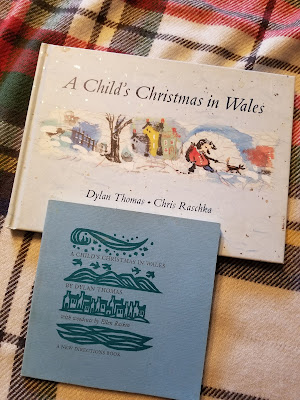
I always, always read Dylan Thomas's A Child's Christmas in Wales, a tradition that I've given to the Kincaid/James family as well. Even though I have a nice, new illustrated copy, before bed on Christmas Eve I will pull out my little much-loved, paper-covered copy with its woodcuts by Ellen Raskin because it's not Christmas until I've read it all the way through.


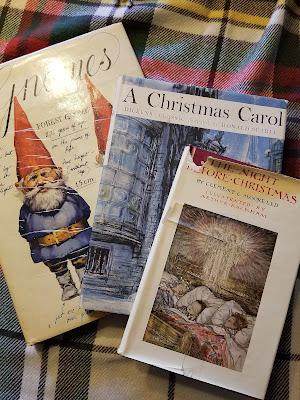
Then there is my very battered copy of The Night Before Christmas, illustrations by Arthur Rackham, and an almost equally battered copy of A Christmas Carol, illustrated by Ronald Searle (although they both miraculously still have their dust jackets!) J.R.R. Tolkien's Letters from Father Christmas. The Polar Express by Chris Van Allsberg. An old book about gnomes which isn't exactly Christmas but is such fun.


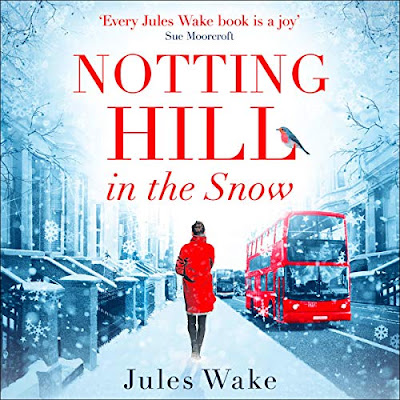
And because nothing says Christmas like a little romance, I'm going to add Notting Hill in the Snow by Jules Wake, We Met in December by Rosie Curtis, Snowflakes at the Little Christmas Tree Farm by Jaimie Admans (the book is better than the title, I promise.)  And I'm looking forward to The Christmas Bookshop by Jenny Colgan.


I know I'm leaning way British here, so chime in, dear REDs, and share what books say HOLIDAYS to you.


HALLIE EPHRON: With my daughters and grandkids arriving soon, Debs you’ve inspired me to scour our many many many bookshelves for holiday stories, hard because Debs grabbed off the classics and because Jerry’s encyclopedic brain isn’t around to point me to the correct room, never mind the right shelf. 


I’m a huge fan of A Child’s Christmas in Wales, especially the opening stanzas that say winter more than any other work I can think of. 


Now I have a little stack ready to go. The Night Before Christmas of course… for the eponymous night. The Grinch That Stole Christmas. And more. Then queuing up music: The Nutcracker and Handel’s Messiah and Elvis’ Christmas Album. 


And adding hot chocolate and marshmallows to my shopping list.


LUCY BURDETTE: I love both of your lists, but I confess not to being much of a rereader. I can recommend Jenny Colgan’s CHRISTMAS AT THE ISLAND HOTEL. I found it in the pile of light reading I’d bought during the pandemic months and didn’t have time to read. At first, I thought it was too light to keep my interest, but by the end, I was yearning for the story to continue. She is so good at bringing cold, remote Scottish settings and quirky characters to life–this one is set on the fictional island of Mure, halfway between Norway and northern Scotland. And the action takes place in a new hotel kitchen leading up to Christmas–it hit all my sweet spots!


DEBS: Lucy, I LOVE Jenny Colgan's Bookshop on the Corner trilogy so much that I hated for the books to end! These are set in a Highland village on the shores of Loch Ness and by the time you finish them you will be hunting for your passport!


HANK PHILLIPPI RYAN: My step-dad used to read from A Child’s Christmas in Wales to us every year when we were little. We could not figure out what was so great about it, and fidgeted. Now, I see. (As can be said for so much.)  What books say holidays? On First Chapter Fun last year, we read out loud the first and last –I think they’re called “staves”--of A Christmas Carol.  I could not get through mine without crying. I urge you all to re-read.

This year we are doing something a bit different, but a bit the same. See you there! And you will be surprised at what books take place at Christmas!


DEBS: Ooh, can't wait! Mark your calendars!


JENN MCKINLAY: The Night Before Christmas every Christmas Eve forever and ever! Then I roll into my favorite Christmas mysteries always set in England, by our Rhys and Kate Kingsbury. Cozy reads by the light of the tree with a hot cup of tea - perfection. 


JULIA SPENCER-FLEMING: Love Christmas mysteries and romances. In fact, I just finished reading several of Carla Kelly’s novella collections. She’s one of my favorite Regency writers, but there aren’t any dukes and marqueses in her books - her characters are most often men and women whose lives have been torn apart by the Napoleonic Wars, which lasted half a generation. SO GOOD. And speaking of Regency, one of my favorite seasonal mysteries is Georgette Heyer’s A CHRISTMAS PARTY - if you’re a fan of Rhys’ THE TWELVE CLUES OF CHRISTMAS or GOD REST YE, ROYAL GENTLEMEN, you’ll like this.


For the classics, I’m a Dickens gal, and when the kids were little, Clement Moore’s ageless poem as well. I would read The Polar Express and bawl at the end, because I was a grown up and couldn’t hear the magical sleigh bell ring.


DEBS: Julia, if I ever read the Heyer, I've forgotten it! Searching now...


RHYS BOWEN: My Welsh grandfather used to insist on A Child’s Christmas in Wales, so I felt that I’d had enough of it, until recently when I rediscovered it and it took me back to my childhood. The Polar Express both moves me and scares me. I don’t want to think of Santa’s place as a giant factory! I’m also a sucker for Christmas cozies–and movies like The Holiday. But who has time for reading right before Christmas? I have family arriving: 15 people for quite a few meals. When they’ve all gone again I’ll curl up by the fire and read.


DEBS: Rhys, somewhere I have a DVD of Denholm Elliott reading A Child's Christmas--it was that dramatization that was done years ago on PBS, I think. So lovely. I also have a recording (somewhere) of Dylan Thomas reading, but I'm embarrassed to admit that I can't understand most of it with his very heavy accent! 


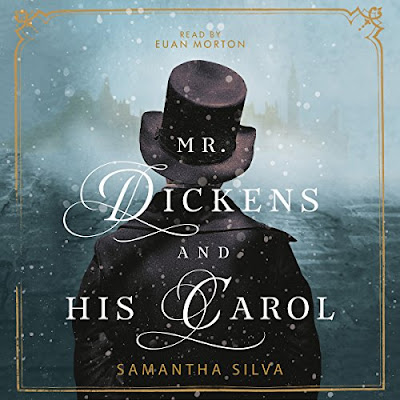
READERS, what faves have we missed? Oh, and has anyone read Mr. Dickens and his Carol? 


It's a novel about Dickens writing A Christmas Carol and has such fabulous reviews that I've ordered it.

Tuesday, May 3, 2016

Tracy Grant--Game Changers

DEBORAH CROMBIE: I've been a huge fan of Tracy Grant's Regency intrigue novels since the very first book, have followed them through the game changes (see below!) and always eagerly anticipate a new adventure. Tracy, like me, fell in love early on with Georgette Heyer's Regency novels, and then with Golden Age mysteries, then went on to create her own unique world. I don't know anyone who combines fascinating and accurate historical detail with romance, mystery, intrigue, and memorable characters as well as Tracy. 


How could anyone resist this description from the latest Malcolm and Suzanne Rannoch book, London Gambit, which comes out Thursday!
 
On a moonlit London night, Suzanne Rannoch slips away from a glittering Mayfair party to assist a wounded man who has escaped Paris one step ahead of Royalist pursuit. That same evening, Suzanne’s husband Malcolm, himself a former spy for Britain, is summoned to the warehouse of a shipping company where a thief has been knifed to death. These two seemingly unconnected incidents prove to be the opening gambit in a deadly game that will test the Rannochs’ skill, strain their divided loyalties to Britain and France, and entangle not only fellow agents and spymasters, but their friends and family. The stakes are their security, their marriage, their very lives.

Tracy has taken the challenges faced by most series' writers and doubled them--or is it quadrupled? (You will see!) Dealing with the peculiar problems of series characters is a dilemma close to my heart--here's how Tracy does it.


TRACY GRANT: I love series, both as a reader and as a writer. As a reader, I love to follow the twists and turns and speculate with other readers of the series. I worry about favorite characters and checking back in with them is like reconnecting with old friends (with Debs' Gemma and Duncan, I feel I know them and their world so well it’s like stepping into their house for a cup of tea or sitting across from them in a pub over a pint). With my own writing, my mind inevitably thinks in terms of a series. After a book, I’m always wondering what happens next for the characters and even when I get ideas for new characters, I want to fit them into the pre-existing world. 

Recently, I was asked whether I have the series planned out or make it up as I go along. The answer, I realized, was a bit of both. My series is particularly complicated because I started out telling the story of Charles and Mélanie Fraser and then when I changed publishers and couldn’t take the series forwards, I decided to go back in time and tell their back story. But I had to change their names, so they became Malcolm and Suzanne Rannoch. Different names but still spies for opposite sides in the Napoleonic Wars (he for the British, she for the French) who end up married to each other. Eventually I had to move the Malcolm and Suzanne books into a sort of parallel universe for a book or two to catch up the two series and move forwards to the books I had originally planned to write in Fraser universe. Not the way I would have chosen to do it, but it did allow me to dramatize their history at the Congress of Vienna and the Battle of Waterloo and in Paris after Waterloo, which I loved telling.  

Because I  went back in time, I more or less knew how I wanted those early stories to play out. But there were still plenty of details to fill in and some points where what I thought was going to happen didn’t fit where the characters actually were when I got to that point on paper. With my last book, The Mayfair Affair, and my new release, London Gambit, I’ve moved into uncharted territory,  taking the series forwards in time, not locked into any plot twists in prior books. But there are still certain developments in the overarching plot of the series I know I am writing towards, some of which I’ve had in mind from the start, some of which have occurred to me along the way, The Mayfair Affair introduced a fairly major new romantic pairing for the series. I had actually intended to get one of these characters together with another ongoing character at the start of the series, but I decided several books ago that these two characters were a better match, and I was really excited to finally get to the point where their relationship could progress. Other things I’ve thought I was writing towards end up playing out differently when I get to that point in the story and realize what I thought would happen doesn’t make sense given where the characters now are.

London Gambit contains a major plot twist I’ve had in mind for some time, though I wasn’t sure precisely where it would occur in the series. It’s something of a game changer for the series. Even when it occurred to me that this plot twist would fit logically in London Gambit, I wasn’t quite sure I was ready to go there. I dithered. I felt like I was being mean to my characters. I considered softening it. I started writing the book with the plot twist in mind, but wasn’t sure I would really go through with it. I even drafted scenes not sure I would include them. Then I discussed the possible plot twist with a writer friend who has read the series from the beginning. When I said I wasn’t sure I really wanted to go this far, and I felt I was being mean to my characters, she said, “That’s probably when you know you’re writing the exact right thing.”

I realized she was right. So I drew a deep breath and went through with the plot twist. And I’m glad I did. It opens a lot of very intriguing possibilities for future books that I’m eager to explore. At the same time reading over the galleys, I still felt a pang for my characters. Which I suspect proves that my writer friend was right - this was a good choice to make.

Writers, do you plan your series out in detail or make up events as you go? Have you ever felt conflicted about a game changer twist in your series? Readers, what are some of your favorite game changer moments in series you read?
 
DEBS: I cannot wait to read this! And, oh, so many times I've dithered over whether or not I can really put my characters through the plot twists I've come up with--and found, like Tracy, that it was exactly what I needed to do. 
 
REDS, readers, what do you think? Do you want your characters to be challenged? 
 
Teresa (Tracy) Grant studied British history at Stanford University and received the Firestone Award for Excellence in Research for her honors thesis on shifting conceptions of honor in late fifteenth century England. She lives in the San Francisco Bay Area with her young daughter and three cats. In addition to writing, Tracy works for the Merola Opera Program, a professional training program for opera singers, pianists, and stage directors. Her real life heroine is her daughter Mélanie, who is very cooperative about Mummy’s writing. Tracy is currently at work on her next book chronicling the adventures of Malcolm and Suzanne Rannoch. 

Thursday, March 29, 2012

Teresa Grant's Imperial Scandal

HALLIE EPHRON: Today we're delighted to welcome author Teresa Grant. Her newest novel, "Imperial Scandal," is a thrilling, romantic tale set in Brussels in the wake of Napoleon’s escape from Elba.

In today's interview, she talks about the era she loves to write about, where she finds the details for her stories, and how she juggles a writing career with being a new mom.

Tracy, why do you think historicals--not just books but Downton Abbey, etc., are so popular right now?

TERESA GRANT:
It's an interesting question. So many people I know love Downton Abbey - my editor and agent and I were just talking about it over lunch last week. I think on the one hand historicals provide an escape from the stresses of the modern world (another friend and I were debating whether Downtown Abbey stirs nostalgia or makes the untenable nature of the class system clear).

But I also think history offers a lot more than escape - as a history major, I often think of it as the ultimate social science. History has so much to say about everything from human interactions to politics and economics. I think historical fiction always says something about the era in which it's created as well as the era in which it is written. I think we're in the midst of a period of change now and both the Edwardian era/the Twenties and the Regency are times of change as well, so I don't think it's a coincidence that stories set in both those eras resonate now.

HALLIE: Why did you choose your particular period?

TRACY: It's an era on the cusp between the 18th century and the industrial era, between the classical and romantic eras, between the Les Liaisons Dangereuses generation and Victorian repression. Echoes of the French Revolution linger. The railroad is in its infancy. There's so much to explore from the Napoleonic Wars to social unrest to Beethoven, Turner, and the romantic poets.

HALLIE: Did you feel any qualms about taking on the Battle of Waterloo? And the real historical characters in the book?

TRACY: I was both excited and terrified to take on Waterloo. It's such an iconic historical event from the Duchess of Richmond's ball at which the British got the news that Napoleon had marched through the battle itself and its aftermath. I wrote about Waterloo in Shores of Desire, one of my historical romances, where the battle was a smaller part of the book than in Imperial Scandal. I'd wanted to explore it in more detail ever since.

But so many wonderful writers have dramatized the battle from Thackeray to Georgette Heyer to Bernard Cornwell that it was hard not to be intimidated. I had to remember that I was telling my version of the battle and the surrounding events, through the lens of this story and these characters.

I love weaving real historical characters into my books. I had particular fun with Lady Caroline Lamb, who actually wasn't in Brussels until after the battle in point of fact but who was such a wonderful foil for Cordelia Davenport, one of my fictional characters, that I couldn't resist including her. The Duke of Wellington, who you'd think might be intimidating, I actually find quite easy to write about - his dialogues comes quite easily to me.

One of the challenges of this book is that there are a number of historical characters, such as Wellington's aides-de-camp, about whom there isn't a large historical record. I tried to build fully realized characters on the information I had to work with.

HALLIE: The details of place and time are so evocative in your book. For example, you open a battle scene:
"Mist hung over the fields, mixed with smoke from the Allied cooking fires and those of the French on the opposite ridge. Steam rose from cheap tea brewed in iron kettles. The smell of clay pipes and officers’ cigars mingled with the stench of wool still sodden from the night’s rain. Shots split the air as soldiers fired their guns to clean them."
Wow. How did you find those incredible sensory details?

TRACY: Thank you so much! I worked really hard to bring the battle scenes to life, so your comment means a lot to me.

I read a lot of letters and diaries and memoirs from people who were involved in the battle. I made notes of details mentioned and then tried to imagine what my characters would see, smell, hear, touch in the midst of the scene.

It's the same for a scene on a battlefield as in a ballroom, though with the battle scenes there was the added challenge of giving the reader a sense of the overall progress of the battle while at the same time writing from the POV of the characters who would mostly be experiencing chaos.The Waterloo scenes in Imperial Scandal are some of the most challenging I've ever written and also some of my favorites.

HALLIE: I know this is a weird question, but I've always been fascinated by the clothing of past eras, and the undergarments women had to wear to get into them. Did questions like this figure in your research for this book??

TRACY: Definitely. As I said above, the clothes are one of the things I love about this era. Malcolm and Suzanne, my investigative couple, do a lot of their talking about the mystery while getting ready to go out for the evening or undressing at night. Which means I have to know things like how dresses unfastens and corsets unlace.

I'm fortunate to have two writer friends who are wonderful fonts of information about early 19th century clothing, Candice Hern and Isobel Carr. Isobel helped me figure out the best kind of corset Suzanne could wear to allow her maximum freedom of motion in action scenes.

HALLIE: Your Facebook page features you with the most adorable baby. We all want to know, how do you juggle your time?

TRACY: I've become quite adept at writing with a baby on my lap :-). I'm lucky that my daughter Mélanie is very adaptable (I just took her to New York and she was a great traveler). I was actually able to get back to writing sooner than I expected after she was born.

She likes the stimulation of going out, so we spend a lot of time in cafés where she can look out the window, and I can write with a latte. I'm definitely better now at grabbing work time when i can. I've always liked to write late at night, and that still works well as she sleeps a lot then. And I've found nursing time is great for catching up on reading.

I think Malcolm and Suzanne will have their second child in the book I'm going to write next so I can put my hands-on baby research to use!

HALLIE: Thanks, Tracy! Tracy will be checking in today so please, share your thoughts and questions. What do you think makes us such suckers for period drama?

Wednesday, June 8, 2011

Tracy Grant's Magnificent Historical Mysteries


DEBS: Today Jungle Red chats with one of my favorite novelists, Tracy Grant.

Fans may be familiar with Tracy's wonderful Regency suspense (is that a category?) novels featuring Charles and Melanie Fraser, but now, writing as Teresa Grant, she brings us Vienna Waltz. Europe's elite have gathered at the glittering Congress of Vienna - princes, ambassadors, the Russian tsar - all negotiating the fate of the Continent by day and pursuing pleasure by night. Until Princess Tatiana, the most beautiful and talked about woman in Vienna, is found murdered. Young diplomatic wife Suzanne Rannoch discovers her husband, Malcolm, who is rumored to be among Tatiana's conquests, kneeling over the princess's body. An intricate dance in the search for the truth ensues. No one's secrets are safe and the future of Europe may hang in the balance.

I just had to repeat the first line of the glowing review of Vienna Waltz from Publishers Weekly: "A murdered Russian princess creates a diplomatic imbroglio in this magnificent mystery set in the midst of the glittering palaces and ballrooms of the Congress of Vienna."

How often have you seen PW use the word "magnificent?" High praise, indeed, and very well deserved. Of course, you might guess that I loved the book, since my quote was featured on the cover. I feel very privileged!

And the cover! It is, I think, one of the most beautiful book covers I've ever seen. Did you have input into the design?

TRACY: Thanks, Deb! I love the cover. My editor asked me for my cover ideas early on, and I sent suggestions and images. I suggested a woman (I described Suzanne and actually the cover model looks quite a bit like her), which seems to be the classic look for historical fiction these days. I said I thought it was important to make sure her dress looked elegant and regal, to suggest the sumptuousness of the Congress of Vienna and the world of Continental royalty, instead of looking too Jane Austen-y and British. The cover design by Kristine Mills-Noble and the illustration by Judy York are beyond anything I imagined. The cover is so beautiful and the dress has a lavish, over-the-top elegance, which perfectly captures the mood of the Congress of Vienna.

DEBS: You're a fellow Anglophile. What led you to your interest in England, and to the Regency era in particular?

TRACY: My mom loved British history and literature. When I was six, my parents took me to the Laurence Olivier-Greer Garson Pride and Prejudice. I loved it and immediately wanted to read the book (or rather have it read to me). My mom said I'm not sure you I'll like it, but we can try. I thought it was wonderful. To me, at that age, it was a story about girls (older than me but young enough that I could identify with them) dealing with their sisters and parents, growing up, falling in love. Every time I reread Pride & Prejudice I get different things from it, but I was totally hooked at the age of six.

A family trip to England and Scotland the next year helped cement my love of British history. We'd been watching the Elizabeth R series on PBS, and we went to a lot of the locations, as well as to country and London houses right out of a Jane Austen novel. My mom and I went on to read all of Jane Austen and then my mom discovered Georgette Heyer's Regency-set novels and introduced me to them.

Even when I was reading on my own, we still tended to read the same books and talk about them, including Anthony Trollope's Palliser series and British golden age mysteries by Dorothy Sayers, Margery Allingham, and Ngaio Marsh. I was always particularly drawn to the Regency/Napoleonic era, I think because of Jane Austen and Georgette Heyer. My mom and I began to plot a Regency romance together when I was thirteen. We worked on it off on and on for several years.

I went on to college at Stanford where I majored in history (specializing in the late fifteenth century for a never-published historical fantasy series I was working on, though I learned a huge amount about historical research that's been invaluable in researching the Regency era). The summer between my sophomore and junior years in college, my mom and I went back to our Regency romance in a very focused way. We sold it (to our own amazement) the next winter. That book, The Widow's Gambit, was published in May 1988, just before I graduated. Though my books are now ore mystery focused, I continue to be fascinated by the
Regency/Napoleonic era and to find new stories to tell in it. I'm having a lot of fun writing Continental set stories now, but I still write about British characters, and I look forward to getting back to writing books set in Britain eventually.

DEBS: You've not only changed your name, writing as Teresa Grant in Vienna Waltz, but you've changed the names of characters you've written about in previous books! Charles and Melanie Fraser became Suzanne and Malcolm Rannoch. How hard was that for you, and why the metamorphosis?

TRACY: It hasn't been as hard as I would have thought. My new publisher, Kensington, wanted me to have a more historical sounding name. I chose Teresa, because Tracy can be a nickname for it, so I can still be Tracy when I interact with readers. Vienna Waltz, as you say, is the story of Charles and Melanie Fraser's adventures at the Congress of Vienna.

Their time at the Congress is referred to in Secrets of a Lady, and in Beneath a Silent Moon there's mention of a murder Charles investigated in Vienna. But my new publisher also wanted them to have new names when they launched my books, so they are called Malcolm and Suzanne Rannoch (Malcolm and Suzanne are Charles and Melanie's middle names).

They're still the same people, just as I'm still the same person. I wrote the book using their real names so I could keep the characters and chronology consistent. Readers who first met the characters as Charles and Melanie have told me they mentally substitute the original names when they read about Malcolm and Suzanne. But I've heard from readers who met the characters through Vienna Waltz who say they find it hard to imagine them being called anything but Malcolm and Suzanne and mentally substitute those names when they read about Charles and Melanie in the earlier books. I like to think that Charles and Mel lead such adventurous lives it's no wonder some of their adventures are chronicled under aliases :-)


DEBS: And, oh, the clothes! What fun you must have had researching the women's gorgeous gowns and costumes. Even the men's clothes were so much sexier than today's.

Tracy: So true! There are so many things I love about the Regency/Napoleonic era--the fact that it's an era on the cusp of change, the political turmoil, the dawn of the romantic era--but the clothes are definitely part of it. I did indeed have so much fun researching the clothes for Vienna Waltz. The gowns, the jewels, the shawls and reticules, the men's coats and waistcoats and breeches, the uniforms. There are several scenes where Malcolm and Suzanne discuss the mystery while dressing for a ball or the theater or undressing after an evening engagement.

My friend and fellow writer Isobel Carr was a big help with getting all the layers of underclothing right for an early scene where Malcolm helps Suzanne undress (and yes, they're discussing suspects rather than doing anything more amorous). I got to make up lavish gowns for Suzanne and the other female characters (I even changed the description of one of
Suzanne's dress to sound like the gown on the cover), and I also worked in references to real gowns some of the historical characters are known to have worn.

And then there's the Carrousel, a re-creation of a medieval pageant that's a major event in the book. There's quite a bit of documentation about the costumes worn by the knights (of whom Malcolm is one) and the gowns of the belles d'amour (of whom Suzanne is one). I even worked in an exchange where Malcolm, who read history at Balliol, points out to Suzanne that real knights dressed in these clothes would have been cut to ribbons at Agincourt.

DEBS: What's next for Suzanne and Malcolm?

TRACY: I'm currently finishing up revisions on their next adventure, Imperial Scandal, which will be out in April 2012. It begins in Brussels a few days before the battle of Waterloo.

Malcolm slips away from an embassy ball for a secret meeting and finds himself in an ambush the leaves two people dead, including a decorous army wife who seemingly had no business being there. Malcolm and Suzanne are drawn into an investigation that involves a spy ring, double agents, and secret love affairs that could shatter the fragile relationship between Britain and her Dutch-Belgian allies. Once again the murder mystery is intertwined with real historical events. The investigation takes an unexpected turn at the Duchess of Richmond's ball where the waltzing is interrupted by news that the army is about to march against the French, and the story goes through the battle of Waterloo itself. Malcolm unearths clues on the battlefield where he's pressed into delivering messages for Wellington, while Suzanne continues the investigation in Brussels, where she's nursing the wounded.

I'm just starting the following book in the series, set in Paris after Waterloo during the White Terror, when restored Ultra Royalists turned on Bonapartists. It opens with a tavern brawl and the death of a former British agent who knows all too many secrets. I'm really looking forward to writing about Paris and also returning to several of the historical characters from Vienna Waltz.


DEBS: I can't wait! And I must say that I, too, loved Georgette Heyer, but your characters are ever so much sexier:-) Danger, intrigue, complex characters with dark secrets in their pasts, and an evocation of the period that seems so real you can almost believe you're there.

Jewels, indeed.

Oh, and if you ever get around to writing the fantasy series, I'd like that, too!