Showing posts with label Houdini. Show all posts

Thursday, August 22, 2013

MARCIA TALLEY--DARK PASSAGE


DEBORAH CROMBIE: Our guest today is the Agatha and Anthonyaward-winning author, Marcia Talley, whose twelfth Hannah Ives mystery, DARK PASSAGE, has just been released.  Publishers Weekly writes that the novel delivers “steady wit, intrigue, and shocks, building to “a satisfying conclusion.”  Because Marcia is my dear friend as well as all that award-winning stuff,  I got to read the novel in manuscript form and couldn’t agree more!
Marcia's heroine, Hannah Ives, has encountered mysteries in some very exotic locales as well as her home town of Annapolis, Maryland, but I found the setting for Dark Passage particularly interesting.
And, because Marcia is gallivanting around the UK while I am in Texas in August, I'm going to grill her about it.
 So, Marcia, what gave you the idea to set a mystery on a cruise ship?
MARCIA TALLEY: I was attending a family funeral last year, and my
three sisters and I were 
lamenting how we never seemed to find opportunities to get together for fun 
times, so we decided right then to fix that. We found a reliable cruise line -- 
and by that I mean one that doesn't have the habit of running into solid objects, like Italy -- bargain rates, and amazingly, a week in April in which we 
were all free.  The only thing left was to locate our passports and pack our 
bags. Anyway, as I waited in line, preparing to embark, gazing up at the enormous ship that would soon be taking us out to sea and miles away from land, I thought what a perfect setting for a mystery novel.  It’s the ultimate “closed circle of suspects,” isn’t it?  Where could a villain go, except overboard?  I was taking a cruise with my sisters, and I didn’t see any reason why Hannah couldn’t do the same.  Research can be hell, you know?
DEBS:  (The photo above is, from left to right, Marcia and her three equally adorable sisters, Susan, Debbie, and Alison.) Marcia, tell us a bit about the plot of Dark Passage.
MARCIA: Hannah, her two sisters and Julie, Hannah’s fourteen-year-old niece, set sail from Baltimore to Bermuda on a bonding cruise, and have a dramatic first night when Pia Fanucci, a bubbly bartender magician’s assistant whom Hannah befriends, narrowly escapes injury during an on-stage illusion. Pia might make light of the incident, but it’s no laughing matter when young Julie suddenly disappears. Has she gone overboard, or is she injured somewhere on the enormous ship?
Early in the cruise, Hannah had met David Warren, a grieving father whose twenty-two-year-old daughter, Charlotte, vanished without trace from a previous cruise where she was working in the ship’s teen club. Ship’s security doesn’t seem to believe there’s a connection, so Hannah teams up with David and Pia and after a series of twists and turns, they manage to track down a dangerous sea-faring predator.
DEBS:  At one point in the novel, a character observes that law enforcement while at sea is really the ‘wild wild west,’ or words to that affect.  I imagine you on a stress-free vacation, lounging in a hot tub with your sisters, so how did you go about researching cruise ship security?
MARCIA:  I was very lucky there.  I ran into author Hannah Dennison
at a conference and we got to chatting about our respective works in progress.  Hannah (no relation!) mentioned that a fellow she’d gone to college with in the UK, a former policeman, was now head of security for one of the big ships in the Cunard line.  She put me in contact with him, and he answered all my questions.  He was very up front about the issues that confront and frustrate him in his job.  Although ship’s security and medical personnel are usually honest professionals who want to do a good job, you have to remember that they work directly for the cruise line, so sometimes there’s pressure to simply make a problem go away.  I read somewhere that the cruise ship industry spends more money lobbying Congress than Wal-Mart!  As a result, it’s extremely difficult to get accurate statistics on cruise ship crime.
DEBS:  What else did you learn while writing Dark Passage that would surprise us?
MARCIA:  I was shocked to find out that a person goes overboard every two weeks.  Most of these incidents are alcohol-related – as are most accidents on board -- but sometimes a person simply vanishes from a ship and their families never find out what happened to them.  Accident? Suicide? Murder?  Unless there’s a witness, it would be impossible to say for sure.  Security cameras can provide some clues, of course, but they can’t see everywhere.  And I was amazed to learn that there are no security cameras in the passenger corridors!  None!  Passengers apparently consider that an invasion of privacy – I figure they don’t want to be caught sneaking into someone’s room for a little hanky-panky, or upchucking in the hallway after a long night in the bar.
DEBS:  So if there is a crime at sea, who does investigate?
MARCIA: It can be a complicated jurisdictional issue.  According to a law passed by Congress in 2010, any crime against a citizen of the United States that happens on a ship that regularly sails in and out of U.S. ports must be reported to and investigated by the FBI.  But that can’t happen until the ship reaches port, which may be days after the incident.  Ship’s security can secure the crime scene, and in recent years medical staff have been trained to collect evidence (such as performing blood tests and rape kits), but they don’t have the authority to arrest anybody.  That authority lies first with the police in the country where the ship is registered (Panama or the Bahamas, for example), the police in the port of call, or in the case of U.S. citizens, with the FBI. I don’t know about you, but I’d rather have the FBI on the case than a cop from some tiny island in the Caribbean.
DEBS:  Seems to me, if somebody goes overboard from a big ship, that would be that.  Buh-bye!
MARCIA:  Sadly, that’s usually true.  By the time a passenger ship large enough to carry 2500 passengers plus another 800 or so crew can stop and turn around, the poor victim would be floundering several miles behind it, if they hadn’t already gotten sucked into the ship’s turbines. One of the largest ships, Royal Caribbean’s Oasis of the Seas can accommodate 8000 passengers and crew, so I imagine it would take even longer to turn around!  But occasionally, someone does survive a fall overboard, especially if the fall is witnessed, and it happens near land.  But here’s another thing I learned that surprised me.  A U.S. Coast Guard search for a missing person can cost more than $800,000.  Does the cruise line pay?  Nope. Not a penny. Another good reason to be registered in Panama or the Bahamas, I guess.
DEBS:  I loved the way you worked magic into the plot of this novel, Marcia.

MARCIA:  As mystery writers, we’re constantly creating illusions, aren’t we, where something (or someone) isn’t who or what s/he seems.  And that’s very much the case in Dark Passage.  I know very little about the art of magic myself, but before he became an award-winning writer of narrative histories like Teller of Tales, The Beautiful Cigar Girl and Night of Peril, my friend Dan Stashower, was an amateur magician.  (Dan started out writing mysteries, actually, a series with Houdini as the sleuth. ) Anyway, Dan recommended a fascinating book by the master illusionist, Jim Steinmeyer, called Hiding the Elephant.  I learned a lot from Mr. Steinmeyer.  And over lunch one day, Dan even helped me design an illusion for Channing, my fictional magician – The Turbine of Terror!  Be afraid, be very afraid!

DEBS: I laughed out loud at the art auction scene.

MARCIA: I’ve been on three cruises and every single one of them had an art auction on the next to the last day.  I watched people pay up to $20,000 for the tackiest art!  Not exactly Elvis or The Last Supper painted on black velvet, but dangerously close, so it tickled me to poke fun at it.

DEBS: So, what’s Hannah up to now?

MARCIA:  You may remember Hannah’s friend, Naddie Bromley, the retired mystery writer, from earlier books.  Naddie’s moved into Calvert Colony, a posh life care community near Annapolis, Maryland where things turn out not to be as idyllic as they seem.  It’s called Tomorrow’s Vengeance.

DEBS: So, readers, who knew all this about cruise lines? This is really scary stuff. Would you still take a cruise?

And do you have any good cruise stories? Tell us, and one lucky commenter will win a copy of Dark Passage.  It might even be more fun--and safer--than a vacation!

Oh, and one last thing--the winner of Jenn McKinlay's Cloche and Dagger is Lynn S. So Lynn, email me at deb at deborahcrombie dot com with your mailing address, and I'll pass it on to Jenn.

PSS: And don't you love Marcia's cover??


Thursday, February 25, 2010

The Accidental Expert


RHYS: Remember the Robert Frost poem, Two roads diverged in a yellow wood... and I tood the one less traveled by, and that has made all the difference?That could be the theme-song for my life. Opting out of the chosen path for me, leaving the BBC instead of rising through the ranks, going to Australia, meeting my husband and moving to California. All my writing career has been one long serendipity too. And along the way I have picked up all kinds of knowledge I never thought I'd want or need.It started when my husband became sales manager of Air India. We had to entertain Indian dignitaries in a city where there was no consul. We became experts in Indian food, were on the board of an Indian dance school and traveled to India numerous times. We ended up with close Indian friends. So we are accidental experts on India.
My kids became swimmers. I found myself president of a swim club. I became a stroke and turn official. Never a competitive swimmer myself, I was judging big meets
.I started writing books about Wales. Although I knew the place well, I learned all kinds of interesting facts--the contents of the National Gallery stored during WWII in a Welsh slate mine, for example. Every book I write involves research into a field I never thought I'd want or need.
When I started to write my Molly Murphy books, my aim was to set a book on Ellis Island. I did all the background reading I could find on the immigrant experience before I wrote the book. Then Molly steps ashore in Manhattan and I realized how little I knew about New York City in the early 1900s. Lots of tramping around the Lower East Side and Greenwich Village followed, hours in the NY library and historical society, a large library of my own and now I know my way pretty well around 1903 New York. I know about the formation of the Ladies Garment Workers Union, and about the rise of spiritualism, and the birth of Coney Island and pharmaceutical recipes of the time. All knowledge I never thought I'd want or need. But sometimes I astound native born New Yorkers by pointing out something about their city that they didn't know. Accidental expert on New York history.
My latest research has been on Houdini and illusionists--and what fascinating reading it made. Actually many of his illusions or stunts have not been improved upon over the years. He was a brilliant escapologist and an equally brilliant illusionist. But when I read that he had probably been used by the secret service as a spy while he was on his European tours, then I knew I had a good story. So I'm now an accidental expert on Houdini too. But I'm not going to tell you about any of his amazing illusions. You'll have to read my book, The Last Illusion, if you want to know more!
And Jungle Red Sisters--in which areas have you become accidental experts?
ROBERTA: Wow Rhys, you have had some interesting twists and turns! We'll be looking forward to the dinner invitation with all that Indian food expertise!(Rhys: If you come to SF for Bouchercon this year, we can definitely cook Indian food for you!)In 1990, I was minding my own business running a therapy private practice with an interest in good tennis. I was considering embarking on advanced training in psychoanalysis (which takes years and years of training and a training analysis) when I met my husband-to-be, John. He got me hooked on golf and because I was such a mental basket case, I began to write about it. Next came the Cassie Burdette golf mysteries and the rest is unfolding. I have to shake my head at how life has changed--mostly for the good.
JANS: As a journalist, I'm used to becoming a 24-hour expert on something, which was brutal on my family when I was health reporter because I could take the fun out of almost everything. (When I told my brother he really should wash the melon before he sliced it because of the bacteria, he told me I had to get another job.) Now because of all the research I've been doing on my non-fiction project, I'm an expert on Boston and its racial and urban crime problems in the mid to late 1970s. I never had a burning need to know these things before I started this project.
RO: All things Indian are in the air for me today..I was accidentally cc'ed by a pal at BBC on a lengthy string of emails about a get-together at an Indian restaurant. It was pretty funny reading someone else's emails...is there a story in this?
I am an accidental expert on Tanzania. My husband and I went there on a Habitat for Humanity build and have since been back a dozen times because we decided to build a library there. It's frightening that I know the bus schedules from Dar es Salaam to Dodoma and I don't know which subway will take me from 59th St. to the east village.(RHYS: The 6 is the closest you'll get. Stops at Astor Place. You see I know my modern NY pretty well too!

RHYS: I think the great thing about writing is that we have the chance to learn new things all the time. And it's the closest to time travel that I'll probably ever experience. Now I've got to get back to Chinatown, which is where the next Molly book is set!

Sunday, February 21, 2010

What's in a Name


RHYS: Ever since early people realized the need to choose grunts to differentiate between a sabre toothed tiger and a squirrel what we name things is of vital importance. Studies have been done on our initial perception of people with popular names versus those with nerdy names. Until recently we'd always choose an Ashley over a Hermione (not any more, however which shows that our perceptions can be influenced by popular culture).
The same is true of the names we pick for characters in our books. The name has to be just right for the person. I have had problems with a character when I am writing. His scenes are just not going well. I don't have a real grasp on his motivation. And then suddenly in the middle of the book he'll look at me and say, "I know you keep calling me Anthony but actually my name is Ron." And as soon as I change his name, everything flows perfectly. I'm sure other writers have experienced this.


For this reason it is always with some trepidation that I auction off characters in an upcoming novel in the big charity auction at conventions. What if the name is hopelessly out of place for my historical period? What if it's just a difficult name and carries negative overtones? So far I'm always managed to do it, but I'm always apprehensive--especially since I've just volunteered to do so again at Malice Domestic and even promised to make the person royal or noble.

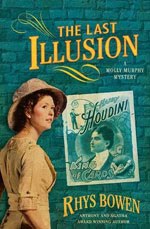
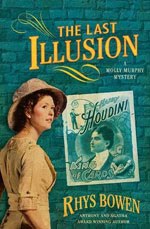
I'm writing about names today because on March 2 my new Molly Murphy mystery, THE LAST ILLUSION, comes out. It is the ninth in this series and the first in which I have deviated from a theme in the titles. The first books (Murphy's Law, For the Love of Mike etc) were all Irish sayings. With O Danny Boy the titles moved to Irish songs, then to popular songs of the early Twentieth Century. But this book is more thriller than mystery in many ways--Molly is hired to find who is trying to kill Houdini and finds herself caught up in the world of international espionage. So I wanted to make the title crisper and more thriller-like. The Last Illusion really describes the pivotal scene in the book and I think it captures the flavor well.

It is really important that the book title fit the tone of the story. If you see a catchy pun, you expect light hearted cozy. I made the mistake with the Constable Evans series of using puns for all my titles. As the series became meatier and darker they weren't really cozy any longer and I think I put off many people from trying my books. When one was nominated for the Edgar, I know quite a few people were surprised at the content.
So now I try to get the titles exactly right. And I'm wondering--how much are you influenced by a book title? Are you attracted to a thriller that has 'bone' or 'blood' in the title? Would you have found The Da Vinci Code as compelling if it was called A Murder at the Louvre? Look how many thrillers now have those buzz words: secrets, chamber, Templars etc in their titles.


If the publisher is not going to spend half a million on publicity and marketing for a book, our title and cover are the only things that can attract new readers. I've been lucky in that I've loved all my Molly Murphy and Royal Spyness covers (especially this one!) but I have writer friends who have felt that their covers were wrong and could do nothing about it. Also I've been lucky in being able to keep my titles. I know of writers who hated the titles their publishers came up with. The only title I have ever really, really hated was back in the days when I wrote YA books. A German translation of one of my books (which was about mountaineering) was calle "First Love Tastes like Strawberry ice Cream." Now if that's not misleading, I don't know what is!

If you go to my website, http://www.rhysbowen.com/, you will find a trailer for The Last Illusion as well as the opening chapter to read. It's a fascinating glimpse into the life of Houdini, Illusionists and early espionage.

HALLIE: Love your title, Rhys! And I'm completely fascinated by Houdini etc. I've read just about every book there is about him. Can't wait to read your new one.
I do think titles are so important, but I confess to being less than brilliant about recognizing a good title when I see it. I wanted to call my last book "Baby, Baby" (it's about two very pregnant women) but the publisher felt it wouldn't convey the creepy suspensey-ness of the the book. So we went with "Never Tell a Lie" - which turned out to be a wonderful title though I was fairly lukewarm at first.

RO: It is a good title. I feel like I wasted almost two years of my life because my publisher changed the title of my second book..and of course had to change the cool image on the cover. It really broke my heart. The few reviews I got were better than they were for Pushing Up Daisies...but the title didn't roll off the tongue the way Daisies did, and the cover...well, you know what a camel is? A horse designed by a committee. That's what I got...a camel. Not the designer's fault..just happened. So, the book didn't get out there much. I never should have let them change it, but I was so new, I figured they knew best.What was it supposed to be called instead of The Big Dirt Nap? Corpse Flower. And the cover would have been gorgeous, we already had images. Maybe when I'm famous someone will reissue with the original title.
Now, I LOVE this year's title and cover. Fingers crossed other people will too!
I have a hard time with character names. I usually go through 3-4 names for each character before I settle on the right one. I've even taken to saving Playbills because of all the donor names in the back.
The auction name that I got at Bouchercon 2008 was fabulous. I may make her a recurring character. Her name is Nina Mazzo and it's absolutely perfect. Nina's a P.I. who specializes in philandering husbands. Uh...Nina's in Dead Head.

ROBERTA: Corpse Flower was a good name Ro:). But there's no telling really why one book takes off and another doesn't. I suspect the first in a series always has a better chance of hitting the big time. I've had several titles changed by the publisher, almost always for the better. And as my agent has said, the cover fairies have been good to me too!
I'm afraid I'm not too imaginative with names. Lots of times I catch myself using the same names over and over. "Michael" for example, shows up a lot. The folks who've bought names for my books in auctions have almost always turned into recurring characters. They get their money's worth. My favorite story was a man in town who was bidding in a silent auction at our library. He was very worried that the cost would shoot up out of his price range. But then his bidding rival had to leave the party early, so he won the prize--a character in DEADLY ADVICE. He was so pleased with the result. Sadly, he died of cancer not too long after the book came out, but his character lived on in the series. I'm so glad it worked out that way!

HANK: My favorite name I got in an auction: Urszula Mazny-Latos. I must say, I freaked for a moment. Then voila, she became Zuzu Mazny-Latos, a chic European fashion designer. Merci, Urszula! And at the next auction, by chance, I got Luca Chartiers! Perfect. (I thnk auction names are a real gift. And I love using them.)Titles? I'm haunted by titles. I'm always thinking of them. Always writing them down. And I'm always astonished that there's always another good one! Sending good vidbes for THE LAST ILLUSION, Rhys! Love it. And Dead Head, RO, is brilliant. And you have both truly scored with those covers! Go Jungle Red.


RHYS: So is it the title or the cover art that makes you pick up a book and ry and new author?