Showing posts with label Kay Kendall. Show all posts

Tuesday, February 19, 2019

Austin Starr mysteries author Kay Kendall on inspiration

HALLIE EPHRON: Today we're thrilled to host the author of the Austin Starr mysteries, Kay Kendall. Kay writes historical mysteries, and her newest is a series prequel, AFTER YOU'VE GONE is set in the 1920's. The series has won won two Silver Falchion awards (Best Mystery AND Best Book!) at Killer Nashville.

Kay is here to talk about the question authors dread. And she's giving away a copy of AFTER YOU’VE GONE to one lucky commenter!


KAY KENDALL: “Where do you get your ideas?”

If you hang around with authors long enough, you’ll invariably hear one say, “Someone asked me a silly question at my book event yesterday.” Then the second will chime in. “Right, I bet it was the old stand-by, ‘Where do you get your ideas?’” The third replies, “Hate answering that, and it comes up often.”

The first time I heard a conversation like that, I mentally patted myself on the back, thinking “Whew, at least I never asked that silly question.” Sure I asked plenty of others as I prepared to become a published author, but not that one.

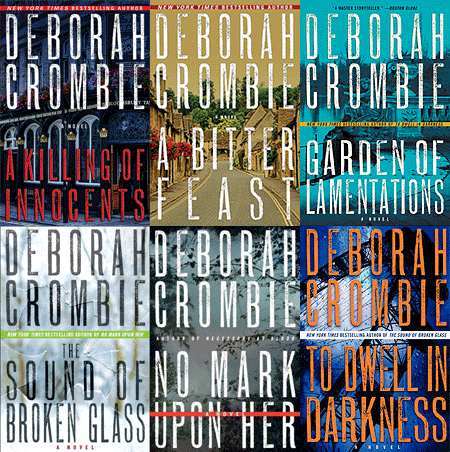
By then I knew that ideas can float up from anywhere, often from the unlikeliest places. I was reminded of this when I read Deborah Crombie’s post here on Jungle Red last week about including maps in her mysteries. She shared examples and extolled the delights of working with her illustrator Laura to prepare maps to show the terrain of her plots.

Now, I happen to be a keen aficionado of maps. A good in-depth map thrills me. In my travels, the best I’ve seen are put out by German publishers—I swear some show every tree. Also, in the UK the Ordinance Survey maps are splendid, offered with astonishing levels of detail. While I was admiring Deborah’s maps online, I recalled other mysteries that contained maps (for example, Donna Leon’s mysteries always include maps of Venice). I was blissed out just thinking about them.

And then it hit me. I could include a map in my next mystery!
What an idea. And why had it never occurred to me before? See. Ideas can bubble up anywhere, anytime. So, thank you Deborah Crombie. 

I realize that when I write, I’m working from a mental map of the places my characters inhabit. For my first two mysteries, I used places that already existed in the cities of Toronto, Vancouver, and Seattle in the late 1960s. I consulted maps that showed streets and landmark buildings, making sure that my people were situated properly. I made nothing up.

In my new book, AFTER YOU’VE GONE—AN AUSTIN STARR MYSTERY PREQUEL, I made up a fictitious small town in Texas. I called it Gunmetal. (I checked. There isn’t one, but there is a Gun Barrel in Texas.  Of course.) I situated my town near the real ones of Cuero and Yoakum. The first time I ever saw Spanish moss on trees was when I visited cousins in Cuero, and my father was born nearby in Yoakum. While I know lots about those towns, I wanted to be free to imagine my own places and not feel bad if I were to hurt any current residents’ feelings by what I wrote. Large cities I’d written about before were different. Small towns didn’t seem like fair game.

I would’ve liked to show readers of AFTER YOU’VE GONE where Gunmetal was located on a map. Although I say in the book that Gunmetal is near Cuero, many readers will never have heard of Cuero (pop. 8,200). Likewise, when I note that Gunmetal is in-between Houston to the east and San Antonio to the southwest, this may not leap to their minds either. My mystery is set in 1923, and my amateur sleuth Wallie MacGregor and her Aunt Ida take a road trip in a brand new Buick motorcar to visit a relative in Houston, 150 miles away. In those days the trip took eight hours or more. Today it takes less than three.

I wish I’d included a map that shows the house twenty-three-year-old Wallie lives in with her father, the judge. Her real name is Walter, after her father, and her male name seems to have made her extra spunky. They live in a large Queen Ann Victorian, with an empty lot to the right and standoffish neighbors to the left—so
mean that they hate Wallie’s beagle puppy Holler on sight. Wallie takes a walk with her dad’s hunting dog across town, across the tracks to the colored part of town, where their housekeeper Athalia lives—she doesn’t have a phone. Now I long to show my readers those things on a map. And then of course there’s the location of the so-called accident that induces Wallie to prove it was murder. And I think …

Well, next time I will include a map.

Luckily for me, Vienna, Austria, is the location of my next book. Austin Starr’s grandmother Wallie flies over there in 1970 to help her granddaughter when she becomes a suspect in a grisly murder. There will be lots of beautiful historic places to situate the explosions and gun battles I have planned. And this time you will see those locations on a map—or perhaps even on two.

What are examples of books you’ve read that included maps—besides those wonderful ones by Deborah Crombie? And are any of you location challenged? My super smart gal pal is and could get lost in a ladies room in a hotel. She can’t even read a map, although she got all A’s in college. Is anyone else like that? 

And a copy of AFTER YOU’VE GONE to one lucky commenter!


Kay Kendall writes the Austin Starr mystery series (austinstarr.com ). After You've Gone (February 2019) is a prequel featuring Austin Starr’s grandmother who comes of age during the Roaring Twenties and Prohibition. This amateur sleuth searches for the killer of her uncle—who just happens to be a famous rumrunner in Texas. The first two Austin Starr books capture the spirit and turbulence of the 1960s. Desolation Row (2013) and Rainy Day Women (2015) show Austin as a young Texas bride, forced to the frontlines of societal change by her draft-resisting husband. Austin copes by turning amateur sleuth. The latter mystery won two Silver Falchion Awards in 2016 at Killer Nashville. In all her fiction, Kay shows how patterns of human nature repeat down the decades, no matter what historical age one reads about.

Before Kay began to write fiction, she was an award-winning international public relations executive, working in the US, Canada, the Soviet Union, and Europe. Ask her about working in Moscow during the Cold War. She and her Canadian husband live in Texas with three rescue rabbits and one bemused spaniel. She is president of the Southwest Chapter of Mystery Writers of America.    

http://AustinStarr.com
www.facebook.com/KayKendallAuthor /  
@kaylee_kendall
Kay blogs monthly on 3rd Wednesday of each month at https://thestilettogang.blogspot.com/ ##

Friday, July 24, 2015

What If Nancy Drew Was 22 Years Old in 1968?


JRW welcomes a guest blog by Kay Kendall
Lots of iconic fictional characters are repurposed and plopped into historical settings unlike those they originally inhabited in novels and plays. Shakespeare’s Romeo and Juliet, for example, became dancing and singing New York City teenagers in Westside Story.  Sherlock Holmes again inhabits London to catch evil doers, but his cityscape now includes the Millennium Wheel.

An icon of my early years was Nancy Drew. She was nosy as could be, always jumping into her roadster and whirling off to uncover clues. When I was eight, I’d no idea that the original series was set in the 1930s. If I’d realized that, I might have understood why no one in my small hometown in Kansas ever drove “roadsters” anymore. If you consider that Nancy’s first adventures took place even before World War Two, then you realize how daring she was for her times.

Many boomers like me grew up on Nancy Drew mysteries. As the years have passed, I’ve realized how much her ethos has stayed with me. When I transitioned into my second career of mystery author—I call myself a reformed PR executive—it seemed only natural to write about a female amateur sleuth. You may not recognize my protagonist Austin Starr as being related to Nancy Drew, but within Austin the spirit of Nancy carries on.

Once I knew the main character, I had to decide what decade she would live in. Since my favorite mysteries are historical, I began to write what I love. I started working on my debut mystery Desolation Row a year before Mad Men made the sixties unexpectedly hot, after being very, very cold indeed for a long time. But that time period fascinates me. After all, I grew up with the Cold War and Vietnam as my backdrops. There was no shortage of drama and violence. I wanted to make that e
ra come alive again, but to treat it like history. And even though I can remember that decade, that doesn’t make it any less historical.


 In her first outing, Desolation Row, Austin Starr must prove her new husband did not kill the son of a United States senator. She is in a foreign land, having moved to Canada in 1968 with her draft-resisting husband. Scared and alone, she has to conquer her fears. But she does plow on, and in her second escapade, Rainy Day Women, she discovers she has a real yen for solving murder cases.


Besides the fun of including hippies, beads, macramé purses and Bob Dylan tunes, the virtue of the sixties time period is that crime solving did not involve CSI techniques. As a writer I am more interested in character and motivation than in fingerprints and DNA. Austin’s extreme inquisitiveness leads to anomalies that she can figure out through logic and a fine understanding of human nature. That world she inhabits is familiar but at the same time quite gone. Austin is forever searching for a payphone and if she misses a call at home, she doesn’t even know she has missed it. In the late 1960s, answering machines existed but were hardly ubiquitous.

I like delving into that world. And staying there for a long time. I like showing how issues that reared their heads then are still current today. My first mystery takes place during an unpopular war, and Austin develops a viewpoint that is anti-war but pro-soldier. My new book introduces Austin to the women’s liberation movement. Slowly but surely, she learns about what has become known as second-wave feminism. This is a subject I’ve longed to write about for years. Sadly, I just never realized the goal of female equality would remain as relevant as it still is today.


Kay Kendall is a long-time fan of historical novels and now writes atmospheric mysteries that capture the spirit and turbulence of the 60s. A reformed PR executive who won international awards for her projects, Kay lives in Texas with her Canadian husband, three house rabbits, and spaniel Wills. Terribly allergic to her bunnies, she loves them anyway! Her book titles show she's a Bob Dylan buff too. New York Times bestselling author Miranda James says, “Austin Starr is back, and that’s great news for mystery fans. Suspenseful and entertaining, this is a worthy follow-up to Kendall’s excellent debut, Desolation Row.”


Find Kay here:

Sunday, April 21, 2013

The Tides of History


HANK:  Susan Orlean had a great tweet Saturday. She wrote something like: "can we just have a nice boring week, please?"

 I'm with ya, Susan. I woke up yesterday and thought I'd feel safe..instead, I felt sad. I walked into the Dunkin Donuts, saw all the regular t-shirted messy-haired normal people just..buying coffee! And I burst into tears. My husband thinks I've lost it.

Anyway.We've been talking all week about the intersection of fiction and reality, so how perfect it is that debut author Kay Kendall (she's fabulous!) is here today to explore that, too.


The Lure of Terrors Past—and Conquered
                           by Kay Kendall

My first experience of the lure of historic catastrophe happened at the movies when I was eight. On the screen a small town celebrated the return of victorious soldiers from World War I, I thought—How exciting it must’ve been to live during wartime. I longed for the drama, the glory. What did I know?

That memory flickers in my head while I watch events in Boston on my television screen. As I write this, the city is in lockdown and Watertown is the focus of the manhunt for a nineteen-year-old terrorist. 

Lives have been lost this week. Many people have been maimed. This terror has not yet been conquered. Perhaps there are more people involved, perhaps more unexploded IEDs lying about. This may be drama, but it is not entertainment. This is not fun.

But people clamor for fiction that features events like this. How do we explain being drawn to horror movies, spy stories, serial killers’ tales and the like? I think fiction of this sort shows how people can act in catastrophic times, overcome their fears and come out on top. When we read novels set during past wars, we can get scared but know how things turn out. The Nazis always lose, even if a few survive to plot another day.

I grew up when the Cold War was pretty hot. I moved rapidly from a severe case of Nancy Drew-itis to being mesmerized by John le Carré’s twisted spy stories. Much later, when I felt compelled to devise my own mysteries, it seemed natural to turn to my favorites as models. For a year I drowned myself in mysteries set during World Wars One and Two and the Cold War. 

Of all the major wars of last century, only the wars in Korea and Vietnam weren’t “taken,” weren’t overrun with thrillers. Vietnam offered a dangerous yet fairly empty niche that needed filling…and I concluded I’d do the filling.

Draft protests, draft dodgers and resisters are symbolic of that war, so much so it seems millions of young men fled to Canada. However, that exodus wasn’t huge, although it was the largest since colonists loyal to England moved north after the American Revolution. (Famous in Canada, that group is called United Empire Loyalists—I’d never heard of them.)

During the U.S. involvement in Vietnam, by law Canadian immigration officials couldn’t ask men entering the country about their draft status. Consequently accurate statistics aren’t available. Informed guesses range from 125,000 down to 50,000. Whatever the number, further estimates conclude that roughly half those who moved to Canada still remain. They settled into Canadian society, made families and careers. Some even entered Canadian politics and were elected to office.

For the half of draft resisters who left Canada eventually, it’s impossible to tell where they went. In 1974, President Ford offered clemency to Vietnam draft resisters and deserters. Only 27,000 of 350,000 eligible applied before the offer (mandating two years of government service) expired in 1975. Two years later President Carter pardoned those who dodged the war by not registering or fleeing the country. Stigma still attaches to the subject of draft evasion.

Desertion, however, is a more serious offence, and it created political furor, especially among American veterans of World War II and Korea. As late as 2005, a Vietnam era deserter was prosecuted by the Marine Corps.

In my debut novel, Desolation Row—An Austin Starr Mystery, one young woman gets swept along by the tides of history during the turbulent sixties. She’s a moderate—not an activist like “Hanoi” Jane Fonda or Angela Davis. My fictional Austin Starr, homesick Texas bride of a Vietnam War activist, must prove her husband didn’t murder a fellow draft resister in Canada, the black-sheep son of a U.S. Senator. When the Mounties are convinced David Starr is guilty and jail him, Austin must find the real killer herself or risk losing everything.

I enjoy writing about historical turmoil that lends itself to personal drama, intrigue and murder, I can control the world that I build on the page. That is comforting.  But now I must return to my television screen, to wait for the newscasters to tell me that the crisis has passed, the bad guys are conquered. Waiting for comfort to come, even if it is only temporary, only until the next horror fills my screen.
============================
HANK: Kay (who apparently has...a rabbit??) will drop in to answer questions and respond to comments, and she'll give away a copy of DESOLATION ROW (Stairway Press, Seattle) to a lucky commenter.

And we'll announce all this week's winners later today!
*************
 Learn more about Kay and her book at www.kaykendallauthor.com, on Facebook  <www.facebook.com/KayKendallAuthor>, on Twitter @kaylee_kendall, and at LinkedIn  <http://www.linkedin.com/in/kaykendallmysteries>.