Showing posts with label Mary Gordon. Show all posts

Friday, May 10, 2013

Elizabeth Benedict's "What My Mother Gave Me"

HALLIE EPHRON: Just in time for Mother's Day comes a wonderful collection of essays, What My Mother Gave Me: Thirty-one Women on the Gifts That Mattered Most (Algonquin paperback) edited by Elizabeth Benedict. It's all about the presents our mothers gave us that have served as a model, a metaphor, or a touchstone in our own lives. The 31 essays range from funny to poignant to heartbroken, and on through a gamut of emotions.

For me, there's no doubt that my mother's gift was books. She doled them out to me and my sisters the way other mothers might give out toys or candy. And, whether it was intentional or not, they almost always featured strong female characters.

From little Madeline who was not afraid of the lion in the zoo, to Dorothy Gale who faced down the wicked witch of the west, to Eloise who turned the Plaza Hotel into her own personal playground, these were characters who provided a model for the women we could be... and also, it turned out, for the women we could write about.

Sadly, though she was a writer, she never shared her own story -- what it had been like growing up, being a woman screenwriter in 1950s Hollywood -- and she died much too young. So the books and those characters that she loved, too, are my placeholders.

Welcome, today, to Elizabeth Benedict! Liz, what was the inspiration for this anthology?


ELIZABETH BENEDICT:
It began with a beautiful scarf, the last gift my mother gave me. She bought it from a holiday vendor who came to the assisted living facility where she lived before she moved to a nursing home. 

I began wearing it on my winter coat, and wherever I went, people often said, “What a beautiful scarf. Where did you get it?”

I longed for a simple answer
– say, “Bloomingdales” – but there was nothing simple about this story, especially after my mother died. 

I had had a loving but distant relationship with her, but because I was so physically close to the scarf, wearing it around my neck and wrapped around my face when it was cold, I was baffled by my attachment.

I spoke to absolutely no one about this, even my husband, because I didn’t have the words to articulate these conflicted feelings. 

One day I wondered if other women have a gift from their mothers, a gift that opens up into the entire relationship the way the scarf does for me. It was my way of finding people to talk to about this!

HALLIE:
Can you tell us a little about your essay that's in the book?

LIZ:
 My essay goes over some of my history with my mother, and how my relationship to her changed in the last few years of her life. I wrote it after receiving and editing the other 30 essays in the book. I only had a few days before I had to hand in the entire manuscript, and I knew the only way for me to write the essay was to give myself this tight deadline – and to be as candid as the other writers had been in their essays. I don’t think I could have written the same essay if I hadn’t had the examples of the other contributors.

HALLIE:
You have an incredible lineup of authors. Was there a piece that especially surprised and delighted you?

LIZ:
I was thrilled by each essay, because of the incredible variety of gifts – and the stories and
revelations that come out of them. But as far as delight, I’ll mention Rita Dove’s piece about getting a box of usual-colored nail polish when she was 15. She had to beg her mother to buy her the green and blue polishes, and her mother finally relented, not thinking they would lead to anything serious.

In fact, her elaborately colored nail have become Rita Dove’s signature, and a symbol for her of her mother allowing her to move into adulthood in her own way.
Another kind of delight is from Lisa See’s essay about her mother Carolyn See giving her the gift of writing. Carolyn passed on the lesson to write 1000 words a day – no matter what – and a charming note to someone who intimidates you.

HALLIE:
Some of the essays have a dark side, too. An example?

LIZ: Judith Hillman Paterson
’s mother died of alcoholism when she was 31 and Judith was nine. The gift she wrote about was a year of sobriety that Judith remembered decades later and that she revisits with aching tenderness in the essay. 


Mary Gordon
’s mother only used to give her money as gifts – sometimes checks - when Mary barely knew what money was. Mary was bitter about this, even as an adult. In the course of the essay, I can see some of the bitterness dissolve as she remembers the day her mother took off from work and took her daughter on the Circle Line boat around Manhattan.

HALLIE:
Tell us where you will be appearing in the weeks to come.

LIZ:
This coming week, as it leads up to Mother’s Day, is the last week of the formal tour.

  • Tues. May 7th 6.30, New York Society Library, 53 E. 79th St., NY NY, RESERVATIONS REQUIRED - Margo Jefferson, Martha McPhee, Roxana Robinson, and Liz.
  • Thurs. May 9, 7:30pm, Greenlight Books, Fulton St. Brooklyn, Join Mary Morris, Maud Newton, Elissa Schappell, Emma Straub, and Liz.   
Visit the book's tumblr site to see photographs of the gifts in the book and photos of some of the mothers and daughters – and to submit a photo of a gift from your mother with a brief story about it.

HALLIE: And here on Jungle Red, share: What's one gift your mother gave you?


Friday, October 2, 2009

On Mentors, Muses & Monsters

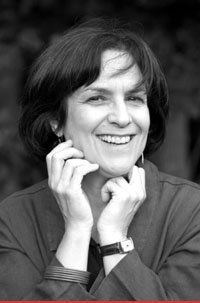
We all remember that special person who encouraged our writing and, of course, the one who shut us down. Then there was the individual whose work inspired us to reach higher. Author Elizabeth Benedict (photo by Emma Dodge Hanson) would call these our “mentors, muses, and monsters”

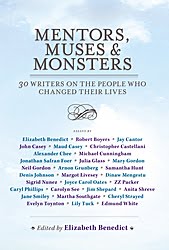
Who influenced the amazing Joyce Carole Oates? Or Mary Gordon? Or Michael Cunningham? Or Jane Smiley? Readers can find out in Elizabeth’s new collection of essays, “Mentors, Muses & Monsters: 30 Writers on the People Who Changed Their Lives.” The collection also contains Elizabeth’s own essay, “Why Not Say What Happened?” in which she writes about her college tutorial teacher, esteemed woman of letters, Elizabeth Hardwick.

JRW: Elizabeth, what inspired you to write this book?

EB: I was asked to write a remembrance of Hardwick after she died (December 2008) for Tin House magazine. The night I sent it in, I was floating around my apartment, feeling particularly good, not just that I'd finished it but that I got to express my appreciation for what she'd meant to me when I was a college kid with nothing but a crazy ambition.

In that dreamy mood, I idly wondered if there was a book of essays about fiction writers and their mentors and went to Amazon to look - and there wasn't. An hour later, I'd cooked up the title -the 3 M's, as I call it - and the next day I invited Mary Gordon. She said yes right away. So did most of the other people I invited. I was stunned by how many people said yes, sometimes even before they knew whom they'd write about.

JRW: What were some of the revelations in these essays that surprised you?

EB: First of all, I expected everyone to write about a person, but many people wanted to write about a book or an author, dead or alive, and some wanted to write about a place or a transformative period. When Jane Smiley went to the Iowa Writers' Workshop in the 1970s, she was more inspired by her classmates than her teachers. Her piece, about them and the mood in 1974, is a lovely piece of personal and social history. Joyce Carol Oates wrote about what "Alice in Wonderland" means to her. In the 1970s, Sigrid Nunez was the girlfriend of Susan Sontag's son and lived in an apartment with both mother and son, and has a particularly intimate view of Sontag. I was surprised by the incredible variety of influences, from "Mrs. Dalloway" to "Harriet the Spy."

But mostly I was surprised by how seriously writers took the assignment. I knew the essays would be good, with this group of writers, but had no idea they would all give so much to these pieces. As you read, you can feel the engagement, the writers' determination to get every nuance right; it's exhilarating and very moving.

I came to understand that the relationship you have with a mentor is among the most powerful there is. That person noticed you when you were young and lost and said, "I think you've got talent, and here's what to do with it." We're lucky if that happens to us once! Falling in love and giving birth (so I've heard) are pretty powerful experiences. I think the mentor/influence connections - in their power to changes lives - are up there with those.

JRW: Were there any common threads?

EB: Writers are a cranky bunch who are prone to worry and complaining, but this subject seems to have opened the spigots of gratitude. For the most part, the writers were obsessed with their mentors.

Alexander Chee's piece about studying with Annie Dillard at Wesleyan is so full of detail and dialogue - from twenty years ago! - that it's like taking a course with Dillard, and a course in obsession: "By the time I was done studying with Annie," he writes, "I wanted to be her."

Cheryl Strayed is obsessed from afar with Alice Munro, in part because they both had mothers who died young. I've read this line in her essay a dozen times and it still breaks my heart with its vulnerability and longing: "I love Alice Munro, I took to saying, the way I did about any number of people I didn't know whose writing I admired, meaning, of course, that I loved her books.... But I loved her too, in a way that felt slightly ridiculous even to me."

JRW: Sounds like you've got more mentors than monsters.

EB: That surprised me too. The only full-blown one is in Edmund White's portrait of Harold Brodkey. There are a few other people whose behavior has monstrous moments, including a wicked step-mother. I expected there'd be someone who said, "Writing well is the best revenge for having been treated badly," but even Edmund White felt that Brodkey had been helpful to him as a writer. These writers clearly wanted to accentuate the positive - because they feel immense gratitude to the person who showed them the way.

JRW: Will you be out and about, promoting the book?

EB: I'll be on the pavement and on-line. If you're in New York City, Cambridge, MA, or DC, there'll be an event near you in November or early December. For details, visit the blog at http://mentorsmusesmonsters.blogspot.com/ where there'll also be some on-line chatting once the book comes out, and a few books to give away.

JRW: So, Jungle Red readers, tell us about your muses, mentors and monsters? Elizabeth will be responding to comments and questions. Please, join in the discussion.