Showing posts with label Mary Russell. Show all posts

Thursday, February 8, 2024

Laurie King: Sherlock Holmes and the Easter Eggs

DEBORAH CROMBIE: I have been a huge fan of Laurie R. King's Mary Russell novels since the publication of the very first in the series, THE BEEKEEPER'S APPRENTICE, so I'm thrilled to be introducing the latest Mary Russell and Sherlock Holmes adventure, #18,  THE LANTERN'S DANCE! 


Here, Laurie gives us a behind the scenes look at the choices she made as she was plotting--and I'd love to read every one of these potential stories.


Sherlock Holmes and the Easter Eggs*

Laurie R. King


I sometimes wonder if I write as an excuse for research. In part, it’s the travel—when you’re writing a book about Japan or Transylvania or the Riviera, you have to go there, right? Smell the air, taste the food? And in part, it’s being what my daughter calls a recovering academic, a person whose grad school career was diverted into a life of fiction rather than a life of theological minutiae.

But honestly, what’s not to love about diving into the historical background of your characters?

One of those characters is Sherlock Holmes, and after decades of pastiches, film versions, and fan-fiction, you’d think people had discovered or invented absolutely everything about him. And it’s true, in the course of a career battling everyone from Jack the Ripper to Nazis to Martians (yes, I’m afraid so), Holmes has gone everywhere.

Except perhaps his own past.

Yes, says the writer’s brain: let’s go there!

And let’s structure the book with glimpses of the past, so we can shape a story that’s like a zoetrope, with a series of images that comes to life as the wheel spins: The Lantern’s Dance.


But where to start? Well, one of the few things Arthur Conan Doyle tells us about his detective, in a story that introduces Sherlock Holmes’ previously unknown brother, Mycroft (“The Greek Interpreter”) is that their grandmother came from a famous family of artists. As Holmes says to Dr. Watson:

“My ancestors were country squires, who appear to have led much the same life as is natural to their class. But, none the less, my turn that way is in my veins, and may have come with my grandmother, who was the sister of Vernet, the French artist. Art in the blood is liable to take the strangest forms.”

“But how do you know that it is hereditary?” [asks Watson]

“Because my brother Mycroft possesses it in a larger degree than I do.”

Naturally, if I wanted to write a story exploring the personal history of Sherlock Holmes, I needed to know something about the Vernets. And naturally, for a writer like me with a taste for academic research, the waters of the investigation pool quickly grew very deep indeed.

I shall not burden you with the… shall we say, challenge of the Vernet genealogies and family histories, no two of which agreed on dates, relationships, or even the sex of a child. Nor will I tell you my personal feelings about a family that cannot stick to an identity, but drops names, randomly switches around their first and middle names, or even adopts one that they like better. I will merely say that there’s good reason why we didn’t create a family tree for The Lantern’s Dance’s book club guide.

But—let’s start small, and first try to decide which “Vernet, the French artist” Holmes was talking about. That is a fairly simple problem, for if we work back from the birth date of the elder Holmes brother (1854, though some sources say 1847), it would suggest a grandmother’s birth date somewhere between 1785 and 1815. The Vernet artist who matches those dates as a brother would be Horace (1789-1863.)


(Horace, Self Portrait, 1835)

Therefore, if we’re interested in playing with the links between the Holmes family and the Vernets in The Lantern’s Dance, the artist we want to start with is Horace.

The problem is, even this one single Vernet carries with him such a huge wagon-load of fascinating facts and potential story lines that I could have written half a dozen books, each following a different side-track.

Such as Horace Vernet’s childhood traumas. As a three-year-old during the Revolution, little Horace was rushed through a hail of bullets in the Tuileries. Soon after, his aunt was put to the guillotine by a colleague of Horace’s artist father, Carle, by name of Jacques-Louis David. What if, all these years later, Sherlock Holmes were to uncover some secret rivalry between David and the Vernets, that…

No. Too convoluted, too thinly linked with Horace—and in any case, I don’t want to spend large portions of this book buried amidst the horrors of the French Revolution.

But what about Horace Vernet’s time in a later unrest, the 1848 revolution? His paintings were burned, he was forced to retreat to a small apartment in the Institut de France, he conveniently found a change of patrons…

No: pas de révolution!

How about some nice espionage instead? Ah yes, that’s more like it.

Without giving away plot-spoilers, Horace Vernet does indeed enter our story, during his 1839 sketching trip to Egypt and Palestine. His companions include a young man with a daguerreotype camera—only invented that year—and a nephew by the name of Charles Burton. Burton is an Army officer fluent in Arabic, 26 years old, who happens to be free to accompany his famous uncle, providing the skills both to translate and to guard this remarkable new machine capable of recording clear and detailed images of such places as Acre and Cairo. Vernet’s reputation preceeded him, clearing the way for the artist and his companions to move among the important officials and leaders of the area.


(Horace Vernet: Arabs Traveling in the Desert)

Hmm, says the writer’s brain: access plus communication skills plus a plausible reason for poking around equals a superb opportunity for sending back reports and images to the French military.

So what if….?

But along that track, too, lies a plot that is not what I need.

There is another generation of artists already in this book. I need the Vernets for their art, not their opportunities for espionage.

Reluctantly, grudgingly, I scoop up whole pages of a first draft involving 19th century spycraft (Horace even went to Russia! I could write about the Czar!) and drop them into the “Cuts” file.

Instead, the Egyptian sketching expedition takes on a different role, with Horace’s travels made to serve a rather different purpose in the plot. Don’t worry, espionage remains—I couldn’t resist that temptation—but in a far more covert manner than the original thought.

The spying, the travel, the references to specific Vernet paintings all become Easter Eggs, little spots of colorful treasure that not everyone will see, but which nestle into the story and await discovery. A game, between a writer and her readers.

But still, I am curious. If I were to go back and re-make those decisions that went into The Lantern’s Dance, if I were to pick up one of the discarded possibilities that my research teased me with, which do you think that should be? The French Revolution? Artistic spies in North Africa? Some side task required by Czar Nicholas, perhaps?

Let me know what you’d like in the comments. After all, that’s what short stories are for!

* Easter Egg: a bit of hidden treasure, or an inside joke among game-players.


Laurie R. King is the bestselling author of 30 novels and other works, including the Mary Russell-Sherlock Holmes novels. She has won the Agatha, Anthony, Edgar, Lambda, Wolfe, Macavity, Creasey dagger, and Romantic Times Career Achievement awards, has an honorary doctorate, and is a Baker Street Irregular and a Mystery Writers of American Grand Master. She is celebrating thirty years of Russell & Holmes with a series of all-day Beekeeper’s Apprentice events (see her events page) and her new book, out on February 13, is The Lantern’s Dance.

Mary Russell and Sherlock Holmes, hoping for a respite in the French countryside, are instead caught up in a case that turns both bewildering and intensely personal.


“Deftly interlacing present and past, King offers further fascinating insights into Holmes’s family while also delivering an intriguing mystery.”—The Washington Post

After their recent adventures in Transylvania, Russell and Holmes look forward to spending time with Holmes’ son, the famous artist Damian Adler, and his family. But when they arrive at Damian’s house, they discover that the Adlers have fled from a mysterious threat.

Holmes rushes after Damian while Russell, slowed down by a recent injury, stays behind to search the empty house. In Damian’s studio, she discovers four crates packed with memorabilia related to Holmes’ granduncle, the artist Horace Vernet. It’s an odd mix of treasures and clutter, including a tarnished silver lamp with a rotating shade: an antique yet sophisticated form of zoetrope, fitted with strips of paper whose images dance with the lantern’s spin.

In the same crate is an old journal written in a nearly impenetrable code. Intrigued, Russell sets about deciphering the intricate cryptograph, slowly realizing that each entry is built around an image—the first of which is a child, bundled into a carriage by an abductor, watching her mother recede from view.

Russell is troubled, then entranced, but each entry she decodes brings more questions. Who is the young Indian woman who created this elaborate puzzle? What does she have to do with Damian, or the Vernets—or the threat hovering over the house?

The secrets of the past appear to be reaching into the present. And it seems increasingly urgent that Russell figure out how the journal and lantern are related to Damian—and possibly to Sherlock Holmes himself.

Could there be things about his own history that even the master detective does not perceive?

DEBS: Horace was quite the dandy, wasn't he? What fun!

And we have more fun for you today--2 GIVEAWAYS!!

#1

Comment here on the BLOG to be entered to win a signed copy of THE LANTERN'S DANCE!!

#2

And comment over on our REDS & READERS Facebook group to be entered to win a copy of ECHOES OF SHERLOCK HOLMES, a fabulous collection of Sherlock-themed short stories edited by Laurie and Leslie Klinger. Hank, Hallie, and I all have stories in this anthology and it is such fun!! 

If you haven't joined our REDS & READERS FB group, here's the link.

You can learn more about Laurie and THE LANTERN'S DANCE here:


Wednesday, April 1, 2009

Visiting with Laurie King

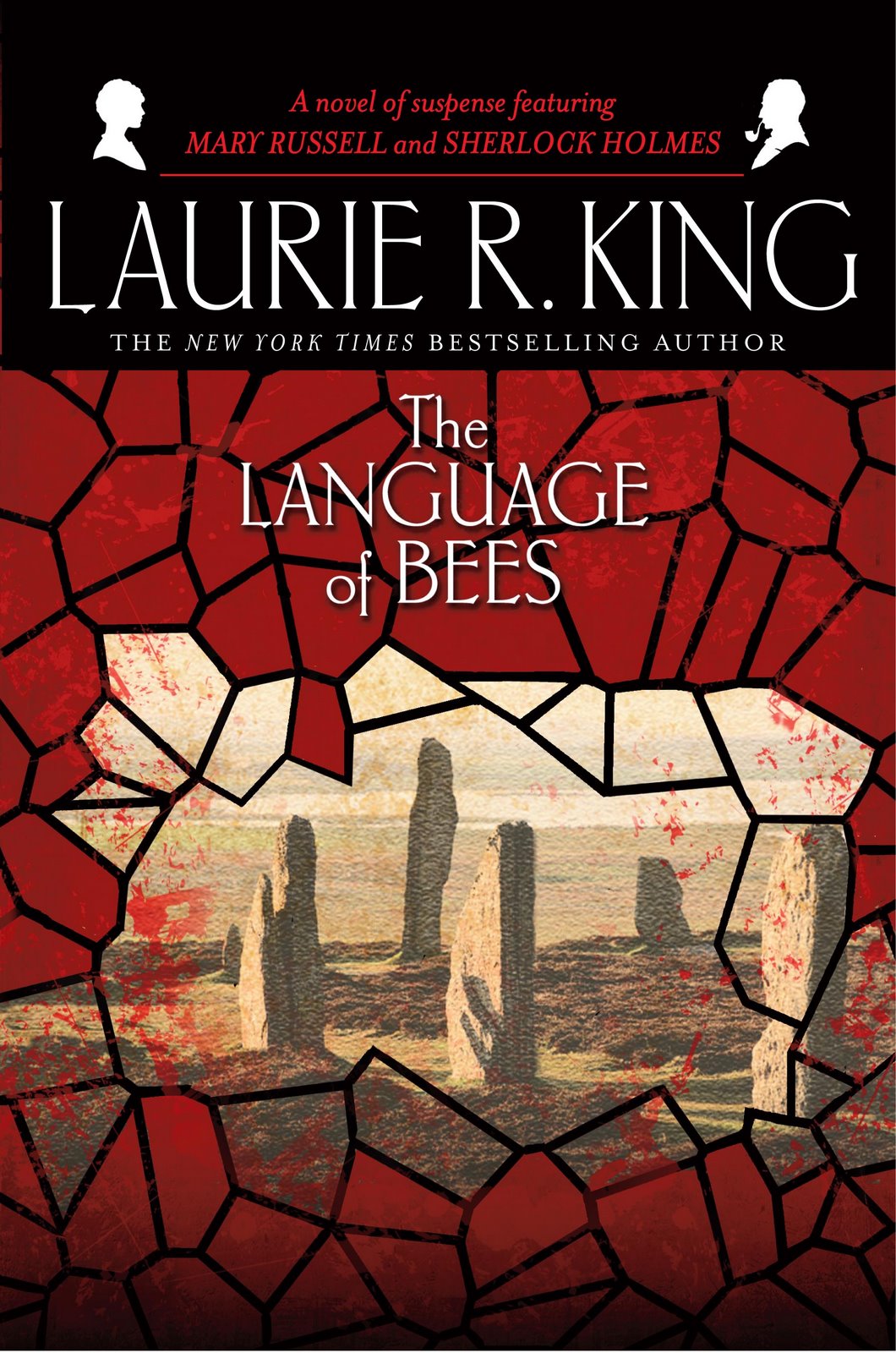
ROBERTA: Today Jungle Red Writers is positively elated to welcome Laurie King, author of nineteen novels including this month’s release, The Language of Bees. Laurie has won the Edgar, the Creasey, the Macavity, the Nero Wolfe, and the Lambda awards, and has been nominated for Macavities, Edgars, Anthony and Agatha awards. We could go on and on, but we’d rather hear from Laurie herself. Laurie, welcome, and let’s start with the new book. THE LANGUAGE OF BEES is the ninth installment of a series featuring Mary Russell, the wife of Sherlock Holmes. Please tell us how you came up with that amazing idea.

LAURIE: Thanks Roberta, for inviting me to be an honorary Jungle dweller. Mary Russell is what happens when a young mother (me, 20 years ago) faces the daily investigative demands of raising small children and thinks, Why did Sherlock Holmes get all the points for figuring stuff out? A woman looks at a kid with no appetite, sees the diminished cookie jar, knows instantly what happened, and at the most gets credited with “feminine intuition.” A man follows the same process, calls it deduction, and you have Watson standing there exclaiming, “Holmes, I just don’t know how you do it!” I thought it would be interesting to put that mind of Holmes (which, granted, is a superior model of mind) into another package—instead of a middle-aged Victorian male, a young, twentieth century, intellectually inclined female: Mary Russell.

ROBERTA: Since this series is set in early 20th century England, we’d love to experience vicariously how you get your facts right. What kind of research is involved?

LAURIE: Being a recovering academic, research is a dangerous project—although I can give it up any time, I swear! Information about a time or a place needs to be intimate to be of any use for a story—historical photographs are intensely flavored with their time, as well as giving detail of clothing and technology (although you have to be careful that they’re actually from the dates the publisher claims, since photo captions are not always completely accurate.) I love old guide books, which are all about the day-to-day needs of moving about a country or city (where to hire armed guards for your trip through the Sinai; the monastery whose “divans are infested with fleas...”) Sometimes you can find governmental surveys that cover a given year, or diaries, although many times those are too self-reflective to be of use to an idea-thief: give me facts, not feelings! One of my best finds in the course of research started when I was looking at the life of British officers in India during the early 20th century, and came across mention of pig sticking, when young British men were encouraged to work off their energy (in the 110 degree heat) by climbing on their ponies and hunting wild pigs with long spears. Can you believe it, there’s an entire book written on the art of pig-sticking, written by the Boy Scout man Baden Powell—what kind of spear, what to look for in a horse, techniques of the sport, you name it. And of course, Mary Russell (good Jewish girl) just had to go pig sticking (that’s in The Game.)

ROBERTA: Tell us about the logistics of using someone else’s character in your books. How does that work?

LAURIE: For me, it only works because I pick up Sherlock Holmes and his companions after the original author was finished with them. The last date Conan Doyle set a story was literally the eve of the Great War, 1914. For him, Holmes was too inextricably a member of the previous era. Under the terrible light of the War and the vast social changes that followed, his Holmes would fade into obscurity. However, it seemed to me that a person as brilliant and mentally flexible as Holmes (yes, even though a male) would have thrown himself at the changes with gusto. These are not pastiches, which use the characters of others and slip them into the existing stories; they are Russell stories, with Holmes as a supporting character—or as the publisher put it, they are about “The world’s greatest detective—and her husband, Sherlock Holmes.” Because I continue Holmes after Conan Doyle, not during his tales, I can show Holmes growing as a character, which a pastiche really cannot.

ROBERTA: Since you write two different series, along with standalones, how do you choose what comes next and then keep everything straight?

LAURIE: As far as the Russells go, after nine books, it’s definitely tricky to keep details straight, especially when I try to pick up material that I wrote ten or fifteen years ago. Short of having to read my books time and again (which would be pure hell) I often depend on the people who know my books better than I do—readers. If I can’t remember where I talked about Russell’s childhood psychotherapist, or what color Lee Cooper’s eyes are, one of them will know. And I make sure to give one or two of the more committed an early ARC as a last-minute chance to catch mistakes.

In general, though, because the various projects are so very different—time, place, person, language—my head seems to keep track of them without too much difficulty.

ROBERTA: We have a number of aspiring writers who follow this blog. Could you give us some advice about writing and publishing? I’m impressed with your promotion—blogs, book clubs, Myspace, Facebook…how do you fit it all in?

LAURIE: You have to remember, I’ve been published for sixteen years and nineteen books. My local bookseller (Capitola Bookcafe—hooray for Independents!) gave me signings, but my first “tour” was a visit to the ALA in Miami (in late June!) to give away copies of the third book (To Play the Fool.) I didn’t go onto a proper book tour until the fourth (Chicago in January—oh, the romance of this job!)

It can be a real problem for new writers to be told that they need to self-promote. Some of them have both the time and the interest, to hang around Facebook and Dorothy L and so on, chatting people up and spreading the word. And if a person enjoys that, if it’s entertainment and an agreeable social network, fine, getting your name out there certainly can’t hurt sales.

However, to do these things as part of the job is another matter. I feel very strongly that the primary task of a writer is to write. Not post, not blog, not make flyers: to write. Anything that interferes with that task should be dumped. The hours spent every week online could better be spent honing skills—taking a course, analyzing loved books, studying bloggers who write about writing.

At the moment, the LRK universe is going through an intensive phase online, which we’re calling the Fifteen Weeks of Bees, an oh-so-clever way to tie together The Beekeeper’s Apprentice (the first Russell) with the new book The Language of Bees (number nine.) This has involved asking “fans”—they call themselves Friends of Laurie (FOLs) or LRKers—if there’s anything they’d like to do to celebrate Russell. One woman came up with three puzzles for the contests (this week’s contest is one of her crosswords.) Another is helping keep track of Myspace and Twitter, others have taken charge of Goodreads. In each of these, I’m involved, but they provide the energy and time, giving me a list of the responses that I can answer all at once, for example, instead of having to log onto the site every day. It’s a temporary state, and will subside the middle of May, but everyone enjoys it and it can’t hurt sales, so I put in the extra effort to Tweet and wrote an ongoing Mary Russell story for Myspace and do guest blogs like this one.

However, after mid-May I’m back to my electronic hermitage, with occasional outings to the spaces, and I’m writing.

I swear, this too I can give up any time!


And now for the official Jungle Red stumper! Please tell us three truths and a lie and we’ll try to guess….

LAURIE:

1. Laurie’s first real job was managing a coffee store.
2. Laurie once dropped her wedding ring into a human skull on Easter Island.
3. Laurie once owned a Coatimundi.
4. Laurie searches out B and C roads on her British Ordnance Survey maps.

(Laurie is on tour for The Language of Bees from LA to Boston during April and May—visit her at an event near you.)