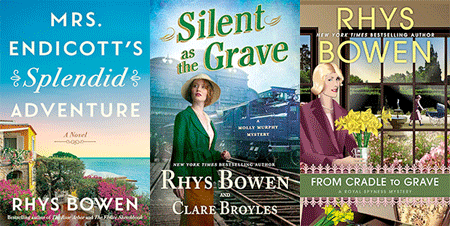
We are SO PROUD to share the wonderful news: Our very own Rhys Bowen's VENICE SKETCHBOOK has been nominated for a 2022 Edgar Award for BEST NOVEL!
HALLIE EPHRON: For my own writing, I have a definite rule about writing viewpoint: Each scene should be written from the point of view of ONE of the characters in the scene. If the viewpoint shifted or the time/place changed, you inserted a scene (or chapter) break to mark the shift.

I realized early on that headhopping can be very confusing to the reader. Most non-writers will have no idea what I’m talking about.
Here’s an example of sliding viewpoint:
Bob entered the room. Preening. Bill was sure he'd never seen anyone as egotistical.We start in Bob’s head and then we slide into Bill’s. Why is this bad form? Because it’s confusing. It’s never a good thing when a reader has to ask, “who’s he?” and “whose is his?”
What an asshole. Why was Bill staring at him? He was probably admiring his piercing blue eyes.
However, really good writers get away with sliding viewpoint all the time. Here’s an example from Louise Penny’s THE NATURE OF THE BEAST:
“Where’s Ruth?” Myrna never thought she’d hear herself asking that question.The first paragraph begins in Myrna’s head. The third is omniscient. Then in paragraph 4 it shifts into Clara’s. But at no point are we confused reading it.
“Don’t know,” said Clara, looking around the crowded bistro. “She’s normally here by now.”
It was five thirty, and every chair in the place was taken. They could barely hear themselves think for the hubbub.
Clara saw Monsieur Beliveau at the door connecting Sarah’s boulangerie with the bistro. He was scanning the room.
I recently read (and loved) the first two books in “The Thursday Murder Club” series. Author Richard Osman plays fast and loose with viewpoint, too, breaking all kinds of rules. He even has some chapters in first person and others in third.
So I’m trying to temper my views on the subject of POV. If Louise Penny and Richard Osman can get away with it…
Is there a “writing rule” about which, over the years, your views have shifted?
RHYS BOWEN: This is what I always teach in writing classes. I think it’s fine to give viewpoints of various minor characters but it’s hard to shift away from a protagonist in a scene. The reader has to know who she is following and whose story it is.
Rules I keep to? Playing fair in a mystery. Introducing the antagonist early on. Laying clues.
Rules I break, constantly? Having a body before page 50. Never happens. I’m too busy introducing characters and setting up interactions
HANK PHILLIPPI RYAN: I really truly do not enjoy headhopping. GAH. I notice it instantly, and it makes me so annoyed that I truly cannot read the book. It’s all I see.
In the Louise Penny, though, I could convince myself that Myrna saw Clara see Monsieur. And that it’s all Myrna’s POV. That one doesn’t bother me.
If it said:
“Where’s Ruth?” Myrna never thought she’d hear herself asking that question.
“Don’t know,” said Clara, looking around the crowded bistro. She wondered why Ruth was late. “She’s normally here by now.”
THAT would be totally wrong.
Some chapters in first and some in third? With the SAME character? Ah, I have never seen that.
Some chapters in first and some in third from different characters? I have done that, with much delight.
The writing “rule” I break, and will continue to break, probably has to do with commas and run-on sentences and sentence fragments. Whatever. It’s how I think, and how some of my characters think, and no one, not anyone, can take that from me, not even a copyeditor who insists I‘m wrong. The folly of youth.
JENN McKINLAY: Nora Roberts is a notorious head hopper, too, but she manages it masterfully. So much of “the rules” is subjective, I think. Some readers hate first person, some loathe present tense, and some despise the lack of quotation marks in dialogue. Are they rules or personal preferences?
I feel like quotation marks are a rule but then I read an author’s brilliant book without quotation marks in the dialogue and it makes a liar out of me, looking at you Sally Rooney, author of Normal People. Ha! Perhaps, there really aren’t any writing rules, merely suggestions. ¯\_(ツ)_/¯
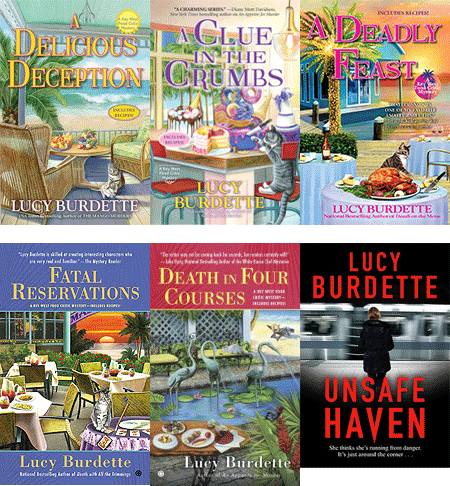
LUCY BURDETTE: I don’t enjoy head hopping either. In fact, UNSAFE HAVEN was the first book I’d told from more than one point of view, not to mention third person. The one thing you don’t want (actually two) is the reader losing interest because they’ve lost touch with the protagonist, or getting confused about who’s talking or who’s there and giving up.
Another rule is related to the use of adverbs. Use strong verbs and you won’t need the descriptors, I was taught. (In fact, it was worse than that–I was told by a teacher that I had the worst case of adverbitis she’d ever seen.) Stick to two adverbs per page.
Maybe the point is when you’re starting out, it’s good to have rules to help you figure out how to tell a story. With more experience, you can take off some of the training wheels.
DEBORAH CROMBIE: I am rigid in my own writing about viewpoint. I try to make it clear at the beginning of a scene whose head we are in, and there we should stay throughout the scene. I find head-hopping very annoying when other writers do it, but I will tolerate it from a writer I really like. Still, it makes me grit my teeth.
I do break other rules, but I think you have to learn them before you can break them. I think the no-adverb rule is way over- stressed. Of course, using too many adverbs can be lazy writing, but I think it's just silly to throw out a perfectly useful part of speech. And now I will get off my soapbox…
But.
Are the examples we’ve been giving here BETTER because the authors break the rules? I don’t think so. When you jump points of view, even as naturally as Louise, you’re forcing the reader to work harder. Sally Rooney is amazing, but what purpose does leaving the dialog markers out, really? Margaret Maron is one of my personal writing heroes, but in some of her Deborah Knott books, she had chapters in first person and chapters in third and it irritated the heck out of me. It felt like cheating - like she couldn’t think of a way to tell her story with the usual POV, so she slid into another when convenient.
If you can’t articulate why breaking a rule is necessary and preferable in your writing, stick to it.
HALLIE: Are there writing rules that you feel or too rigid, or one that's not adhered to rigidly enough.