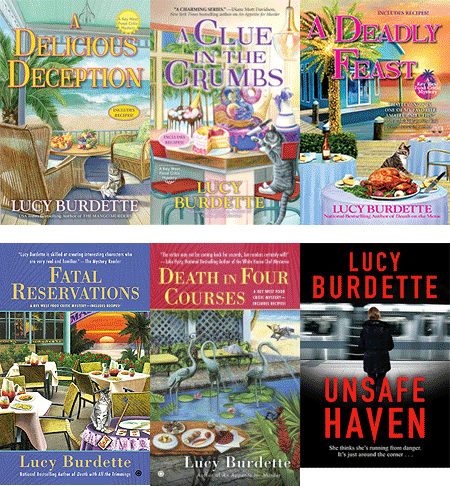
LUCY BURDETTE: I loved Leslie Karst's Sally Solari mystery series, and was sad to hear no more would be published. But luckily for us, Severn House picked up the series and a brand new one is coming. Welcome Leslie!

LESLIE KARST: You may notice that the cover of my newest Sally Solari mystery, The Fragrance of Death—which releases on August 2nd—depicts artichokes. No, it’s not the murder weapon (though that’s there, too), but the noble thistle does play an important part in the story.
Because I adore artichokes. I love plucking off the leaves one by one, dunking them in melted garlic butter, then scraping off the tender flesh with my teeth; and I love the way they cause everything you eat or drink them with taste surprisingly sweet. Given my love affair with artichokes, I decided it would be fun to include them in my new book, which revolves around both an artichoke cook-off as well as an artichoke farm up the coast from Santa Cruz, where the series is set.

I come by this passion honestly, through both nature and nurture. As for the nurture part, I’m a second-generation Californian (almost third, as my grandparents all moved to Los Angeles in the 1920s when they were in their twenties), and artichokes could be considered the unofficial state vegetable of California.
Artichokes are thought to be one of the oldest foods, and the plant likely originated in the Mediterranean region. Historians believe they were cultivated by North African Moors beginning about 800 A.D. and that the Saracens then introduced the plant to Italy. This would explain how the Arabic al-qarshuf—meaning “thistle”—became articiocco in Italian and eventually “artichoke” in English. They were first brought to California by the Italians (such as the Solari family featured in my books) who emigrated to the Golden State back in the late 1800s.
In 1922, Andrew Molera, a landowner in the Salinas Valley, decided to lease to Italian farmers the land he’d previously dedicated to growing sugar beets, encouraging them to try growing this “new” vegetable—the artichoke. His reasons were economic, as artichokes were fetching high prices and farmers could pay him triple what the sugar company did for the same land. And it paid off.
Now, one hundred years later, Central California, with its Mediterranean-like climate, produces virtually 100% of the artichokes sold in the US, and of that, more than 80 percent come from Castroville, the self-proclaimed “artichoke center of the world.” (Fun fact: Marilyn Monroe was crowned the very first “Artichoke Queen” of Castroville at age 22 in 1948, two years before she hit the big time with All About Eve and Asphalt Jungle.)

So artichokes are a big deal in California. And they’re also far less expensive here than in other locales. It’s not uncommon to see those baby artichokes on sale for as little as twenty-five cents each at roadside stands.
As for the “nature” part of my artichoke obsession, this comes from my mother, who was born and raised in Pasadena, California. Till her dying day, Mom was passionate about artichokes, and even at age 91 when I’d bring them to her at her assisted care facility—steamed with a side of mayonnaise, another one of her passions—she would devour them greedily.
Mom loved to tell a fun story about artichokes. My older brother was born at the Ohio State University hospital, during my father’s tenure as a law professor at OSU. As was the norm back in 1954, Mom stayed the night at the hospital, even though the birth was uneventful. That evening, the hospital cafeteria for some bizarre reason had steamed artichokes on the menu for dinner, and all the new mothers were presented with half of a large artichoke, over which melted butter had been poured.

Now, this is most certainly not the proper way to serve artichokes (one pulls off the leaves and dips them in a separate bowl of butter), and the Midwestern women were unanimously repelled by the strange, ugly, and messy vegetables they had been presented with for dinner.
Except Mom—the home-sick Californian who hadn’t set eyes on an artichoke for years. The other women gladly gave all theirs to her, and my mother forever claimed that she ate every single artichoke served in the maternity ward that evening, gorging herself until she nearly popped.
Readers: Are you a fan of artichokes? When was the first time you tried one of the noble thistles, and what did you think? Leave a comment to be entered in the drawing for Leslie's first book, DYING FOR A TASTE.
About The Fragrance of Death: Restaurateur Sally Solari is a champion, both in the kitchen and on the case, but after getting mixed up in one too many murders, her nonna’s friends have taken to crossing themselves every time they meet. Sally’s determined to stay out of trouble and focus on her cooking. It’s too bad the food scene in Santa Cruz is cut-throat—sometimes literally.
When a head cold knocks out Sally’s sense of taste and smell, at the same time her old acquaintance Neil Lerici is murdered at the annual Artichoke Cook-Off, her powers of investigation are once again called into action. Could Neil have been killed by the local restaurant owner who took his winning spot at the competition? Or maybe by one of his siblings, who were desperate to sell the family farm to a real estate developer?
Sally plunges headfirst into the case, risking alienating everyone she knows – including the handsome Detective Vargas, who finds her sleuthing both infuriating and endearing. And soon it’s not just her restaurant and her tentative new relationship that are on the line—it’s her life . . .

About Leslie: Leslie Karst is the author of the Lefty Award-nominated Sally Solari culinary mystery series. The daughter of a law professor and a potter, she waited tables and sang in a new wave rock band before deciding she was ready for a “real” job and ending up at Stanford Law School. It was during her career as a research and appellate attorney in Santa Cruz, California, that Leslie rediscovered her youthful passion for food and cooking and once more returned to school—this time to earn a degree in culinary arts. Now retired from the law, Leslie spends her time cooking, cycling, gardening, singing alto in her local community chorus, and of course writing. She and her wife and their Jack Russell mix split their time between Santa Cruz and Hilo, Hawai‘i.