LUCY BURDETTE: I’m slowly inching my way into Key West food critic #13, fondly known as the Scone Sisters mystery. I remember telling you last time writing week came around that my two Scottish ladies have arrived in Key West to help judge a contest seeking the next host for the American edition of the British Baking show. Since I don’t outline in advance in detail (as our ever-so-smart and prolific Jenn does,) I seem to have to learn this lesson over and over: I may have a wonderful concept, but when I sit down to write it, a million questions have been left unanswered. Things such as who is the killer? Why are they driven to murder? Who are the other reasonable suspects? Why are all these old ladies involved in police business? This is my process at this time—write some words, figure some things out. Repeat. Repeat. Repeat.
I’ve bumped up against another issue that I hoped you might find interesting. One of things that can stop me from reading a new book is if too many characters are introduced and I can’t tell them apart. In this new Key West book, how do I differentiate between the two sisters so that readers get to know them separately and individually? They appeared in A SCONE OF CONTENTION as a pair and they’ve never been on the page separately, so I don’t know them well as individuals. (Some might say this would be a good time for a writer to write up a several page bio on each…) Since that’s not likely, after the first draft is hammered out, I’ll have to focus on what makes them different from each other—the way they speak, or look, or their body language, for example.
This snippet is from the draft of Chapter Four. Hayley Snow has ferried Violet and Bettina and all their baking equipment and Miss Gloria to Williams Hall, where the contest is about to begin…
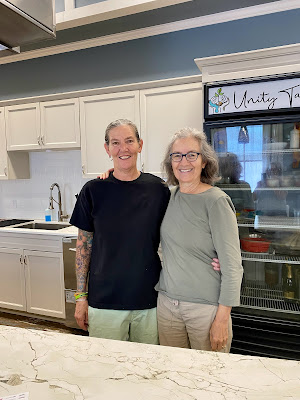 |
| The real Martha Hubbard in her kitchen with Lucy |
“How many contestants have you signed up?” asked Bettina.
“We started with six,” said Martha. “Several of them have backed out as the process continued so I’m afraid we’re down to three. I suppose it all sounds exciting to our home bakers to appear on television with the Scone Sisters, but the reality of competing over a week is a little harder. One woman couldn’t get the time off from her job. Another turned up with a recipe that was clearly lifted Word for Word from Cooks Illustrated, and the third was not sure that her husband would allow her to appear on camera.”
“Really?” Bettina had her hands parked on her hips. “I hope you urged her to leave that arse!” She clapped a hand over her mouth. “I shouldn’t say that in good company, should I?”
Martha grimaced. “I tried. She was really gifted too, and I told her she deserved a wide audience for her confections. When I phoned her to say she’d made the cut, she said she’d decided cooking and baking for her husband was reward enough. She waffled a bit, so who knows—she might show at the last minute.”
While we were busy unpacking the equipment and placing it on the counters where Martha suggested, the lights and camera crew arrived and began to set up. I felt a little bit nervous even watching how professional it all looked. But the Scottish ladies were taking it in stride.
“Don’t you get rattled in front of a crowd and these cameras?” Miss Gloria asked, leaning her elbows on the end of the counter as several bright lights were switched on.
“I was going to ask the same thing,” I said, and winked at Miss Gloria. “Comes from several years of living together I suppose, great minds and all that.”
“We were slightly bothered at the beginning,” said Violet. “But everyone kept telling us we were naturals, so after a bit we started to believe it.”
“All you have to do really is pay attention to what you’re doing—and we do know these recipes like old friends. Plus, ham it up a bit. We love giving our opinions about baking, and we love meeting the amateurs and showing them the ropes.” Bettina grinned. “Our motto is to be truthful but kind. They are the ones who are nervous as cats, and we’re so busy calming them down and trying to set the poor souls at ease that we forget about ourselves.”
“Besides, we are old ladies now,” Violet added. “What’s the worst can happen? Our lipstick smears or our hair is mussed? We don’t worry one bit about how we look in the camera.” She puffed up her gray hair and pooched her lips, now layered with glossy pink.
Even the sternest cameraman laughed. “Can we get a run-through please with the sisters?” he asked Martha.
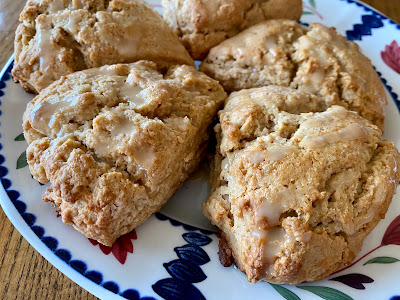
The ladies moved behind the expanse of white counter and began to lay out their ingredients. As they launched into describing their preparations for their prize-winning cinnamon scones, I saw my mother and Sam come in from the back entrance. I waved them over.
“They’re completely adorable,” my mother whispered when they drew close.
“They are too cute in real time,” I whispered back, “but don’t they light up the room when they’re in front of a camera?”
I watched as they smiled cheerfully into the camera, bantering with each other as they measured the flour, baking soda, salt, and sugar and then grated frozen sticks of butter into the dry ingredients.
“The cold butter is absolutely the secret.” Violet held a finger up to her lips. “We are sharing it here with you but please don’t pass it on.”
Bettina laughed, though she’d surely have heard her sister say that line many times. “Actually, we’d love it if you share it because we want everyone’s scones to succeed wildly. My sister thinks it’s the temperature of the butter, while I believe it’s the quality of the cinnamon. We did bring ours from the UK,”—she held up a small glass bottle—"but you can find good cinnamon lots of places in your country. Don’t settle for something that has been at the back of your cupboard for years. Don’t take a chance on a store brand either. You want your flavor to pop!” She clapped her hands together and mimicked the sound of a pop by smacking her lips.
The two of them stirred the grated butter into the dry ingredients, added a bit of milk and kneaded the dough lickety-split into a nice circle.
“Another secret,” Violet said, facing her sister again, “is not to overwork the dough. Nobody will mind one bit if it looks a little lopsided as long as the scones or biscuits rise high and taste flaky and delicious. Which they will if you keep that light hand, and remember your butter must be good quality, too. We of course prefer Scottish or Irish butter but do use whatever best quality you have here. Organic, unsalted, if you can.”
“She’s right for once,” Bettina added. She clapped the flour from her hands. “If you overwork the dough, you will produce curling stones instead of fluffy scones.”
They began to laugh hysterically at their own joke.
Lucy here again. I would love to hear your thoughts about characters you remember as distinct, and what stood out about them?
Also, on another subject, for those of you who’ve read UNSAFE HAVEN, I would be very grateful if you’d leave a short review—wherever you talk books. Thank you!