 JULIA SPENCER-FLEMING: When reviewers talk about Sarah Stewart Taylor's Maggie D'arcy series, they use words like, "lyrical," "tender," "atmospheric," and "intricately plotted." And there have been a lot of reviewers - the first in the series, THE MOUNTAINS WILD, appeared on almost every Best Of list in 2020. They're calling the third in the series, THE DROWNING SEA, "rich and gothic," "gorgeous" and "heartfelt."
I'd describe the Maggie D'arcy books as novels with mysteries in them, which isn't to detract from the cunning twists and turns that unfold organically throughout the story! Rather, I read them as much for the characters, and for what the books say about love, family, difficult relationships, and coming to terms with the past.
Which brings us to today's topic! Sarah has been thinking and researching and digging into the past, and has discovered some of the most compelling questions arise from our own family histories. Who were you? Where did we come from? And how did we get from there to here?
 In my new Maggie D’arcy mystery, The Drowning Sea, Maggie,
an American homicide detective who is spending the summer in Ireland with her
daughter and her Irish boyfriend and his son on a remote West Cork peninsula, goes
to see the place where her grandmother once lived before emigrating to America.
She thinks about ancestors and legacies and mysteries and wonders why it was so
important to her to stand on the piece of ground where one branch of her family
tree began to grow.
In my new Maggie D’arcy mystery, The Drowning Sea, Maggie,
an American homicide detective who is spending the summer in Ireland with her
daughter and her Irish boyfriend and his son on a remote West Cork peninsula, goes
to see the place where her grandmother once lived before emigrating to America.
She thinks about ancestors and legacies and mysteries and wonders why it was so
important to her to stand on the piece of ground where one branch of her family
tree began to grow.
Maggie’s experience mirrors my own visit to the spot in West Cork where my great-great grandfather and his family lived before he emigrated to Boston. My own visit was the reward at the end of a lot of genealogical sleuthing. I knew that my mother’s maternal ancestors were named McCarthy, and that her great-grandfather Michael had emigrated from Ireland, as a young child at the height of the Great Famine, I’d been told. But most of the details of his early life had been lost to the years.
 I discovered through newspaper
archive research that Michael served in the Union Army in the Civil War, trained
as a doctor, and married a Boston woman whose family had also immigrated from
Ireland. He died young, only a few months after his only child, my
great-grandfather Charles, was born. (Charles would go on to attend Harvard
College and Harvard Law School and become Chief Justice of the Idaho Supreme
Court. Another family mystery is how his widowed mother, a seamstress,
marshaled the resources for his education.)
I discovered through newspaper
archive research that Michael served in the Union Army in the Civil War, trained
as a doctor, and married a Boston woman whose family had also immigrated from
Ireland. He died young, only a few months after his only child, my
great-grandfather Charles, was born. (Charles would go on to attend Harvard
College and Harvard Law School and become Chief Justice of the Idaho Supreme
Court. Another family mystery is how his widowed mother, a seamstress,
marshaled the resources for his education.)
We didn’t know where in Ireland Michael came from or how he’d traveled to America. I spent almost a year following clues in documents on Ancestry.com, plugging in birth and death dates and one night, deep down a genealogy rabbit hole, I found a baptism record for Michael in the tiny townland of Shanacashel, Kilmichael Parish, West Cork. Eventually I was able to track down birth records for seven brothers and sisters. And I was able to find his naturalization records, which showed he actually arrived in Boston when he was twelve years old, in 1855, and not when he was four, as I’d been told.
.jpg) I’ve tracked down threads of the family story on
genealogical websites and in archives in Ireland and the U.S. But still hanging
out there is the mystery of how he got to Boston and with whom. Ship records
for the years he would have arrived are missing and the years between his
arrival in Boston and his discharge from the Union Army after the Civil War are
a complete mystery. I’m also fascinated by the idea of all of those brothers
and sisters back in Ireland. Did any of them travel with Michael? Where are
they now? While I’ve been able to locate some family members with whom I share
DNA through the Ancestry.com and 23 and Me, I haven’t had any luck tracing McCarthy
relatives in Ireland. But my visit to Shanacashel a couple of years ago was
satisfaction of a sort. It was surprisingly meaningful to stand on the piece of
Planet Earth where my great-great grandfather was born, but it also raised many
new questions for me, as it does for Maggie in The Drowning Sea.
I’ve tracked down threads of the family story on
genealogical websites and in archives in Ireland and the U.S. But still hanging
out there is the mystery of how he got to Boston and with whom. Ship records
for the years he would have arrived are missing and the years between his
arrival in Boston and his discharge from the Union Army after the Civil War are
a complete mystery. I’m also fascinated by the idea of all of those brothers
and sisters back in Ireland. Did any of them travel with Michael? Where are
they now? While I’ve been able to locate some family members with whom I share
DNA through the Ancestry.com and 23 and Me, I haven’t had any luck tracing McCarthy
relatives in Ireland. But my visit to Shanacashel a couple of years ago was
satisfaction of a sort. It was surprisingly meaningful to stand on the piece of
Planet Earth where my great-great grandfather was born, but it also raised many
new questions for me, as it does for Maggie in The Drowning Sea.
Speaking of DNA, chances are there are at least a couple of DNA mysteries lurking in my family tree, though I haven’t found them yet. With the sheer numbers of people contributing DNA to these databases, it makes sense that a growing number of crime novels center on genetic revelations. I’ve heard so many stories from friends about family mysteries uncovered through these sites, some with sad outcomes and some with happy ones. (I love SC Perkins’s genealogical mysteries and there are some other series that also take on secrets amongst the branches of family trees.)
 As I’ve gotten older, I’ve found I’ve only become more and
more interested in family history. I’ve also become more and more aware of my
own privilege in being able to find and put together at least some of the
pieces of the puzzle. For adoptees in closed adoptions, researching family
trees can be difficult and can open up difficult family history or lead to
joyful reunions. Many Americans can’t explore these family mysteries because
their ancestors were brought here enslaved or came as refugees or seeking asylum.
Records were left behind or have gone missing. So many stories have been lost
to trauma. When we explore one half of my husband’s family tree, we run up
against many lost threads representing his Lithuanian and German Jewish
ancestors who came here fleeing discrimination, pogroms and the Holocaust.
As I’ve gotten older, I’ve found I’ve only become more and
more interested in family history. I’ve also become more and more aware of my
own privilege in being able to find and put together at least some of the
pieces of the puzzle. For adoptees in closed adoptions, researching family
trees can be difficult and can open up difficult family history or lead to
joyful reunions. Many Americans can’t explore these family mysteries because
their ancestors were brought here enslaved or came as refugees or seeking asylum.
Records were left behind or have gone missing. So many stories have been lost
to trauma. When we explore one half of my husband’s family tree, we run up
against many lost threads representing his Lithuanian and German Jewish
ancestors who came here fleeing discrimination, pogroms and the Holocaust.
One of the most interesting mysteries in my family involves my ancestor Mary Perkins Bradbury, who was tried and convicted as a witch during the Salem Witch Trials. She was sentenced to death but somehow escaped (this is where the mystery comes in, though there was likely an exchange of money for her freedom) and, according to some accounts, traveled to Maine with her husband, where she remained until the worst of the fervor had passed in Massachusetts. This summer I’m planning on traveling to Salisbury, Massachusetts, near Salem, to see the site of the Bradbury home.
I’m looking forward to continuing to try to solve some of my family puzzles. What are the mysteries in your own family that you’ve been able to solve or are still exploring?
JULIA: I think Michael McCarthy's story would make a gripping historical novel, don't you, dear readers? Oh, and Sarah is giving away not one, not two, but THREE books - a signed copy of each of the Maggie D'arcy mysteries to three lucky commentors!
SARAH STEWART TAYLOR is the author of the Sweeney St. George series and the Maggie D'arcy series. Her most recent book, THE DROWNING SEA, will be out June 21st. Taylor grew up on Long Island in New York and was educated at Middlebury College in Vermont and Trinity College in Dublin. She lives with her family on a farm in Vermont where they raise sheep and grow blueberries. Visit her online at www.SarahStewartTaylor.com.
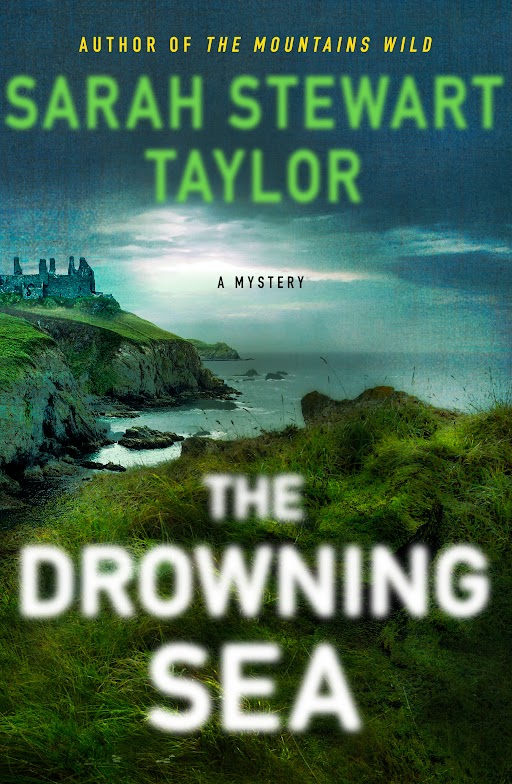 For
the first time in her adult life, former Long Island homicide detective Maggie
D’arcy is unemployed. No cases to focus on, no leads to investigate, just a
whole summer on a remote West Cork peninsula with her teenage daughter Lilly
and her boyfriend, Conor and his son. The plan is to prepare Lilly for a move
to Ireland. But their calm vacation takes a dangerous turn when human remains
wash up below the steep cliffs of Ross Head.
For
the first time in her adult life, former Long Island homicide detective Maggie
D’arcy is unemployed. No cases to focus on, no leads to investigate, just a
whole summer on a remote West Cork peninsula with her teenage daughter Lilly
and her boyfriend, Conor and his son. The plan is to prepare Lilly for a move
to Ireland. But their calm vacation takes a dangerous turn when human remains
wash up below the steep cliffs of Ross Head.
When construction worker Lukas Adamik
disappeared months ago, everyone assumed he had gone home to Poland. Now that
his body has been found, the guards, including Maggie's friends Roly Byrne and
Katya Grzeskiewicz, seem to think he threw himself from the cliffs. But as
Maggie gets to know the residents of the nearby village and learns about the
history of the peninsula and its abandoned Anglo Irish manor house, once home
to a famous Irish painter who died under mysterious circumstances, she starts
to think there's something else going on. Something deadly. And when Lilly
starts dating one of the dead man's friends, Maggie grows worried about her
daughter being so close to another investigation and about what the
investigation will uncover.
Old secrets, hidden relationships, crime, and
village politics are woven throughout this small seaside community, and as the
summer progresses, Maggie is pulled deeper into the web of lies, further from
those she loves, and closer to the truth.