Showing posts with label legal thriller. Show all posts

Saturday, January 29, 2022

In Her Defense--Breaking Up Is Hard to Do!


HANK PHILLIPPI RYAN: Right now, I am doing two things at once. One, I am worrying about the snow. (Are you all okay?)

Two, I am singing “come-a come-a down, doobie doo down down,” over and over, in my head. Thank you, Amy Impellizzeri.

(If you don’t know that song, lucky you, because the people who do have the ear worm now. Sorry, Reds and readers. (Look up Breaking Up Hard to Do by Neil Sedaka. Described in 1962 by AllMusic as “Two minutes and sixteen seconds of pure pop magic.”) Anyway.)


Amy Impellizzeri? Is one of the most amazingly innovative and energetic and talented people I know. She moves at a non-stop pace, writing best-selling fiction and non-fiction, being a leader at the Tall Poppies, doing TV book reviews on network TV, and generally being a fabulous person. You can see more in her bio, below.

Question for you: if you have a job that identifies who you are, what happens when you leave it? The fabulous Amy has been there, done that…and succeeded wildly. And she’s here to tell us how.
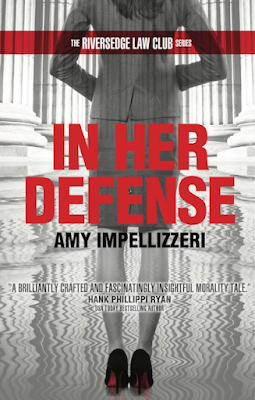

AND: a copy of her brand new IN HER DEFENSE (notice the shoes!) to one lucky commenter!


Breaking Up
    by Amy Impellizzeri


“I took a one year sabbatical from my New York City law career over a decade ago. And I’m still on it.”

I often start conversations with new friends this way. It’s my way of making light of a big transition, the after-effects of which continue to flare up on me even now.

I started out my professional life with only one goal: to be a lawyer. And then I continued my professional life with one more goal: make it to the top. When I got an offer to join the Mass Torts Litigation Department at Skadden Arps - one of the biggest law firms in the country, working on some of the most high-profile litigation at that time, well, I felt pretty good. 

I marched into the partner’s office at the smaller firm where I was cutting my litigation teeth at the time to give him the news. That partner looked at me sadly and said, “You’ll never be happy there.”

I was sort of shocked and very indignant. Of course I would be happy. It was more money. More prestige. I would be a Skadden lawyer. Just saying the words out loud gave me a kind of clout I felt certain would make up for any negatives. 

Ten years later, however, I was burned out from regularly working 80-90 hours a week, sleeping on the office floor, and evading the advances of, and sexual harrassment by, male counsel and partners. It wasn’t any fun to be a Skadden lawyer anymore. It wasn’t even fun to say I was one.

Just as my former mentor had predicted, I was not, it turns out, happy there.

But still, it wasn’t easy to leave. I didn’t run out the door. Instead, I applied for a one-year sabbatical and made plans for a temporary leave only. I didn’t pack up my office or take my degrees off the wall. I just turned off the lights and said: See you in a year. 

Leaving the law was, for me, in many ways, like leaving a relationship (albeit an abusive one). There was sadness, poignancy, emotional trauma, financial implications, and other practical considerations. I wasn’t prepared to break up with the law completely at that time.

I took the year to re-group. I was intentional, taking on projects that would help me decide what to do next. I did some pro bono work, some advocacy work. I worked with a start-up company that helped female entrepreneurs tell their stories and I attended Board meetings for a local non-profit. In a decision that would have some lasting effects, I reclaimed my voice and started writing again.

At the end of the year, I had started writing what would become my first novel and I had an offer to join the executive team of that start-up company. I was, in a word, happy. But still, I couldn’t quite cut ties with my lawyer identity and I asked Skadden if I could extend my sabbatical with a leave of absence. We decided a 3 year leave made sense.

By the time my three years was up, I had 2 book contracts, a new lease on life, and a new opening line when I’d meet new friends: “I’m still on my one-year sabbatical from Skadden. That I took 4 years ago.”

Each year, I’d change the line slightly, but not the message.

The message was and is: It’s a lot for me to admit I gave up my identity. My ability to say I’m a Skadden lawyer. Please be gentle with this information. Please be gentle with me. I’m not quite ready to break up with the law entirely yet.

This year, I have two books coming out with Wyatt-MacKenzie Publishing that will make that message even more clear. Or confusing. Depending on how you look at it.
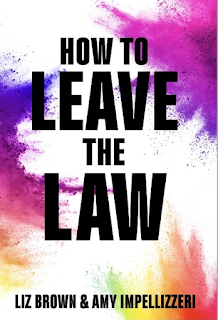

How To Leave The Law, is a non-fiction book co-authored with a friend of mine, Liz Brown, a Harvard Law grad-turned-Law-Partner-turned-Professor and will help aspiring and current lawyers learn how to turn their law degrees into tools for good.

In Her Defense, releasing May 3, 2022, is my first legal drama - residing at the intersection of courtroom drama and psychological suspense. It’s the first of a new series called the Riversedge Law Club Series, in which each book will have an unlikely heroine exposing the corruption and back door politics of her small town outside Manhattan (and Manhattan law culture itself).

It seems that more than a decade after I left the law, I’m not quite ready to break up with the law entirely. And maybe I never will be. But the law and my slow going transition from the law have both provided inspiration for storytelling and from that place, I finally can say to my earliest mentors: Don’t worry. I’m happy here.

What about you, Jungle Red Writers? Do you have a story of breaking up - with a job, a lover, or a best friend - that ended up inspiring you creatively in some way? Please share!


HANK: Oh, what a good question! (And I have certainly done that. Several long and eventually wonderful stories. But we’d rather hear yours!) And remember--a copy of IN HER DEFENSE to one lucky commenter!


Amy Impellizzeri is a reformed corporate litigator, former start-up executive, and award-winning author of fiction and non-fiction. Amy’s upcoming novel, IN HER DEFENSE ("a brilliantly crafted and fascinatingly insightful morality tale" - Hank Phillippi Ryan, USA Today Bestselling Author) releases May 3, 2022. She is a Tall Poppy Writer, past President of the Women’s Fiction Writer’s Association, a faculty member in Drexel University’s MFA in Creative Writing Program, and a frequently invited speaker at legal conferences and writing workshops. Connect with Amy at www.amyimpellizzeri.com.
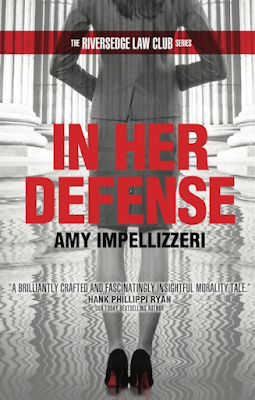


About IN HER DEFENSE


Ingrid DiLaurio lives in Riversedge, New York, four express train stops from Manhattan. Don't be fooled: With its tree-lined Main Street, and quaint ambiance, Riversedge is only impersonating a small town. While it's a place small enough for everyone to know each other's secrets, few do. The town revolves around the prestigious Riversedge Law Club, where deals are made and cases are resolved and where Ingrid DiLaurio -- a former lawyer turned nationally recognized podcast host - has never once been made to feel welcome.

When Ingrid's husband, Peter, is found dead, and Ingrid's former friend, Opal, is arrested as the prime suspect, the press quickly seizes on Opal's past as a single mom and stripper. Ingrid's first priority is protecting herself and her son, Drake, along with her business, from salacious gossip. But when Opal finds herself in desperate need of a defense lawyer, she tells Ingrid she wants to call in a "favor," and Ingrid reluctantly returns to the law for one last case.

As the trial unfolds, Ingrid realizes quickly that she has taken on more than she bargained for, including Opal's dark past, a corrupt judge, a blackmailing prosecutor, another dead body, and a black tinted car that follows her everywhere. In the end, it's clear that both women know more than they are letting on about Peter's death, but who will tell the truth first?

And is the truth what anyone really wants to hear?


Saturday, July 18, 2020

A True Legal Thriller


HANK PHILLIPPI RYAN: How often do we say it? Wow. You cannot make this stuff up. My dear pal Mike Avery--an astonishingly good lawyer and an astonishingly good person, talented and funny and wise--has spent his life doing good things. Winning big cases, and small ones, and all on the side of the good guys.

You will see one particular story about that below. It will take your breath away.

But then, after retiring from practicing and teaching, and when he  just as easily  might have rested on his considerable laurels (look at that bio!), he decided to write a book. Well, a novel, since he'd written groundbreaking non-fiction before.

And being Mike, he did not do it the easy way. He did it the right way. 
           
North End Justice
  by Mike Avery
 One afternoon in January 2007, I was standing with my client Peter Limone, admiring the Boston Harbor from the hallway of the U.S. District Court in Boston. The courthouse sits on the bank of the harbor and massive windows, a few stories high, showcase the boats drifting by and the Boston skyline. We were in court trying Peter’s case against the United States government, seeking compensation for the thirty-three years he’d wrongfully spent in prison. 

As the court ultimately found, Limone, who’d been a numbers runner before he was arrested, was framed by the FBI for a murder of which he was completely innocent. Federal agents covered up the fact that the murder was committed by Jimmy Flemmi, an FBI informant.

  For over thirty years the FBI was in partnership with stone cold killers in Boston, including Joe (The Animal) Barboza, Steven (The Rifleman) Flemmi, and the infamous Whitey Bulger. With the explicit approval of Director J. Edgar Hoover, the agents made deals, including sanctioning murders, with gangsters, mostly Irish, to go after gamblers and loan sharks, mostly Italians. It was one of the most corrupt chapters in the history of law enforcement in America.

Limone and three other innocent men were convicted in 1968 on the testimony of Joe Barboza, who committed the murder with Jimmy Flemmi, Steven’s younger brother. The FBI agents were warned of the murder the night before it took place by an informant, who confirmed a day later that it had gone down. 

The agents recorded all this in written memos, which never mentioned Limone or the other innocent men, but which identified the true perpetrators. These memos were buried in the FBI files. In the 1990’s Steven Flemmi was finally prosecuted on racketeering charges and defended himself on the ground that the FBI had assured him that he could commit crimes with impunity. The federal judge ordered the FBI to turn over its informant files and a special assistant U.S. Attorney furnished the relevant memos to Limone’s attorneys. Peter was finally freed in 2001.

 Peter swept his arm across the view of the water and turned to take in the courthouse and all of South Boston where it was located. “When they divided up Boston,” he said, “the Irish got all this. What did the Italians get? We got the North End.” He was saying the Italians had been cheated. But I knew he loved the North End. 

Down a side street you’ll find a square named after his brother Ninny. My son David and I joined the Limone family there one evening to celebrate St. Anthony’s Feast, held every summer. It came to me in the courthouse corridor that the North End would be a good setting for a novel, and the FBI’s criminal activities could be the basis for a plot.

 I’d always wanted to write a mystery novel. In my early years I read Mickey Spillane, Eric Ambler, Rex Stout, Dorothy Sayers, Agatha Christie, Graham Greene, Georges Simenon, and many others. More recently I enjoyed Robert Parker, Scott Turow, Patricia Cornwell, and Dennis Lehane. 

I wondered if I had it in me.
           
In 1998, after nearly thirty years trying cases as a civil rights and criminal defense lawyer, I’d closed my practice and become a professor at Suffolk Law. I had time to write. But between the law review articles for tenure, the legal treatises about evidence law and police misconduct litigation that I’d written for years that required annual updates, and two books about law and politics that I felt compelled to do for political reasons, there was no time for fiction. I managed a few awkward chapters, then set my fantasy of writing a mystery aside.

When I retired from the law school at age 70, my goal was to get better at writing non-fiction. The two books I’d attempted to write for a general audience were overly dense and technical. A friend told me about the low residence MFA writers’ program at Bennington. I applied and was accepted in the non-fiction genre. I was the oldest person in my class—the youngest was 25. 

I paid for my tuition with Social Security checks.

 Bennington let MFA students switch genres for one semester and on a lark, I moved over to fiction. I was so unprepared it was embarrassing. When I submitted a chapter of a potential novel to the workshop, everyone said, “You’re constantly jumping around and changing the point of view.” “Uh,” I said, “what’s ‘point of view’?” Fortunately, I had wonderful teachers and one of them, Stuart Nadler (Wise Men, The Inseparables) worked with me for over a year after that semester and went through the drafts of my novel twice.

 I used what the FBI had done to Peter Limone as a starting point. At first, I thought I was writing a story about a burned-out lawyer, Bobby Coughlin, who took court appointments to make a living and got in over his head in a high-profile murder case. 

I gave him a law student intern, Susan Sorella, with the idea that she would embarrass him into shaping up and eventually he would reform and save the day. That started to feel like a cliché. 

As I wrote, however, Susan took over the investigation into the murder and then took over the book. She was unstoppable. Susan became a real person to me as I struggled to get into her head. She developed a relationship with the mob boss, Frank Romano, who helped her battle with the FBI. Things got more interesting. Eventually I figured out how to end the story and then began the long and painful process of rewriting.

 This has been a difficult but rewarding journey. Starting a new career so late in life was hard but seeing the novel in print was a moment like no other. When I finally held my published book in my hands, I had to sit down to keep from falling over. These days Susan Sorella has passed the bar and is practicing law, still going to Frank Romano when she needs help. If The Cooperating Witness is well received, I’ll create a series based on her cases.


HANK: So you all know the feeling. A dear pal sends a book.  Want to read this? they ask. 


Ahhhhh, sure.You say. But in truth?  This is terrifying. What if it's terrible?

But yay. And whew. This book is terrific. Robert B. Parker meets John Grisham and that is no hyperbole. It's a gem.

So tell us--what's your favorite legal thriller? Or legal story? The best trial you ever watched? The most surprising thing you've heard about the law?

And ooh. What questions do you have for Michael? If you're writing a book with legal elements--lucky you. This is your guy. Ask away!


THE COOPERATING WITNESS
Suffolk Law student Susan Sorella is tending tables at her father’s restaurant in Boston’s North End when the head of the local mob pays her a surprise visit. What he tells her sends her on a mission to save an innocent man accused of gunning down the mob’s accountant.
Susan’s an intern for Bobby Coughlin, a burned-out defense attorney who cops his clients out faster than they can sign his retainer agreement. The judge, having dropped the accused trigger man in Bobby’s lap, is pushing for a quick guilty plea. Bobby wants to supply it before he has a nervous breakdown.
Susan has to battle Bobby’s fear of failure, his sexism, the State’s Attorney, crooked FBI agents, their homicidal informants, and a cooperating witness to get to the truth. She’s not a lawyer yet, but with her knack for digging up evidence and the wise guys on her side, she’s racing to get to the truth before an innocent man goes to jail.


Michael Avery is a freelance writer who lives in New Orleans. He writes nonfiction about law and politics. He produces fiction on a broader canvass and is interested in the problems of contemporary America.

Beginning in 1970, Michael enjoyed a career as a civil rights and criminal defense attorney over four decades, representing clients in jury trials and arguing cases in federal and state appellate courts, including the United States Supreme Court. His principal specialty was law enforcement misconduct. Michael and a team of lawyers obtained the largest award ever against the FBI for wrongful convictions, securing damages of $102 million for the families of four innocent men who were framed on murder charges by the Bureau. In 1998, he joined the faculty of Suffolk Law School in Boston, where he was a tenured professor, teaching Constitutional Law, Evidence, and related courses. In 2014 Suffolk awarded him the status of professor emeritus.

Michael graduated from Yale College in 1966 and Yale Law School in 1970. In 1968-1969, he was an exchange student at the University of Moscow, Recently, he returned to school and received an M.F.A. from Bennington College in January 2017.

He was the editor and a contributing author to We Dissent: Talking Back to the Rehnquist Court (NYU Press), a critical review of civil liberties and civil rights cases from the Rehnquist Court, and co-author of The Federalist Society: How Conservatives Took the Law Back from Liberals (Vanderbilt U. Press). Prof. Avery is co-author of Police Misconduct: Law and Litigation (West), a leading treatise on civil rights law, co-author of the Handbook of Massachusetts Evidence (Aspen), the leading treatise on that subject, and the author of the Glannon Guide to Evidence (Aspen), as well as several law review articles.

Michael has been politically active since the Civil Rights Movement and the Anti-War Movement of the sixties and seventies. From 2003-2006 he served as president of the National Lawyers Guild.
Follow him on Twitter: @profavery1


Friday, May 1, 2020

The Jury is: You!


HANK PHILLIPPI RYAN: To Kill A Mockingbird. Presumed Innocent. Defending Jacob. Twelve Angry Men. Oh, don’t even get me started. I adore legal thrillers, and devour them.

(And may I say? THE MURDER LIST was the NUMBER ONE legal thriller on Amazon this week. And here is the astonishing proof! Whoa. And um, now it is ON SALE! for 1.99. Whoa.)

But didn’t you adore Adam’s Rib? A Few Good Men. Compulsion. Witness for the Prosecution. Oh, as I said. Don’t get me started. But attorney/author Michael Kahn—welcome to Jungle Red!--has some faves of his own.

Great Legal Thrillers


by Michael Kahn, author of BAD TRUST: A Rachel Gold Mystery


"Do you ever wish you could write a real novel?"

Ah, yes. The Question.

Every writer of legal thrillers hears it. Usually served with a withering disclaimer, such as "I confess I haven't read any of your works" or "I'm just not what one might call an aficionado of the whodunit." As if the commandments Moses brought down from Mt. Sinai included, "Thou shalt place no Perry Masons before thee."

Welcome to the world of the literary snob, that rarified zone where the so-called genre fictions — mysteries, horror, romance — are the riffraff of fiction, grubbing out an existence in that noisy rock quarry far beneath that celestial realm known as "literature.” And no amount of examples from Erle Stanley Gardner to Scott Turow will convince our snob. That’s because, as he will snidely point out, you won’t find those books on the syllabus of any Great World Literature college course.

Okay. Let’s take him up on that claim. He may not realize that the legal thriller, with its courtroom clash of vivid personalities, compelling facts, and moral dilemmas, has inspired playwrights and novelists for centuries. 

Fictional lawyers and trials have played a significant role in literary classics since at least Geoffrey Chaucer’s 14th century masterpiece, The Canterbury Tales, whose cast of pilgrims includes the Man of Law. Others might point further back to the trial of Socrates in 399 B.C.E.

I’ve picked three of my favorite literary classics that use the courtroom as their dramatic engine. All three would make any snob’s list of great literature. The common theme in these three is a grim one: a courtroom is no place to seek justice, redemption, or satisfactory closure.

We readers watch from the courtroom gallery as the legal system grinds out injustice in the name of the law in these brilliant works of literature.

Bleak House by Charles Dickens

Bleak House is one of the greatest novels by one of the giants of English literature. It is also, in the words of one legal scholar, “the ultimate indictment of law, lawyers, and the legal system in the English language."
The engine of this novel is a massive trusts-and-estates case that has been slogging through the Court of Chancery for decades. In a novel filled with wonderfully Dickensian names—the money-grubbing attorney Vholes, the arrogant baronet Sir Dedlock, the sleazy loan shark Smallweed—it is fitting that the lawsuit’s name sounds more like a double dose of symptoms from a liver ailment: Jarndyce and Jarndyce.

The essence of what Dickens has to say about justice and the legal system is captured in the novel’s extraordinary first chapter—which, in my view, is the most vivid opening chapter in all of English literature. It starts with the equivalent of a Hollywood tracking shot through the streets of London on a cold and muddy November morning:

“As much mud in the streets, as if the waters had but newly retired from the face of the earth, and it would not be wonderful to meet a Megalosaurus, forty feet long or so, waddling like an elephantine lizard up Holborn Hill."


The sky is overcast, the city shrouded in fog, as we approach the Court of Chancery:

"The raw afternoon is rawest, and the dense fog is densest, and the muddy streets are muddiest, near that leaden-headed old obstruction, appropriate ornament for the threshold of a leaden-headed old corporation: Temple Bar. And hard by Temple Bar, in Lincoln’s Inn Hall, at the very heart of the fog, sits the Lord High Chancellor in his High Court of Chancery.”

Dickens then introduces us to the proceedings underway. He captures that lawsuit, every bit as foggy and dangerous as London itself, in one magical paragraph, which begins:

“This scarecrow of a suit has, in course of time, become so complicated, that no man alive knows what it means. The parties to it understand it least; but it has been observed that no two Chancery lawyers can talk about it for five minutes, without coming to a total disagreement as to all the premises.

Innumerable children have been born into the cause; innumerable young people have married into it; innumerable old people have died out of it. Scores of persons have deliriously found themselves made parties in Jarndyce and Jarndyce, without knowing how or why; whole families have inherited legendary hatreds with the suit.”

Finish reading that paragraph, and the rest of that enthralling first chapter, and you will be hooked.

Billy Budd: Foretopman by Herman Melville

The manuscript for this remarkable novella was discovered among Herman Melville’s papers after his death. Finally published three decades later in 1924, it’s now recognized as a masterpiece, second only to Moby Dick amount Melville’s works.

The pretrial plot is fairly straightforward: Set in 1797, the British Navy has been rocked by two mutinies. Billy Budd, a guileless young seaman, is impressed into duty by a warship in need of sailors as the Royal Navy struggles to confront Napoleon’s navy. The cheerful, innocent Billy, an orphan, is soon the favorite of the crew on his new ship. His only flaw: He stutters severely when under distress.

The malevolent master-at-arms, John Claggert, develops a hatred of young Billy, perhaps based on jealousy, and eventually accuses him of conspiring to mutiny—a profoundly serious charge in the aftermath of the other two mutinies. The ship’s decent and honorable captain, Edward Fairfax Vere, summons both men to his cabin, where he has Claggert repeat his false charge. Billy is literally rendered speechless—so upset that he is unable to respond to the accusation. The Captain, knowing the charge is false, tries to soothe him, but Billy, unable to speak, punches Claggert, who drops to the deck and dies.

Believing the law and the concern over the prior mutinies leaves him no choice, Captain Vere reluctantly convenes a drumhead court, i.e., a court martial held aboard a ship at sea. The trial, the jury deliberations, and the aftermath are among the most powerful and poignant scenes in all of Melville’s writings. Spoiler alert: the epilogue may make you misty-eyed as you read the words of the ballad sung by sailors around the world in memory of poor Billy.

The Merchant of Venice by William Shakespeare


The trial in Act IV of The Merchant of Venice has long been recognized as one of the most dramatic scenes in all of Shakespeare. It takes place in the Court of the Duke of Venice, where Shylock comes seeking to enforce a promissory note signed by Antonio, the merchant of the play’s title.

That note contains the infamous bond provision: If Antonio defaults, Shylock is entitled to the security pledged, namely, a pound of Antonio’s flesh. While that bond may seem absurdly grotesque outside the context of the play, by the time Shylock arrives in court he is by far the most complex and compelling character in the play, and the enforcement he demands makes sense within the play’s version of Venice.

Indeed, earlier in the play, when it appears that Antonio may default, one of Antonio’s friends asks Shylock why he would ever enforce such a bond. What is a pound of Antonio’s flesh good for? His answer, one of the most famous passages in all of Shakespeare, is “revenge”--revenge for the ways Antonio has abused him because of his religion:

“Hath not a Jew eyes? Hath not a Jew hands, organs, dimensions, senses, affections, passions?

Fed with the same food, hurt with the same weapons, subject to the same diseases, healed by the same means, warmed and cooled by the same winter and summer as a Christian is?

If you prick us, do we not bleed? If you tickle us, do we not laugh?

If you poison us, do we not die?

And if you wrong us, shall we not revenge?

If we are like you in the rest, we will resemble you in that.

If a Jew wrong a Christian, what is his humility?

Revenge.

If a Christian wrong a Jew, what should his sufferance be by Christian example?

Why, revenge!”

The great Shakespeare critic William Hazlett describes the courtroom scene in Act IV as “a masterpiece of dramatic skill,” explaining that “the legal acuteness, the passionate declamations, the sound maxims of jurisprudence, the wit and irony interspersed in it, the fluctuations of hope and fear in the different persons, and the completeness and suddenness of the catastrophe, cannot be surpassed."


Enjoy, in the theater or in one of the motion picture adaptations, including the most recent one with Al Pacino as Shylock.

So those are three of my favorite works of literature that qualify as legal thrillers. So here is my request: can you offer one or more legal thrillers from your own reading lists? Any language, any country, any century will do.

HANK: Oh, how wonderful! Loved reading this, and so wonderfully thoughtful. (Don’t you enjoy being here? Oh, we think about such wonderful things!) But I am in love with legal thrillers, as you well know, and listed above. I have left out SO many! So yes, Reds and readers, what are your favorites?

And hey--a copy of BAD TRUST to one lucky commenter, and THE MURDER LIST ebook to FIVE lucky commenters!


MICHAEL KAHN

A trial lawyer by day and a writer by night, Michael Kahn is the award-winning author of ten Rachel Gold novels (including his latest, BAD TRUST, the stand-alone novel THE SIRENA QUEST, another stand-alone novel THE MOURNING SEXTON (under the pen name Michael Baron); and several short stories.

His latest novel, PLAYED!, was published in July of 2017. As Kirkus Reviews wrote, “the spectacle of these ornaments of the Missouri bar attacking, undermining, and double-crossing each other provides brisk, sprightly entertainment, and the hapless defendant’s baseball background comes into play just when it’s most needed.”

A former elementary school teacher in the Chicago Public Schools, Mike wrote his first novel, GRAVE DESIGNS, on a challenge from his wife Margi, who got tired of listening to the same answer whenever she asked him about a book he was reading. “Not bad,” he would say, “but I could write a better book than that.”

“Then write one,” she finally said, “or please shut up. I don’t want to hear you fifty years from now telling your great-grandkids that you could have written a book.”

BAD TRUST

In this fascinating and fast-paced legal thriller, attorney Rachel Gold learns that family doesn't always come first...

An ugly trust fund dispute among siblings turns deadly when Isaiah, CEO of the family firm he stole from their father, is murdered in his office. St. Louis attorney Rachel Gold, hired to bring suit against Isaiah on behalf of his sisters, must now defend one against the charge of fratricide.

As Rachel and her team seek essential evidence, the widowed Rachel struggles with family issues of her own, including relationships with her young son Sam and her boyfriend Abe. The jury is still out on whether or not Rachel can create the work-life balance she is seeking.

Bad Trust, the 11th book in the fascinating Attorney Rachel Gold Mysteries, is the perfect pick for fans of Lisa Scottoline and Sara Paretsky.


.
..

Tuesday, August 20, 2019

Jungle Reds Celebrate Hank's Big THE MURDER LIST Day!


RHYS BOWEN: We Reds are having such a fun month. First we danced for joy when Hallie’s book, CAREFUL WHAT YOU WISH FOR, and mine, LOVE AND DEATH AMONG THE CHEETAHS, came out and now we have been counting down until Hank’s THE MURDER LIST. 

Well, dear readers, that day is finally here. We are so excited about this book. Already so many stellar reviews. So much buzz. It has to be a huge hit. And we decided to celebrate by making Hank the spotlight of our deep and meaningful questions:


HALLIE EPHRON: It seems like with every book, you push the envelope. Going deeper. More complex. More unexpected. What new turf are you tilling with THE MURDER LIST?

HANK PHILLIPPI RYAN : Here’s a funny thing.  So many of the marvelous and spectacular reviews (yay!) of THE MURDER LIST have called it character-driven, and wow, I love that. Hurray. But in fact, THE MURDER LIST came from the story. Then the characters, like Rachel and Jack, came to populate that story. And happily, they took over.

I was listening to my criminal defense husband discuss a murder case one day. One track of my mind was listening to his narrative, and the other track was thinking—wow, what a good guy he is. The authentic real thing—standing up for the little guy, protecting the rights of the individual against the vast power of the state and the prosecution, making sure the prosecution plays by the rules and that the trial is fair and just.

And then I thought--what does the prosecutor’s wife think about her husband? Certainly she things he’s a good guy—protecting the public, putting miscreants behind bars, keeping criminals off the streets, standing up for law and order.

So how, I thought, can everyone be a good guy? And I started thinking about good, especially when it comes to the justice system. And realized that everyone involved chooses the side they think is the good side. And then they fight it out to see which “good” wins.

And then added to that: the obsession with lawyers--sorry, Jonathan and all--to win. 

You ask a lawyer, “What’s a good case?” And they’ll say “Winnable.” So given that they all think they’re good, and that they all want to win—and they’re always always in a battle with each other—doesn’t that set up perfect conflict? And the question of how far someone might go to win?

And then add a newbie—a young lawyer wannabe who has to choose a side.

So I created law student Rachel, trying to figure out her legal life.  And her influences—her brilliant defense attorney husband and her new employer, the powerful prosecutor. Two sides, battling for the legal soul of this novice attorney.

At least, that’s what they think they’re doing.


LUCY BURDETTE:  Your books are mostly (all?) set in Boston, and they involve reporters and lawyers, all of which are close to home for you. How closely do you stick to reality, with settings and characters and plot?


HANK PHILLIPPI RYAN: Yes, they are all set around Boston at least, and yes they involve reporters and lawyers. I'm fascinated by how reporters and lawyers are required to think, seeing every possible side of every possible story, and then sticking to the truth they choose. 

Then, think how much what a reporter says in the story can affect a trial. And how much what a lawyer tells a reporter can affect that story. And yes, no one in my books, reporter or lawyer, does anything that a real person would not or could not do.

THE MURDER LIST, I have to say, is quite realistic. Terrifyingly so.

As for the settings, yes, part of the fun is making it authentic. Now I sometimes drive by places where events occurred in the murder list, and I think oh, that’s where Rachel and Jack first met for coffee. And then I laughed, and remember, oh, I made that up.

If a murder takes place in someone’s house, though. I make up an address or if there is a scene in a restaurant, I make up the restaurant.  Just in case :-)


JULIA SPENCER-FLEMING:  You dig deeper into the legal profession in THE MURDER LIST than you have in any other book, and you have expert help in the form of your husband! (For readers who don't know, Jonathan Shapiro is a VERY distinguished trial attorney.) But what's it like getting him to talk about the messy details of cases? Will Jonathan spill tea? Do you have to wait until X many years after a verdict before he'll disclose what REALLY happened?

HANK PHILLIPPI RYAN:   Well, I have to admit I am incredibly lucky to have having in-house legal counsel. We are also both lucky to have the framework of spousal immunity, and reporter-source confidentiality. Jonathan and I talk about absolutely everything about everything, with the understanding that some of it will never get past the kitchen table. Except very fictionally :-)

In THE MURDER LIST,  all the super conflict, and the super dynamics, and the super inside details, those are all based on reality. Sometimes I say to Jonathan: I cannot believe you have such an interesting life! And he says the same thing to me.  

But one caveat (!) there is a dashing handsome brilliant defense attorney in THE MURDER LIST, and people wonder if that actually is Jonathan. It most definitely :-) is not. Truly. Trust me. (Hmm. The more I say that the more you won’t believe me. But Jack is not Jonathan!  And I know you have read it, Julia, and I know you recognize that from page 1.)

The murders are not based on any real cases. And, though I worked hard to keep legal jargon at a minimum, all the details are authentic.


DEBORAH CROMBIE: Hank, which came first, wanting to be a reporter or a writer? What were your "aha" moments?

HANK PHILLIPPI RYAN  Oh, Debs, I never wanted to be anything but a lawyer or a disc jockey. Those were my basic ambitions. I kind of wanted to be a detective, too, like Sherlock Holmes. 

My aha moments, and there have been many, came more as a surprise then a quest. My mother always said I was incredibly curious, and she taught me, and I can hear her saying this, to “go and find out. “ so I learned how to do that.

I knew I wanted to be a reporter only after two weeks of being a radio reporter! I went home those two weeks, sobbing, because I had no idea what I was doing. Then one morning I went to the station and I thought wow, this is exciting. And I know how to do this! And I have been a reporter ever since then, 1971, can you believe it?  
Same with television… There was a learning curve, certainly, and then I fell in love with it.

As for investigative reporting, I totally remember that aha moment. I was interviewing the head of the water department from somewhere, and he said “we have no evidence of toxicity in our water.”
And I sort of looked at him, and said: “Have you ever tested for it?”
And he said no. And I thought: whoa. People lie. And I can find out the truth.

As a writer, the aha was when I had the idea for Prime Time. I had absolutely no doubt that would be a good book, and that I could do it. Silly naive me, right? But it turned out to be true.


JENN MCKINLAY:  What was your most embarrassing moment on air?

HANK PHILLIPPI RYAN:  Most embarrassing moment? Such a perfect Jenn question.  Oh, I have two big big big ones. 

One, when I was filling in for the weekend anchor person, and you know, one of the edicts in television is to just read the prompter. So at the end of the newscast, as I was mentally telling myself how good I was, I read the prompter. Which said  Thank you for being with us tonight, I’m Kate Sullivan, have a good evening.”

Which I read, out loud, on live TV. And then I realized, no, I was not Kate Sullivan.

Other one was when I was doing a big investigation into nuclear medicine. And one of the elements sometimes contained in those is krypton. But--I called it kryptonite. Much to the glee of all the scientists who called me to tell me that that was only in Superman.

What can we learn from this? ALWAYS have an editor who is smarter than you are.

RHYS:  And last from me. Everyone else was so literary and career-oriented in their questions. Mine is more mundane. I have always wanted to know about the nickname HANK. Who gave it to you and when? Did you choose it yourself? Are you happy with it? Do you feel it fits your personality? Has it been a help or a hindrance in your career? Have people thought you were a male? Any funny mixups? (I ask because Rhys is also a man’s name and I have been approached with Dear Mr. Bowen).


HANK PHILLIPPI RYAN  Oh, Rhys.  My real name is Harriet Ann. I loathed it, absolutely hated it. I was such a geeky nerdy kid, and Harriet just made it all worse, especially when all the cool girls were Debbie and Linda.  Then my first day of college in 1967, someone said oh, you don’t look like a Harriet, we’ll call you Hank. And it’s been that ever since.(I love Harriet now.)

Honestly? I think other people like it more than I do. If I had a choice, I might be Harriet again. And yes, if it weren’t for my picture on the books, it would be utterly baffling. Because unlike people who use initials, where there is always the possibility of being either gender, Hank is definitely a man. Until they meet me or see the picture. 

Interestingly, The UK version of TRUST ME comes out this Thursday — and my fabulous UK publisher wondered if there was another name I could use instead of  Hank. So in the UK, I will be at Anna Ryan. Cool, huh? I love it! And here is the cover of that book.


But here in the US, Hank it is.  I love it, though, in that it’s at least memorable. You never know what seemingly small decisions are going to change your life!


RHYS:   We are rooting for you and hoping for great things this week, my friend!

Dear readers, check out Hank’s signing schedule on her website. She has a HUGE tour!

And--not being pushy, but we're all pals: you can buy THE MURDER LIST here! 

And who has a question they would like to ask Hank? A signed copy of THE MURDER LIST to her one very lucky commenter!

Tuesday, January 30, 2018

Keenan Powell and the Good Things Jar #bookgiveaway

HALLIE EPHRON: I had the great pleasure of reading Keenan Powell's debut novel, DEADLY SOLUTION, and it's a corker! 

Who knew Alaska had mean streets? And the opening, set on one of those mean alleys, grabs the reader by the throat. In Chapter Two we meet a complex, prickly new crime fiction protagonist, attorney Maeve Malloy, and Keenan (an Anchorage attorney) is in her element. It's a seriously good read with compelling ideas to chew on and an ending I didn't see coming. 

So I'm delighted to welcome Keenan as a guest (and newly minted!) author on Jungle Red. She's a writer at the top of her game, talking about how one of life's unexpected complications made her stronger.

KEENAN POWELL: My grandson came to live with my last year, rather abruptly, and it was a period of adjustment for us all. He was twelve years old at the time.

I wanted him to feel my home was his home. So, with help from my oldest daughter, I transformed my periwinkle yoga room into a soft gray mancave, filled it with manly brown bunk bed set and decorated it with Star Wars posters.

He said he would like to wake up to the smell of frying bacon. Who doesn’t? So, I started making a fry-up every morning. Sometimes I’m frying up ground turkey in bacon grease because bacon every day is more sodium than I want in my body, but the smell is what’s important, right?

We created our own traditions, mostly around food because he’s a growing boy. Every Saturday morning, we go to breakfast at Gwennie’s Old Alaska Restaurant, which is stuffed with animal mounts and other Alaskana artifacts. After breakfast, I give him three quarters to drop into the wishing well in the middle of the restaurant which is designed to look like a gold miner’s panning site. 

This photo of Gwennies Old Alaska Restaurant is courtesy of TripAdvisor


Also, I started a “Good Things Jar” which is kept on the kitchen counter next to the coffee pot. The idea is to write down good things that happen on a slip of paper and put them into the jar. Then, if I’m feeling a little sad or stressed, I look at all the good things piled up in the jar. The grandson has joined in too. He’s thankful for the new Star Wars movie.

My notes in the jar include meeting Hank Phillippi Ryan at a Mystery Writers of America University in Seattle a few years ago, learning from her on Facebook about the Malice Domestic grant, winning the grant, using the grant money to go to Book Passages Mystery Writers Conference, consulting with Hallie Ephron and Rhys Bowen at Book Passages, and receiving invaluable critiques from them, and then going on to sign with Level Best Books

I have a lot to be thankful for, most especially the generosity of the mystery community.

One of the more recent notes in the Good Things Jar is the January 23, 2018 release of my debut, DEADLY SOLUTIONS. I was twiddling my thumbs in a continuing legal education seminar several years ago when the inspiration for this book hit me like lightening, demanded to be written and led me into this whole new wonderful world of a writer’s life.

HALLIE: We're so happy to welcome you, Keenan! 

Do you have anything like a Good Things Jar in your life? I don't, but I'm starting one now.

Keenan will be giving a copy of her book away to one lucky US-based commenter.

# # # # # # # # # # #
Less than a year after drinking sidelined her career as a public defender in Anchorage, Alaska, Maeve Malloy is asked to defend an Aleut Indian accused of beating another homeless man to death. With no witnesses to the crime and a client who claims to have no knowledge of the night of the murder due to a blackout, the case is stacked against them.

As Maeve works to maintain her sobriety, she and her investigator Tom Sinclair search for answers in homeless camps, roadside bars, and biker gang hangouts. When they uncover more than a few people with motives all their own for wanting the victim dead, they are determined to prove their client's innocence before he is sentenced to a life behind bars for a crime he swears he didn't commit.

When Maeve and Tom discover there may be a link to an unusually high number of deaths among the homeless community, the search is on for a killer hunting among the most vulnerable members of society.   
     
Keenan Powell was born in Roswell, New Mexico, several years after certain out-of-towners visited. Her first artistic endeavor was drawing, which led to illustrating the original Dungeons and Dragons when still in high school.

Her publications include Criminal Law 101 in the June 2015 issue of The Writer magazine and several short stories. She writes the legal column, Ipso Facto, for the Guppies’ newsletter, First Draft, and blogs with the Mysteristas.

She lives, and practices law, in Anchorage, Alaska. When not writing or lawyering, she can be found riding her bike, hanging out with her Irish Wolfhound, studying the concert harp, or dinking around with oil paints. Find her on facebook at www.facebook.com/keenanwrites