Showing posts with label memoir. Show all posts

Tuesday, August 29, 2023

THE BUTTERFLY CAGE: an interview with Rachel Zemach

JULIA SPENCER-FLEMING: We're just a few days from September, Deaf Awareness month, and we have a wonderful guest to kick it off for us. Diana Todd, a/k/a Bibliophile, is a long-time commentor here who is also part of the Deaf community. She offered to interview Rachel Zemach about her critically-acclaimed memoir, THE BUTTERFLY CAGE.

Diana and Rachel are also giving one lucky commentor the chance to win a signed copy of THE BUTTERFLY CAGE. Thank you, Diana!


DIANA TODD: So excited to introduce Rachel Zemach here on Jungle Red Writers blog.  Rachel was living in England with her sisters and parents, themselves authors and illustrators of children's books, when she suddenly lost her hearing at the age of 10.  She learned Sign Language at school in America after her family moved back to the States. She has written a memoir, THE BUTTERFLY CAGE, about her experiences as a Deaf teacher in a Deaf classroom at a public school.  

Welcome, Rachel!

Your poignant memoir, The Butterfly Cage is about your experiences teaching Deaf children at a public school and at a residential school where all of the students are Deaf.

How did you come up with the title "The Butterfly Cage"?


Rachel:  I was looking for a title, and I had just written two chapters:  one titled "Blood" and one (that I later deleted), that had a description of a time in my classroom when we had some butterflies hatch from caterpillars then released them. To our surprise, when they first came out of their cocoons, we saw spots of blood.  We thought they were hurt, but it was a natural part of their growth process.

The title "Butterflies and Blood" suddenly hit me and I was excited.  The beauty and tragedy combination reminded me of my experiences in Deaf Education.  Though there were mixed reactions to the title.  While some loved the title, others hated it and I eventually changed it to "The Butterfly Cage".  The metamorphosis the butterflies go through is like my students learning American Sign Language. The "cage" is the mainstream school.  The title fits better and sounds less like a horror flick.


What kind of challenges, besides the lack of American Sign Language interpreters, did you face since publishing your memoir?


Rachel:  Oh my goodness. The hard part is hiring a publicist or a book marketer who knows about book marketing AND who knows the world of the Deaf community. (It’s icons, values, major institutions, and resources).  I have not been able to find that, so either I work with hearing people, who have no knowledge of Deaf Culture, or Deaf people who have limited experience with marketing.  For me hearing publicist, fighting for me, and for my friends in the Deaf community to have access, including when I am on the radio, is a new experience.   It is a steep learning curve for outsiders.  

Another tricky issue is deciding whether or not to use my voice.  I do not want to alienate Deaf people but I do not want to rely on an interpreter to voice for me either. The ability to speak is a privilege for sure, but the decision of whether to do that does not come lightly at all.  I myself had the gut punch experience of seeing someone I’d always signing, suddenly speaking with their mouth.  It is a disconcerting and alienating feeling.  


A recurring theme in your memoir is about ableism.  Can you tell us a bit about that?  


Rachel: I loved that quote "I read books, not lips" by Brendan Stern, that you shared with me.  

 First, there is the unconscious assumption that speech, hearing devices, and being mainstreamed in hearing classes makes the person smarter and better somehow than if they sign and are in a Deaf class, or proudly Deaf-identified.  

Second, that same assumption is applied to Deaf staff members.

Third, is the lack of accountability the Administration and staff have with evaluating problems.   The assumption is always that being Deaf, or knowing ASL is the problem.  When in reality, the root causes are language deprivation due to families not being encouraged and required to learn ASL early on in their child's infancy. Also, poor quality of education, and the dearth of Deaf teachers in public, mainstream schools, which 85% of our students attend.


Speaking of families, I read about a couple who found out their baby was Deaf before it was born.  The hearing couple decided to learn ASL before the child was born, and they also made friends with other Deaf people.

 Rachel: WOW, that’s fantastic!


As a Deaf Author, what have you learned since you published your memoir in April 2023?  


Rachel: I have learned that marketing is a full time job!  It is totally worth it, just like all of the work writing the book was.  Also, do not write a book with the expectations of making money.  There are other rewards, including stunningly passionate and powerful letters from readers telling me how my book impacted them.  One feels more connected to the human race, in very positive ways.  

As a Deaf Author, I learned that the Deaf community are absolute champs about spreading the word about my book.  Even though I wrote the book for hearing people, I held firm to my principles.  When hearing editors wanted to remove the Deaf POV, I refused to do that.  It's always been clear to me that if my book did not earn the respect of the Deaf people— whom I respect—then I would not have done my job. I treasure their opinions.


You are organizing a dinner party.  Which writers, dead or alive, would you invite?


Rachel: Wow.  Tears sprang to my eyes at this question.  All of your questions are great.  My answer is not hard.  Paddy Ladd, Mary Karr, Mark Drolsbaugh, Ayelet Waldman, Sara Novic, Michael Chabon, Joyce Maynard, Jason Rezaian, Raymond Carver and Anne Lamott. And there are many more! I would also invite an ASL interpreter (or two).  I would also like to invite all of my brilliant Deaf and Deaf-adjacent friends who want to, or have started, writing their own books.  I want everyone to write books now, especially those who can help get the word out about the Deaf experience; to help hearing people understand what it is and what it is not.  

One word of warning about this dinner though:  I am not much of a cook.


THE BUTTERFLY CAGE

Joy, heartache, and corruption: Teaching while Deaf in a California public school

This book is tender, funny, surprising, and disruptive. You'll be a fly on the wall in a Deaf classroom in a public school, watching a Deaf teacher struggle with staff, administration, and aides who sabotage the teachers at every turn. You’ll also see the children struggle with a principal who removes their textbooks, a vindictive, power-hungry speech therapist, and a system that leaves them defenseless against it.

You'll also meet a language-hungry boy who will capture your heart and run away with it and the political, fiercely intelligent elite members of the Deaf community who rally to change legislation after his life takes a shocking turn. Learn from these true stories of individual students and their quirky, fallible teacher, what the deepest feelings and dilemmas of Deaf and hard of hearing people are, and why 90% of our students around the country are being unnecessarily set up for failure.

Rachel Zemach was hearing for half of her childhood, until an accident left her Deaf at age ten.  But it was not until later, over a ten year period when she taught Deaf classes at a hearing public school, that she began to identify as Deaf with a capital D.  Rachel Zemach's parents were also authors and illustrators of children's books. 


You can find Rachel's memoir, The Butterfly Cage here. You can find out more about Rachel at her website, you can friend her on Facebook, follow her on Twitter as @rachel_zemach and enjoy her Instagram posts at @mezemach.

Monday, April 4, 2022

What We're Reading


Some read, some in the wings

LUCY BURDETTE
: Dearest Reds, I hope you won’t think me dull for suggesting WHAT WE’RE READING for another Monday post! Even if you do, let’s go with it, because it’s my favorite day:). I’ve read some good ones lately… HONOR by Thrity Umrigar is a devastating novel set in modern day India, featuring an Indian-American woman sent to cover an assignment for her: a grisly crime in a village named Birwad on the Maharashtra-Gujarat border. Meena, a Hindu woman, and Abdul, a Muslim man, fell in love and married in defiance of the social proscription against interfaith marriage. Infuriated by the perceived dishonor she has caused to the family, Meena's brothers set them on fire in their home. There’s nothing light about this book, but it’s fascinating and well-written and shows sides of India that you might otherwise never see.


ALMOST FRENCH by Sarah Turnbull is the memoir of an Australian woman who falls for a Parisian man and moves to Paris to live with, and eventually, marry him. She describes the culture clash she experienced and her outsider's view of what makes French people French. Fed my Paris/France obsession until I can get back!


Alka Yoshi’s THE SECRET KEEPER OF JAIPUR, following her big hit THE HENNA ARTIST. This book is set on the gorgeous palette of India as well. Although Yoshi doesn’t shy away from conflicts of caste, family, and power, her books are less emotionally fraught than Umrigar’s.


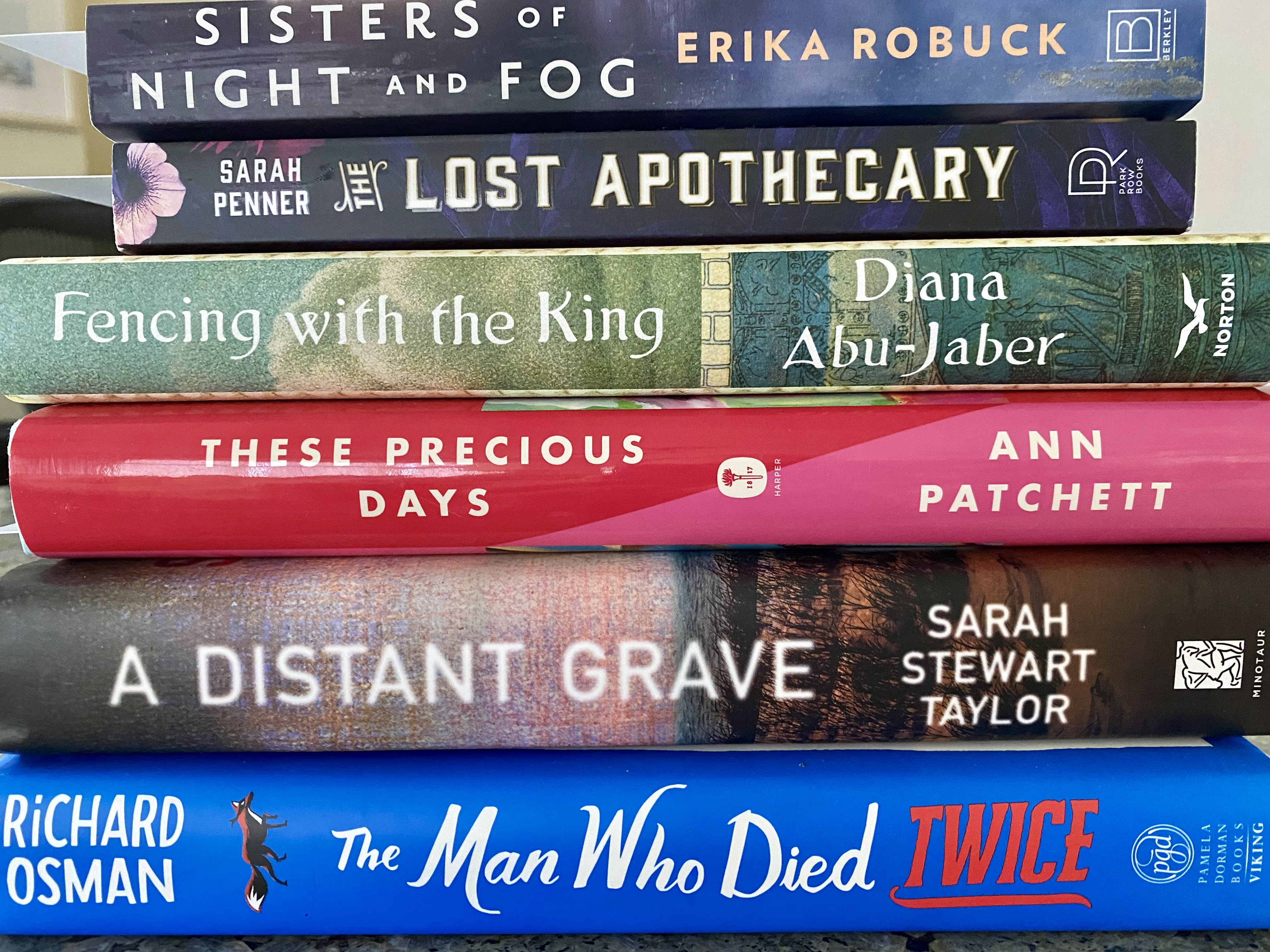
I also finished Sarah Stewart Taylor’s second Maggie D’Arcy novel, A DISTANT GRAVE. Even better than the first one I think, and now I can’t wait for another trip to Ireland in the third in the series, coming in June. At this moment, I’m reading THESE PRECIOUS DAYS by Ann Patchett. Essays aren’t usually my reading of choice, but Patchett’s writing is beautiful and her insights deep.


Looking over that list, I think I’m yearning to get back to traveling. What are you reading Reds?


JENN McKINLAY: My favorite book this year (so far) is David Goggins’s CAN’T HURT ME. Hooligan 2 loved it, so now I’m listening to it and what an amazing memoir. It’s impacted me so much that H2 and I are planning to run a 5K together!


As for fiction, I enjoyed Tessa Bailey’s It Happened One Summer a delightful romcom, featuring a king crab fisherman. I also adored an upcoming cozy mystery by Zac Bissonnette entitled A Killing in Costumes - Palm Springs and Hollywood collectibles - so fun!


And I’m reading Suze Orman’s Ultimate Retirement Guide for 50+ - not fun, but informative! As a person who has always seat of the pantsed her life, it seemed like time to prepare for when the hooligans graduate school and Hubs and I are “free”!


DEBORAH CROMBIE: My absolute delight the last few weeks has been discovering S.J. Bennett's Her Majesty the Queen Investigates series. I admit I was a bit skeptical–the queen as a detective? But a page into the first novel, THE WINDSOR KNOT, and I was absolutely hooked. Then I had to read book #2, ALL THE QUEEN'S MEN, and now will be eagerly awaiting the next adventure featuring Her Majesty the Queen and her assistant private secretary, Rozie Oshodi, and the rest of the wonderful cast.


Also, I think I was the only person not to have read Richard Osman's THE THURSDAY MURDER CLUB, but have now remedied that, and have also read THE MAN WHO DIED TWICE. These are absolutely delightful.


Now I'm counting the days until the new Ben Aaronovitch Rivers of London novel, AMONGST OUR WEAPONS, releases in a couple of weeks. I can't wait to see what's in store for Peter Grant and Thomas Nightingale in this one!


RHYS BOWEN: Lucy, I loved Almost French! So insightful as to how the French behave differently. I loved the scene when she goes to a dinner party and takes an hors d’oevre and gets looks of horror because you don’t start eating until everyone is present!

My latest book is Cara Black’s MURDER AT THE PORTE DE VERSAILLES. It’s #20 in the series, really good and suspenseful.


I’ve also read several non fiction biographies on WWII British women who became spies as I’ve sent my new heroine into horrible danger that I don’t really want to write about but have to!


HANK PHILLIPPI RYAN: It’s so wonderful to be doing the live Crime Time interviews for A Mighty Blaze not only to talk to the authors, but because I get to read so many books early. I cannot begin to tell you how I felt when I read THE VIOLIN CONSPIRACY by Brendan Slocumb. It’s truly life changing. 

 Lisa Scottoline’s WHAT HAPPENED TO THE BENNETTS is pure Lisa; a fascinating story and an insightful look at justice and ethics. She is so great. Lisa Jewell’s THE NIGHT SHE DISAPPEARED is amazing, a master class, so brilliant. And a book called MISS ALDRIDGE REGRETS has just arrived, by Louise Hare. It looks amazing. 

And pleeeese do not miss THE WOMAN IN THE LIBRARY by Sulari Gentill. Completely meta and brilliant. I keep using the same words–amazing, brilliant. Well, they are what they are.

JULIA SPENCER-FLEMING: I've been on a British literary kick, courtesy of a friend who passed a whole bagful of books on to me. I haven't tackled the Booker Prize winner (those always seem more like homework than reading, to me) but I've been enjoying the very funny MAN AT THE HELM by Nina Stibble, the adventures of two prepubescent daughters who decide their divorced mother needs a new husband to be accepted in the small village to which they've relocated after Daddy ran off with Phil from the factory.


 IN A GOOD LIGHT by Clare Chambers is a lovely slice-of-life character study about two siblings living together that moves back and forth to explore their relationship with each other and their circle of friends. Siblings must be my unofficial theme, because the next on my TBR list is UNSETTLED GROUND, which promises to be akin to what might have happened if the sisters from We Have Always Lived in the Castle actually had to relocate and face real life (without, presumably the mass murder and fire.)


HALLIE EPHRON: I've been bogged down with trying to downsize our ridiculously massive collection of books, and took time off to read Flann O'Brien's (Brian O'Nolan) THE THIRD POLICEMAN. He also wrote AT SWIM-TWO-BIRDS.) It was written in 1939 but not published until after the author died in the late sixties.

It's unlike anything I've read. Glorious language. Tongue planted in cheek. I'm taking it slowly in small doses.


HANK: I love how our reading is so different….!

LUCY: I love that too, Hank! And now Reds, we can't wait to hear what you're reading!

Sunday, August 2, 2020

Susan Cerulean's Single Bird


LUCY BURDETTE: I know I mentioned to you all a while back that my fabulous older sister, my Irish twin (11 months difference), would be launching a book in 2020. Well, yay! It's here and we get to host her. I HAVE BEEN ASSIGNED THE SINGLE BIRD is a memoir based on the years she spent caring for our father when he had dementia, and based on her devotion to caring for the natural world. It's a beautiful, thoughtful must-read book and I'm thrilled to welcome her...

SUSAN CERULEAN: One of the things that kept me going as a caregiver for my father during the years that he battled dementia were moments of unexpected kindness. A favorite encounter I remember was with a young nurse’s aide in my father’s assisted living facility, and that’s what I’d like to share with you today.

Afterward, I’d love to hear what kindnesses—expected and unexpected--have made the unbearable, bearable, in your own life.

Toward the end of my Dad's life, he became an unreliable narrator of his own life, and less able physically, than ever before. I had hired extra caregivers to be with him all day, every day of the week, whenever I couldn’t be with him myself. 


Still, I worried about the long stretch of hours, from 8 o’clock when our paid caregivers helped him to bed, until 8 in morning, when another returned. Other residents’ families whispered rumors of rough treatment at night; how was I to know if he was truly safe?
At 4 a.m. one morning, I was awakened by a nightmare in which my father was calling me and pleading for help. I slipped out of bed, pulled on my clothes, and drove the two miles to his residence. The facility’s massive front door was locked, so I sneaked through a low hedge of boxwood shrubbery, and let myself in through the kitchen. I hoped I wouldn't startle the staff. 

No one moved about the silent facility, but through Dad’s open door a triangle of light lit the hall. A young woman was making up his bed. She heard the door creak, and turned to face me. Her name tag read “Iclene.” She smiled at me, somehow unsurprised. 

“Your father’s bed was soaking wet so I got him up and changed him,” she said. “We check on them all night long.”

Dad was dressed in daytime clothes, resting in the recliner, awake and calm. Iclene bundled up the soiled sheets, and left the room. I crouched beside Dad’s chair, took his hand. “Iclene seems very kind,” I said. “How are you doing?” 

“Sue, ask her if there’s some food we could eat together for breakfast,” he said. 

I'd been wanting to meet Iclene. I’d been told she sang to Dad by the gas log fire in the living room, in the middle of the night sometimes, when he couldn’t sleep. I found her in the kitchen. She wore black plastic glasses, was very tall, and kept eye contact as we talked. 

While I unwrapped wheat bread to make toast, I asked her about herself. Iclene was 24 years old, a student of nursing at Tallahassee Community College, an employee at Dad’s facility, and a member of Bethel AME Missionary Church on Tennessee Street. “You'll find me there every Wednesday and Sunday night,” she said. 

The young woman stood very still, like a graceful forest animal, her hands folded together in front of her diaphragm, as if she were at that moment—perhaps in all moments--in prayer. And it was true.
“I pray for strength all the time,” she said. “I ask Him for strength. He gives me what I need.” 

The bread popped up in the toaster. Iclene reached in the industrial refrigerator for butter. 

“He got me this job,” she said, referring up to the ceiling, to God. So I know he'll give me the strength to do it.” I’d heard Iclene worked the 11-7 shift four nights a week. 


When I returned to Dad with his toast, he was dozing. I set the plate of food on a bedside table and slipped out the door. In the parking lot, a rim of light in the east caught me by surprise.

“Wheep,” called a great crested flycatcher from high in the pines.

As I drove home, I felt myself drop into peace. Confronted by overwhelming kindness, my fear for my father fell away.


Question: What kindnesses—expected and unexpected--have made the unbearable, bearable, in your own life?

--This essay is excerpted from I Have Been Assigned the Single Bird: A Daughter's Memoir by Susan Cerulean, published by the University of Georgia press and now available from your favorite independent bookseller.


Lucy again: We would love to have you attend our joint sisters event on August 9 at 5 pm, moderated by our own Red Hallie Ephron and sponsored by RJ Julia Booksellers in Madison CT. You will need to register here, but the event is free!


SUSAN CERULEAN is a writer, naturalist, and advocate who divides her time between Indian Pass and Tallahassee, Florida.  Her latest book, I Have Been Assigned the Single Bird: A Daughter’s Memoir (Georgia, 2020) will be released on August 1.  Sign up for her monthly newsletter at https://comingtopass.com/

You can also find her on Facebook and Instagram   


Friday, December 20, 2019

Cover Reveal: I Have Been Assigned the Single Bird @susancerulean


LUCY BURDETTE: Every guest is special to us, but I bet you will forgive me for saying it's especially special when my sister Susan Cerulean has book news to share. Her new book, I HAVE BEEN ASSIGNED THE SINGLE BIRD, will be out next August, but the cover is too spectacular to wait. So here it is, and here she is with an introduction and some pre-order links. And you'll see more of this next summer!


SUSAN CERULEAN: I am thrilled to join you as a guest of the awesome Jungle Red Writers! You're the first to hear of my new memoir, I Have Been Assigned the Single Bird, and I hope you'll be intrigued.

 My main line of work and writing has always had to do with wildlife and natural landscapes. These days there's so much bad news out there, regarding climate, regarding species extinction, you name it. So how can I draw in my readers to understand the root causes of these planetary issues, and hopefully be part of the change we need?

 In 2009, our beloved stepmother, Mary Jane, died unexpectedly. Our  80-year-old father, frail and in the early stages of dementia, had been placed in a  residential care facility close to her home in southern New Jersey. None of her five children and none of my  siblings lived close enough to be helpful on a daily basis.

How would we see to our father's care after his wife had died?  That's an issue that so many people can identify with these days.

Bob Isleib with Susan and Roberta

My husband and I volunteered to bring dad down to Tallahassee, Florida where we live and work. I knew my sister Roberta (Lucy) would be a strong support, so I didn't feel completely alone. However, the work of advocating and seeing to the care of someone who is ever so slowly, but inevitably declining due to the brain disease that would eventually end his life--that was far more than I understood at first.

One of the gifts of the four years that we had Dad very close by, was to see the links between my work as a conservationist and writer, and the work of taking care of a vulnerable elder.  As writers do, I took good notes of both kinds of care giving, and eventually realized that the two belonged together in a braided memoir. I'm so glad to share its upcoming birth with you! 

I wonder if all of you out there--writers and readers both--can think of two  apparently disparate parts of your life that could meld into a compelling memoir?

Pre-order from University of Georgia Press

Pre-order on Amazon


SUSAN CERULEAN is a writer, naturalist, and activist based in Tallahassee, Florida. Her most recent book, Coming to Pass, won the Florida Book Award for best nonfiction in 2016. 

Wednesday, October 7, 2009

In Her Wake---A Memoir and A Mystery


“A fearless memoir of loss and grief….veering between ‘being a detective and... a realist.
Publishers Weekly Starred Review


HANK: A delivery announcement on elegant paper stamped with the date of a daughter's birth; a tarnished silver baby cup, dented at the rim; a lovingly hand-knitted sweater; a school committee flyer; hurried grocery lists. This is all Nancy Rappaport had left to remember her mother--a woman defined by her absence.

In 1963, Nancy Rappaport's mother took a fatal overdose after a bitter public divorce and custody battle. Nancy was just four years old and the youngest of six children. Growing up in a blended family of eleven children after her father remarried, Nancy was bewildered about why her mother took her own life and left her behind.

Years later, encouraged by her own children's curiosity about their grandmother, and fortified by her training as a child psychiatrist, Nancy began to investigate her mother's life and the mysteries surrounding her death.

Nancy Rappaport, a child psychiatrist, is an assistant professor of psychiatry at Harvard Medical School and Director of School Programs at Cambridge Health Alliance. Her new book is In Her Wake: A Child Psychiatrist Explores the Mystery of Her Mother's Suicide. She says about her memoir, "Like any good mystery, this was a story that needed to be told. It was larger than me. It had a momentum to it . It's the most meticulous, painstaking, most important thing I've done."

Nancy and I met at a booksigning..and after I heard her story, I instantly wanted you all to hear it, too. Although its non-fiction, it's about as mysterious as life (and death) can get. Turns out: she had a haunting mystery in her own life--and as it turned out, it was one she was brave enough to try to solve. And where did the clues come from? That's what she'll reveal today.

NANCY: One morning during breakfast Phyllis, my father’s wife, phoned me. She told me that she was taking on a difficult initiative of her own making, which was to do the right thing, and she wanted to distribute some of my mother’s things to me and my siblings. She suggested that I might be too busy to come over on such short notice. But I had never even seen my mother’s handwriting before.

When I arrived, Phyllis had a blue trunk with brass hinges open and was meticulously organizing its contents into different boxes for each of my siblings—photographs, drawings, letters, all kinds of materials that my mother had saved. Seeing these objects stunned me.

“Where did the trunk come from?” I asked. Phyllis could see how momentous this was for me, but she focused on the task at hand. She explained that my mother’s friend Peggy Melgard had dropped it off at my father’s office several years ago when she moved from Boston to Florida.

I learned later from Peggy that for almost forty years Peggy herself had guarded the trunk. Alex, my mother’s new husband at the time of her death, had asked Peggy to keep some of their possessions. But Peggy never heard from Alex again, and she began to have the nagging feeling that my mother’s children would want the trunk. Peggy had known my parents before they were married and they saw each other socially as a couple for many years. After my father and mother divorced, she became an even closer friend of my mother.

Here was evidence of a life I did not know—small calendars with handscrawled appointments, a high-school yearbook, report cards, school awards, newspaper clippings, and chatty letters from her friends.

A photo of my mother cradling me as a baby in her arms. A photo of my mother and father, their eyes filled with laughter. Her handwriting—big and full. I sat down on the floor and picked up a letter that Phyllis had placed to the side of the trunk. It was from Peggy.

To the Rappaport Children:
Your mother cherished these photos, cards, notes, and drawings. I thought you would like to have them. Also, in the trunk, is a novel Nancy was in the process of writing at the time of her death.
The notes from those of you old enough to write at the time of her death show how much you loved her. I hope you still hold happy memories of her in your hearts as I certainly do.

Fondly,
Peggy


I looked up at Phyllis. “Where is the novel?” I asked, worried. She burst into tears and confided that she was reading the novel. She wasn’t exactly sure what to do with it, but she thought she would give it to my sister Judy, whom she considered the family historian. Finally, she sighed heavily and trudged up the staircase. A few minutes later, Phyllis came down not only with the novel, which she explained was over 400 typewritten pages on legal paper with my mother’s handwritten corrections in the margins, but also with a few of my mother’s thin journals.

As she handed me four bulky black folders stuffed with legal-sized paper, I sensed that she was relieved. She told me that she had a deep and abiding relationship with my father, and she wanted me never to use the material in any way that would hurt Dad. Not knowing what I was promising, quietly resenting that I was being asked to be honorable, and worried that the novel might be destroyed, I quickly agreed. It was an irresistible chance to know my mother’s mind. At that moment, I would have agreed to almost anything.


(Nancy's website--with some of the photos--is http://www.inherwake.com/ )