Showing posts with label miniatures. Show all posts

Thursday, August 10, 2023

How You Build it

RHYS BOWEN: I just had surgery on my ankle, which meant I had to keep my leg raised and I couldn’t go anywhere. What’s more I’d turned in my latest manuscript, Clare was working on the research for our next book together and I wasn’t ready to write anything new.

                I’m used to going to my health club to swim every afternoon and I was really missing that. What’s more the weather was unusually hot so I couldn’t really enjoy sitting on my patio or balcony. I was bored. I complained to my daughter Anne. The next day this kit arrived from her. This will keep you busy until you can go out again, she wrote.
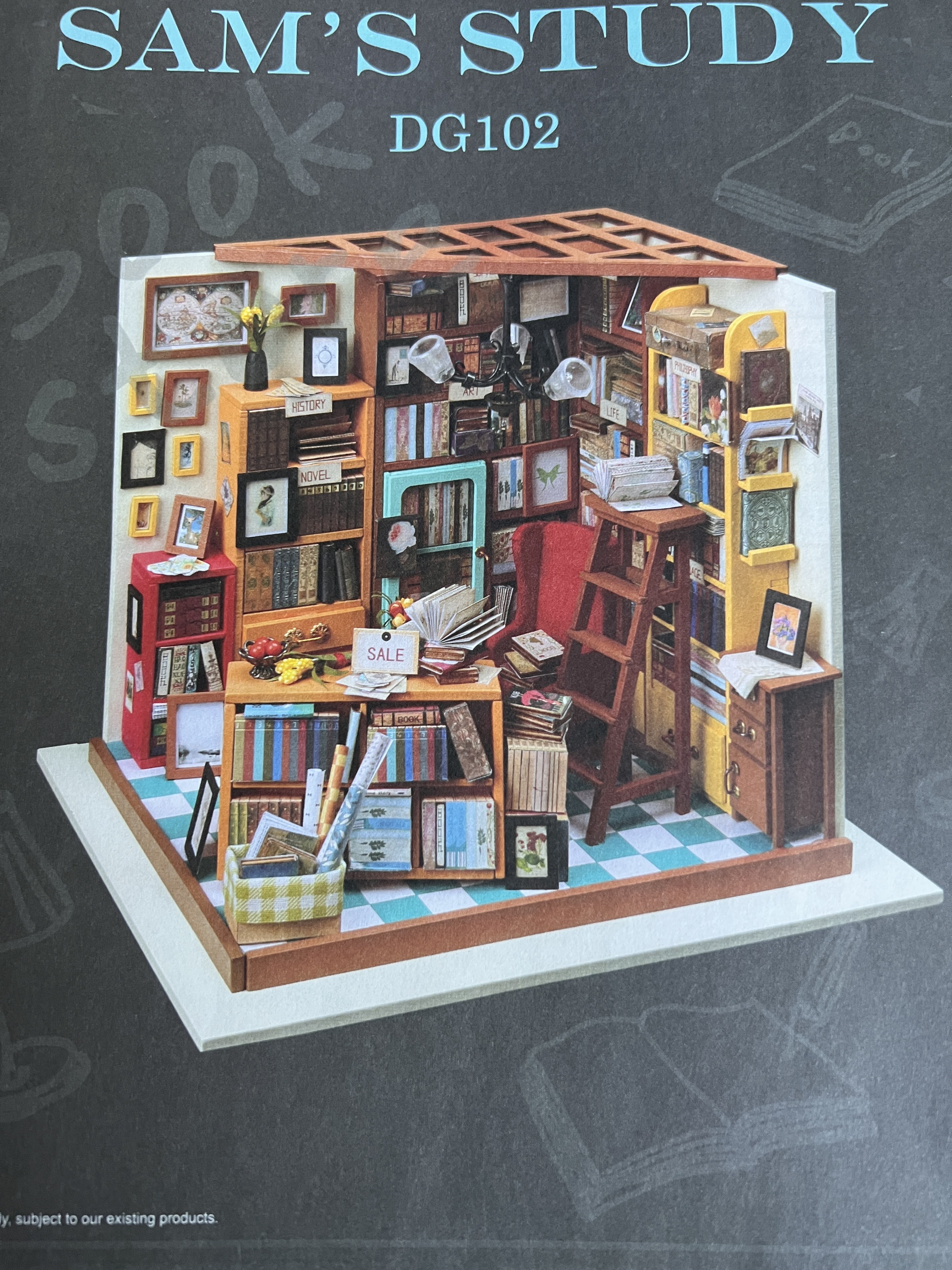
I stared at it in horror. Zillions of tiny pieces. Where did one even start. I unpacked bag after bag and found it no way logical. One bag did not contain the pieces for one shelving unit. 

I had to tip all the pieces out and sort them, hoping I’d got it right.  I almost gave up and thought it wasn’t worth the effort, then I decided, “I’ll make one cabinet, just to see if I can.”

So I did.

Then I thought, “I’ll make one book. Just to see if I can.” 

And I did. (The book is perhaps one fourth of an inch big and has all real pages)

Then I kept going…

And I realize that this whole thing is a metaphor for writing a book. I come up with a broad idea for a story: woman, tragedy in WWII, secret service, resistance, retribution after the war…

Then I try to pick out the details: who is she? Why is she? What little things, turning points, will happen and when?  I try and jot down notes. Why is she attracted to Giles? Why is he attracted to her? Are they happy? Is he a good husband?

And I realize I don’t know any of this. Nothing at all until I meet them, get to know them, and start to write. This is just like my miniature kit. So many interesting pieces but where to start? Overwhelming at first.

So I write the scene where they meet. And he starts talking and tells me things. And she tells me things. And I can move on.

I’ve made that first cabinet and book. I can do it, piece by piece. I start to build the world. I put in the framework of the kit and I know where the finished pieces will stand.


As I write my book gradually I see my way ahead. As soon as I get to know my characters I know how they will act and react to their world. And it starts to come together.  The way I work I can never see too far ahead. I could never write an ending before I can see how it will end. I have to learn to trust my characters, and follow them as they make their way through their world.

I’m already playing with ideas for my next book. Maybe the one in Jersey with a woman poet and a manor house and Paris before the war and the German occupation and… where and when to start, who is the hero/heroine? It all seems daunting until I think… build that one cabinet.

Who has tried to build miniatures? I think I may be hooked now. When you are working you have to concentrate so utterly that there is no room for thought or worry.

Sunday, November 22, 2020

Jane Willan on Miniatures and Murder


LUCY BURDETTE: I met Jane Willan at the Toronto Bouchercon a few years ago at a cocktail party where we had to shout to be heard over the din. She seemed so sweet, and when I heard she was a minister, my impression was confirmed. However, as you will learn from her post, she's as devious a mystery writer as they come. Welcome Jane!


JANE WILLAN: I love miniatures. Dollhouses, tiny tea sets, miniature horses (ok, those don't really count as miniatures, but there is no denying how cute they are). I especially love miniature books. And my love of miniature books is matched by my love of old books. So, when I discovered miniature incunabulum…well, you can imagine my excitement. 


Nothing like a fairy garden for sweet miniatures

An incunable is a book printed between 1450 and 1500. The name sounds strange, but in Latin, it means "baby clothes"; in other words, it was when printing was in its infancy. During this infancy period, printers not only produced a lot more books than ever before, but they also began to make books smaller and smaller; as small as one or two inches in length and diameter. One reason that printers made the tiny books was to show off their craftsmanship. The other reason though was that readers had started demanding books that they could carry around with them. 


A Miniature Book bound with tortoiseshell 

By Erik Lernestål - LSH 92297 (sm_dig8643), Public Domain


The most famous miniature incunable is The Book of Hours, printed by Nicholas Jenson in Venice in 1474. It is fully illustrated and contains entire prayers, gospel readings, and the liturgical office. The Book of Hours comes in at a whopping 3 inches by 2 inches. Perfect for any monk's pocket.


An excerpt from the Book of Hours. There were many editions of The Book of Hours. This one is a miniature from France. Attribution: Ghent University Library, CC BY-SA 4.0 <https://creativecommons.org/licenses/by-sa/4.0>, via Wikimedia Commons. No changes were made to this image.


One day when I was reading up on miniature incunabula, I came across another interesting fact. The paint used to illustrate the little books was mixed with arsenic. Yes, I said arsenic. Are you thinking what I am thinking? I began to feverishly read about arsenic use in 16th-century books and discovered that the ink on the pages remains dangerous even today-- five hundred years later. 

Suddenly, I was plotting a new murder for Sister Agatha. What could be more perfect? An Anglican nun, a rare medieval manuscript so small it could be slipped into a pocket, and best of all, the presence of arsenic. Sometimes things are just handed to you. 

Read all about it Abide With Me, Sister Agatha and Father Selwyn (#3).


A Miniature Horse. Super cute, right? 


ABOUT ABIDE WITH ME: The season of Epiphany is in full swing at Gwenafwy Abbey when ten new nuns from a convent in Los Angeles join the community of Anglican sisters. They bring energy, youthful enthusiasm, and more electronic equipment than Sister Agatha could have imagined. The arrival of the new nuns brings something else to the Abbey—a bit of unexpected notoriety. Claire Pennoyer, an ambitious young reporter for The Church Times, interviews the new sisters for a feature story. Murder is the last thing on anyone’s mind when Claire is found dead on the beach, her mobile phone in the sand. A tragic death, says Constable Barnes. A selfie gone bad. Meanwhile, Sister Agatha is unconvinced and puts on her detective’s hat. Clues abound including the mysterious discovery of a missing key baked into the king’s cake for the feast of Epiphany. Her tangled list of suspects includes everyone from the new sisters to Reverend Mother to the beloved archbishop of Wales. Worst of all are her worries about the abbey's beloved Shetland pony, Bartimaeus who may be reaching the end of a noble life. Time is running out as Sister Agatha uncovers a shocking reality. Will she reveal the truth hidden in an ancient document before it is too late?   

Join old and new friends in Abide With Me, Jane Willan’s blend of cozy village, sparkling humor, and enough action to keep you turning pages, the third book in the Sister Agatha and Father Selwyn mystery series. 


ABOUT JANE: Reverend Jane Willan is the author of the Sister Agatha and Father Selwyn Mystery series. As the pastor of the First Congregational Church in Paxton, Massachusetts, Jane finds writing clerical mysteries second nature. At First Congregational, she preaches from a 300-year-old pulpit once occupied by Puritans, teaches bible study, attends lots of meetings, and never misses a potluck dinner. Jane now lives in the church parsonage with her husband Don and two rescue dogs, Moses and Magi. When not working at her church or writing novels, Jane likes to drink coffee at her favorite bookstore, binge-watch detective shows on Netflix, and embark on not-too-challenging hikes with her husband and canine companions.


Wednesday, October 5, 2016

Modeling Life. A visit from the Multi-talented Camille Minichino

RHYS BOWEN: To call Camille Minichino a woman of many talents would be understatement. First she holds a PhD in Physics. That's impressive enough for someone like me whose entire knowledge of physics was how to find the volume of a lead ball.

But as a writer she wears many hats: she has published the Periodic Table Mysteries in her own name. As Margaret Grace she writes the Miniature Mysteries. As Ada Adison she writes the Professor Sophie Knowles books AND as Jean Flowers she writes the Postmistress Mysteries. The new one, Cancelled by Murder, is out this month, as is her latest Miniature mystery: Matrimony in Miniature.

I've always had a fascination for doll houses and I'm delighted to welcome Camille today for her thoughts on miniatures and life.

CAMILLE MINICHINO: Making miniatures (models of life) and writing fiction (also models of life) have a lot in common.
On my crafts table is a room box, about a foot on each side, newly painted and wallpapered, waiting to be furnished. On my computer is my latest novel, newly formatted and word-crafted, waiting to be furnished.

Adding a descriptive passage to emphasize a point in a scene is like dropping that tiny string of pearls onto m'lady's dresser in the Victorian mansion dollhouse. Cutting a paragraph from a chapter in a novel translates into removing a too-large scatter rug that overpowers the rest of the kitchen furnishings in a modern dollhouse.
I change a verb for a more powerful statement; I change the draperies in the dollhouse dining room for the same reason.
For a miniature scene or room box, after I choose the colors and assemble the pieces, I leave it on my crafts table for a while, living with it, looking at it from different angles over the course of a week or so, to be sure all the elements fit together nicely. Only when a particular design has stood the test of time, do I glue all the parts in place.
I do the same for my novels, leaving each chapter or day's work to sit for a while. When I come back later, I see what does or does not fit. I notice phrases or sentences or plot elements that don't work well together, and make the changes. Only then do I consider it "finished" and metaphorically glue it in place.
I have the most fun when I can combine my two favorite crafts, making miniature scenes and writing mystery novels. At writing conferences and meetings, I donate miniature scenes for charity auctions, often including miniature replicas of books that are featured on the panels. Here's one, put together for a recent conference, where the furniture is covered with pages of books and other publications. 

In each case—making a miniature scene or writing a novel—I'm creating a model of reality, a fictional world where things can be easier and often make more sense than in the life-size world.
I enjoy combining my miniatures hobby with the themes of my mystery series, not only the Miniature Mysteries.
Some samples:
• the funeral parlor above which Gloria Lamerino lives in the Periodic Table Mysteries;


• the post office where Cassie Miller reigns in the Postmistress Mysteries;
• and, of course, one of the many dollhouses Gerry Porter of the Miniature Mysteries has built, this one a crime scene as well. Someone has wrecked the house!


Another interesting aspect of making miniatures and writing fiction: Both endeavors involve cheating!
When I put a roof on a dollhouse, I don't have to worry about the materials really being weatherproof. Dollhouse admirers assume all will be well if it rains. When I move my characters about in a novel, I'm not concerned about filling their cars with gas or giving them a rest stop on a long journey, unless it's crucial to the plot. Readers assume the mundane things are being taken care of.
In the world of dollhouses and most fiction, there's no laundry to do, and a houseful of carpeting can be changed in a matter of minutes. In my mystery novels, the good guys always win and justice is always served.
What could be more satisfying?

RHYS: I love those little scenes you make for conventions, Camille. Does anyone else like making miniatures? I don't think I'd have the patience or precision. I tend to be like Lady Georgie and would drop glue on something.

So please stop by to welcome Camille, Margaret, Ada or Jean... she will give away a signed copy to one of today's commenters.