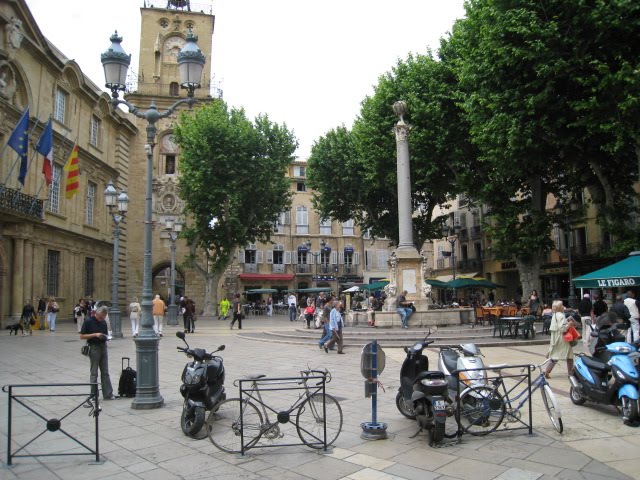
JAN: There were a lot of terrific things about spending a month in southern France. The food, the language, the art museums, the friends, the clothing sales.
But surprisingly, the biggest benefit was this: There was no Internet connection in the condo I was staying. To check my email, I had to walk to the school where I'd studied in college and use its library.
At first, I hated it. The streets were hot and it was all uphill. But soon, I realized it was a bonus. I was no longer spending my day responding to electronic information, but was out in city talking to real people. If I wanted to find a boulangerie open on Sunday, I didn't google it. I walked over to the little market where I bought roast chicken and asked the owner to help me.
So, I made an important decision while I was over there. That I don't care what the stakes are: I'd actually rather not be a successful writer if it means I have to spend my limited time on earth twittering. I'm also reassessing Facebook and all those strangers who friend me from California so they can sell me their novel or their winery.
So is this too radical? OR does anyone else think that all this social-media connection is disconnecting? And that possibly, the only way to reconnect is to disconnect?
ROBERTA: Right now I may be too sick with jealousy about your month in France to answer, but I'll try! If you read the interview from the publicist that Hank brought to us last week, you'd hear that Facebook is the most important social networking tool, Twitter maybe not so much.
But that aside, I definitely think there's a cost to the constant online connections. Maybe even more so with the next generation. I sound like an old fart, but it bugs me to see kids text-messaging while they're at the dinner table with other folks. If you're with people, you should be with them, right?
I think the question is definitely worth asking, Jan. Though I'm not convinced that Twittering can make a bestseller. Nor am I ready to renounce that possibility:). The secret is balance...if someone could only tell us how to find it!
RHYS: I can't believe how naked and lost I feel if I can't check the internet all the time. I even have to check my Google updates every day to see what people are blogging about me. It's a sickness, isn't it? And all those people from my past who friend me--they weren't ever my real friends. If we had little in common then, why would we now? I'm actually going to be experiencing total cut-off from electronic communication in September when John and I will be in the Australian Outback, visiting Uluru and Kakadu National Park and other such remote places. Will I suffer withdrawal symptoms? Probably. But it may be a good thing.
But surprisingly, the biggest benefit was this: There was no Internet connection in the condo I was staying. To check my email, I had to walk to the school where I'd studied in college and use its library.
At first, I hated it. The streets were hot and it was all uphill. But soon, I realized it was a bonus. I was no longer spending my day responding to electronic information, but was out in city talking to real people. If I wanted to find a boulangerie open on Sunday, I didn't google it. I walked over to the little market where I bought roast chicken and asked the owner to help me.
So, I made an important decision while I was over there. That I don't care what the stakes are: I'd actually rather not be a successful writer if it means I have to spend my limited time on earth twittering. I'm also reassessing Facebook and all those strangers who friend me from California so they can sell me their novel or their winery.
So is this too radical? OR does anyone else think that all this social-media connection is disconnecting? And that possibly, the only way to reconnect is to disconnect?
ROBERTA: Right now I may be too sick with jealousy about your month in France to answer, but I'll try! If you read the interview from the publicist that Hank brought to us last week, you'd hear that Facebook is the most important social networking tool, Twitter maybe not so much.
But that aside, I definitely think there's a cost to the constant online connections. Maybe even more so with the next generation. I sound like an old fart, but it bugs me to see kids text-messaging while they're at the dinner table with other folks. If you're with people, you should be with them, right?
I think the question is definitely worth asking, Jan. Though I'm not convinced that Twittering can make a bestseller. Nor am I ready to renounce that possibility:). The secret is balance...if someone could only tell us how to find it!
RHYS: I can't believe how naked and lost I feel if I can't check the internet all the time. I even have to check my Google updates every day to see what people are blogging about me. It's a sickness, isn't it? And all those people from my past who friend me--they weren't ever my real friends. If we had little in common then, why would we now? I'm actually going to be experiencing total cut-off from electronic communication in September when John and I will be in the Australian Outback, visiting Uluru and Kakadu National Park and other such remote places. Will I suffer withdrawal symptoms? Probably. But it may be a good thing.

JAN: You might be surprised how good it feels.
RO: I was looking forward to being disconnected in Africa. And I was..for the most part. I didn't rush to the internet cafe when I was in or near a hotel. There were more than a few e-conversations going on among people I know that I would have gladly left the country to avoid, if I hadn't been gone already. Then one night in a mud brick building in central Tanzania, I heard some buzzing. A giant mosquito? Nope. My Blackberry (which is all of three weeks old so I didn't recognize the sound.) I was able to pick up emails from underneath a mosquito net in Mvumi Makula. On one hand, I thought, you gotta love technology. Then I was reminded of the time that Bruce's boss found him on Lake McDonald just to tell him someone was leaving the company. Or the time we were in Granada and he got a fax that the company had been sold and he had to return home.I turned off the phone and went outside to look for the Southern cross.
HANK: Guilty guilty guilty. Rhys, I'm with you. I can literally *feel* when I haven't checked my email. I mean, that's--bad! I have to say I'm not a devoted Facebooker--I like it, it's fun, I learn intersting things. I love to read what my pals are doing. But I'm not addicted. And it is SUCH a time-waster. You feel as if you're doing something---you're typing, right? So it feels like working. But most often it's nothing. But not always. Wait--just gotta check one thing over there... Twitter..gosh. I'm just not sure it matters. But what if it does? Ah...back in a moment.
JAN: I think that's why we writers are so vulnerable. We THINK we're working.
HALLIE: Anyone take Psych 101? Pigeons who received INTERMITTENT reinforcement (they didn't get a food pellet every time they hit the button, but every so often) became much more addicted to hitting that button than the ones who were fed every time. That's what the Internet does. You don't get a nice new message every time you check, but often enough that you become addicted to checking. I've gotten to the point where I have to disconnect my cable modem in order to buckle down and write. And even then... Hope I never break down and get a Blackberry or an iPhone.