Showing posts with label Agatha Christie. Show all posts

Thursday, March 5, 2026

Agatha evergreen?


HALLIE EPHRON: I recently spent several evenings watching new adaptations of Agatha Chrstie novels: AGATHA CHRISTIE'S SEVEN DIALS (on Amazon) and WHY DIDN'T THEY ASK EVANS (on Britbox).

WHY DIDN'T THEY ASK EVANS starts as golf caddy and all around swell guy, Bobby Jones, witnesses a man plummet from a cliff onto rocks below. He gets to the body in time to hear the man say, "Why didn't they ask Evans," but too late to save him.

Bobby becomes embroiled in the investigation (was the man pushed?) with a shove from a plucky, smart, quintessentially Christie-an female sleuth, Lady Frankie Derwent.

It has an amazing cast that includes Hugh Laurie (who also directed it) and a cameo by Emma Thompson (I think she's Lady Frankie's mother).

What happens from there is so complicated that I couldn't begin to explain it, and in fact I was barely follow the lookalike identities, hulking mean goons, precipitous will, fancy estate with nearby mysterious mental hospital... I just went along for the smart talk and colorful ride... and waiting for Emma Thompson to reappear.

SEVEN DIALS is a locked room (with a fireplace mantle and seven... or was it six?) ticking alarm clocks that go off to tip the house residents that there's been a murder. Also featuring a plucky, upper crust, female sleuth (Lady Eileen "Bundle" Brent). Supporting cast includes Helena Bonham Carter as (I think) Bundle's mother.
I enjoyed both series, but the plot lines are SO COMPLICATED I don't even know for certain who did it for either series or why. Honestly the main thing I remember are the clocks of one and the reveal of who Evans is in the other.

Whodunnit? Not so much.

Which leads me to my question: Why are Agatha Christie stories so evergreen? Is there a "formula" and does it work today?

RHS BOWEN: Hallie, I’ve watched all of the recent Agatha Christie TV movies. They alter the plot and make them much more suspenseful and violent than the books. I really loved the original Why Didn’t the Ask Evans?” when I first read it but reading it again makes it annoyingly outdated. Her bright young things protagonists take stupid risks, get into households containing murderers, sneak into clubs full of people who would easily kill them. I suppose the world was a safer place in those days.

I remember reading Enid Blyton’s Famous Five when I was a child. I loved the books but again so unrealistic. They trap the smugglers in their cave and then men say “We’re sorry” instead of shooting the kids.

I’ve been quite a student of Agatha. I’ve written a couple of learned articles for books on her and even a piece for the Washington Post on Miss Marple. I think this is where she is at her best. The simple village murder, gentle sleuth, clever clues. All make reassuring and predictable reading. We know good will prevail. The bad guys will get caught. When she tries to move to a bigger canvas… more thrilleresque, she is no longer believable. Read the book of the Seven Dials. It’s quite good, apart from the risks they take.

DEBORAH CROMBIE: I watched an episode or two of WHY DIDN'T THEY ASK EVANS when it was first released, and I remember I thought the protagonists were cute. But then it got really confusing and unbelievable and I gave up. I think for the Christie adaptations I much prefer the Poirot/Marple series format as it seems they stayed a bit closer to the original books.

JULIA SPENCER-FLEMING: Oh, I have SO many opinions. First off, one of the things I love about all the various screen adaptations is getting more depth to the characters.

Dame Agatha was wonderful with her series sleuths (and no, I don’t need to find out about Miss Marples’ beau who died in WWI or Poirot’s dead lady friend who ALSO dies in WWI. People can just be single, folks.) But she’s not great at fleshing out the one-off characters, and those people really come alive with skill performers.

I also love the beautiful settings and costumes of the BBC adaptations of the past decade or so. They spend a lot of money and it shows, and they’re accurate with their period details. (Hallie, I turned off SEVEN DIALS after the first episode because the hair and clothing was such an inaccurate muddle!)

But some of the most faithful adaptations are the ones from the 40s through the 80s. Yes, the hair and clothing is usually wrong, but I don’t expect it to be; that wasn’t really a thing back then. Watch the 1981 THE SEVEN DIALS MYSTERY. I loved it.

JENN McKINLAY: Chiming in as the person who hasn’t watched nor attempted to watch any Christie adaptations–cynical me thinks they’re evergreen because Christie is evergreen as in “bankable”. I think the Christie connection means potential money maker to the studios but I could be wrong. I don’t think so but…

HANK PHILLIPPI RYAN: Oh, my goodness, thank you. I was beginning to doubt my brain cells. I tried to watch EVANS, really I did, and after about 10 minutes, I had NO idea what was going on. None. And I kept thinking, yeah, why didn't they ask him? Woulda been so much easier. I gave up.

As for Seven Dials that was RIDICULOUS because ((spoiler)) but I watched every bit anyway because Bundle is a wonderful name and she was fun to see. And the clothes.

And I think they are evergreen because on the page, at least, they are truly entertaining. And the dialogue is so wry. And from time to time, talking to you, Orient Express and Roger Ackroyd, they are truly spectacular mysteries.

It's odd, though, thinking about it now, because shouldn't they be EASIER to understand on TV? But sometimes, they aren't.

HALLIE: So what do you all think. There really is something special about Dame Agatha’s novels that continues to make them fodder for dramatization. But what is it??

Tuesday, August 19, 2025

Amanda Chapman--Mrs. Christie at the Mystery Guild Library

DEBORAH CROMBIE: I have been so excited to share this book with you all. This is the debut in a new series by Amanda Chapman, AKA our good friend Amy Pershing!! Just to show you how much I loved this book, here's what I wrote when I was lucky enough to read an early copy:

"Amanda Chapman's MRS. CHRISTIE AT THE MYSTERY GUILD LIBRARY has everything a reader could want in a mystery, including the ghost of Mrs. Christie, the queen of puzzle solvers.  Add a whopping good mystery, engaging characters, a little romance, glamorous New York, and you have the perfect cocktail. It's a sparkling, witty gem with heart, and I can't wait for the next installment!"

I predict that MRS. CHRISTIE is going to be one of the standout hits of the year. I asked Amanda/Amy how she came up with such a clever idea, and now I think I love it even more.


MRS. CHRISTIE AT THE MYSTERY GUILD LIBRARY by Amanda Chapman (aka Amy Pershing)

In Which the Author Tries to Justify Her (Over-) Imagination

Nobody picks up a book like MRS. CHRISTIE AT THE MYSTERY GUILD LIBRARY without wondering where this, shall we say, uncanny idea came from. So, a little background…

I blame my grandmother. With love, of course. But still, it’s all her fault.

My grandmother, Margaret Jane Pershing, was a woman of her generation. She dutifully raised three very obedient children while serving as wife to a not-very-obedient lawyer husband. But this was a woman who today -- with her drive and intellectual curiosity and (let’s be honest) bossiness – would be running a Fortune 500 company.

Instead, my grandmother turned this drive and intellectual curiosity (and probably the bossiness) toward becoming one of the foremost Emily Dickinson collectors of her day. In fact, her extensive collection of original manuscripts, letters, and other Dickinson ephemera are now housed in the special collections department of Princeton University’s Firestone Library. But that’s not the best part.

Margaret Jane was a collector with a twist. She made it her business to search out as many of the books in Dickinson’s personal library as she could in order to – as she explained it to her bookish nine-year-old granddaughter  “understand the poet's mind." In my (over) imagination (with which I am still blessed/cursed), I pictured her sitting down for little chats with Emily over lovely cups of tea, surrounded by the books treasured by the poet. That image never left me.

So when I turned my hand to writing “detective stories” (as Agatha Christie liked to call them), I thought, "What would happen if someone were to recreate Agatha Christie's personal library from her holiday home, Greenway House, and unwittingly opens a portal through which the Queen of Crime comes visiting?” (Or at least attracts a person claiming to be the Queen of Crime.) 


Well, in MRS. CHRISTIE AT THE MYSTERY GUILD LIBRARY, someone does just that – a certain Margaret Jane (of course) Van Dyne, grandmother (of course) to our book conservator heroine, Tory Van Dyne.  Granted, Margaret Jane does just that in New York City, but as it happens, Mrs. Christie’s father was born and raised in New York, and it was a city she had great affection for. So the city itself would certainly be an attraction. And the Christie Room? Well, here’s how Tory describes our (possible) portal:


 The Christie Room had been carved out of Grandmother’s second-floor drawing room overlooking the park. It was not only an architectural replica of the Greenway library, including faithful reproductions of its furnishings, it also housed copies—hunted down over years by my grandmother—of many of the more than four thousand volumes on the Greenway library shelves. These, of course, included Dame Agatha’s own sixty-six mystery novels (every one of which I had read, and in many cases reread, much to Grandmother’s delight), nineteen plays and two memoirs.

But the most interesting volumes, at least to Grandmother—whose goal was to plumb Mrs. Christie’s very mind—were the books used by the writer in her work, including, of course, Martindale’s Extra Pharmacopoeia, with its vast compendium of poisons. Or you could while away an hour or two with some other delight from Mrs. Christie’s rather eclectic collection. Perhaps a treatise on Buddhism or D. M. C. Prichard’s Commentary on the Laws of Croquet. I, though, was partial to the first edition of Robert Vermeire’s 1922 classic Cocktails: How to Mix Them


But cocktails aside (and, yes, cocktails play a large part in our story), would the Christie Room be enough to induce Agatha Christie to return to the land of the living?

I tried to imagine the author -- with her fertile imagination, her love of carefully working out whodunit -- lounging around in the Great Hereafter where everything is known. And all I could think was, “The woman would be bored to death.”   But what if her fertile imagination was needed to help a reclusive book conservator solve a murder (or two)? How could she resist?

Well, as it turns out, she can’t.

Here’s Tory being her initially skeptical self about her unexpected visitor:


Mrs. So-Called Christie leaned toward me. “I do realize, you know, that this is not actually my library.”

Well, hallelujah, I thought. Not totally crackers anyway.

“No?” I said neutrally.

“Of course not, my dear Miss Van Dyne,” she said. “This is merely a remarkably good approximation of my library at Greenway House.”

But still pretty crackers. We needed to move on. I was ready to get off the bus to Bonkersville. “Excuse me if this seems rude, Mrs., um, Christie,” I said, “but why are you here?”

“Not rude at all, my dear,” she responded graciously. “I’m here, of course, to help you solve a mystery.” So definitely still on the Bonkersville bus.

I took a deep, calming breath. Which again totally did not help. I had to ask. “What kind of mystery, Mrs. Christie?”

She didn’t miss a beat.

“Why, my dear Miss Van Dyne, a murder mystery, of course.”

     “But the fact is, I don’t have a complex murder for you to solve.” I very carefully did not say “help me solve.” If she wanted to solve a murder mystery, fine. But leave me out of it.

“Oh, but you will,” Mrs. So-Called Christie returned. “That much I do know. You most certainly will.”


And so MRS. CHRISTIE AT THE MYSTERY GUILD LIBRARY  was born.


DEBS: And luckily for us readers! I do think Amanda should come back to talk to us about the vintage cocktail recipes! I was fascinated by the vintage fashion, too.


Amanda Chapman is a lifelong mystery lover and wordsmith who estimates she has read all 66 detective novels written by Dame Agatha Christie, many of them more than once. (This is absolutely possible if you have been reading Mrs. Christie since you were ten.)  After graduating from Bryn Mawr College, she moved with her husband to New York City, where she worked as a book editor and occasional fashion reporter before taking on employee communications at a major financial services firm.  But when the writing bug hit, she cheerfully waved goodbye to Wall Street to write mysteries full time, including the Cape Cod Foodie mysteries under the name Amy Pershing. MRS. CHRISTIE AT THE MYSTERY GUILD LIBRARY is the first book in her Agatha Inc. mystery series.


Here's more about MRS. CHRISTIE:


Book conservator Tory Van Dyne and a woman claiming to be Agatha Christie on holiday from the Great Beyond join forces to catch a killer in this spirited mystery from Amanda Chapman.

Tory Van Dyne is the most down-to-earth member of a decidedly eccentric old-money New York family. For one thing, as book conservator at Manhattan’s Mystery Guild Library, she actually has a job. Plus, she’s left up-town society behind for a quiet life downtown. So she’s not thrilled when she discovers a woman in the library’s Christie Room who calmly introduces herself as Agatha Christie, politely requests a cocktail, and announces she’s there to help solve a murder—that has not yet happened.

But as soon as Tory determines that this is just a fairly nutty Christie fangirl, her socialite/actress cousin Nicola gets caught up in the suspicious death of her less-than-lovable talent agent. Nic, as always, looks to Tory for help. Tory, in turn, looks to Mrs. Christie. The woman, whoever or whatever she is, clearly knows her stuff when it comes to crime.

Aided by an unlikely band of fellow sleuths—including a snarky librarian, an eleven-year-old computer whiz, and an NYPD detective with terrible taste in suits—Tory and the woman claiming to be her very much deceased literary idol begin to unravel the twists and turns of a murderer’s devious mind. Because, in the immortal words of Miss Jane Marple, “murder is never simple.”


DEBS: MRS. CHRISTIE AT THE MYSTERY GUILD LIBRARY is out on the 26th, but I recommend you preorder so you can get it in your hands soonest, and you can do that here!


Saturday, July 20, 2024

My First Love by VM Burns

LUCY BURDETTE: I’m really excited to introduce my pal VM (aka Valerie) Burns to the Jungle Red family today! If you follow Mystery Lovers Kitchen, you will recognize her name. She cooks amazing southern food, and loves dogs, and has been getting all kinds of recognition for her multiple mystery series. You will love her blog today about what got her started in the world of mysteries. Welcome Valerie!


VM BURNS: I can trace my obsession with mysteries back to one author and one book. I grew up three blocks from my branch library and it became my home away from home. My best friend and I visited that small library at least twice every week. It’s there that I discovered my first Agatha Christie, The Murder of Roger Akroyd. That book blew my mind. When I got to the end, I can honestly say, “I didn’t see that coming.” The next day, I rushed back to the library and looked for another book by the same author. My librarian gave me, And, Then There Were None. I read the back cover, and I wasn’t sure this book would be as thrilling. I mean, ten people are on an island and they are each murdered. Obviously, the last one left standing would be the killer, right? Oh well, I had the book and decided to give it a try. HOLY COW! SPOILER ALERT, she kills them all!!! I should have known from the title, “And, Then There Were None,” but that little detail escaped me. Who was this woman with the diabolical mind who had twisted my twelve-year-old brain? The next day I went back to the library and grabbed every Agatha Christie book I could find. Thus, started my love of mysteries and my obsession/fascination with the Queen of Crime Fiction.


Agatha Christie is the bestselling author of sixty-six crime fiction books and 14 short stories. Her play, The Mousetrap, set a record for the longest-running play in London, running from November 25, 1952, until the theatre was closed due to the pandemic on March 16, 2020.

Christie’s style of manor house mysteries featuring nosy old spinsters or finicky Belgian private detectives may not be everyone’s cup of tea. Twenty-first-century readers may struggle not only with her sleuths but also with her prose. However, her plots are IMO brilliant. I re-read these books regularly. Each time, I see a clue or a red herring I missed previously. A Cup of Flour, A Pinch of Death is my twenty-first mystery. They say you never forget your first love, and that’s especially true in my case.


Do you remember the book/author that got you hooked on mysteries?


Valerie (V. M.) Burns is an Agatha, Anthony, and Edgar Award-nominated author. She is the author of the Mystery Bookshop, Dog Club, RJ Franklin, and Baker Street Mystery series. As Kallie E. Benjamin, Valerie writes the Bailey the Bloodhound Mystery series. She is an adjunct professor in the Writing Popular Fiction Program at Seton Hill University in Greensburg, PA. Born and raised in northwestern Indiana, Valerie now lives in Northern Georgia. Connect with Valerie at vmburns.com.


Tuesday, February 13, 2024

FATAL FIRST EDITION -- Jenn's Release Day!

BUY TODAY!


JENN McKINLAY: How much do I love this cover? Let me count the ways... 

As ever, Heathcliff the dog is featured and now Zelda the cat is as well. Maybe that's how you can determine the longevity of a cozy series. How many of the amateur sleuth's pets are on the cover? 

The artist Julia Green is always amazing and when I told the art department that the opening of the book is a murder on a train and that a train set with the dog would be cool...well, they delivered. I mean look at that cover. It's fabulous!

This book is my homage to Patricia Highsmith's STRANGERS ON A TRAIN mashed up with Agatha Christie's MURDER ON THE ORIENT EXPRESS. This mysteries really make you want to try train travel, don't they? 

But truly the entire plot came about when I decided it would be fun to have my characters meet up with the characters of my plot group buddy Kate Carlisle, author of the NYT bestselling Bibliophile Mysteries. Her amateur sleuth Brooklyn Wainwright is a professional bookbinder and it just felt like my librarian Lindsey Norris needed to meet Brooklyn. Of course, I spent months teasing Kate that I was going to kill off her characters (I could never, I adore Brooklyn) but when it was time to submit the manuscript, I sent Kate the relevant pages and she approved the cameo. Not gonna lie, it was a blast to write another person's characters, especially since I'm a super fan as well as a friend of Kate's.

Hey, here's a thought the Reds should all scramble books and write each other's mysteries...aaaaand, they all just keeled over in horror! LOL.

But seriously, what do you think about cameos of characters from other author's series, Reds and Readers? Yay or Nay? 


ABOUT FATAL FIRST EDITION


Tuesday, December 12, 2023

Solving an Agatha Christie Mystery with Celeste Connally

DEBORAH CROMBIE: I was lucky enough to read my pal Celeste Connally's ACT LIKE A LADY, THINK LIKE A LORD in manuscript last year, and I've been so excited for this book's debut. I knew it was going to be a smash and, indeed, the accolades have been glowing! Kirkus calls this Regency mystery "Effervescent...A delightful period adventure with pitch-perfect banter."  Publisher's Weekly says "Delightful...Petra is marvelously drawn―an easy-to-love, instantly memorable heroine―and Connally equips her with a brisk, page-turning adventure. This is catnip for historical suspense fans," and I couldn't agree more. Mystery fans will be enchanted with Petra and her adventures, but today Celeste has a different mystery to share with us.


Solving a Mystery in Agatha Christie’s Greenway House

By CelesteConnally

So, what was an author like me to do in October of 2022 when I happened to be in England for a research trip and I discovered my publisher termed my then-upcoming Regency-era mystery, Act Like a Lady, Think Like a Lord, as “Agatha Christie meets Bridgerton?” Well, I felt that it was only right that I should visit Greenway, Agatha Christie’s famed holiday home in Devon, England.


Okay, so I’d already planned to visit Greenway with my fellow author friend, Hannah Dennison—who lives in a lovely village in Devon full time—but this delightful tagline made me feel as if it wasn’t just a fun excursion, but also legitimate extra research. Because what mystery author (or mystery reader, for that matter, for I will always be both) wouldn’t feel inspired by being in the beloved getaway of the grand master of the British mystery?

And inspiring Greenway is. A beautiful, white, three-story Georgian house set on a hill above the banks of the River Dart, it is immediately obvious why it was so loved by Mrs. Mallowan—as Agatha Christie was known in her private life, having married Max Mallowan in 1930 after meeting him on an architectural dig. Greenway is large, but truly cozy, and it retains the air of a house that was beloved by the famous writer and her family.


In fact, I almost felt as if I might be greeted by Dame Agatha at every corner I turned as I went through the house and listened to the knowledgeable tour guides. That she might show off her lovely collection of pocket watches and postage-stamp boxes, her framed needlework scenes of fox hunts and horseraces (a particular favorite of mine), or take me into her invitingly open kitchen for tea.


For in my mind, Agatha Christie would just as easily sit in the kitchen and have tea as in the light-filled drawing room where she was known to read her manuscripts out to her family to see if they could figure out “whodunit” before she revealed the killer. I may be wrong on that, but that’s what I’m going to imagine.


And another place she loved on her property was the Boathouse. It’s situated on the gorgeous, curving River Dart, where sailboats float by and the banks on both sides are amassed with trees. It was in this boathouse where a part of Christie’s Dead Man’s Folly takes place, and visitors there can sit in the very chair Agatha Christie liked to relax in when she entertained friends by the water. As you can see in the photo, I absolutely took the chance to sit in her chair, holding a copy of Dead Man’s Folly in tribute!


But, of course, one of my favorite rooms in Greenway was the library. Boasting some five thousand books, which include subjects like gardening, poetry, travel, and a book I noted titled Famous Stories of Code and Cipher, it was a delight to see what Agatha Christie herself liked to read. Yet on the wall, where it meets the ceiling, is where I saw a bit of Texas that has been in Greenway since World War II. And that is where I helped solve a little mystery…even if it might only have been for one tour guide and my fellow admirers that day of Christie and Greenway House.

While Greenway was used early on in the war to house children evacuated from London, from 1944 to 1945 it was also requisitioned by the U.S. Coast Guard. During that time, Lieutenant Marshall Lee, who was also an artist, painted a frieze on the uppermost part of the wall depicting the journey of his Coast Guard flotilla. On a painted ribbon that undulates beneath depictions of the flotilla’s journey, you can read the towns and ports where Lee and his fellow Coast Guardsmen spent time, including Houston and Galveston, Texas; Norfolk, Virginia; Bermuda; Morocco; Algeria; Tunisia; Sicily and Salerno, Italy; Gibraltar; and Falmouth in Cornwall, England, and Dartmouth in Devon, England.


But at the very beginning of the ribbon of port names was the word Orange, and our lovely tour guide—who had been giving tours for many a year—told us she’d never known the significance. That is when I held up my hand and explained that Orange is a small town in Texas, right on the border with Louisiana.

Our tour guide was happy to finally know this, and through the power of the internet, I later discovered that Orange, Texas—which is located along the Sabine River that flows down to the Gulf of Mexico—served as a shipbuilding base where naval destroyers were built for the war effort. And thus, that was where Lieutenant Lee’s flotilla truly began their journey. The journey that took them, and all the Coast Guardsmen on each boat, all the way from a small town in Texas, through the horrors of WWII, to Devon, England, and Agatha Christie’s beautiful house.


I have no doubt that Dame Agatha discovered this about Orange, Texas, when Greenway once more became the Mallowan’s treasured family holiday home after the war. She certainly liked the frieze enough to allow it to stay on her library walls and delight guests to this day! But I also enjoy imagining that she would have approved that I, a mystery writer from Texas (who writes about England), helped solve a little mystery—even if it was only for one otherwise extremely knowledgeable tour guide—while I was visiting and being inspired by the house she routinely called “the loveliest in the world.”

DEBS: This is so fascinating! Greenway has been on my bucket list for ages (so jealous!) and I've read about it, but I did not know about the frieze! I love the Texas connection--who'd have thought it? I love that Dame Agatha loved it.


Celeste Connally is an Agatha Award nominee, and a former freelance writer and editor. A lifelong devotee of historical novels and adaptations fueled by her passion for history—plus weekly doses of PBS Masterpiece—Celeste loves reading and writing about women from the past who didn’t always do as they were told. You can find her on Instagram and Facebook at @celesteconnallyauthor and at celesteconnally.com.


Bridgerton meets Agatha Christie in Act Like a Lady, Think Like a Lord,a dazzling first entry in a captivating new Regency-era mystery series with a feminist spin from Celeste Connally.

London, 1815
. Lady Petra Forsyth, daughter of the Earl of Holbrook, has made a shocking proclamation. After losing her beloved fiancé in an accident three years earlier, she announces in front of London’s loosest lips that she will never marry. A woman of independent means―and rather independent ways―Petra sees no reason to cede her wealth and freedom to any man now that the love of her life is gone. Instead, she plans to continue enjoying the best of society without any expectations.

But when ballroom gossip suggests that a longtime friend has died of a fit due to her “melancholia” while in the care of a questionable physician, Petra vows to use her status to dig deeper―uncovering a private asylum where men pay to have their wives and daughters locked away, or worse. Just as Petra has reason to believe her friend is alive, a shocking murder proves more danger is afoot than she thought. And the more determined Lady Petra becomes in uncovering the truth, the more her own headstrong actions and desire for independence are used against her, putting her own freedom―and possibly her life―in jeopardy.

DEBS: Who has visited Greenway--or has it on their wish list? I do love that drawing room. I could spend many an hour just imagining myself having a cuppa or a glass of sherry!


Saturday, October 7, 2023

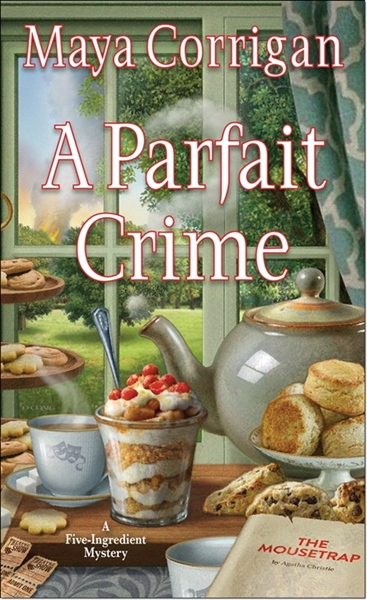
FATALITIES AND FLOOR PLANS by Maya Corrigan

Congrats to Sherry Brown, the winner of A PARFAIT CRIME!

LUCY BURDETTE: I love the way Maya Corrigan has studied the work of Agatha Christie and then figured out how to weave what she learned into her newest book--I bet you will find this fascinating as well! Welcome Maya!


MAYA CORRIGAN: Thank you, Lucy, for hosting me on Jungle Red Writers. I appreciate the chance to talk about my upcoming mystery, A PARFAIT CRIME, and about Agatha Christie. A community theater production of her long-running play, THE MOUSETRAP, is at the center of my 9th in my Five-Ingredient Mysteries. Set in a quaint Chesapeake Bay town, the series features café manager Val Deniston and her recipe columnist grandfather – a sleuthing duo that shares a Victorian house, a love of cooking and eating, and a talent for catching killers. A PARFAIT CRIME comes out on October 24th. Here’s a taste of what’s in the book.

At the site of a fatal blaze, Val’s boyfriend, a firefighter trainee, is shocked to learn the victim is known to him, a woman named Jane who belonged to the local Agatha Christie book club—and was rehearsing alongside Val’s grandfather for an upcoming Christie play being staged for charity. Just as shocking are the skeletal remains of a man found in the freezer. Who is he and who put him on ice? After Val is chosen to replace Jane in the play, the cast gathers at Granddad’s house to get to work—and enjoy his five-ingredient parfaits—but all anyone can focus on is the bizarre real-life mystery. When it’s revealed that Jane’s death was due to something other than smoke inhalation, Val and Granddad retrace the victim’s final days. As they dig into her past life, their inquiry leads them to a fancy new spa, where they discover that Jane wasn’t the only one who had a skeleton in the cooler...

Most mystery readers know that Agatha Christie has sold more books than any other fiction writer. She also holds the record for the most enduring play in London theater history. THE MOUSETRAP opened in 1952 and is still going strong. (photo credit Ji-Elle, CC BY-SA 4.0 <https://creativecommons.org/licenses/by-sa/4.0>, via Wikimedia Commons)


Decades ago I had the chance to see the play twice in London. I remember its scary moments and stunning climax. After each performance, then and now, the audience is asked not to disclose the surprise ending to anyone. I’ve abided by that rule. A PARFAIT CRIME does NOT reveal whodunit in Christie’s mystery.

To prepare for writing my book, I read and reread Christie’s playscript. It begins with a long description of the one and only set: the sitting room at a guesthouse, where a snowstorm has marooned the characters with a murderer in their midst. Christie describes twelve pieces of furniture, some made of “good oak” and others looking “shabby and old-fashioned.” She also specifies what’s on the walls, the desk, and the table.

Christie was used to “stage setting” in her mysteries. Her early books include diagrams, complete with furniture, to help readers visualize the crime scene. Her first Poirot book, THE MYSTERIOUS AFFAIR AT STYLES (1920), contains sketches of the bedroom where the victim dies and the layout of nearby rooms where the household members and guests sleep. Illustrations of the crime scene and a floor plan also appear in THE MURDER OF ROGER ACKROYD (1926), the blockbuster book that made Christie famous.


The first Miss Marple book, MURDER AT THE VICARAGE (1930), includes, not just sketches of the crime scene and the house plan, but also a map of the St. Mary Mead village. In later books Christie provides the seating plan of an airplane where an in-flight murder occurs. Her famous train mystery shows the layout of a sleeping car, with the characters’ names on the compartments they occupied the night of the murder. Besides orienting readers to the setting, Christie’s diagrams contain clues . . . and sometimes red herrings.

Though I’ve never put house plans or room sketches in my books, I’ve created them as a reference for myself. When I was writing the first Five-Ingredient Mystery, I looked up Victorian home plans and modified one to design the house that Val shares with her grandfather. For other books I sketched the layouts of places my sleuths visit, like the hotel where a mystery festival is held in BAKE OFFED (2022).

As Val and Granddad try to solve the murder in A PARFAIT CRIME, they don’t just attend rehearsals, they also go undercover at an upscale spa to trap a killer who has committed the perfect crime. Two sleuthing locations meant two floor plans—one of the 1950s motel that had been converted to a high-end spa and the other of the theater’s stage and backstage for the big “reveal scene.” Neither visual is in the book, but I couldn’t have written the mystery without those plans in front of me.

READERS: Have you read any mysteries with images of house plans or maps? If so, did they enhance the story or help you solve the mystery?

WRITERS: Do you create floor plans or diagrams as you write? Have you included any in your books?

I’ll give away a signed copy of A PARFAIT CRIME to one person who comments.


Maya (Mary Ann) Corrigan writes the Five-Ingredient Mysteries featuring a café manager solving murders in a Chesapeake Bay town with her live-wire grandfather, the Codger Cook. Each book has five suspects, five clues, and Granddad’s five-ingredient recipes. Before writing mysteries, Maya taught college courses in writing, literature, and detective fiction. When not reading and writing, she enjoys theater, travel, trivia, cooking, and crosswords. Visit her website, for recipes, fun food facts, and mystery history and trivia.

Blog: https://mysteryloverskitchen.com

Facebook: https://www.facebook.com/mayacorriganbooks/

A PARFAIT CRIME is available for preorder now as a paperback or ebook

Publication Date: October 24, 2023

Visit Kensington Books for Buy Links and to read an excerpt

Monday, April 17, 2023

Revising Agatha Christie

 RHYS BOWEN:  We’ve all been talking about the revisions that have taken place in the works of several known literary figures recently.  Their works are being altered to conform to current sensibilities, creating debate over how much we should try to reform the past and whether we have the right to do so without permission of the author.

In Agatha Christie’s novels terms like ‘oriental, gypsy and native’ have been removed. Ian Fleming’s books are being scrubbed of racist and sexist phrases. (can you picture Bond girls wearing plaid skirts below the knee and suggesting a game of ping pong to James?)

We’ve all read about Roald Dahls books with adjectives like fat and ugly being taken out as well as references to skin color.

So is this a good idea? Is the aim of literature not to offend anybody? Are most readers not wise enough to think “this is how it was in the past. People were more racist/sexist.”  

I’ve just experienced this myself in the last round of edits for my upcoming Royal Spyness book. I too have had to remove words like “natives” even though I know that a person living in 1936 would have used them. The one occasion I dug my heels in was when an explorer says he was chased by tribesmen across the desert. No, they were not local inhabitants. They were Bedouins. Tribesmen.

In one of my books, set in Kenya, I had to write a foreword to explain that this was how the British colonials treated the natives  local inhabitants in those days, even though we find it offensive today.  How else do we know exactly how it was? How else do we learn?

My feeling is that books are supposed to invoke emotions in us. We are supposed to feel rage about Oliver Twist asking for more in the orphanage. We are supposed to feel rage and weep when we read Uncle Tom’s Cabin. Books should be learning experiences.  When you read about what some of my characters had to endure in WWII you should feel that war is never a good idea.

So how far do we go with this cleansing of anything that could offend? Does Oliver Twist now live a happy children’s home? Does Fagin, that kind old man, take the children out for fun walks where they sometimes find a handkerchief fallen from a pocket?  I personally do not do well with violence in books. So no torture scenes from now on. No on page killing please. Every murder must be neat and sterile.  And what about bad language. Some readers get offended at four letter words. So are drug dealers now going to have to say, “Please go away, you naughty policeman?”


What do you think, Reds? Do you think we should purge books written long ago so that they conform to current sensibilities? Don’t you think readers can rationalize that this is how it was and even learn from past mistakes?

HALLIE EPHRON: I think… it’s complicated. When viewed from my more (what?) privileged viewpoint it looks one way. When I try to put myself in the shoes of someone who is arguing for the changes? No, I still don’t get it. But then…Coincidentally I recently managed to get my hands on a copy of a play my parents wrote; it ran on Broadway for a year, a hit, starting in 1944. It’s about a young couple who have a baby during the Depression and have to move in with her parents. Other relatives move in, too, and chaos ensues. It’s a farce  with the baby as a Whoopi cushion. 

Here’s the thing: It’s totally racist. There’s a Black housekeeper who is SO stereotyped it’s horrifying. Yes it’s a period piece. No amount of rewriting can make it palatable to today’s audiences. And my parents, old Lefties, thought they were liberal and racially tolerant. 

So, like I say, it’s complicated

JENN McKINLAY: I’m a recovering librarian so I am not down with censorship of any kind. And, yes, purging old books of anything offensive is censorship. How can we measure the progress of society if we take away the starting mark? I understand that some will argue that those original works promote racism, misogyny, homophobia, and xenophobia, etc., but I believe it’s the opposite. I don’t believe they promote these things so much as they call them out by their mere existence.

I remember reading the opener of a John D. MacDonald book where Travis McGee slaps a woman (she was hysterical, of course, she was) and I thought nope, and yet, I kept reading because it was published in 1965 and I knew it was a reflection of the time in which it was written. Could we go back and erase the slap? Sure. But again, how does society improve if we don’t have an accurate reflection of ourselves from which to grow? My other core belief, as a librarian, is that a good library has something to offend everyone. So there’s that.

LUCY BURDETTE: I’m with Jenn and Rhys here–we should not try to fix what’s already written as those books are an important part of our history. It’s a different matter if an author wants to rewrite something, or for that matter, if a publisher denies a book because of racist/sexist/anti-LBGTQ language. I’m so worried about the growing trend toward removing books from schools and libraries–this feels like part of that. BTW, Hallie, you must have been horrified to read that play from your parents!

JULIA SPENCER-FLEMING: I’m just going to point out that announcing you’re going to publish an “updated, non-offensive” edition for an old book is a terrific way to get an enormous amount of unpaid publicity, and I’m cynical enough to suspect the opportunity to get everyone talking online and in print about your forty-year-old intellectual property might have something to do with these recent efforts - which, you’ll notice, are always announced by the publisher. Think of the sales - from people buying the original “before it’s gone,” and buying the “modern” version in order to either support it or tear it apart. Providentially, every company putting out bowdlerized versions of these classics has said it’s also going to continue selling the original. 

Anyone else notice this? Or do I simply have a low, suspicious mind?

DEBORAH CROMBIE: Yikes, it is complicated. I start out being incensed at the idea of "re-writing" (censoring!) books that some people may now find offensive, and then I think that with my white, middle-class, Protestant identity, is that just me shouting out my privilege? But cleaning things up is a slippery slope and if we start down it, where does it end? Who gets to be the final arbitrator? And shouldn't we be aware of the changes in society's norms and perceptions? For instance, I've recently been rereading Dorothy Sayers. When I first read Sayers in my teens it would never have occurred to me that she used anti-Semitic terms. Now they make me cringe. But if you change them you lose the opportunity to see how we've progressed in the hundred years since they were written.

And my cynical self agrees with Julia.

RHYS: So what about you, dear friends? Should we re-write books to take out anything that might now offend or should we leave it to the judgment of the reader to realize that we have progressed in some ways and are now more enlightened as to what is offensive?  Or is there a middle ground?

Tuesday, November 22, 2022

Lighten up your holidays with Agatha Christie; a guest blog by Ann Claire

JULIA SPENCER-FLEMING: What goes better with the holidays that Agatha Christie? Her publisher's habit of releasing "A Christie for Christmas" has been carried on by the BBC's annual adaptations, released around December, as well as homages to the Queen of Crime (Knives Out II or See How They Run, anyone?)

 Ann Claire (who writes the Bookmobile Mysteries as Nora Page and the Santa Fe Cafe Mystery series as Ann Myers) knows in this disorderly world, we all crave the Christie magic. (Go to the bottom of this page and read the description of her new series debut, DEAD AND GONDOLA. Murder in a snowbound Swiss chalet bookstore? Sign me up!)

But since you must, at times, put down the book you're escaping into - if only to avoid dripping turkey gravy and cranberry sauce on the pages - Ann is sharing some delightful Christie tidbits you can throw out as your holiday table conversation lifeline.


The holidays are upon us and with them, gatherings from festive to forced. Office obligations, family feasts, Zoom mixers, and strangers stuffed on planes on the way to grandma’s house. Also upon us: all those topics we’re warned to avoid lest we incite an uncle and/or indigestion.

Politics, religion, finances, inflation, pandemics, facial hair, bad relationships, too-good relationships, diets, Jeffrey Dahmer, Twitter, how hot it’s been, and how to carve that turkey.

What’s a small-talker to do?  

I have a suggestion: serve up interesting facts about Agatha Christie. Slice them into diatribes. Sprinkle them around the dinner table just for fun.

Here are a few to get you started:

1.  1.   Agatha Christie loved to surf. I think that’s enough to start, end, or swerve any conversation, don’t you? But there’s more: Agatha Christie was a surfing pioneer, thought to be one of the first (if not the first) western women to practice standup surfing. She learned the sport while on a world tour in 1922 and “surfed splendid waves” in Hawaii and South Africa.

2.   2.  Agatha Christie also adored dogs. When Agatha was five, her American father gave her a Yorkshire terrier named George Washington (Agatha preferred to call him Tony). Perhaps her most beloved canine was Peter, a wirehaired terrier to whom she dedicated the Poirot mystery Dumb Witness: “Dear Peter, Most Faithful of Friends and Dearest of Companions, A Dog in a Thousand.” Peter also appeared on the cover of the first edition and in the mystery as intrepid Bob, who helped solve the crime.  


    3.   Agatha worked as a pharmacy dispenser during both world wars. She applied her knowledge to her mysteries, in which poison was her most-used means of murder. In real life, she stopped a head pharmacist from accidentally overdosing a patient. She hid her heroism by spilling the too-potent pills and crushing them under her shoe so as not to embarrass or anger her boss.   


4.   Twice, Agatha Christie spotted Poirot out in the world. Once, while having lunch at the Savoy in London and again on a visit to the Canary Islands. There’s a good topic of conversation or an escape from the table: Seen any fictional characters lately? Anyone up for a post-dinner stroll to look for Poirot?


5.     We have Agatha’s older sister Madge to thank for the mysteries. Madge bet Agatha she couldn’t write a detective story. Agatha sure proved her wrong! Agatha Christie remains the best-selling novelist of all time with over two billion copies sold. Raise a toast to Madge!  

6.      

        Even the Queen of Crime suffered social anxieties. Agatha Christie nearly missed a banquet in her honor because a hotel security guard failed to recognize her and turned her away. Before bumping into a friend, Agatha roamed the hotel’s halls wondering if she should just go home. Who else can relate? 


Readers, will you be gathering this holiday season? Do your plans include curling up with a good book, possibly an Agatha Christie?   


Whatever the season brings, I wish you health, happiness, and smooth conversations. But in case talk does sour, sneak off to the kitchen and mix up Agatha Christie’s favorite drink: Cream. Instructions: Open a container of cream. Pour into a large mug. Thin with milk (optional). Cheers!   


Ann Claire earned degrees in geography, which took her across the world. Now she lives with her geographer husband in Colorado, where the mountains beckon from their kitchen windows. When she’s not writing, you can find her hiking, gardening, herding housecats, and enjoying a good mystery, especially one by Agatha Christie. Online, you can visit Ann on Instagram (https://www.instagram.com/annclaireauthor/) and Facebook (https://www.facebook.com/AnnClaireMysteries/) or check out her website for information on all her books and pen names at https://novelmystery.wixsite.com/books.

  Ellie Christie is thrilled to begin a new chapter. She’s recently returned to her tiny Colorado hometown to run her family’s historic bookshop with her elder sister, Meg, and their beloved cat, Agatha. Perched in a Swiss-style hamlet accessible by ski gondola and a twisty mountain road, the Book Chalet is a famed bibliophile destination known for its maze of shelves and relaxing reading lounge. At least, until trouble blows in with a wintry whiteout. A man is found dead on the gondola, and a rockslide throws the town into lockdown—no one in, no one out.

The victim was a mysterious stranger who’d visited the bookshop. At the time, his only blunders had been disrupting a book club and leaving behind a first-edition Agatha Christie novel, written under a pseudonym. However, once revealed, the man’s identity shocks the town. Motives and secrets swirl like the snow, but when the police narrow in on the sisters’ close friends, the Christies have to act.

Although the only Agatha in their family tree is their cat, Ellie and Meg know a lot about mysteries and realize they must summon their inner Miss Marple to trek through a blizzard of clues before the killer turns the page to their final chapter.