Showing posts with label Alan Gordon. Show all posts

Friday, July 26, 2024

Allison Montclair--Murder at the White Palace

DEBORAH CROMBIE: Such a treat today to have Allison Gordon, whose Sparks and Bainbridge series is one of my absolute favorites of the last few years! In the novels, Iris Sparks, a former intelligence operative, and Gwendolyn Bainbridge, a widow with a six-year-old son, open a marriage bureau in 1946 London, and it turns out that they have a talent for solving crimes as well as making matches. Allison, who you may know from previous posts is actually the always entertaining Alan Gordon, is here to tell us what they are up to in their latest adventure, MURDER AT THE WHITE PALACE.


"When The Underlying Story Meets The Standalone"

Allison Montclair 

 
  When I began writing the Sparks and Bainbridge series, I had the benefit of learning from writing another historical series, my Fools' Guild mysteries. I now had a veteran writer's perspective on creating backstories and needs for the characters to drive the books beyond the immediate needs of the body on their doorstep.
  So I made sure that I had enough to complicate the lives of Gwen Bainbridge and Iris Sparks to hopefully make the reader care about their lives. I was interested in writing about the traumatic impact of WWII on two British women in different economic and social situations. Gwen, the daughter of the aristocracy whose perfect marriage and life were shattered with the death of her husband, leading to her suicide attempt and commitment to a sanatarium and Iris, whose intellect and abilities propelled her from Cambridge into British Intelligence operations, where she was forced to do things that destroyed much of her life and her sense of self.
  The Right Sort Marriage Bureau, the setting for the series, was meant to reflect the healing process that was needed, both by the two women, but also symbolizing the recovery of London after the war.
  And I may have done too good a job, because once they were living full time inside my head, I needed to know what was going to happen with their lives as much as anyone.  But this is a mystery series, which meant that in order for me to write the underlying stories and progress for the two, I would have to keep having them jump into murder investigations. So the bodies started piling up. The first book starts in June, 1946, and it's been virtually Murder By The Month ever since.
  I like to call this Jessica Fletcher Syndrome, where you have to keep inventing plausible scenarios for your protagonist to be investigating. Yet I am trying to avoid repetition and cliches. It ain't easy. I learned this lesson early as a kid watching "Mannix," and realizing that reunions of old school chums is a situation fraught with danger.
  With the latest book, MURDER AT THE WHITE PALACE, I am tying up some storylines set up from the beginning. Gwen is finally free of the restrictions of the Court of Lunacy and her controlling in-laws, while Iris is ready to move forward with her relationship with her gangster boyfriend, Archie, planning on finally introducing him to her MP mother while going public with him at his nephew's wedding. The Right Sort is organizing a New Year's dance for their unmatched clients, and Archie has a night club undergoing renovation that may do the trick.

In the immediate post-war days of London, two unlikely partners have undertaken an even more unlikely, if necessary, business venture—The Right Sort Marriage Bureau. The two partners are Miss Iris Sparks, a woman with a dangerous—and never discussed—past in British intelligence and Mrs. Gwendolyn Bainbridge, a genteel war widow with a young son entangled in a complicated aristocratic family. Looking to throw a New Year’s Eve soiree for their clients, Sparks and Bainbridge scout an empty building—only to find a body contained in the walls. What they initially assume is a victim of the recent Blitz is uncovered instead to be a murder victim—stabbed several times.

To make matters worse, the owner of the building is Sparks’ beau, Archie Spelling, who has ties to a variety of enterprises on the right and wrong sides of the law, and the main investigator for the police is her ex-fiancĂ©e. Gwen, too, is dealing with her own complicated love life, as she tentatively steps back into the dating pool for the first time since her husband’s death. Murder is not something they want to add to their plates, but the murderer may be closer to home than is comfortable, and they must do all they can to protect their clients, their business and themselves. 

Allison Montclair is the pseudonym of Alan Gordon. As Allison, she writes the Sparks and Bainbridge mysteries, beginning with THE RIGHT SORT OF MAN (The ALA Reading List Council’s Best Mystery of 2019). Set in 1946 London, the books detail the adventures and struggles of two women trying to run a licensed marriage bureau. The fifth book, THE LADY FROM BURMA, was released this past July. 

DEBS: Readers, does the Jessica Fletcher syndrome worry you when you read novels with amateur detectives?

Wednesday, August 23, 2023

Allison Montcliar on Words, Words, Words

DEBORAH CROMBIE: One of my favorite new mystery series (as in immediately pre-order in print as soon as I see there's a new book coming!) in the last few years has been the Sparks and Bainbridge books by Allison Montclair


I love the fascinating post-WWII London setting, and I love Iris Sparks and Gwendolyn Bainbridge's complicated lives and relationships, but most of all I love the witty banter between the two protagonists. I'm happy to say that the 5th Sparks and Bainbridge, THE LADY FROM BURMA, is every bit as delightful as the previous books.

Of course those of us in on the secret know that Allison is actually Alan Gordon, who's joining us today to talk about something we've never really explored on the blog--


Words, Words, Words


by Allison Montclair,

AKA Alan Gordon


            When I first began to write mystery novels, it never occurred to me that the word count mattered. I went in more or less following the sage advice of the King of Hearts in Alice in Wonderland: “Begin at the beginning … and go on till you come to the end: then stop.”

            My first published book [writing under my actual name] came in around 73,000+ words. To my happy surprise, sequels were wanted. However, buried several paragraphs into my brand, spanking new contracts, were minimum word counts of 80,000.

            I had no idea this was a thing, and having already engaged in pre-sequel panic (Can I do this again? What if it’s worse than the first book? Do I have to give the money back?), this became one more set of worries. What if I fall short? What if I end up padding the writing to stagger across the finish line? I found myself channelling Lucy Van Pelt from the great “Book Report” song in “You’re a Good Man, Charlie Brown.”: “And they were very, very, very, very, very, very happy to be home.”

            Fortunately, I was able to make the adjustment, and as the series continued, 80K became a thing of ease. I even surpassed 100k words on one book, and not a single one was padding. I still consider that one my best published work.

            Eighty thousand words took on a particular feel for me. It had a rhythm to it. As the word count from each finished chapter was added to the total, I had a sense of where I was in the storyline, and where I needed to go. I am not a detailed outliner, tending to chapter outlines with a few sentences for each, so the 80K rhythm becme essential.

            Then I started the Sparks and Bainbridge series — and the new contracts came in with an 85,000 word minimum!

            What? Wait, when did this become a thing? I mean, I had been delivering books that length in the old series, but only because I wanted to. Now, I had to.

            Grumbling ensued on the part of the author.

            But that was the gig, so I let it flow, tried not to worry about it, and hit my mark on the first book, as well as every one since then.

            It does feel different. Not longer, necessarily, but a different rhythm than the first series. Adjustments were made. And it led to one interesting writing adventure. When I was working on the fourth book, An Unkept Woman, I was about halfway through the first draft when I checked on the word count and realized that I wasn’t going to reach the minimum. Not by a long shot. I thought about it for a while, and came up with another plot line to fold into what I already had, involving a potential threat from another source. I went back to the beginning and rewrote, setting it up.

            The end result not only passed the 85k mark, but the book itself became my personal favorite of the series. And it was the required minimum that spurred that creativity on.

            Mystery novels, by and large, are not epic tomes. They have for me a rough three act structure: Crime, Investigation, Solution, and shouldn’t run too long if one is to maintain the tension. There are, of course, exceptions. Iain Pears’s An Instance of the Fingerpost clocked in at a massive 691 pages in hardcover. It also blew me away, with its tale told by four, count ‘em! four different unreliable narrators. By comparison, my longest work, the aforementioned 100,000+ one, came at 304 pages in hardcover. Agatha Christie’s longest mystery under her own name is Sparkling Cyanide, which comes in at 288 pages in the paperback. (Her longest book Giant’s Bread, was under her Mary Westmacott pseudonym. I haven’t read it, but it doesn’t sound like a mystery.)

            I don’t know how other writers have to deal with this (Jungle Red folks, please chime in!). But as a good writer should, I have saved the final twist for the end. Sparks and Bainbridge #7 will be published by a different company. And for the first time in my career, I have a word count —- MAXIMUM!

            Conceptually, this has an entirely different feel. What if I rush the ending? If I fall in love with a plot line that needs more time to unfold? What if I have to cut something I really, really like?

            Lucy Van Pelt, I invoke your spirit. Tell me that the Book Doctor is in to give me advice!

            I have your five cents fee ready.


          Allison Montclair is the pseudonym of Alan Gordon. As Allison, she writes the Sparks and Bainbridge mysteries, beginning with THE RIGHT SORT OF MAN (The ALA Reading List Council’s Best Mystery of 2019). Set in 1946 London, the books detail the adventures and struggles of two women trying to run a licensed marriage bureau. The fifth book, THE LADY FROM BURMA, was released this past July.

            As Alan, he has written the Fools’ Guild mysteries, beginning with THIRTEENTH NIGHT, featuring a 13th century pair of married jesters; WHERE WEREWOLVES FEAR TO TREAD, a darn fine werewolf novel; numerous short stories in different genres; and is also a librettist/lyricist for several musicals which have either been performed or workshopped around the country. He has won the Kleban Prize, received honorable mentions for The Best American Mystery Stories and The Best American Science Fiction Stories, and has been on “The Moth Radio Hour” telling the truth, among other accomplishments.

            He has subsidized all of this as a public defender in NYC for nearly 39 years.


THE LADY FROM BURMA


               London, 1946. Gwendolyn Bainbridge: Aristocrat, war widow, co-proprietor of The Right Sort Marriage Bureau — and a ward of the Crown ever since her husband’s death drove her into an asylum. Now, the long-awaited and long-dreaded date for her petition before the Court of Lunacy has been set. The last thing she needs is another murder investigation falling into her lap, but that is precisely what she gets when the Lady From Burma comes to their office, seeking a new wife for her husband, then turns up dead a few days later in Epping Forest. Along with her partner, Iris Sparks, Gwen is dragged into a case she never wanted, and more will die before it’s over and done with.

DEBS: My first book came in around 70,000 words, if I remember correctly. I had no idea there was such a thing as word count! The next few were a little longer, then the books got a LOT longer. A KILLING OF INNOCENTS was 96,000 words after I cut 100 pages from the manuscript, and it's not the longest book I've written.

REDs, do you try to work to a word target?

READERS, do you have a preferred length of book? Is this something you think about when choosing a book to read?

And readers, stop in with more questions for Alan, who will be stopping in to visit!


Saturday, July 30, 2022

Introducing the REAL Allison Montclair

DEBORAH CROMBIE: This seems to be my summer for being smitten with books set in post WWII London. First I discovered Natalie Jenner's wonderful Bloomsbury Girls, then a new series by Allison Montclair featuring Iris Sparks and Gwendolyn Bainbridge.

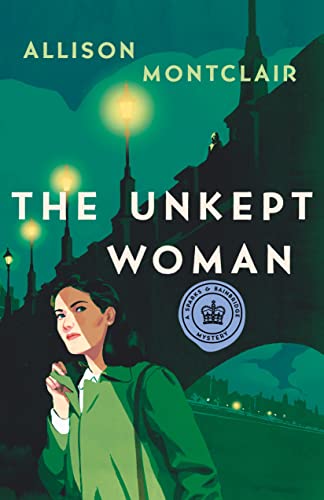
THE RIGHT SORT OF MAN introduces Iris, a former intelligence operative, and Gwen, a widow with a six-year-old son, who open a marriage bureau in 1946 London. I zipped through the first three books, then eagerly awaited the fourth, THE UNKEPT WOMAN. I loved the premise, the characters, the period detail, the witty dialogue!

But who was the woman writing these terrific books? I'd never heard of Allison Montclair. With good reason, as you will see!


How Alan Became Allison


by Alan Gordon, AKA Allison Montclair


Writing, in part, is about ego. As much as we might delude ourselves into thinking we are artists, craftspeople, or merely professionals fulfilling the voracious and unstoppable needs of our readers, there still lies that joyous kick from seeing our name emblazoned across the front cover. And yes, it’s still better with a tangible book in our hands because we know all of the effort from different people it took to produce that precious object just so we could have our name writ large on the front.

But what happens when the book is yours, but the name isn’t? What’s in a name? I found this out unexpectedly when I began writing the Sparks and Bainbridge series. My first series, the Fools’ Guild mysteries, was very much my own creature, and I loved the researching, the writing, and the ultimate glory of declaring myself an author, or [insert food-providing real-life profession]/author on my taxes. When that series came to an end, I wrote other books, stories, and even musicals with varying degrees of success, but enough to justify doing it all.

 Then, out of the blue, Keith Kahla, my editor from St. Martin’s Minotaur, invited me to lunch. I should have been suspicious immediately, but a chance to catch up and, more importantly, free food overcame those suspicions immediately. He had come across a book about a London marriage bureau founded by two women before WWII, and thought it would be a good setting for a mystery series, and that I would be a good fit for it.

 I liked the idea, and wrote a chapter on spec, along with my ideas for Iris and Gwen, the main characters, and the shift of the period to post-war London, an era that I thought would be more interesting. I wanted each of my protagonists to have been traumatized by the war in some fashion, so that the founding of this agency would also be a way for them to reinforce and rescue each other.

I sent it in. A few days later, my agent called and said they loved it. And, he added, they want you to use a pseudonym.

I hadn’t expected that. I was nonplussed. The joy of acceptance was intermingled with the stomping of my ego. But it was quickly resolved by the answer to a simple question: Do I want to be published? The answer was yes, of course. So it didn’t matter what name was on the cover, because the work was all mine.

And that was an interesting realization. Once I had let go of the ego gratification of having my name on the cover, I was able to have the greater gratification of finding out that people liked my book without having any idea it was mine. I had taken my persona out of the equation. It never was about me, nor should it have been. I was able let it go and relax, knowing that only the work was being judged, not the author.

 So, we had to come up with a name. It became a combined effort between my editor, my agent, and me. My first attempt: First name, Lana, which was an anagram of Alan. Last name, St. Clair, because it sounded vaguely British.

 Problem, said my editor. Having the last name of St. Anything confuses the shelving. Really? I asked. [I have recently spoken to a book store owner who confirmed this, so it must be so.] So I tried Lana Sinclair.

 Problem again, said my editor. It sounds too much like another author’s name.

 And so we tossed pseudonyms around like juggling clubs. It turned out that many were already taken by authors, strippers and porn stars. Finally, my agent, who like me had grown up in New Jersey, suggested Allison Montclair. And here I am.

 There were some advantages to being anonymous that I hadn’t anticipated. Since the author was not available to go out and plug the book [and my family and I became quite silly playing with the idea of putting me in drag, or sending my wife out as Allison], Saint Martin’s Minotaur had to do all the publicity themselves. They did a terrific job, as it turned out. Keeping my identity secret was interesting. I had permission to reveal it to a select few. One small website did a deep dive into the copyright to find my true identity, but they were the only one and the vast majority of the readers didn’t know. My favorite moment was when I told a bookseller friend, who turned out to have just finished reading The Right Sort of Man. “I had no idea it had been written by a dude!” she exclaimed, and I felt very proud indeed.

 After A Rogue’s Company, the third book, came out, the publisher finally decided to out me as the author. I’ve started going to conferences and bookstores again, with the AKA scribbled on my name tag under my own name. And I have found that while I enjoyed the secrecy, watching my books bravely go into the world without my help, it’s nice to be meeting people again, especially in these strange, isolating times.

So, if you meet me, call me by either name. I’ll answer to both.

Allison Montclair returns with the fourth Sparks & Bainbridge mystery, The Unkept Woman: London, 1946, Miss Iris Sparks--currently co-proprietor of the Right Sort Marriage Bureau--has to deal with aspects of her past exploits during the recent war that have come back around to haunt her.

The Right Sort Marriage Bureau was founded in 1946 by two disparate individuals - Mrs. Gwendolyn Bainbridge (whose husband was killed in the recent World War) and Miss Iris Sparks who worked as an intelligence agent during the recent conflict, though this is not discussed. While the agency flourishes in the post-war climate, both founders have to deal with some of the fallout that conflict created in their personal lives. Miss Sparks finds herself followed, then approached, by a young woman who has a very personal connection to a former paramour of Sparks. But something is amiss and it seems that Iris's past may well cause something far more deadly than mere disruption in her personal life. Meanwhile, Gwendolyn is struggling to regain full legal control of her life, her finances, and her son - a legal path strewn with traps and pitfalls.

Together these indomitable two are determined and capable and not just of making the perfect marriage match.

DEBS: I was gobsmacked when I learned that Allison was Alan! I would never have twigged! These books are a delight from either gender! 

Signed copies are available from the The Poisoned Pen here.

And you can see the Pen's interview with Alan/Allison and Ashley Weaver here.

Alan will be stopping in to chat, but in the meantime, REDs and readers, any favorite books written under a pseudonym by authors of the opposite gender?