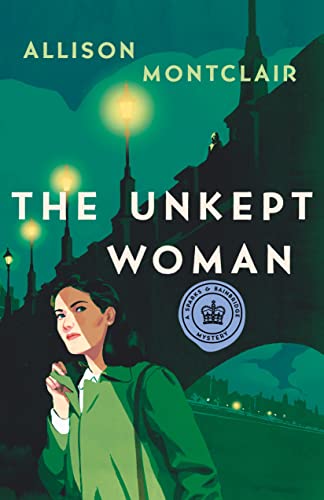
DEBORAH CROMBIE: One of my favorite new mystery series (as in immediately pre-order in print as soon as I see there's a new book coming!) in the last few years has been the Sparks and Bainbridge books by Allison Montclair.

I love the fascinating post-WWII London setting, and I love Iris Sparks and Gwendolyn Bainbridge's complicated lives and relationships, but most of all I love the witty banter between the two protagonists. I'm happy to say that the 5th Sparks and Bainbridge, THE LADY FROM BURMA, is every bit as delightful as the previous books.
Of course those of us in on the secret know that Allison is actually Alan Gordon, who's joining us today to talk about something we've never really explored on the blog--
Words, Words, Words
by Allison Montclair,
AKA Alan Gordon
When
I first began to write mystery novels, it never occurred to me that the word
count mattered. I went in more or less following the sage advice of the King of
Hearts in Alice in Wonderland: ““Begin at
the beginning … and go on till you come to the end: then stop.”
My
first published book [writing under my actual name] came in around 73,000+
words. To my happy surprise, sequels were wanted. However, buried several
paragraphs into my brand, spanking new contracts, were minimum word counts of
80,000.
I
had no idea this was a thing, and having already engaged in pre-sequel panic
(Can I do this again? What if it’s worse than the first book? Do I have to give
the money back?), this became one more set of worries. What if I fall short?
What if I end up padding the writing to stagger across the finish line? I found
myself channelling Lucy Van Pelt from the great “Book Report” song in “You’re a
Good Man, Charlie Brown.”: “And they were very, very, very, very, very, very
happy to be home.”
Fortunately,
I was able to make the adjustment, and as the series continued, 80K became a
thing of ease. I even surpassed 100k words on one book, and not a single one
was padding. I still consider that one my best published work.
Eighty
thousand words took on a particular feel for me. It had a rhythm to it. As the
word count from each finished chapter was added to the total, I had a sense of
where I was in the storyline, and where I needed to go. I am not a detailed
outliner, tending to chapter outlines with a few sentences for each, so the 80K
rhythm becme essential.
Then
I started the Sparks and Bainbridge series — and the new contracts came in with
an 85,000 word minimum!
What?
Wait, when did this become a thing? I mean, I had been delivering books that
length in the old series, but only because I wanted to. Now, I had to.
Grumbling
ensued on the part of the author.
But
that was the gig, so I let it flow, tried not to worry about it, and hit my
mark on the first book, as well as every one since then.
It
does feel different. Not longer, necessarily, but a different rhythm than the
first series. Adjustments were made. And it led to one interesting writing
adventure. When I was working on the fourth book, An Unkept Woman, I was
about halfway through the first draft when I checked on the word count and
realized that I wasn’t going to reach the minimum. Not by a long shot. I
thought about it for a while, and came up with another plot line to fold into
what I already had, involving a potential threat from another source. I went back
to the beginning and rewrote, setting it up.
The
end result not only passed the 85k mark, but the book itself became my personal
favorite of the series. And it was the required minimum that spurred that
creativity on.
Mystery
novels, by and large, are not epic tomes. They have for me a rough three act
structure: Crime, Investigation, Solution, and shouldn’t run too long if one is
to maintain the tension. There are, of course, exceptions. Iain Pears’s An
Instance of the Fingerpost clocked in at a massive 691 pages in hardcover.
It also blew me away, with its tale told by four, count ‘em! four different
unreliable narrators. By comparison, my longest work, the aforementioned
100,000+ one, came at 304 pages in hardcover. Agatha Christie’s longest mystery
under her own name is Sparkling Cyanide, which comes in at 288 pages in
the paperback. (Her longest book Giant’s Bread, was under her Mary
Westmacott pseudonym. I haven’t read it, but it doesn’t sound like a mystery.)
I
don’t know how other writers have to deal with this (Jungle Red folks, please
chime in!). But as a good writer should, I have saved the final twist for the
end. Sparks and Bainbridge #7 will be published by a different company. And for
the first time in my career, I have a word count —- MAXIMUM!
Conceptually,
this has an entirely different feel. What if I rush the ending? If I fall in
love with a plot line that needs more time to unfold? What if I have to cut
something I really, really like?
Lucy
Van Pelt, I invoke your spirit. Tell me that the Book Doctor is in to give me
advice!
I
have your five cents fee ready.
Allison Montclair is the pseudonym of Alan Gordon. As Allison, she writes the Sparks and Bainbridge mysteries, beginning with THE RIGHT SORT OF MAN (The ALA Reading List Council’s Best Mystery of 2019). Set in 1946 London, the books detail the adventures and struggles of two women trying to run a licensed marriage bureau. The fifth book, THE LADY FROM BURMA, was released this past July.
As
Alan, he has written the Fools’ Guild mysteries, beginning with THIRTEENTH
NIGHT, featuring a 13th century pair of married jesters; WHERE WEREWOLVES FEAR
TO TREAD, a darn fine werewolf novel; numerous short stories in different
genres; and is also a librettist/lyricist for several musicals which have
either been performed or workshopped around the country. He has won the Kleban
Prize, received honorable mentions for The Best American Mystery Stories and
The Best American Science Fiction Stories, and has been on “The Moth Radio Hour”
telling the truth, among other accomplishments.
He
has subsidized all of this as a public defender in NYC for nearly 39 years.

THE LADY FROM BURMA
London, 1946. Gwendolyn Bainbridge:
Aristocrat, war widow, co-proprietor of The Right Sort Marriage Bureau — and a
ward of the Crown ever since her husband’s death drove her into an asylum. Now,
the long-awaited and long-dreaded date for her petition before the Court of
Lunacy has been set. The last thing she needs is another murder investigation
falling into her lap, but that is precisely what she gets when the Lady From
Burma comes to their office, seeking a new wife for her husband, then turns up
dead a few days later in Epping Forest. Along with her partner, Iris Sparks,
Gwen is dragged into a case she never wanted, and more will die before it’s
over and done with.
DEBS: My first book came in around 70,000 words, if I remember correctly. I had no idea there was such a thing as word count! The next few were a little longer, then the books got a LOT longer. A KILLING OF INNOCENTS was 96,000 words after I cut 100 pages from the manuscript, and it's not the longest book I've written.
REDs, do you try to work to a word target?
READERS, do you have a preferred length of book? Is this something you think about when choosing a book to read?
And readers, stop in with more questions for Alan, who will be stopping in to visit!