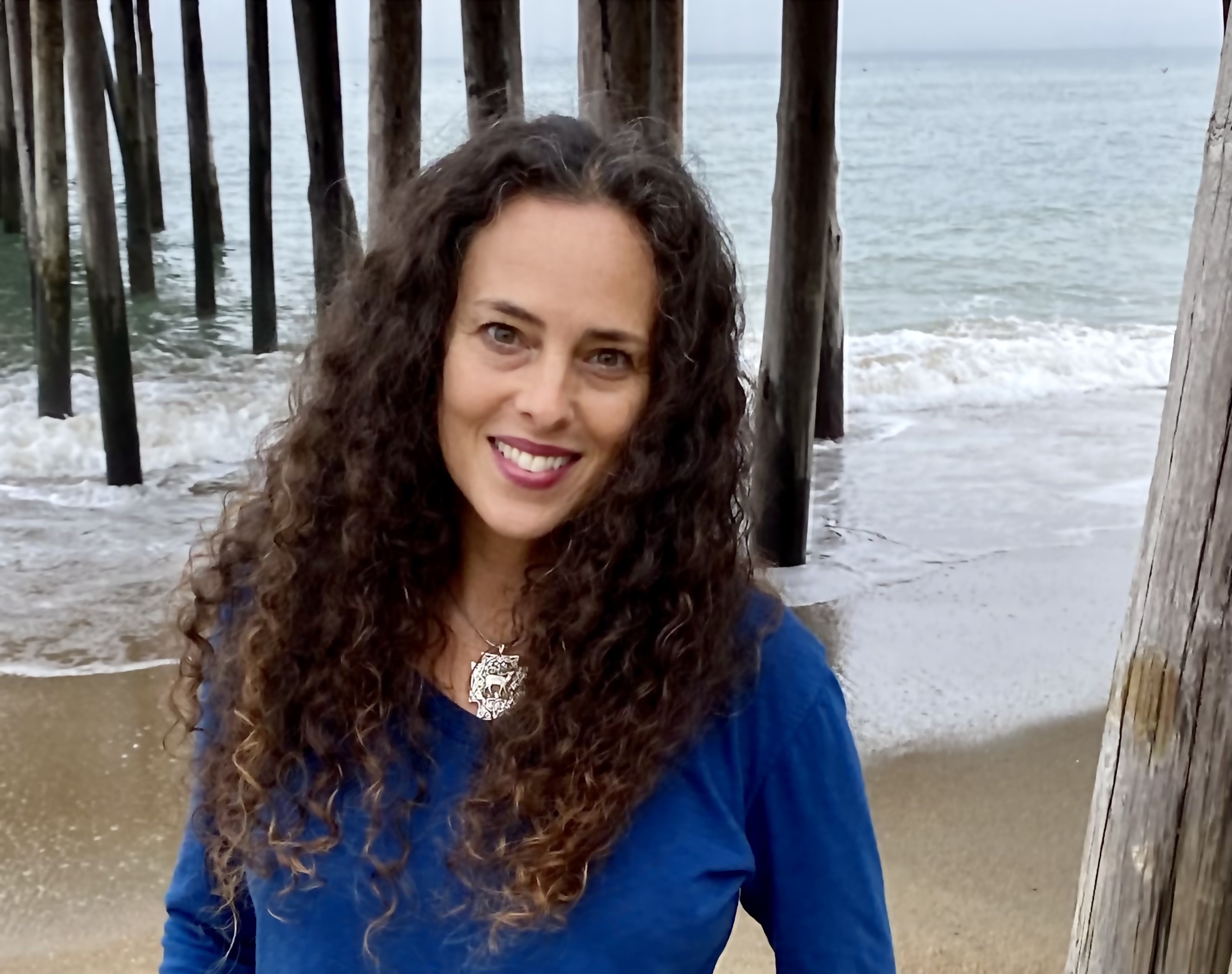
ALICIA BESSETTE: I’d lived on the Outer Banks for months before I saw the famed wild horses that roam the Virginia/North Carolina border. It was a warm, overcast day in June of 2016—seven years ago, almost to the day—when my friend Adam aired-down his Jeep tires and took me and a few other friends to what’s known as “the 4x4 beaches,” an area accessible only to four-wheel-drive vehicles.

The journey was bumpy and jostling. Even Adam’s expert navigation and the fresh ocean air blowing all around didn’t ease my white-knuckled grip on the grab-handle. Soon, however, I caught my first-ever glimpse of a wild mustang: a chestnut mare standing atop a dune, gazing out over the Atlantic Ocean. We stopped to admire her from a distance, and I snapped a photo. After that we saw more horses. They galloped in the surf. They nuzzled each other. In the dunes, they grazed on sea grasses. I was so mesmerized by the mustangs that I forgot to take photos. When we reached the fence that marks the state line, I snapped a cool shot of some pelicans coasting overhead. Then, reluctantly, we turned around and headed home, admiring a few more horses along the way.

Fast forward to five years later, when I was brainstorming ideas for the sequel to Smile Beach Murder. I remembered that wild mare gazing out to sea, and I asked, what if a very important mustang inexplicably goes missing from her sanctuary on beautiful, fictional Cattail Island? That was the question that spurred the writing of Murder on Mustang Beach, in which your bookselling heroine, Callie Padget, does everything in her power to restore order to the beloved herd.
While researching Murder on Mustang Beach, I learned that no one really knows how the Banker horses got here, though it’s theorized that they have lived on this skinny strip of land for about five hundred years, having descended from Spanish horses brought by explorers.
I learned that Banker mustangs in the Corolla area are managed by a nonprofit called the Corolla Wild Horse Fund, which promotes continued land preservation as their permanent sanctuary.
I also learned that they drink from rain puddles; manmade canals; ponds and lakes that form after heavy storms; and the Currituck Sound, which is mostly freshwater. And, the mustangs are locavores, dining on acorns, persimmons, sea oats, and various coastal grasses.
In fact, Banker mustangs cannot digest apples or carrots and frequently die after accepting those food items offered by tourists. The takeaway: never approach, touch, or feed wild horses.
“It only takes one apple to kill a horse,” says Meg Puckett, herd manager of the Corolla Wild Horse Fund, who was kind enough to speak to me after I found out I’d be guest-posting here at Jungle Red Writers.
“Culturally, historically, and genetically,” Puckett says, “each individual horse is critical to the herd’s survival. There are 300 of these horses total in all the world, and here in Corolla, there are 99 horses. When you’re talking numbers like that, if you lose just one horse, it damages the genetic health and overall wellbeing of the herd for generations. It’s so important for all of us to keep in mind that when we are in their home, our actions have consequences.
“People are always asking me what they can do to help, and I like to tell them, ‘Awareness is a big part of it.’ These horses don’t belong to the caretakers. They belong to everybody. So talk about the horses. Advocate for them.”
It’s my hope that this blog post does just that: advocates for the continued thriving of the mustangs of the Outer Banks. As Puckett reminds us, very few remain, and they need us. For more info, see the Corolla Wild Horse Fund at https://www.corollawildhorses.com
Thank you for checking in today, Jungle Red Writers & readers. I’d love to hear about a wildlife encounter that left an impression on you. Please feel free to discuss in the comments. I’ll pick a lucky winner at random to receive a beautiful, signed, hardback copy of Murder on Mustang Beach.
Happy Summer to one and all!

BIO: Alicia Bessette’s first mystery, Smile Beach Murder, was a finalist for the inaugural Lilian Jackson Braun Memorial Award given by the Mystery Writers of America, and was a Southern Indie hardcover fiction bestseller; an Amazon Editors’ Pick; and one of Real Simple’s Best Beach Reads of 2022. Bessette’s journalism has won a first-place award from the New England Newspaper & Press Association. She lives in coastal North Carolina with her husband, novelist Matthew Quick.
ABOUT MURDER ON MUSTANG BEACH:
When a killer stirs up trouble on the Outer Banks, amateur sleuth and bookseller Callie Padget is on the case, in a new beachside mystery from author Alicia Bessette.
Cattail Island in the Outer Banks is a popular destination for honeymooners and nature lovers alike. So it is a huge blow when the murder of a newlywed grinds the pre-summer season to a screeching halt. Bookseller Callie Padget launches her own investigation after mysterious customer Geri-Lynn Humfeld, caretaker of the island’s protected wild horses, brings in an irresistible piece of information.
Determined to restore order and safety to her beloved hometown, Callie searches for answers—even as those answers cast suspicion on her soon-to-be boyfriend, Toby Dodge, whose martial arts studio was the scene of the crime. As she digs deeper, Toby becomes the police’s prime suspect. The truth raises troubling questions and sends her scouring the bookshop’s shelves for guidance.
Meanwhile, a well-loved member of the mustang herd—a pregnant mare whose anticipated foal is a symbol of summery hope for locals and visitors alike—may be facing dire circumstances. With help from Geri-Lynn, Callie unearths startling secrets surrounding not only the compromised mare, but the murdered newlywed, too. And when another body shows up, this time on isolated Mustang Beach, she must race against time to stop a killer from claiming any more innocent lives.