"The book sweeps from the steamy bazaars of Egypt to proper English drawing rooms as Ursula battles international intrigue and her own sensuous nature. Dorothy Sayers would be proud of her Oxford sister."
**Rhys Bowen, Award winning author or the Molly Murphy and Royal Spyness mysteries
HANK: I met Clare Langley-Hawthorne in the one of the world's most high-tension white-knuckled situations--Malice Go Round. That's the feared and beloved event where new authors get like 10 seconds to convince a group of experienced, savvy and educated mystery readers that their new novel is the greatest thing since..well, the last greatest thing they've ever read.

This gives me particular empathy for my character, Ursula Marlow, who is a suffragette in Edwardian England desperately trying to secure votes for women at a time when voting in England was restricted to men who owned or rented property. My first book, Consequences of Sin, is set in 1910 and includes the infamous ‘Black Friday’ protest which occurred after the failure of the Conciliation Bill which would have extended voting to some women.

On that day women faced unwarranted police brutality and realized just how entrenched the ‘establishment’ that opposed female suffrage was in Britain. Many of these women had already spent time in Holloway Prison and had endured forcible feeding (they went on hunger strike to protest the government’s refusal to treat them as political prisoners).
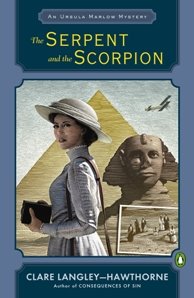
By 1912, the year in which my second Ursula Marlow book, The Serpent and The Scorpion is set, members of the militant suffragette movement (the Women’s Social and Political Union) had become thoroughly disenchanted (as well as disenfranchised!) and had begun to mount a window smashing and arson campaign. The fight for votes was reaching a level of desperate militancy that would only cease with the outbreak of the First World War when the WSPU agreed to suspend their fight for votes for women to focus on their patriotic war duty.
Clare hit Malice Go Round out of the ballpark. Talking about her debut Consequences of Sin, she was calm and direct, articulate, passionate and intelligent. And funny. (And of course, 'historicals' are hot in the publishing world these days.) I told her afterward--I was running right out to buy her book. She absolutely won me over.
Now she's on book two--more about that in a minute. But while millions of voters in the US woke up this week to find they had participated in an historic election, Clare didn't get to vote. Why? And how does she feel? She tell us in one word:
Disenfranchised
by Clare Langley-Hawthorne
After the election this week I confess to feeling particularly disenfranchised. As I am not a US citizen I was not able to vote (and neither was my husband which actually may be a good thing as we traditionally cancel out each other’s vote as we hold opposing political views!) nor am I able to vote in Australian elections as we have been abroad so long.
After the election this week I confess to feeling particularly disenfranchised. As I am not a US citizen I was not able to vote (and neither was my husband which actually may be a good thing as we traditionally cancel out each other’s vote as we hold opposing political views!) nor am I able to vote in Australian elections as we have been abroad so long.
In Australia voting is compulsory – a fact that many American’s find incredible – and we are fined if we fail to vote in an election. For the last couple of elections my husband and I missed getting postal votes and had to send in a letter ‘excusing us’ from voting to avoid a fine – we were then unceremoniously dropped from the Australian electoral roll. So now we are truly disenfranchised!
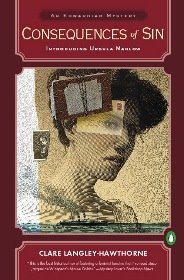
This gives me particular empathy for my character, Ursula Marlow, who is a suffragette in Edwardian England desperately trying to secure votes for women at a time when voting in England was restricted to men who owned or rented property. My first book, Consequences of Sin, is set in 1910 and includes the infamous ‘Black Friday’ protest which occurred after the failure of the Conciliation Bill which would have extended voting to some women.
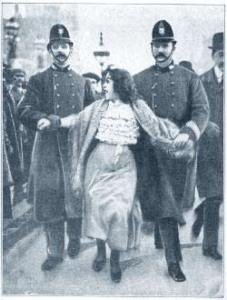
On that day women faced unwarranted police brutality and realized just how entrenched the ‘establishment’ that opposed female suffrage was in Britain. Many of these women had already spent time in Holloway Prison and had endured forcible feeding (they went on hunger strike to protest the government’s refusal to treat them as political prisoners).
By 1912, the year in which my second Ursula Marlow book, The Serpent and The Scorpion is set, members of the militant suffragette movement (the Women’s Social and Political Union) had become thoroughly disenchanted (as well as disenfranchised!) and had begun to
 mount a window smashing and arson campaign. The fight for votes was reaching a level of desperate militancy that would only cease with the outbreak of the First World War when the WSPU agreed to suspend their fight for votes for women to focus on their patriotic war duty.
By the time the war was over a whole generation of men would be wiped out, women over 30 would finally be granted the vote and the nearly 2 million so called ‘surplus’ women became a political force to be reckoned with. Just imagine what could have happened if women had received the vote before the war?!
It’s hard for me to believe that Australia –a land settled by convicts and squatters - granted votes to women nearly twenty years before Britain (although Aboriginal women were still excluded).

HANK: Thanks, Clare! And there's more--
I have to confess, as an unabashed feminist, I fully support my character’s political quest (and hey, my husband is convinced Ursula is actually me anyway!) though I have to admit to a sneaking jealousy (maybe even covetousness) for Ursula’s upper class Edwardian lifestyle. She gets to have a maid, a chauffeur, a butler, a housekeeper and a cook. At my house I have to play all those roles!
She also has the luxury of time and wealth. The kind of wealth that allows you to have custom designed French clothing (where’s my dress by Poiret?!), travel by elegant ocean liner (rather than being a sardine in coach class) and flout conventions (though I live just near Berkeley where there are no conventions to flout anyway!). But was all of this lifestyle worth having no say in the way your country was governed? When I try to absorb the sensibilities of the Edwardian period, to think and feel as Ursula would have, the answer is clearly no.
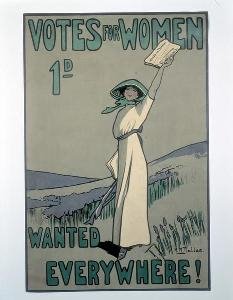
So my character and I have something in common – neither of us have the vote but we both recognize just how powerful and important that right can be.
HANK: Thanks, Clare! And there's more--
A contest! Clare has generously offered to give away a signed edition of her first book--and that's something we can all vote for. So just leave her a comment...and she'll pick a winner at random!
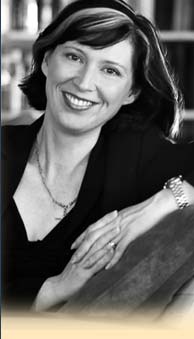
Clare Langley-Hawthorne was raised in England and Australia. She was an attorney in Melbourne before moving to the United States, where she began her career as a writer. Her first novel, Consequences of Sin, was nominated for the 2008 Sue Feder Memorial Historical Mystery Macavity award. The second in the Ursula Marlow series, The Serpent and The Scorpion, was published in October 2008. Clare lives in Oakland, California with her family.
http://www.clarelangleyhawthorne.com/
http://www.clarelangleyhawthorne.com/