
DEBORAH CROMBIE: It is always such a treat to have Stephanie Barron (who you also know as Francine Mathews) here on Jungle Red! Francine is multi-talented and I love her both her historical novels and her contemporary mysteries set on Nantucket, the Merry Folger books.
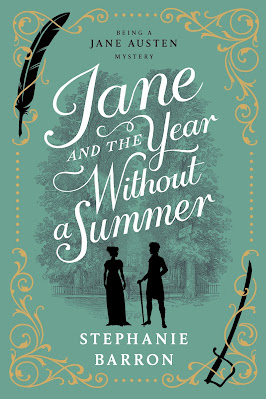
But her Jane Austen mysteries, written as Stephanie Barron, have a special place in my heart. I've followed Jane's adventures from the very first book, and am always thrilled when I know there is a new Jane novel coming my way. JANE AND THE YEAR WITHOUT A SUMMER is the 14th, and finds Jane and her sister Cassandra taking the waters at the new spa town of Cheltenham--a fun Cotswold link for me! But there is more than mystery going on in Jane's life--there is a little romance, too, as you will see.
Jane Austen’s Man
of Mystery: Raphael West
For the past twenty-six years, I’ve been
writing a series of mystery novels with Jane Austen as detective. The first, Jane
and the Unpleasantness at Scargrave Manor, showcased the famous English
Regency novelist in December, 1802, when she was twenty-six years old, and had
just accepted an offer of marriage from the twenty-year-old brother of her dear
friends Althea and Catherine Bigg. Harris Bigg-Wither, heir to the Hampshire
estate of Manydown, was in a position to make Jane’s life comfortable and
secure—one reason she probably agreed to marry him. But he was socially awkward
and suffered from a pronounced stutter, and Jane was not in love. After a
sleepless night, she descended the stairs to breakfast and retracted her
consent.
This
was such a social solecism in Austen’s day that she and her sister Cassandra
broke off their visit to the Biggs and left Manydown immediately to return to
their own home in Steventon. Jane was a jilt—someone who toyed with an
honourable gentleman’s affections and treated his heart with careless cruelty. But
she was also a woman of conviction, and we’re fortunate she refused to marry
for mercenary reasons. If she had become Mrs. Harris Bigg-Wither, mistress of
Manydown, we might never have known her name.
Accepting
a life of financial penury and dependence, as Austen did by refusing her one
documented offer of marriage, meant that she was thrown back on the resources
of her pen. If she’d married and succumbed to all the duties of managing a
great house and rearing its owner’s children, she would never have to publish her
novels. They would have remained an amusing pastime, like the amateur
theatricals she wrote as a young girl.
But
did rejecting Harris mean Jane’s life was completely devoid of romance?
I
say not. Emphatically not.
One
of the treats of writing historical fiction, particularly about famous people
(something I’ve done repeatedly in my thirty novels to date) is that I offer them
opportunities they may have missed in their real lives. One character who has
surfaced in the past three Jane Austen mysteries, most notably in the current
and fourteenth novel Jane and the Year Without a Summer, is Raphael
West—the handsome, sensitive, and intelligent artist Jane first encounters in
book twelve, Jane and the Twelve Days of Christmas. He’s the son of
famous Georgian painter Benjamin West, an American from Philadelphia who became
Court Painter to George III of England, and founded the Royal Academy in
London. A contemporary of Jane’s—a widower and father to a grown daughter—Raphael
quickly becomes Jane’s notable detective sidekick and love interest.
But
who was Raphael West, and is it possible Jane actually met him?
And
why did I decide to make Raphael a character in my ongoing series?
Jane
herself showed me the way:
I have seen West’s famous Painting, & prefer it
to anything of the kind I ever saw before. I do not know that it is reckoned superior to
his “Healing in the Temple,” but it has gratified me much more, &
indeed is the first representation of our Saviour which ever at all contented
me. “His Rejection by the Elders” is the subject.—I want to have You and
Cassandra see it.
--Jane Austen in a letter to
her friend and housemate Martha Lloyd, date Friday 2 September 1814, written from
London
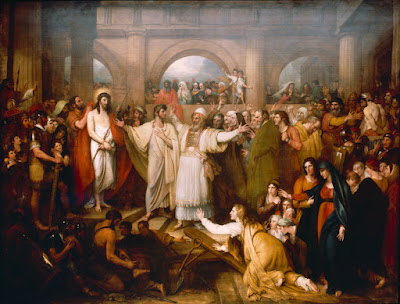
Christ Rejected by the Elders, Benjamin West, 1814
It was clear
from this passage that Jane not only saw this painting of Benjamin West’s,
she’d seen several. This isn’t surprising; West was the most famous painter in England
of large-scale historic scenes throughout Austen’s life. His “Death of Nelson”
and “Death of Wolfe,” depicting idealized and quasi-religious ends for two of
Britain’s great war heroes, were hugely important propaganda pieces in
contemporary politics. Remember, this was an era when there were no
photographs, and popular understanding of events was spurred by graphic prints
and cartoons sold in the streets, or by traveling exhibits of spectacular works
of art.
But
West was unique for the time in his brazen self-promotion and hustle. For
forty-five years, he operated a multi-use compound at his home in the
fashionable West End, at 14 Newman Street. This was a block of houses
newly-built as London expanded during the Georgian era, and West both lived in
his modern row house and set up his studio there—along with an atelier for art
students under his tutelage, many of them American, and a gallery where he hung
and sold his work. He was not simply an artist; he was an entrepreneur, and
he capitalized on the public enthusiasm for his great works of history by
flogging his paintings to anyone who cared to ring the bell at 14 Newman.
In
other words, you suddenly didn’t have to be a king or emperor to be an art
patron; you could be any person with money and taste, and you, too, could own a
Benjamin West.
When
Jane writes that she’s just seen “Christ Rejected by the Elders,” it’s possible
she attended a public exhibition. But it’s equally probable that she saw it in
the gallery at Newman Street—the painting was executed in 1814, and West would
have wanted to exhibit it in his own gallery. Which means that Jane may, in
fact, have encountered Benjamin West’s eldest son, Raphael, at 14 Newman Street.
Of West’s two sons, Raphael was his father’s right-hand man.
Art
at this time was very much a studio product, meaning that Raphael and the
students in his father’s atelier made sketches and studies for the subjects of West’s
great historical tableaux. Raphael never achieved the artistic status of his
dad, but he was definitely a significant part of the family business. I own a
catalogue of his drawings, many of them sketched during a trip he made to the
United States, and his hand is deft and sure. He also surfaces in promotional
ads in London papers from 1820, when his father died, and the entire West stock
was being sold—along with the Newman Street house.
It's
difficult to find much in the historical record about Raphael. I know he was
married and had at least one daughter; I know he emigrated to France with his
father for a period of several years after the Revolution, which makes him
useful as a quasi-spy against Napoleon, whose transition from Man of the People
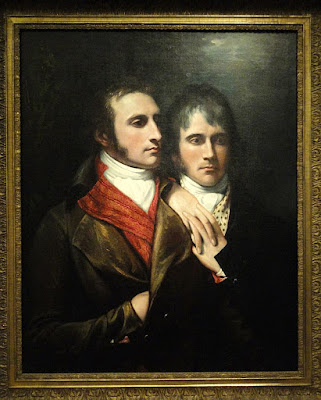
to dictator disillusioned the whole West family. I also know he was handsome:
his portrait, painted by his father, shows him as a man of fashion who’d make a
perfect Darcy in an Austen novel.
In
Jane and the Year Without a Summer, we’ve reached 1816 in Austen’s life.
It’s a wretched time in England—the economy has plummeted due to the end of the
Napoleonic wars, and there’s a famine throughout Europe and North America due
to a catastrophic climate event caused by the most massive volcanic eruption in
recorded history. Jane’s family is in upheaval: her brother Charles has lost
his ship in a hurricane and he may be court-martialed; her brother Henry’s
banks have failed, leaving him destitute; and her wealthy brother Edward is
being sued by Jane’s neighbors for wrongful inheritance, or fraud. Jane herself
is feeling ill, and decides to run away to the spa town of Cheltenham with her
sister, Cassandra, for a bit of R&R.
Raphael
West visits Cheltenham at the same time—and sparks fly as the pair stumble over
an unfortunate series of bodies.
I
like to think these two intriguing Creatives found endless subjects to discuss.
Maybe it’s only a product of my fevered imagination—but Jane Austen deserves,
at any time in her brief life, a partner worthy of her intelligence.

Stephanie Barron is a graduate of Princeton and Stanford, where she received her Masters in History as an Andrew W. Mellon Foundation Fellow in the Humanities. Barron is perhaps best known for the critically-acclaimed Jane Austen Mystery Series, in which the intrepid and witty author of PRIDE AND PREJUDICE details her secret detective career in Regency England. A former intelligence analyst for the CIA, Stephanie--who also writes under the name Francine Mathews--drew on her experience in the field of espionage for such novels as JACK 1939, which The New Yorker described as "the most deliciously high-concept thriller imaginable." She lives and works in Denver, CO.
DEBS: Don't you love the idea that Jane Austen, whose heroines always met their match, had a handsome and witty flame of her own? It's a delicious set up, and a fascinating period.
Do stop in and chat with Stephanie--if you have any Jane Austen questions, here's your chance to ask them!








