
Showing posts with label Merry Folger. Show all posts

Thursday, February 17, 2022

Stephanie Barron--Jane Austen's Man of Mystery

DEBORAH CROMBIE: It is always such a treat to have Stephanie Barron (who you also know as Francine Mathews) here on Jungle Red! Francine is multi-talented and I love her both her historical novels and her contemporary mysteries set on Nantucket, the Merry Folger books.

But her Jane Austen mysteries, written as Stephanie Barron, have a special place in my heart. I've followed Jane's adventures from the very first book, and am always thrilled when I know there is a new Jane novel coming my way.  JANE AND THE YEAR WITHOUT A SUMMER is the 14th,  and finds Jane and her sister Cassandra taking the waters at the new spa town of Cheltenham--a fun Cotswold link for me! But there is more than mystery going on in Jane's life--there is a little romance, too, as you will see.



Jane Austen’s Man of Mystery: Raphael West

 by Stephanie Barron

     For the past twenty-six years, I’ve been writing a series of mystery novels with Jane Austen as detective. The first, Jane and the Unpleasantness at Scargrave Manor, showcased the famous English Regency novelist in December, 1802, when she was twenty-six years old, and had just accepted an offer of marriage from the twenty-year-old brother of her dear friends Althea and Catherine Bigg. Harris Bigg-Wither, heir to the Hampshire estate of Manydown, was in a position to make Jane’s life comfortable and secure—one reason she probably agreed to marry him. But he was socially awkward and suffered from a pronounced stutter, and Jane was not in love. After a sleepless night, she descended the stairs to breakfast and retracted her consent.

This was such a social solecism in Austen’s day that she and her sister Cassandra broke off their visit to the Biggs and left Manydown immediately to return to their own home in Steventon. Jane was a jilt—someone who toyed with an honourable gentleman’s affections and treated his heart with careless cruelty. But she was also a woman of conviction, and we’re fortunate she refused to marry for mercenary reasons. If she had become Mrs. Harris Bigg-Wither, mistress of Manydown, we might never have known her name.

Accepting a life of financial penury and dependence, as Austen did by refusing her one documented offer of marriage, meant that she was thrown back on the resources of her pen. If she’d married and succumbed to all the duties of managing a great house and rearing its owner’s children, she would never have to publish her novels. They would have remained an amusing pastime, like the amateur theatricals she wrote as a young girl.

But did rejecting Harris mean Jane’s life was completely devoid of romance?

I say not. Emphatically not.

One of the treats of writing historical fiction, particularly about famous people (something I’ve done repeatedly in my thirty novels to date) is that I offer them opportunities they may have missed in their real lives. One character who has surfaced in the past three Jane Austen mysteries, most notably in the current and fourteenth novel Jane and the Year Without a Summer, is Raphael West—the handsome, sensitive, and intelligent artist Jane first encounters in book twelve, Jane and the Twelve Days of Christmas. He’s the son of famous Georgian painter Benjamin West, an American from Philadelphia who became Court Painter to George III of England, and founded the Royal Academy in London. A contemporary of Jane’s—a widower and father to a grown daughter—Raphael quickly becomes Jane’s notable detective sidekick and love interest.

But who was Raphael West, and is it possible Jane actually met him?

And why did I decide to make Raphael a character in my ongoing series?

Jane herself showed me the way:

I have seen West’s famous Painting, & prefer it to anything of the kind I ever saw before. I do not know that it is reckoned superior to his “Healing in the Temple,” but it has gratified me much more, & indeed is the first representation of our Saviour which ever at all contented me. “His Rejection by the Elders” is the subject.—I want to have You and Cassandra see it.

--Jane Austen in a letter to her friend and housemate Martha Lloyd, date Friday 2 September 1814, written from London
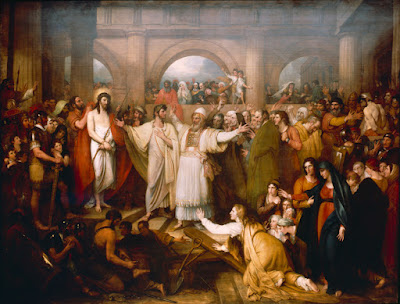


                                          Christ Rejected by the Elders, Benjamin West, 1814

It was clear from this passage that Jane not only saw this painting of Benjamin West’s, she’d seen several. This isn’t surprising; West was the most famous painter in England of large-scale historic scenes throughout Austen’s life. His “Death of Nelson” and “Death of Wolfe,” depicting idealized and quasi-religious ends for two of Britain’s great war heroes, were hugely important propaganda pieces in contemporary politics. Remember, this was an era when there were no photographs, and popular understanding of events was spurred by graphic prints and cartoons sold in the streets, or by traveling exhibits of spectacular works of art.

But West was unique for the time in his brazen self-promotion and hustle. For forty-five years, he operated a multi-use compound at his home in the fashionable West End, at 14 Newman Street. This was a block of houses newly-built as London expanded during the Georgian era, and West both lived in his modern row house and set up his studio there—along with an atelier for art students under his tutelage, many of them American, and a gallery where he hung and sold his work. He was not simply an artist; he was an entrepreneur, and he capitalized on the public enthusiasm for his great works of history by flogging his paintings to anyone who cared to ring the bell at 14 Newman.

In other words, you suddenly didn’t have to be a king or emperor to be an art patron; you could be any person with money and taste, and you, too, could own a Benjamin West.

When Jane writes that she’s just seen “Christ Rejected by the Elders,” it’s possible she attended a public exhibition. But it’s equally probable that she saw it in the gallery at Newman Street—the painting was executed in 1814, and West would have wanted to exhibit it in his own gallery. Which means that Jane may, in fact, have encountered Benjamin West’s eldest son, Raphael, at 14 Newman Street. Of West’s two sons, Raphael was his father’s right-hand man.

Art at this time was very much a studio product, meaning that Raphael and the students in his father’s atelier made sketches and studies for the subjects of West’s great historical tableaux. Raphael never achieved the artistic status of his dad, but he was definitely a significant part of the family business. I own a catalogue of his drawings, many of them sketched during a trip he made to the United States, and his hand is deft and sure. He also surfaces in promotional ads in London papers from 1820, when his father died, and the entire West stock was being sold—along with the Newman Street house.

It's difficult to find much in the historical record about Raphael. I know he was married and had at least one daughter; I know he emigrated to France with his father for a period of several years after the Revolution, which makes him useful as a quasi-spy against Napoleon, whose transition from Man of the People to dictator disillusioned the whole West family. I also know he was handsome: his portrait, painted by his father, shows him as a man of fashion who’d make a perfect Darcy in an Austen novel.
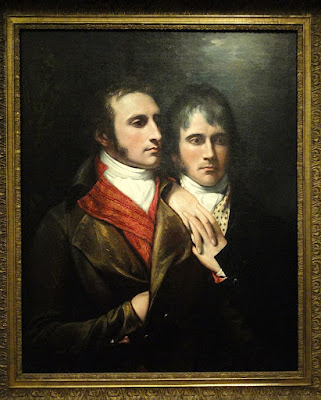

 Raphael West and Benjamin West, Jr. by Benjamin West, c. 1796, Nelson-Atkins Museum of Art

In Jane and the Year Without a Summer, we’ve reached 1816 in Austen’s life. It’s a wretched time in England—the economy has plummeted due to the end of the Napoleonic wars, and there’s a famine throughout Europe and North America due to a catastrophic climate event caused by the most massive volcanic eruption in recorded history. Jane’s family is in upheaval: her brother Charles has lost his ship in a hurricane and he may be court-martialed; her brother Henry’s banks have failed, leaving him destitute; and her wealthy brother Edward is being sued by Jane’s neighbors for wrongful inheritance, or fraud. Jane herself is feeling ill, and decides to run away to the spa town of Cheltenham with her sister, Cassandra, for a bit of R&R.

Raphael West visits Cheltenham at the same time—and sparks fly as the pair stumble over an unfortunate series of bodies.

I like to think these two intriguing Creatives found endless subjects to discuss. Maybe it’s only a product of my fevered imagination—but Jane Austen deserves, at any time in her brief life, a partner worthy of her intelligence.



Stephanie Barron is a graduate of Princeton and Stanford, where she received her Masters in History as an Andrew W. Mellon Foundation Fellow in the Humanities. Barron is perhaps best known for the critically-acclaimed Jane Austen Mystery Series, in which the intrepid and witty author of PRIDE AND PREJUDICE details her secret detective career in Regency England. A former intelligence analyst for the CIA, Stephanie--who also writes under the name Francine Mathews--drew on her experience in the field of espionage for such novels as JACK 1939, which The New Yorker described as "the most deliciously high-concept thriller imaginable." She lives and works in Denver, CO.

DEBS: Don't you love the idea that Jane Austen, whose heroines always met their match, had a handsome and witty flame of her own? It's a delicious set up, and a fascinating period.

Do stop in and chat with Stephanie--if you have any Jane Austen questions, here's your chance to ask them!

Wednesday, June 10, 2020

Francine Mathews--Death on Tuckernuck

DEBORAH CROMBIE: I am a huge fan of anything Francine Mathews writes! Some of you may know her as Stephanie Barron, author of the Jane Austen Mysteries, as well as That Churchill Woman, and the wonderful historical standalones, The White Garden and Flaw in the Blood. 

But I've know Francine longest as the author of the contemporary Nantucket Mysteries, featuring Nantucket police detective Merry Folger. Death on Tuckernuck is the sixth and newest book in the series.  


The Washington Post says of it, "A mystery that’s so suspenseful it’s hard not to skip a chapter to see if certain deeply likable characters are still alive . . . The novel lives and breathes New England island life, with a plot brimming with the best kinds of rude surprises," and I totally agree! Here's Francine to share her inspiration for this suspenseful and atmospheric mystery.


A VERY PRIVATE MURDER:

DEATH ON TUCKERNUCK ISLAND


     I am emphatically not a morning person. And that Wednesday in July I was doubly groggy from waking every hour the previous night, in a subliminal terror that I might oversleep. So as I turned my rental car into the Madaket road and headed for Hither Creek at seven-thirty a.m., coffee cup at the ready, I plugged a vague address into my phone’s GPS app just to be certain I arrived where I needed to be.

Jackson Point, on the western end of Nantucket Island.

There was a boat waiting there I couldn’t afford to miss, owned by a man I’d never met, and had only spoken to once. If I got lost or didn’t appear by eight a.m., he’d leave me behind without a second thought. He’d agreed only reluctantly to make room for a passenger on his morning run across Madaket Harbor, and he’d probably be relieved if I didn’t show. I was determined that wouldn’t happen. I’d been trying to catch this boat for the better part of a year.

I write a series of detective novels set on Nantucket, featuring a woman police detective named Meredith Folger. I’d researched five novels in this idyllic setting, part historic New England whaling town and part sybaritic playground, but this morning I was on a mission to get off the island and onto neighboring Tuckernuck--a scrap of sand nine hundred acres round that sits in the Atlantic a mile and a half from Nantucket’s left coast. There is no public ferry between the town of Madaket and Tuckernuck’s Lagoon, as it’s called, where a handful of boats are moored. 


Neither is there any public access, per se, on Tuckernuck itself. The place is entirely owned by the few families that have passed down houses through multiple generations. There are no paved roads, no beach stands or coffee shops, no gas station or package store, no roadside shack selling sand spades and boogie boards. No restaurant or art gallery. No electrical grid. No public water. Not much cell phone coverage, and next to no internet. It is a place of generators and oil stoves, the night sky brilliant with stars.


And unlike nearby Nantucket, there are no tourists or day trippers on Tuckernuck. The island is intensely private, and its residents are fiercely protective of their peace and isolation. To set foot on the Lagoon’s gantry dock or one of Tuckernuck’s beaches, one must be a resident or an invited guest.

I, of course, was neither.

I was mounting what we used to call, in my old days as a CIA analyst, an Intel Op. I was deliberately penetrating a Denied Area with the goal of collecting privileged information. I was, in short, a writer determined to research the perfect location for a murder. And I had gone to idiotic efforts to make it happen.

The previous summer, I’d appeared at the Nantucket Book Festival and cheerfully announced in my author presentation that I wanted access to Tuckernuck, hoping some local reader would be thrilled to arrange it for me.

No one was thrilled.

I’d queried Nantucket friends, residents with boats, about taking me over. All of them looked leery. “It’s private property, you know,” they said. “You’ll really can’t go out there.”

In Colorado that winter, I contacted a friend with the last name of Coffin, whose ancestors were some of the first people to build houses on Tuck early two hundred years ago. He’d never been there himself. But he had a few friends who’d summered there all their lives. He gave me their names and email addresses. Slowly, gradually, I formed a network of people whose memories I could tap, whose teenage experiences threw light on a community so cut off from the rest of the world it might as well have been Everest.


One of them, in turn, gave me a phone number for a guy named Manny. He was a Caretaker, she said. Or in another words, a man with a boat and the keys to Tuckernuck’s kingdom.

Caretakers are professionals who sustain life on Tuckernuck. They are hired by the small island’s residents to spend a good part of their lives from mid-May to mid-October ferrying everything necessary for a comfortable existence between Jackson Point and the Lagoon. This includes blankets, toilet paper, strawberries, cases of wine, rose bushes, lawn mowers, steaks, tonic water, limes, solar panels, Portuguese bread, propane, gin, patio umbrellas, sacks of dog food, lawn chairs, milk, pate, and paint. Anything you might consider necessary for happiness, including the one-hundred and twenty-five guests you invited to your Tuckernuck wedding, can be transported by a Caretaker’s boat, and then removed—along with your week’s worth of trash and your dead wedding bouquets.

The Caretakers are people of deep and hard-won institutional knowledge. Tuckernuck is surrounded by constantly shifting shoals of sand, so unpredictable and wayward that they are merely dotted lines on nautical charts. To navigate the channel into the Lagoon is a tricky and oft-revised endeavor, best accomplished by those who tackle it daily. The Coast Guard avoids Tuckernuck; the draft of its boats is too deep. There is no fire department or police presence on the barrier island, no EMTs. Consider, then, what happens in an emergency—medical, or otherwise. A fire, perhaps, or an act of violence. A sudden stroke in the brain or a clot in an artery. Each trip between Tuckernuck and Madaket takes roughly twenty minutes, in good weather. Call it an hour by boat to the hospital in the best of circumstances.

But what, my feverish imagination asked, about a crisis in the worst of circumstances? --A vessel grounded on one of Tuckernuck’s shoals, say, as a hurricane bore down on New England?

--And what if there was a body in that boat?

How would the police respond, in the form of Meredith Folger?

And what would happen when a crime scene was set adrift in a gale?

This is how writers amuse themselves. How we pass the time. But Caretakers? They’re the ones who answer cries for help. Who stand between life and death. Who might get marooned with a killer in the midst of a natural disaster.


I left my car in the unpaved beach permit lot. There were only two boats idling off the landing. One was a local sportfisherman’s, calibrating the best spot to drop anchor. The other was a scuffed, well-used, and perfectly ordinary aluminum working boat with an outboard motor lowered for action. A guy in a gray sweatshirt was shifting gear around the bow.

“Are you Manny?” I called out to him, breathless.

He shook his head. “I’m George.” In his broad New England accent, it came out as Geoahrge. “Manny’s my brother.”

“He agreed to take me to Tuckernuck.”

“Oh, yeah?” George surveyed me speculatively. “Who you going to see?”

I uttered a name. George shook his head. “He’s not there. Left Saturday.”

“I know,” I attempted. “He offered to rent me a cottage. I’m  going over to look at it.”


“Yeah?” George was persistently skeptical. “What are you gonna do over there?”

“Walk to the house.”

“You know there are people living in it now, right? You can’t bother them.”

“Absolutely not.”

“You can’t just walk around. It’s all private property.”

Yes, I knew.

I subsided meekly on the dock, pacing while I drank my coffee. George heaved empty trash bins into the belly of his craft. Every scrap of garbage generated on Tuck has to be carried back by boat and then trucked to the Nantucket landfill. The smell of diesel fuel and brine rose from the pilings. A gull or two dipped its wings overhead. Then Manny arrived, all grizzled beard and swordfisher’s cap thrust back on his mane of hair, and studied me with his brother’s blunt speculation.

“Who you going out there to see, again?” he asked.

I muttered the name.

Manny scratched his head and gazed out over the harbor at the thin graphite smudge on the horizon that was Tuckernuck. “Don’t look in any windows or walk down any driveways. Don’t bother anybody. We’ll take you off at noon. Got it?”

I got it. I scrambled onto the middle seat of the boat and tried to look as small as possible. George cast off the painter while Manny fired up the motor. And then the boat backed and turned with a wave for the neighboring fisherman, and we headed out to sea.


What remains in my memory now of those hours on Tuckernuck is the eeriness of the empty landscape. Colonies of birds in the thousands, screaming above the eggs they’d laid in the sand and dune grasses. A white-tailed deer; a lone heron in the marsh; a snake slithering across the sandy track beneath my feet. The desolation of an abandoned house, engulfed in decades of scrub oak and rugosa. The wind, and the echoing impression of silence when it dropped. 


I walked the entire perimeter of the island and much of the interior, and encountered only a single other soul, as lost and out of her depth as I was. But I returned to downtown Nantucket that night with a vivid mental notebook of impressions and anecdotes imparted by Manny and George. I had only to mention, on our return trip to Jackson Point, that I’d worked as a nanny on the island forty years before, and suddenly, I was acceptable—a working stiff, too, who like them had catered to Summer People. They unbent and told me a few things about their lives. How they, too, owned a second home on Tuckernuck, along with the fleet of boats that serviced its residents; how deep the Milky Way could be on clear nights; how precious the isolation and peace could seem, in the height of Nantucket’s tourist frenzy. Manny and George gave me passage to the forbidden place, yes, but they gave me something more valuable—the stuff of character. Months later, writing Death on Tuckernuck in a Colorado winter, it was the Caretakers who’d lasted.

I hope they and their remarkable island come as much alive in the pages of my latest book, for you.


More about Death on Tuckernuck: In the Category 3 winds of a late-season hurricane, Nantucket police detective Merry Folger and her team attempt a rescue off the secluded island of Tuckernuck—only to discover a deadly secret.
As a hurricane bears down on Nantucket, Dionis Mather and her father have their work cut out for them. Their family business is to ferry goods and people back and forth from Tuckernuck, the private island off Nantucket’s western tip, a place so remote and exclusive that it is off the electric grid. As caretakers of the small plot of sand in the middle of the Atlantic, the Mathers are responsible for evacuating Tuckernuck’s residents. But as the storm surge rises and the surf warnings mount, Dionis has to make a choice: abandon whatever—or whoever—was left behind, or risk her own life by plunging back into the maelstrom. Even she has no idea what evil the hurricane is sheltering.
When the coast guard notifies the Nantucket police of a luxury yacht grounded in the shoals off Tuckernuck’s northern edge—with two shooting victims lying in the main cabin—detective Meredith Folger throws herself into an investigation before the hurricane sweeps all crime-scene evidence out to sea. Merry is supposed to be on leave this weekend, dancing at her own wedding, but the Cat 3 has thrown her blissful plans into chaos. As her battered house fills with stranded wedding guests and flood waters rise all over Nantucket Island, Merry has her own choice to make: How much should she risk in order to bring a criminal to justice?

DEBS: Reds and readers, would you want to spend a long summer in such an isolated place?

Comment below to be eligible for this fab giveaway from Francine!

Signed trade paperbacks of the previous 5 books in the series
A Women’s size M Nantucket Beach Permit T-shirt
A jar of Bartlett’s Farm Beach Plum jelly
12 oz. Nantucket CoffeeRoasters Sconset Blend
A Beach Sign key fob from iconic Murray’s Toggery
A shatterproof thumbprint wine glass with a silhouette of Nantucket.


 Francine Mathews, who also writes as Stephanie Barron, is the author of 29 novels of mystery, espionage, and historical fiction. A former intelligence analyst at the CIA, she lives and writes in Colorado. DEATH ON TUCKERNUCK is available now from Soho Crime.

Friday, May 19, 2017

Francine Mathews--Death in Nantucket

DEBORAH CROMBIE: One of the (many) blessings attached to writing crime novels for twenty-plus years is the writers you come to admire--and the friends you make--along the way. For me, one of those is Francine Mathews. You may know her as Stephanie Barron, for her wonderful novels featuring Jane Austen as a detective, or for her brilliant and original stand-alone novels. But I came to Francine's books with her first series, featuring Nantucket police detective Merry Folger, and those books have remained in my sacred shelf of favorites ever since.


Luckily for all of us, new readers now have a chance to know Merry, too, and there is a new novel to boot! Here's Francine (my favorite ex-spy) to explain how it came about.


FRANCINE MATHEWS:
WHEN YOU NEED AN ISLAND IN THE WORST WAY

Twenty-five years or so ago, I was working as an intelligence analyst at the CIA. I’d been assigned to Eastern Europe, because the Berlin Wall had recently fallen and the lack of knowledge on the part of the US was staggering. For example, I was supposed to study the region but I knew not a single East European language. I’d been researching Brazil in graduate school when I was hired. But the situation was dire--none of the Iron Curtain apparatchiks we’d been following for years was in power any longer, and none of the old intel assumptions applied. I spent my days researching and drafting psychological profiles of emerging leaders, people who’d been dissidents for years, like Vaclav Havel of Czechoslovakia and Lech Walesa of Poland. It was interesting work, but I suffered from something of a Princess Complex. I hated having to be at my desk from 8 a.m. until 6, regardless of whether anything life-shaking was happening in the world; and I figured out quickly that NOBODY is really capable of nine solid hours of mental effort. Most of us pretend we’re working for at least half of that.

How much more efficient, I thought, if I simply put in a good four hours of work each day? --And did it at my own desk, instead of the Agency’s?

So I proposed the idea to my husband. What if I quit my job, stayed home, and tried to write a bestseller?

He was a little bemused by the suggestion. But he took me seriously enough to offer me a challenge. Don’t burden your dream with the necessity of financial success, he said. That’s too much pressure. Everybody has a good idea for a novel. Very few have an entire book in their heads. See if you can FINISH a story. And if you can—we’ll talk about you quitting.

I mention all this because it catapulted my writing career.

I knew it was a mistake to attempt the Great American Novel straight off the bat. The sort of people who’d taught in my college writing program—Toni Morrison, Joyce Carol Oates—specialized in those, but it seemed a tall order to me. This was essentially an exercise designed to convince my spouse I deserved to work in my pajamas, right? I cast about for a story template, something I could analyze (like an unknown East European leader) and emulate. I hit on my favorite kind of reading: The murder mystery.

I’d been devouring detective stories since I was a kid. I’d been watching them on PBS. I was inspired by authors like P.D. James and Elizabeth George (and later Deborah Crombie) who advanced the puzzle plot into a complex study of the psychological development of characters. I was also impressed by the strong sense of place and social order that certain localities, particularly British-based mysteries, gave to the world these authors created. I began to think seriously about setting interesting people in a distinct landscape and burdening them with violent conflicts that absolutely could not be ignored.

I chose Nantucket Island to live on, for the next nine months or so that my writing project required. Why Nantucket? I had first seen the island at the age of four and had loved the place forever, it seemed. I had spent my seventeenth summer as a nanny exploring the terrain with a three-year-old on the back of my rented bicycle. But I got there from DC all-too-rarely, now. If you have to inhabit a place in your mind on a daily basis and torture its inhabitants, it had better be a place you passionately miss. 


It seemed to me then, and still does today, that small New England villages offer delights similar to those of Agatha Christie’s St. Mary Mead. I would go further and argue that they have the same sterling qualities peculiar to Jane Austen’s universe of “two or three families in a country village.” Intimate observation of character, penetration of motive, and familiarity with ordered traditions—as well as the ways they can be violated—are the gifts of the amateur detective. They work for Emma Woodhouse in Austen’s eponymous novel as well as for Miss Marple in Nemesis.

In my case, however, I chose to make my protagonist a professional: the first female police detective on the Nantucket force, an institution run by her father and grandfather before her. Merry Folger is descended from one of the four founding families of the island, a lineage that dates back to the early 18th century. She knows Nantucket on an instinctual level, but her island is no longer an isolated, windswept and foggy world teetering on the edge of the Continental Shelf. It’s a tourist destination half the year, slowly overwhelmed by the rarified economics of outrageously wealthy Summer People who invade in jets every three seconds during the peak months of July and August. The potential for violent strains in a small community is amplified by the cultural divide between islanders and off-islanders, natives and Summer People. I’m particularly obsessed with the Nantucketers who sustain the island’s police, firemen, schools and basic services—but can barely afford to live there. They feel displaced and usurped and yet vital to a community that is their birthright; and those emotions often express themselves in violence. 


I managed to finish my Spousal Exercise. It had a beginning, a middle, and an end. I gave it tentatively to a few people to read. One of them was my mother-in-law, a newspaper editor with an acquaintance who was a literary agent. Without informing me, she sent it to him—and a few months later, I had a two-book deal.

I quit my job and moved to Colorado.

I eventually wrote four novels in the Merry Folger Nantucket mystery series during the 1990s, before exploring other themes that intrigued me, in standalone espionage and the long-running Jane Austen mysteries I write under the pen name of Stephanie Barron. The Nantucket years were golden. They coincided with the childhoods of my two sons, whom I carried off for summer weeks among the dune grass and the wind. I would spend hours researching such things as fishing fleets and heroin addiction and climate-based beach erosion and the dying scallop industry and the impact of lawn fertilizer on the algae bloom in the Harbor—or occasionally, how FBI forensic psychologists approach serial killers. But in between, I’d buy fresh harpooned swordfish and cook it on the charcoal grill for my sunburned boys while they played baseball in the yard with their dad. It was perfect.

A year or two ago, Soho Crime asked me to consider republishing the entire series, which had gone out of print, and write a new novel in Merry Folger’s life. The books had never been digitized for eBook download, and this was a perfect opportunity. I agreed to the idea, on one condition: That I be allowed to bridge the twenty-year gap that now existed between Merry’s original outings and the current Nantucket reality. That meant I would have to reread and revise the first four novels I’d ever written...twenty-seven novels later.
Friends and relations, there is no more hideous assignment on earth.

Sitting down with that Spousal Experiment for the first time in two decades convinced me it should never have seen the light of day, much less a literary agent or publisher. On the one hand, it was comforting to recognize that I’d learned something in all the years I’d been writing. On the other, it was embarrassing to think that I’d put my name on this thing in the first place. And a blessed relief to be able to edit it again before it was offered to current readers.

I decided to bring the action forward from the 1990s—nobody’s favorite decade—to an achronological present. That way, the new fifth novel—DEATH ON NANTUCKET, due out in hardcover from Soho June 6th—moves seamlessly from the previous book, DEATH IN A COLD HARD LIGHT. Moreover, all kinds of tech advances in the intervening years have transformed police work. Consider that there was no DNA analysis when Merry debuted, much less cell phones or electronic crime databases, and you begin to get the idea.

My favorite thing?
New covers.

The reissued Nantucket books are gorgeous trade paperbacks instead of mass market editions, graced with the images of Cary Hazelgrove, a longtime Nantucket photographer whose work I’ve collected over the years. They offer moody, atmospheric visuals that perfectly capture the whole world I wanted to describe in print, all those years ago.

My husband and I went back to Nantucket last May to research DEATH IN NANTUCKET. In mid-May, the Summer People have not yet arrived. Most of the restaurants aren’t even open. You can easily find a parking space on Main Street. Painters are scaling ladders to brighten the clapboard fronts of the gray-shingled buildings and landscapers are sticking hydrangeas in the ground. We drove an open jeep all over the island, revisiting the places we’d loved with our boys: the turtle-fishing pond in Madaket near the Town Dump; the hedge-lined houses we’d rented on Eagle Lane and Carew Street; the ice cream place in Sconset. For a few days, it was our island again.

In my heart, and Merry Folger’s, it always will be. 


DEBS: Readers who aren't familiar with the Merry Folger books, you are in for such a treat. 


AND we have an extra-special gift for today's commenters--Francine is giving away two complete sets of the five Merry Folger books!!!!

So tell us in the comments if you would like to get to know Merry, and tell us your island of choice for a dream getaway!

Meanwhile, I am dreaming of Nantucket...

Here's more about DEATH IN NANTUCKET.

"Mathews takes readers on a holiday tour with an ocean view, complete with a murder mystery as twisted as the emotions that family can evoke."
   —Publishers Weekly


Spencer Murphy is a national treasure. A famous correspondent during the Vietnam War who escaped captivity in Southeast Asia, he made a fortune off of his books and television appearances. But Spence is growing forgetful with age; he's started to wander and even fails to come home one night. When a body is discovered at Step Above, the sprawling Murphy house near Steps Beach, Nantucket police detective Meredith Folger is called in to investigate.
The timing couldn't be worse: It's the Fourth of July, Merry's planning her wedding to cranberry farmer Peter Mason, and her new police chief is gunning for her job. Merry is inclined to call the death at Step Above a tragic accident . . . until another member of the Murphy clan comes to a brutal end. As Merry grapples with a family of unreliable storytellers—some incapable of recalling the past, and others determined that it never be known—she suspects that the truth may be forever out of reach, trapped in the failing brain of a man whose whole life may be a lie.






