Showing posts with label Jeri Westerson. Show all posts

Friday, May 1, 2026

Jeri Westerson's Sherlockian Pastiche... with vampires! And a quiz!


HALLIE EPHRON: Now for one of our favorite guests, Jeri Westerson, here to reveal all the gory (truly!) details about her new IRREGULAR DETECTIVE MYSTERY. She'll take us to Baker Street with a pastiche blending Holmes and DRACULA!

Over to Jeri...

JERI WESTERSON: My Irregular Detective Mystery series follows the detecting exploits of former Baker Street Irregular Tim Badger and his partner Ben Watson, under the mentorship of Sherlock Holmes.

In my newest novel in the series THE VAMPYRE CLIENT, Badger and Watson’s client is a pale man, with dark glasses, has an allergy to sunlight, and studies bats.

He asks Badger and Watson to go to his estate in Ashwell to convince the suspicious villagers he is not a vampire…when tragedy strikes!

 You know. Just a typical Victorian mystery.

I do like my research, and for this story, some of that research was vampires. I dove deep. And I came away with something I could really sink my teeth into.

Starting from the beginning doesn’t mean we will be starting with Bram Stoker’s novel DRACULA from 1897 (two years after the timeframe of my novel), nor the folklore from the Balkans where some folks are still buried beheaded if they are suspected of being vampires, or with a brick shoved down their skull’s gullet, but rather with 1819’s THE VAMPYRE, by John Polidori, finishing a story that Lord Byron told during that celebrated weekend where Mary Shelley came up with FRANKENSTEIN. This vampyre was a nasty piece of work, breaking hearts and sucking blood.

But it didn’t stop there. In the 1820s, Paris was lousy with plays about sexy vampires. Le Vampire; Le Trois Vampires ou le clair de la lune; Encore un Vampire; Les Étrenne d’un Vampire …and more! These were all vampires of the sexy variety, and boy, did Paris love them!
But in 1897, DRACULA was published. Based a little on lore in the Balkans, and a lot more of imagination, Stoker created something quite different. 

But if you are thinking of a sexy portrayal, you’d be wrong. What Dracula really looked like in the book is someone thin and pale of face, a long, white mustache, pointed nose and ears, protruding teeth, nearly a unibrow, and sparse curly hair on his head but hairy everywhere else, including his palms. Not exactly a sexy times kind of vampire.

With the emergence of early silent films, we begin to see the sexy vamp again. And the scary ones.

London After Midnight, the lost Lon Chaney Sr. silent film where we see Chaney in particularly scary makeup, and then Nosferatu, the copyright violation film that widow Mrs. Bram Stoker fought for decades to suppress and was almost successful (and, incidentally, looked the most like her husband’s creation). And then finally, the 1931 film Dracula based on the play, both starring Bela Lugosi, who was supposed to be considered sexy back in the day.


Do vampires see their own reflections?

Stoker adopted some characteristics of folkloric vampires for his own: aversion to garlic, staking as a means of killing them. But he invented the idea that they must be invited into one's home, sleep on earth from their homeland, and have no reflection in mirrors.

Do they wear capes?

The cape-wearing Vampire with a high collar comes from the illustrations accompanying VARNEY THE VAMPIRE OR THE FEAST OF BLOOD from 1845.

Can they turn into a bat…a wolf…a gerbil?

The lesbian vampire of Sheridan Le Fanu's Carmilla (1872) can transform into a cat, as Dracula can transform into a dog…and a bat. Gerbil’s might be a little too cutesy. And short.

And since we are talking about my Sherlockian Pastiche here, let’s refer back to Sir Arthur Conan Doyle and his Sherlock Holmes short story The Adventure of the Sussex Vampire It was first published in 1924.

The story -- with spoilers ahead:
Mr. Ferguson tells Holmes that he lived in Peru and married a Peruvian woman while there, bringing back not only the wife to England but souvenirs of Peru. He also has a 15-year-old son, Jack, from his first wife. He was alarmed when he caught his wife sucking blood from their baby son’s neck. Mrs. Ferguson also struck her stepson Jack several times and then sequestered herself away, never telling her husband why. Holmes, of course, worked it out long before he and Dr. Watson arrived to the Sussex home; that Jack was jealous of the new child and had been shooting Peruvian poisoned darts at the baby from the collection his father had, so that the mother was forced to suck out the poison but did not tell her husband about it for fear the family would break up. Boarding school was probably a good option.

Doyle here, as he had in his other two “supernatural” stories, one being the short story The Adventure of the Creeping Man, followed the popular penny dreadful genre; lurid tales of vampires, ghosts, fiends, and non-supernatural villains.

Only in Doyle’s case – even though he was a believer in séances and mysticism – wouldn’t allow his scientific detective to believe in the supernatural, and always sussed out the true cause of these events.

So it is important that when you encounter vampires, you know who you are dealing with; an unsexy white-mustachioed Dracula; a bat-looking Nosferatu; a sparkling vampire in Seattle; or hang-dog Louis in New Orleans. If you aren’t exited around them, a stake through the heart is the way out of that relationship.

Which really could be said for ALL relationships.

And now, a bit of a Sherlockian Supernatural Quiz!

1. Besides the Sussex Vampire, Doyle wrote two other supernatural stories. Was one of them:
(A) The Adventure of the Lazy Ghost
(B) The Dreadful Account of the Deadly Sea Slug
(C) The Hound of the Baskervilles
(D) The Case of the Unpleasant Odor

2. In The Hound of the Baskervilles, what sort of creature did Holmes encounter?
(A) Scooby-Doo
(B) A swearing Parrot
(C) A ghost cat
(D) A gigantic hound

3. In The Adventure of the Creeping Man, why is that man creeping?
(A) He’s constipated
(B) He’s a burglar
(C) He injected himself with monkey extract
(D) He’s lazy

4. The creeping man uses a ‘creeper.’ What is it?
(A) A vine
(B) A walker
(C) A new dance move
(D) A hip replacement

Answers to the Quiz: 1 is C, 2 is D, 3 is C, and 4 is A

THE VAMPYRE CLIENT, book 4 in An Irregular Detective Mystery series, releases today in ebook, paperback original, and audiobook. https://books2read.com/u/3G0w2K

HALLIE: So how was your knowledge of vampire lore? 

Wednesday, April 2, 2025

Blogging again! Jeri Westerson is back at it and invites you...

Congratulations to Deb Romano and Alicia Kullas, winners of Edith Maxwell's SCONE COLD DEAD. Deb and Alicia, please contact edith@edithmaxwell.com.

HALLIE EPHRON: I still remember my first "encounter" with Jeri Westerson. She'd come out with her first (hilarious and mystifying) medieval mystery and was showing up at talks in full knight's regalia.

Since then, having written a myriad of mystery subgenres (Medieval, Tudor, Sherlockian, LGBTQ, Historical, and Paranormal!), she's checking in with us today with a look back and a look ahead...  where old is new again.

JERI WESTERSON: Many years ago in the early 2000s, before social media became the behemoth it is today—for better or worse—I, like many other authors were told to have a blog.

Agents and editors wanted authors and would-be authors to get an online presence. No longer could authors dwell in the shadows to sell their books. They had to be a “personality”. A commodity that the reading public could get to know. No more J.D. Salingers.

I thought about what I could do. I wasn’t yet published as a book author, though I was a freelance journalist for two local dailies and several weeklies in southern California. I didn’t want to write another “my journey to publication” blog. Those were a dime a dozen. I wanted something more interesting, something that could possibly raise my profile, so when the time came that I did get published, I might just have a ready-made audience.

So I got myself a domain name of “Getting Medieval” and decided it would be, more or less, a magazine of history and mystery.

And I’d throw in some interviews, not just of authors, but of swordsmiths, people competing as knights (yes, it’s a sport), and historians who would talk about their various subjects of expertise.

It was, of course, the interviews that put me on the map. And I would advertise those in particular to the bigger blogs out there that posted about crime writing and writers.

In fact, this strategy proved so successful, that when I went to my first Bouchercon with my agent who took me under his wing and introduced me to various Important People in the biz, that a lot of people recognized my name from my blog.

Now that’s what I’m talking about. That’s paying your dues and nose to the grindstone and a bunch of other metaphors.

As a matter of fact, the formula worked so well, I even had a blog for my LGBTQ mystery series, the Skyler Foxe Mysteries

And another one for my character Crispin Guest in the medieval mystery genre, done in first person as my character.

And then I was invited to be a part of the group blog Poe’s Deadly Daughters (now defunct) with several other female mystery writers, each taking our own week.

So that was FOUR blogs I was writing.

I was younger then. Had more energy.

After some years of success with my Crispin Guest Medieval Noir mysteries getting published and nominated for awards, it seemed to me that social media was the way to go to promote myself, and I decided to stop blogging and give up that domain name. I slowly weened myself from all those other blogs since I simply did not have the time to do it anymore.

Fast forward to today. Facebook was my biggest media platform. It was even paying me for “engagement”. I never got into Twitter, and I used Instagram and TikTok sporadically. Then with the most recent election, fascism came to corporate America, and Facebook was no longer a safe place to be, what with the rules of civility gone out the window, a directive from the top of that corporation.

That meant bye-bye any Meta products like Facebook and Instagram (and bye-bye engagement money).

TikTok and Twitter were never my jam so they were easy to dump. I migrated to Bluesky which is a much healthier place to be, but it’s not the same kind of engagement one used to have on Facebook.

And then it occurred to me. It worked once. Why not try blogging again?


So here I am. Back to the old formula of interviews, and I started with longtime friend and colleague Gary Phillips. Who doesn’t like Gary Phillips? He and I had both served terms as president of the Southern California chapter of Mystery Writers of America, I have done several stories for the wide variety of anthologies he has edited, and we’re both from the same part of L.A.


Next I asked James R. Benn , the bestselling author of the Billy Boyle WWII mystery series. And then it will be my narrator for my audiobooks (still to post). And who knows where it will go from there?

Sprinkled in between are articles on history from the two genres of historical mystery I currently write, the Tudor era and the late Victorian era (for my Sherlockian pastiche series An Irregular Detective Mystery where a former Baker Street Irregular takes up the mantle of detective).

There will be author guest blog posts coming up as well, and I’m looking forward to that from my author friends out there.

It’s a case of everything old is new again. But hey, here on Jungle Red Writers, they’ve been going strong for years. It’s a good idea to take a leaf from their book and squeeze myself back into the blogosphere. Why not? The water’s fine. Come to http://jeriwesterson.com/blog/ to get started.

HALLIE EPHRON: We're thrilled to welcome Jeri (back? back again??) and boy we so agree: that "old interview" formula still works for us.

Today's question: When you hop over and check out a new-to-you blogger, what are you looking for?

Thursday, January 5, 2023

A Jester is Nobody’s Fool By Jeri Westerson

LUCY BURDETTE: Here at JRW, we love the advent of a brand new series. Today, I'm delighted to have Jeri Westerson here to introduce hers. She has imagined a most unusual protagonist...Take it away Jeri!


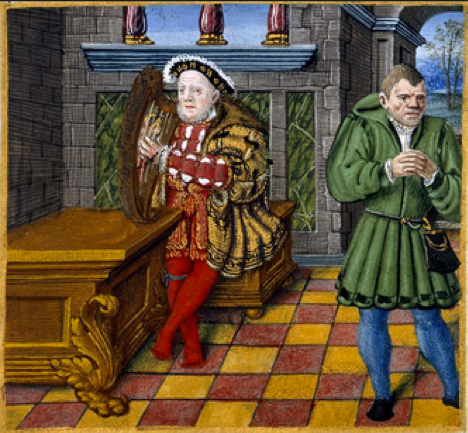
JERI WESTERSON: There is a proverb that tells us that “All places are full of fools” and I certainly can’t argue with that. But one fool in particular has always captured my imagination, possibly because he is so long-lived (as royal courts go). That would be Will Somers, Henry VIII’s court jester, who survived through Henry and all of his wives, in the court of his son Edward VI, Henry’s daughter Mary I, and even into the reign of Henry’s other daughter, Elizabeth I. 

That must have been one witty fellow. 


And yet, we know so little. He appears in a few paintings with Henry, usually somewhere in the background, and even one with a pet monkey on his shoulder; he appears in a few plays of the later time period, and in other contemporary novels. We believe he was born in Shropshire, he first shows up in the accounts at Henry’s court 28 June 1535, though we know he came to court ten years earlier, and we know the date of his death; 15 June 1560. But we don’t know exactly when he was born, if he ever married and had children, and of his personal life in general. 

There is a most interesting account written a hundred years after his death called “A Pleasant History of the Life and Death of Will Summers: How He Came First To The Be Known At Court, And By What Means He Got To Be King Henry The Eighth’s Jester; With The Entertainment That His Cousin Patch, Cardinal Wolsey’s Fool, Gave Him At The Lord’s House And How The Hogsheads Of Gold Were Known By His Means.” That’s a mouthful. Which means that there might be grains of truth in this account, but, well, mostly it can’t quite be trusted. Therefore, much of it is up for grabs. That makes my life easier as I write my series, though it’s just as easily problematic. 

“A Jester? A Jester? A funny idea a jester.” – from the 1955 film The Court Jester

But just what did a jester do? Men—and women—were fools or jesters. With two sorts of jesters: the “natural” kind of fool, meaning mentally challenged, deformed, or genetically little people, (and yes, part of their comical value was to make fun of their looks but also because they were thought to be guileless.) And then there was the cunning and crafty kind, true wits. These latter had to be quick-witted with a jibe or jest. Some were musically inclined and could sing and play for their masters (not always the monarch. Rich men and women had their own fools. Cardinal Wolsey had his own, a man named “Patch”, who became a friend of Will’s). 


A good fool could juggle, do acrobatics or at least pratfalls, was quick and often scathing with his tongue, and, most importantly, had the ear of the monarch. In my novel COURTING DRAGONS, I often have Will express he is therefore the most dangerous man in the court because he is close to the king, even calling him “uncle” or “Harry” in public. Except because of his staunch loyalty to Henry, he is also the safest man. 

And because my series is a mystery, Will Somers can also go anywhere he needs to go at court to do his amateur investigations, threading him nicely between the politics and intrigues that beset Henry VIII’s troubled reign. 


I think Will must have been a very likeable man, the sounding board for Henry and his wives, and Henry’s children, the other Tudor monarchs that came after him, whom Will must have entertained by playing with them when they were small. After all, these were Will’s family, the only family he would ever know after, on that fateful day, he was sent to the Tudor court to take up residence for the rest of his life. And like any person under those circumstances, he came to love those who became his surrogate intimates. It makes for some tender moments between fool and monarch. But it isn’t all drama, because Will is, after all, a fool, a man whose job it was to entertain, to make quips, to make fun of others. So there is, naturally, a lot of comedy as well.  

Let it not be said that he could ever turn away a good fart joke.    

_______________


Jeri Westerson is the author of the new King’s Fool Mysteries with the reluctant sleuth Will Somers, Henry VIII’s real court jester, solving mysteries and murder at the Tudor court. She is also the author of an upcoming Sherlockian series An Irregular Detective Mystery, the multi-award-nominated Crispin Guest Medieval Noir series, paranormal books, including a gaslamp-steampunk fantasy the Enchanter Chronicles Trilogy, standalone historicals, and an LGBTQ rom/com mystery series. See it all at JeriWesterson.com.


Thursday, November 4, 2021

A Medieval Mystery Series Comes To An End, a guest post by Jeri Westerson

 JULIA SPENCER-FLEMING: I first met Crispin Guest in 2008, along with the chronicler of his adventures, Jeri Westerson. I've been a fan ever since, so when Jeri told me Crispin was exiting the stage (hopefully not pursued by a bear) my first response was, "Oh, no!" 


But my second thought was, "That's perfect." How many times have you read the final novel (or watched the last episode) and been left a little disappointed - no ultimate resolution, threads left dangling, questions unanswered. There's a reason people still talk about The Fugitive - we found out what happened with Dr. Kimble and the one-armed man!


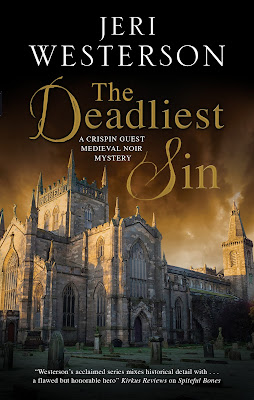
So though I'm sorry to see him go, I'm very, very excited to find out what happens to Crispin, his apprentice, Jack, their friends and family and Henry Bolingbroke (okay, I know what happens to Henry Bolingbroke) in THE DEADLIEST SIN.


What do you write for the last book of a series? How do you sum up over sixteen years of your time and devotion?

By killing people, of course.

Well, not random people, but people in the book. There still has to be a murder. Or multiple murders, and in this case, because it is set in London in the late fourteenth century, it seemed that it had to be in a priory and the deaths had to be in the manner of the Seven Deadly Sins, hence the title THE DEADLIEST SIN. And so Crispin Guest, medieval private detective, embarks on his last-ever case to solve in the tangled and shadowed realm of St Frideswide Priory in the heart of London.


Of course, in the background there are great political movements afoot that will change the course of English fortunes. King Richard II, a far from beloved king, may be in the process of being overthrown, and he hasn’t figured that out yet. Henry Bolingbroke, the son of Crispin’s mentor John of Gaunt, the duke of Lancaster, has returned from his banishment…with an army. And Crispin must decide whether to commit treason again—the thing that started him on this course with his own banishment from court and all the misfortunes and humiliations he’d endured for the last twenty years.


But it was no secret to me when I began writing this series how I would end it. As always happens when you are researching a particular time period, your expectations expand when you find out all sorts of interesting historical nuggets that lead you on to new ideas, new directions to aim for in your plotting about a disgraced knight who is hired to solve crimes. When you hang your fortunes on the real timeline, and put your fictional characters in there, a natural ending unfolds.

I always planned on ending the series in a particular year. For one, I felt it would round out the characters’ lives sufficiently. And for another, I didn’t want to get stale or repetitive in my writing of it. I think fifteen books is a good collection of novels and it leaves me time to work on new historical mysteries where I can research in some other time period or periods. Two of which, I am already writing: One in Tudor England, and another in Sherlock Holmes’ London. 


As a writer, I like to constantly challenge myself to find other stories to tell. And it’s nice to get the chance to do that. There’s something about writing in another time period that gives an author a great excuse to spend those hours in university libraries or online archives. No matter how long you are at it, it’s never wasted time.

What has been the most interesting to me is the reaction to ending the series from readers and librarians. “I hope you’ll continue the series with Jack Tucker investigating,” many have remarked. Jack is Crispin’s servant and protégé, who started as an orphaned street urchin and cutpurse, and grew up under Crispin’s (at first) reluctant guidance.

But the answer to that is “no”. There will not be any spin-offs or sequels. The series will be done and complete, and I will be onto other things, as mentioned above. It’s funny what a writer thinks about their characters and how they interact with them…as opposed to what the reader experiences. And being a reader myself, I get it when you aren’t allowed to experience any more of a favorite characters’ adventures. But I always think that the best characters have lives before one opens the book and when one closes the cover on the last page; that they continue to live their lives…somewhere. We’re just not privy to them. Those are the best adventures. The ones that linger on the minds of readers. The ones that endure.

I need to thank Julia Spencer-Fleming for taking me under her wing when this series started. She certainly didn’t have to. But it was very helpful for me to understand what I had to do to promote this series and the fact that I still enjoy her friendship all these years later, well… It’s this wonderful community of mystery writers I am grateful to. As well as the booksellers I got to know through this series, and all the librarians all over the country. A big thank you to all. Be on the lookout for more.


JULIA: Thank you, Jeri, for the many years of pleasure I've gotten from following the adventures of Crispin and young Jack. Readers,  do you like it when a series has an actual conclusion? Have there been any that you felt leave you hanging? Let us know, because one lucky commenter will win a signed copy of THE DEADLIEST SIN!

___________________________________________________

Jeri Westerson writes the CrispinGuest Medieval Noir novels, a fifteen-book series nominated for thirteen mystery awards. She also writes an urban fantasy series, Booke of the Hidden; a spin-off werewolf mystery series, Moonrisers; a gaslamp-steampunk fantasy series Enchanter Chronicles Trilogy; a few standalone historical novels; and a humorous/romantic LGBTQ mystery series, the Skyler Foxe Mysteries under the pen name Haley Walsh. Find them all and any future series at JeriWesterson.com. She is also happily active on social media at Facebook, Instagram, Pinterest, YouTube and Twitter.


Friday, October 9, 2020

It's All an Illusion, a guest post by Jeri Westerson

JULIA SPENCER-FLEMING: I've been a fan of Jeri Westerson since way back in mumble mumble when I blurbed one of her early Crispin Guest historical mysteries, a terrific series she describes quite accurately as "medieval noir." This penchant for blurring the lines between genres - or for inventing her own! - has come to fruition in her newest series, the Enchanter Chronicles. Which are historicals. And fantasies. And steampunk. And mysteries!

The second in the series, CLOCKWORK GYPSY, is coming out oh-so-appropriately on Hallowe'en, which gives you time to get started on THE DAEMON DEVICE, which introduces Leopold Kazsmer, The Great Enchanter, and the Special Inspector from Scotland Yard, Mingli Zhao.

Today, Jeri is going to tell us about the fantastical lives of Victorian magicians - and how they inspired her steampunk sensibilities.


“Strange how people imagine things in the dark.”

–Ira Erastus Davenport, Showman/Spiritualist c. 1910


Yes, they do. That’s most of the magic of the stage magician and, ideally, a magician plying his trade in the late nineteenth century.


I was solidly immersed in the medieval era, writing my Crispin Guest Medieval Noir mystery series. Then I made a little side trip in my research into Jewish mysticism and discovered “daemons” (the helpful kind) as opposed to “demons” (the dangerous kind) and all the symbolism behind numbers, colors, and even “magic words” in Jewish myth and mystery.


Magic got me to thinking about the fascinating time period of magicians in the late nineteenth century, where séances and the investigation into the next world compelled and enthralled, and science was still crossed with a certain level of mysticism, where maybe magic was a real possibility.


So I ventured from writing medieval mysteries to steampunk—a subgenre of science fiction and fantasy inspired by the steam-powered era. Technology is strictly steam-powered, even advanced technology, inspired by the works of H.G. Wells and Jules Verne, steampunk masters though they didn’t know it. The aesthetic involves top hats, goggles, gears, corsets, dirigibles, magic, and devices.


Magicians of the late Victorian era fascinated with their supposed close association to the supernatural world. Sometimes they never dropped character so they would seem all the more mysterious to the public. Like nineteenth century African American William Ellsworth Robinson who went by the stage name Chung Ling Soo. He played his part so well no one knew he was American, let alone a black man.


 As magician Fred Kaps once said, “Misdirect all the time.”


Strangely enough, Chung Ling Soo is best known for the failed bullet catch trick…that killed him. On stage. During a performance.


Howard Thurston, another American magician known as “The King of Cards”, was a champion of card tricks. “My object is to mystify and entertain. I wouldn’t deceive you for the world,” he said, all the while deceiving you. That was the trick, after all. To make it appear as if it really were magic. As if there was no trick at all. The more dangerous the conjure, the more amazing the magician appeared as he walked back onstage after escaping certain death without a scratch on him.


Charles Joseph Carter performed his tricks on stages all over the world. You might recall his posters that bragged that “Carter Beats the Devil”. In fact, many of the colorful posters of magicians of the past—including Carter’s—featured demons, little devils, and ghostly apparitions.


Some magicians bragged that they used the help of spirits in their acts in a time when spiritualism was at its zenith, and many mediums of the day included the illusionist’s art when staging their own private performances that they called séances. The veil between magician and medium was very thin indeed.


It was little wonder I got the idea to make my magician, Leopold Kazsmer a man of Jewish/Romani blood and ashamed of both, and styled himself as an English gentleman. He knows how to perform illusions but also the dangerous art of summoning Jewish daemons in order to perform real magic for his act…and to occasionally save the world through sleuthing for Scotland Yard.


French magician Jean-Eugène Robert-Houdin, father of modern magic, (and incidentally where Harry Houdini got his stage name), said, “A conjuror is not a juggler; he is an actor playing the part of a magician…I may even add that where sleight-of-hand is involved, the quieter the movement of the performer, the more readily will the spectators be deceived."


I think writers have a little magician in them, especially mystery writers. Readers trust what we write. They believe. They are misdirected…if we can keep the reader from seeing just how the trick is performed.


And hey, if I have to summon a daemon or two to get the job done, I will. Nothing up my sleeve. Promise.

-------------

Los Angeles native JERI WESTERSON is the author of historical novels and fourteen Crispin Guest Medieval NoirMystery novels, a series nominated for thirteen national awards from the Agatha to the Shamus. Jeri also writes the Enchanter Chronicles, a historical fantasy/steampunk mystery series, the latest of which is CLOCKWORK GYPSY. See her other paranormal series and historical novels at JeriWesterson.com. You can also friend her on Facebook, follow her on Instagram as @jeriwestersonauthor, and chat with her about books on Goodreads.

Thursday, September 6, 2012

Tourney, Joust, Mêlée - A Guest Blog by Jeri Westerson


JULIA SPENCER-FLEMING: If you've been following along at home for any amount of time, you know I love, love, love historical mysteries. And you also know I'm frequently amazed at the amount of research that goes into them; pouring over old photos and court records, reading up on clothing and food. My friend Jeri Westerson, however, doesn't stop there. She rubs medieval memorial plaques. She tracks down medieval relics. She takes pictures of medieval underwear (I promise, she's not a perv.) Honestly? I suspect she started writing her "medieval noir" mysteries so she could feed her habit. She says it's to reproduce the 14th century world of Crispin Guest, disgraced knight-turned-detective, but I think it's an excuse for her to put on her armor and hit the lists.


Two knights sit on horses and aim for each other with lances, trying to knock the other guy off the horse. This is what most people think a joust is. 
 

Not so fast.

There was far more to it than that, and more than Sir Walter Scott even knew in his Victorian potboiler, Ivanhoe.


Why does a mystery author give a joust the time of day? Because I write medieval mysteries, the Crispin Guest Medieval Noir series, to be exact, with my disgraced knight turned detective on the mean streets of fourteenth century London. 
 
But I digress. We were talking about tournaments. A tournament is not necessarily a joust, though a joust can happen at a tournament. Because a tournament is a competition of battling techniques, though it is likely it always involved some sort of horsemanship. The word tornoi from which we derive “tourney” and “tournament” alludes to a mounted charge with lances couched under the arm. It was a dangerous sport, but in the beginning even more so, if you can believe it. In the 12th and 13th centuries it was all about the mêlée or all out battle and these earlier games were going for the real thing with a field so wide it was set between the boundaries of two towns. If your village was unlucky enough to be in the way, well…let’s just say you got a front row seat. The lists were originally not the field set aside for jousting, but actually the place marked off to get out of the way of the battle. No one is sure where the word comes from. It might come from the lil, the designated spot in the French martial court where such games of skill were played, or from licium (band of material) or palicium (paling) the stuff surrounding the lists.


At any rate, William Marshall, the knight of knights from the 13th century, wrote down many of the rules for being a knight and for the proper comportment at a tournament. He even explained how a young knight could make a lot of scratch from ransoms and prizes by “doing the circuit” of the tournaments.


Of course, it’s all fun and games until someone puts out an eye. Or loses a limb. Or gets killed. There were detractors. The Church wasn’t happy with this careless use of manpower. Sixty men alone met their end in a tournament near Cologne in 1240, not from battle, but suffocating from the heat and dust. In 1193, Pope Celestine III declared an edict against tournaments but, maneuvering around it, Richard the Lionheart granted licenses for tournaments anyway. The Church went further to discourage it by declaring a ban on sacramental burial for those who died during a tournament, but the clever knights got around that, too, by slipping a monk’s habit on the dying knight and proclaiming him a cleric. 

 
As armor got better, that is, moved into the era of plate armor rather than simply mail, it became possible to support tournaments with fewer casualties. But it was the joust that made tournaments more acceptable because this was a bout between only two combatants at a time. The word “joust” likely derives from the Latin juxtare—to come together. And indeed, they do.


Two men, mounted on chargers—big warhorses—run at each other between a barrier at full gallop, lowering lances aimed at the other. What could be better than that?
There were three points on the body the knight aimed for: the four nails on the shield, the helm, or the throat armor. Usually, it was a test of three broken lances. If you could withstand the hits without being unhorsed, you could call a draw, keep going, or continue on foot.


With time, more regulations were added and more order took over the rather rough and tumble that the tournaments used to be, making tournaments truly the sport of kings. By the fourteenth century when my books are set, a joust could be held for all occasions; royal weddings, coronations, and even for deciding judicial matters. In my upcoming book BLOOD LANCE, one of the threads of the story involves a dishonored knight accused of desertion. Meanwhile, Crispin witnesses a body hurtling from London Bridge into the Thames. Whispers claim it’s suicide but Crispin insists otherwise. Now he’s caught between rebellious actions in King Richard’s court, an old friend’s honor, and the true ownership of the legendary Spear of Longinus, culminating in a deadly joust on London Bridge.


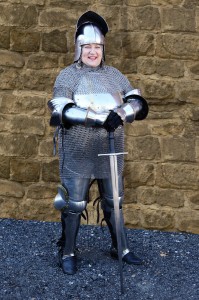
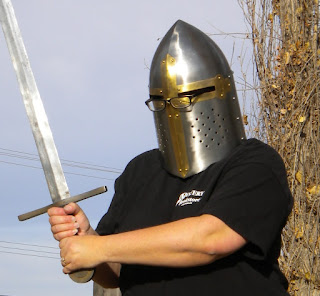
Because such feats of arms always seem integral to my stories, I find myself doing a bit of hands on research. Yes, you can find me in armor now and again, doing my best to capture the feel of what my characters are going through, whipping a sword around, and harassing the populace. 
 

I was most definitely born in the wrong century.
(And yes, those pictures are of me, doing my best research for Crispin). 


BLOODLANCE will be released October 16, 2012 in hardcover, ebook, and audiobook. Find out more on Jeri’s website, including a book trailer and a video on Jeri’s swordcraft. You can read her not-to-be-missed blog, Getting Medieval, and follow her on Twitter as @jeriwesterson. She's not on Facebook, but Crispin Guest is! (His interests include solving crimes, hunting, and hawking.)

Jeri is offering a copy of BLOOD LANCE to one lucky commentor! So hop onto the back-blog and tell us what you'd have been doing back in the Middle Ages!