Showing posts with label medieval noir. Show all posts

Thursday, November 4, 2021

A Medieval Mystery Series Comes To An End, a guest post by Jeri Westerson

 JULIA SPENCER-FLEMING: I first met Crispin Guest in 2008, along with the chronicler of his adventures, Jeri Westerson. I've been a fan ever since, so when Jeri told me Crispin was exiting the stage (hopefully not pursued by a bear) my first response was, "Oh, no!" 


But my second thought was, "That's perfect." How many times have you read the final novel (or watched the last episode) and been left a little disappointed - no ultimate resolution, threads left dangling, questions unanswered. There's a reason people still talk about The Fugitive - we found out what happened with Dr. Kimble and the one-armed man!


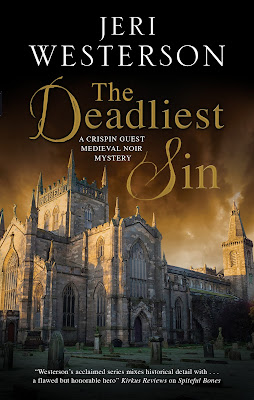
So though I'm sorry to see him go, I'm very, very excited to find out what happens to Crispin, his apprentice, Jack, their friends and family and Henry Bolingbroke (okay, I know what happens to Henry Bolingbroke) in THE DEADLIEST SIN.



What do you write for the last book of a series? How do you sum up over sixteen years of your time and devotion?

By killing people, of course.

Well, not random people, but people in the book. There still has to be a murder. Or multiple murders, and in this case, because it is set in London in the late fourteenth century, it seemed that it had to be in a priory and the deaths had to be in the manner of the Seven Deadly Sins, hence the title THE DEADLIEST SIN. And so Crispin Guest, medieval private detective, embarks on his last-ever case to solve in the tangled and shadowed realm of St Frideswide Priory in the heart of London.
 

Of course, in the background there are great political movements afoot that will change the course of English fortunes. King Richard II, a far from beloved king, may be in the process of being overthrown, and he hasn’t figured that out yet. Henry Bolingbroke, the son of Crispin’s mentor John of Gaunt, the duke of Lancaster, has returned from his banishment…with an army. And Crispin must decide whether to commit treason again—the thing that started him on this course with his own banishment from court and all the misfortunes and humiliations he’d endured for the last twenty years.


But it was no secret to me when I began writing this series how I would end it. As always happens when you are researching a particular time period, your expectations expand when you find out all sorts of interesting historical nuggets that lead you on to new ideas, new directions to aim for in your plotting about a disgraced knight who is hired to solve crimes. When you hang your fortunes on the real timeline, and put your fictional characters in there, a natural ending unfolds.
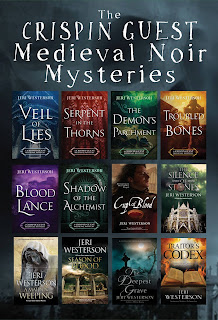
I always planned on ending the series in a particular year. For one, I felt it would round out the characters’ lives sufficiently. And for another, I didn’t want to get stale or repetitive in my writing of it. I think fifteen books is a good collection of novels and it leaves me time to work on new historical mysteries where I can research in some other time period or periods. Two of which, I am already writing: One in Tudor England, and another in Sherlock Holmes’ London. 


As a writer, I like to constantly challenge myself to find other stories to tell. And it’s nice to get the chance to do that. There’s something about writing in another time period that gives an author a great excuse to spend those hours in university libraries or online archives. No matter how long you are at it, it’s never wasted time.
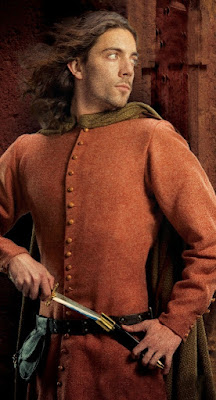
What has been the most interesting to me is the reaction to ending the series from readers and librarians. “I hope you’ll continue the series with Jack Tucker investigating,” many have remarked. Jack is Crispin’s servant and protégé, who started as an orphaned street urchin and cutpurse, and grew up under Crispin’s (at first) reluctant guidance.

But the answer to that is “no”. There will not be any spin-offs or sequels. The series will be done and complete, and I will be onto other things, as mentioned above. It’s funny what a writer thinks about their characters and how they interact with them…as opposed to what the reader experiences. And being a reader myself, I get it when you aren’t allowed to experience any more of a favorite characters’ adventures. But I always think that the best characters have lives before one opens the book and when one closes the cover on the last page; that they continue to live their lives…somewhere. We’re just not privy to them. Those are the best adventures. The ones that linger on the minds of readers. The ones that endure.
I need to thank Julia Spencer-Fleming for taking me under her wing when this series started. She certainly didn’t have to. But it was very helpful for me to understand what I had to do to promote this series and the fact that I still enjoy her friendship all these years later, well… It’s this wonderful community of mystery writers I am grateful to. As well as the booksellers I got to know through this series, and all the librarians all over the country. A big thank you to all. Be on the lookout for more.


JULIA: Thank you, Jeri, for the many years of pleasure I've gotten from following the adventures of Crispin and young Jack. Readers,  do you like it when a series has an actual conclusion? Have there been any that you felt leave you hanging? Let us know, because one lucky commenter will win a signed copy of THE DEADLIEST SIN!

___________________________________________________

Jeri Westerson writes the CrispinGuest Medieval Noir novels, a fifteen-book series nominated for thirteen mystery awards. She also writes an urban fantasy series, Booke of the Hidden; a spin-off werewolf mystery series, Moonrisers; a gaslamp-steampunk fantasy series Enchanter Chronicles Trilogy; a few standalone historical novels; and a humorous/romantic LGBTQ mystery series, the Skyler Foxe Mysteries under the pen name Haley Walsh. Find them all and any future series at JeriWesterson.com. She is also happily active on social media at Facebook, Instagram, Pinterest, YouTube and Twitter.


Thursday, September 6, 2012

Tourney, Joust, Mêlée - A Guest Blog by Jeri Westerson


JULIA SPENCER-FLEMING: If you've been following along at home for any amount of time, you know I love, love, love historical mysteries. And you also know I'm frequently amazed at the amount of research that goes into them; pouring over old photos and court records, reading up on clothing and food. My friend Jeri Westerson, however, doesn't stop there. She rubs medieval memorial plaques. She tracks down medieval relics. She takes pictures of medieval underwear (I promise, she's not a perv.) Honestly? I suspect she started writing her "medieval noir" mysteries so she could feed her habit. She says it's to reproduce the 14th century world of Crispin Guest, disgraced knight-turned-detective, but I think it's an excuse for her to put on her armor and hit the lists.


Two knights sit on horses and aim for each other with lances, trying to knock the other guy off the horse. This is what most people think a joust is. 
 

Not so fast.

There was far more to it than that, and more than Sir Walter Scott even knew in his Victorian potboiler, Ivanhoe.


Why does a mystery author give a joust the time of day? Because I write medieval mysteries, the Crispin Guest Medieval Noir series, to be exact, with my disgraced knight turned detective on the mean streets of fourteenth century London. 
 
But I digress. We were talking about tournaments. A tournament is not necessarily a joust, though a joust can happen at a tournament. Because a tournament is a competition of battling techniques, though it is likely it always involved some sort of horsemanship. The word tornoi from which we derive “tourney” and “tournament” alludes to a mounted charge with lances couched under the arm. It was a dangerous sport, but in the beginning even more so, if you can believe it. In the 12th and 13th centuries it was all about the mêlée or all out battle and these earlier games were going for the real thing with a field so wide it was set between the boundaries of two towns. If your village was unlucky enough to be in the way, well…let’s just say you got a front row seat. The lists were originally not the field set aside for jousting, but actually the place marked off to get out of the way of the battle. No one is sure where the word comes from. It might come from the lil, the designated spot in the French martial court where such games of skill were played, or from licium (band of material) or palicium (paling) the stuff surrounding the lists.


At any rate, William Marshall, the knight of knights from the 13th century, wrote down many of the rules for being a knight and for the proper comportment at a tournament. He even explained how a young knight could make a lot of scratch from ransoms and prizes by “doing the circuit” of the tournaments.


Of course, it’s all fun and games until someone puts out an eye. Or loses a limb. Or gets killed. There were detractors. The Church wasn’t happy with this careless use of manpower. Sixty men alone met their end in a tournament near Cologne in 1240, not from battle, but suffocating from the heat and dust. In 1193, Pope Celestine III declared an edict against tournaments but, maneuvering around it, Richard the Lionheart granted licenses for tournaments anyway. The Church went further to discourage it by declaring a ban on sacramental burial for those who died during a tournament, but the clever knights got around that, too, by slipping a monk’s habit on the dying knight and proclaiming him a cleric. 

 
As armor got better, that is, moved into the era of plate armor rather than simply mail, it became possible to support tournaments with fewer casualties. But it was the joust that made tournaments more acceptable because this was a bout between only two combatants at a time. The word “joust” likely derives from the Latin juxtare—to come together. And indeed, they do.


Two men, mounted on chargers—big warhorses—run at each other between a barrier at full gallop, lowering lances aimed at the other. What could be better than that?
There were three points on the body the knight aimed for: the four nails on the shield, the helm, or the throat armor. Usually, it was a test of three broken lances. If you could withstand the hits without being unhorsed, you could call a draw, keep going, or continue on foot.


With time, more regulations were added and more order took over the rather rough and tumble that the tournaments used to be, making tournaments truly the sport of kings. By the fourteenth century when my books are set, a joust could be held for all occasions; royal weddings, coronations, and even for deciding judicial matters. In my upcoming book BLOOD LANCE, one of the threads of the story involves a dishonored knight accused of desertion. Meanwhile, Crispin witnesses a body hurtling from London Bridge into the Thames. Whispers claim it’s suicide but Crispin insists otherwise. Now he’s caught between rebellious actions in King Richard’s court, an old friend’s honor, and the true ownership of the legendary Spear of Longinus, culminating in a deadly joust on London Bridge.


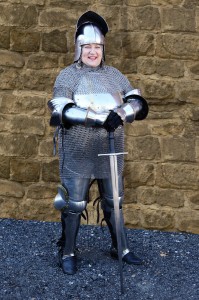
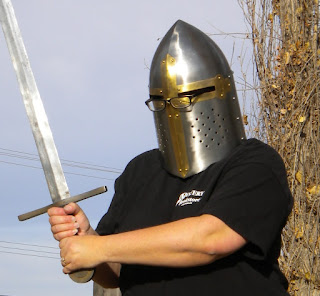
Because such feats of arms always seem integral to my stories, I find myself doing a bit of hands on research. Yes, you can find me in armor now and again, doing my best to capture the feel of what my characters are going through, whipping a sword around, and harassing the populace. 
 

I was most definitely born in the wrong century.
(And yes, those pictures are of me, doing my best research for Crispin). 


BLOODLANCE will be released October 16, 2012 in hardcover, ebook, and audiobook. Find out more on Jeri’s website, including a book trailer and a video on Jeri’s swordcraft. You can read her not-to-be-missed blog, Getting Medieval, and follow her on Twitter as @jeriwesterson. She's not on Facebook, but Crispin Guest is! (His interests include solving crimes, hunting, and hawking.)

Jeri is offering a copy of BLOOD LANCE to one lucky commentor! So hop onto the back-blog and tell us what you'd have been doing back in the Middle Ages!