
Showing posts with label Karen Odden. Show all posts

Wednesday, November 10, 2021

Memories of Reading by Karen Odden

Announcing book winners! Lynn in Texas has won FOGGED OFF by Wendall Thomas and Diana aka Bibliophile has won THE DEADLIEST SIN by Jeri Westerson. Ladies, contact julia spencer fleming (all one word) at the Google mail, and I'll hook you up.


Jenn McKinlay: Very happy to have a fellow Arizonan on the blog today! Our historical mystery readers will be thrilled to have the super talented Karen Odden in the house as we celebrate the release of her latest Inspector Corravan mystery! 


Karen: Thanks so much to the Jungle Reds and Jenn McKinlay

for inviting me today! I think this is my third appearance here, and

over the years, I have loved all the conversations about life,

travel, fears, writing, dogs, and books that happens on this site.

I don’t always comment, but I learn a ton from listening in!


        When people ask me why I write mysteries, I can name

plenty of reasons. For one, there were unspoken words and

secrets in my house of origin that confused me deeply as a

child and resulted in a messy knot of perplexity. I think that

certainly contributes to my desire to craft the happier, smoother

version of that arc, from confusion to clarity, in mysteries. But

other reasons are that when I was twelve, I didn’t play bridge,

and it rains and snows a lot in upstate New York.


         I grew up in Rochester, and most Sundays, my family would

go to my grandparents’ house, about twenty minutes away. They

lived in a sprawling one-story stone ranch in Bergen, a very rural

town with one blinking traffic light and acres of pine trees. On

sunny days in the summer, the whole family—my grandparents,

their five children, and the dozen or so grandchildren, of which I

was the oldest—went to the pavilion for picnics and volleyball

games (I was terrible, always picked last). But on days when it

rained or snowed, which comprised most of the year, the

grownups would gather in the living room at two folding card

tables and play bridge. I could hear their bids (“one no trump”

“two spades”) and mildly snarky chatter from the next room over,

which was the library, a square room with a stone fireplace and

one of those sideways-S-shaped chairs covered in

mustard-colored thick pile, almost like fur. It rocked clunkily

into one of two positions, forward and back, and there was a

light with an adjustable brass arm overhead. Now, usually my

grandfather occupied that chair to watch football, but once he

was in the living room playing bridge, it was mine.


         On the floor-to-ceiling wooden shelves were all kinds of

books—some heavy-duty dull looking medieval history books,

with their navy or black cloth binding fraying at the edge and the

writing on the spine faded; my grandfather’s medical treatises,

with the transparent pages overlaying the skeletons with nerves

and organs; and my grandmother’s bodice rippers, with the

grammar corrected in pen in the margins. I’m not kidding; she

was particular about English usage and deplored phrases such

as “between you and I” and “he was taller than me”.


None of those books particularly interested me. But one day my grandmother pointed me toward a shelf of books by Mary Stewart, Victoria Holt, and Daphne DuMaurier in hardback, with the paper jackets. I devoured them, one per visit, entranced by their settings in exotic Greece and France and Austria and by their portrayals of everyday people in uncertainty and fear. Then I re-devoured them.

Rebecca, Jamaica Inn, The Shivering Sands, The Curse of the Kings,
Nine Coaches Waiting, The Ivy Tree, Airs Above the Ground,
This Rough Magic, The Moon-spinners. (To my delight, I found 
a Disney movie of the last, starring Hayley Mills.) I think these 
books probably laid down tracks in my brain that I’ve never 
quite jumped off.


They were the natural continuation of books I’d read even

younger—Nancy Drew, of course, with her friends Bess and

George and Ned Nickerson. Remember her powder blue

convertible, and her indulgent father, Carson? And then

Trixie Belden, with Honey Wheeler and Jim, the red-headed

orphan the Wheelers adopted, and all the other Bob-whites.

Cherry Ames and Sue Barton, which depicted the nursing

profession as full of adventure and mysteries. Phyllis Whitney’s

young adult mysteries and Elizabeth George Speare’s 

The Witch of Blackbird Pond which isn’t 

really a mystery but is full of suspense, tinged with

romance.
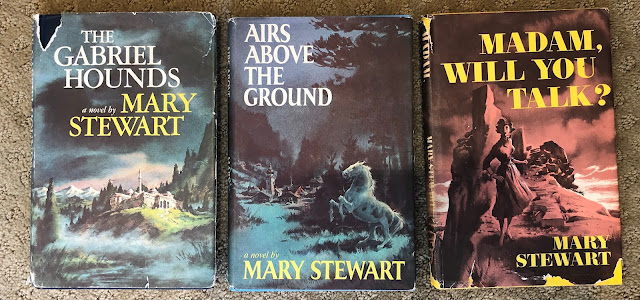


Before she died, my grandmother gave her collection of Mary Stewart and Victoria Holt to me, and once in a while, when I’m in a particular mood, I reread them. Those books are like one of those portkeys in Harry Potter, for I can almost feel myself back in that 1970s lounger with the mustard-colored fake fur and the fire on the hearth warding off the chill.

         What was your favorite place to read growing up?


KAREN ODDEN received her Ph.D. in English literature from New York University and subsequently taught at the University of Wisconsin-Milwaukee. She has contributed essays and chapters to many academic books and journals; she wrote introductions to novels by Dickens and Trollope for the Barnes and Noble Classics Series; and she served as an Assistant Editor for the journal Victorian Literature and Culture. She freely admits she might be more at home in nineteenth-century London than today, especially when she tries to do anything complicated on her iPhone.


All of her mysteries are set in 1870s London. Her first novel, A LADY IN THE SMOKE, was a USA Today bestseller and won a New Mexico-Arizona 2017 Book Award. Her second novel, A DANGEROUS DUET, introduces readers to Nell Hallam, an ambitious young pianist in 1870s London, who stumbles on a notorious crime ring while playing in a Soho music hall. In A TRACE OF DECEIT, Annabel Rowe, a young painter at the Slade School of Art, must delve below the glitter of the art and auction world to uncover the truth about her brother's murder.

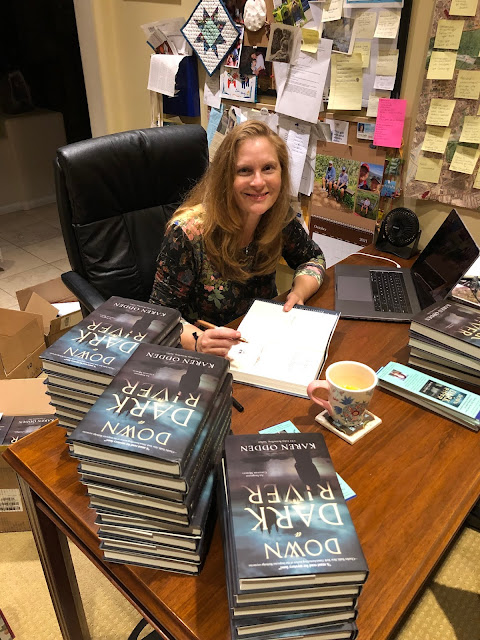
In her fourth mystery, DOWN A DARK RIVER (November 2021), Scotland Yard Inspector Michael Corravan, a former thief and bare-knuckles boxer, is faced with a series of young women's corpses placed in small boats and sent floating down the Thames.

Wednesday, May 18, 2016

Karen Odden: Trains and Trauma


SUSAN ELIA MACNEAL: Today I'm delighted to introduce debut historical mystery writer Karen Odden. She's the author of A LADY IN THE SMOKE: A VICTORIAN MYSTERY:


Following a humiliating fourth Season in London, Lady Elizabeth Fraser is on her way back to her ancestral country estate when her train careens off the rails and bursts into flames. Though she is injured, she manages to drag herself and her unconscious mother out of the wreckage, and amid the chaos that ensues, a brilliant young railway surgeon saves her mother’s life. Elizabeth feels an immediate connection with Paul Wilcox—though society would never deem a medical man eligible for the daughter of an earl.


After Paul reveals that the train wreck was no accident, and the inspector who tried to prevent it dies under mysterious circumstances, Elizabeth undertakes a dangerous investigation of her own that leads back to her family’s buried secrets. The more she learns, the more she must risk. Not only are her dowry and her reputation at stake; Paul’s very life hangs in the balance when he is arrested for manslaughter. As the trial draws near, and Parliament prepares for a vote that will change the course of the nation, Elizabeth uncovers a conspiracy that has been years in the making. But time is running out for her to see justice done.


Today Karen's visiting Jungle Reds to talk about Victorians, railway accidents, and trauma. As someone who writes about war and PTSD (before it was even diagnosed or named that) I found this piece fascinating. Welcome, Karen!

KAREN ODDEN: When I first began researching railways over a decade ago, my interest was actually in trauma. I’d been reading Oppenheim and Freud, whose late-1800s treatises began to describe traumatic neurosis. But as I read, I found myself thinking, OK, these guys are clever, but surely the notion of “trauma” didn’t spring into their heads out of nowhere. As I began to read histories of trauma and PTSD (a diagnosis officially accepted in 1980), I realized that to some extent, trauma began with the accounts of Victorian railway disasters.

One of the most famous accounts came from Charles Dickens, who survived a horrifying crash in 1865. He crawled out of his toppled railway car, dragging his mistress Ellen Ternan, her mother, and his manuscript for Our Mutual Friend behind him. He spent several hours ministering to other victims, serving them brandy from his hat. Then, he walked home. But in the days following, he had ringing in his ears; he had nightmares; and his hands shook so badly he couldn’t sign his usual flourish. By the 1860s, some medical men attributed these symptoms to “railway spine” or “concussion of the spine.” But most admitted they didn’t really understand it.

Intrigued by all this, I headed off to the London libraries to see if I could find other accounts. Little did I know. I found hundreds of newspaper articles, poems, sensation novels, parliamentary papers, cartoons, pamphlets, and medical treatises. Clearly, Victorians had a lot of anxiety about railway accidents! What I began to notice, though, was how many accounts hinted at how the experience was beyond words: “This railway disaster is simply too terrible to describe”; “the horror of it defies all description.” 

On the other hand, there were often strange overlaps or excesses in the accounts. For example, this illustration from a medical textbook is of a spine, but it’s drawn in a way that suggests a railway track too; thus, one illustration suggests both the cause of the injury and the injury itself. With a jolt, I realized that these failures of language and excesses of meaning were akin to the unspeakability and profusion of symptoms that we now associate with trauma and PTSD.

What began to interest me—after I recovered from the painful dissertation process—was how creative writers since the late 1800s have experimented with different literary elements to represent trauma.

One modern example is Tender is the Night. Beginning in 1925 and drawing on his experience of his wife Zelda’s mental illness, Fitzgerald wrote this story about a psychoanalyst Dick Diver and his former patient/wife Nicole, who suffers from mental illness brought about by the (arguably) traumatizing experience of being molested by her father. Significantly, in the first version, the novel contains three sections: the troubled present; a jump to the past (when Dick treated Nicole); and a return to the present. Perhaps not surprisingly, his critics didn’t like the “novel” structure. After Fitzgerald’s death, his friend Malcolm Cowley revised it so the story became chronological. But I think part of the power and discomfort that the original novel generates comes from the ruptures. 

Jump forward to after WWII, when the symptoms of “shell shock” (a post-WWI diagnosis) were well known. One of my favorite J.D. Salinger’s stories, “For Esme—with Love and Squalor” (1948) concerns a WWII soldier who meets a precocious young girl in an English tearoom before he leaves for the front. He survives five campaigns, but afterward he suffers from nervous tics; he can’t sleep or eat; he smokes incessantly; he has chewed his nails down until they bleed. Halfway through the story, there is a gap of white space, followed by:

            This is the squalid … part of the story. I’m still around, but from here on … I’ve disguised myself so cunningly that even the cleverest reader will fail to recognize me.   
            It was about ten-thirty at night in Gaufurt, Bavaria, several weeks after V-E Day. Staff Sergeant X was in his room on the second floor of the civilian home in which he and nine other American soldiers had been quartered, even before the armistice.

The shift from first-person to third-person, the white space, and the meta-comment about the “disguise” suggest that by this point, conventions existed for representing the trauma of war, and people could begin to acknowledge war’s effects on those who survived it.

Now for the twenty-first century. I just read Alison Bechdel’s graphic novel “Fun Home,” which demands a constant, even jarring switch back and forth between words and pictures. As I read, I felt in some way that the constant switching made me feel the unease of shuffling between two realities: the pain of knowing a frightening truth about a father and the desire not to know it.

What I love about literature is that it evolves. Maybe, as Christopher Booker once wrote, there are really only seven plots; I don’t know. But the ways stories are told changes over time. The flashback that breaks Tender is the Night doesn’t seem so “novel” any more. We’ve all seen the wry type of “meta” that Salinger uses in “Esme.” But what keeps literature vital is that writers are continually experimenting with form and structure and language, daring to stretch the bounds for representing human experience.


SUSAN ELIA MACNEAL: Thank you, Karen! Reds and lovely readers, we all read lots of mysteries and thrillers. Many of them deal with murder in an intellectual way (Sherlock Holmes, for example), yet others let their protagonists take the brunt of what they have witnessed and experienced. Who's your favorite character who's experienced a profound change in life/personality/outlook due to trauma? Who's your favorite character who seems to remain perpetually trauma-free? Please tell us in the comments!


Karen Odden's interest in the Victorian era and specifically railway crashes goes back to her New York University doctoral dissertation, which explored how the medical, parliamentary, and literary representations of railway disasters helped to create a discourse out of which Freud and others fashioned their ideas of “trauma.”

Karen has served as an Associate Lecturer at the University of Wisconsin-Milwaukee and taught classes in English language and literature at New York University and the University of Michigan-Ann Arbor. She has contributed essays and chapters to books and journals, including Studies in the Novel, Journal of Victorian Culture, and Victorian Crime, Madness, and Sensation; and she has written introductions for Barnes and Noble’s Classics Series editions of books by Dickens and  Trollope. Prior to receiving her Ph.D. in English, she worked as an Editorial Assistant at Harcourt Brace Jovanovich and McGraw-Hill, as a Media Buyer for Christie’s Auction House in New York, and as a bartender at the airport in Rochester, where she learned how to stop being shy. She is a member of SCBWI and Mystery Writers of America; and she 
currently serves as an Assistant Editor for the academic journal, Victorian Literature and Culture (Cambridge UP).

Karen currently resides in Scottsdale, Arizona with her husband, her two children, and her ridiculously cute beagle, Rosy.






