Showing posts with label Libby Hellmann. Show all posts

Friday, February 26, 2016

Edward Snowden's Tips On How to Take Back Your Privacy @LibbyHellmann


 LUCY BURDETTE: Our friend Libby Hellmann always brings interesting blogs to the table to celebrate her new books. This time she's launching JUMP CUT, an Ellie Foreman thriller, much concerned about privacy. I'll let her tell you...

 “The typical methods of communication today betray you silently, quietly, invisibly, at every click. At every page that you land on, information is being stolen. It’s being collected, intercepted, analyzed, and stored by governments, foreign and domestic, and by companies.” Edward Snowden

LIBBY HELLMANN: Regardless whether you think Edward Snowden is a hero or a traitor, he has ignited a firestorm about the lengths and limits that government and corporations do and should have over our privacy. In fact, the issue of privacy is at the heart of my new thriller, Jump Cut, the first Ellie Foreman thriller in ten years. Ellie finds herself under surveillance… not only her phones are tapped, but her computers are hacked, and her car has a tracker on it.

Remember when we learned the average person was caught on video cameras at least 6 times a day? And how our emails were (and continue to be) hijacked by phishers? And how our identities can be stolen off our computers or smart phones in an instant with the right tools? What Snowden did was take the theft of privacy to a higher level, by showing us how easy it is for organizations to capture even more data and information.

Facebook is fully aware of your password security questions, your personal details are stored by Gmail and plenty of other websites. Your internet service provider knows exactly who you are, where you live, your credit card number, when you made your last payment, and how much you spent. Retailers track your every visit online.

No wonder there's a growing movement of ordinary people protesting government and corporate snooping. It's serious business. And if you’re anything like Ellie, you’d want to know what to do to arm yourself against privacy and security “thieves.”.

Fortunately, Edward Snowden was interviewed in a Moscow hotel last October, and, in addition to a broad commentary on privacy, surveillance and encryption, he also offered a detailed look into opsec (operations security) and how to improve your own personal security and privacy.

Here's what he recommends.

  1. Use Tor, the private browser. Snowden says it's the “most important privacy-enhancing technology project being used today”, letting you keep your physical location private and look things up without leaving a trace to identify you.

  1. Encrypt all phone calls and text messages. Use a free smartphone app like Signal, by Open Whisper Systems. When you do this, nobody can read or hear your conversations. It's available for iOS and Android, and it's really easy to use. Although I didn’t name it, this is the system Ellie’s boyfriend downloads to her smart phone in JUMP CUT.


  1. Encrypt your hard disk. If your machine gets stolen, nobody can see where you live, look at your files or anything else.

  1. Use a password manager to stop your login details from being exposed. It will let you create a unique password for every site you need to log into. They're unbreakable, and you don't need to remember them. Snowden recommends KeePassX, a free cross-platform manager that never stores information in the cloud.

  1. Use two-factor authentication so if your password gets stolen the provider can send you a secondary way to authenticate your identity, for example in a text message. When you do this, anyone wanting to hack you has to have your password plus an actual device, like your phone, to complete the transaction.

  1. Use ad blocking software to cut the risk of vulnerabilities in code like Javascript and Flash.
  

Extreme  protection?

What if you want to go even further? Snowden recommends using software called SecureDrop – a system for whistleblowers - over the Tor network, so there's no connection with the computer you're using. You could also use an operating system like Tails, which leaves no forensic trace on the computer you're using. Take things even further and you're looking at using disposable machines, which can't be found in a raid so can't be appropriated and analyzed.

As Snowden says (and he would know):

“This is to be sure that whoever has been engaging in this wrongdoing cannot distract from the controversy by pointing to your physical identity. Instead they have to deal with the facts of the controversy rather than the actors that are involved in it.”

He goes on to say, “We need means of engaging in private connections to the internet. We need ways of engaging in private communications. We need mechanisms affording for private associations. And ultimately, we need ways to engage in private payment and shipping, which are the basis of trade. We need to find a way to protect the rights that we ourselves inherited for the next generation.”


Where does it end?

You can keep going to deeper and deeper levels, and I’m sure some people do. Or you could stay sane and concentrate on the six steps Snowden suggests. They will help thwart the most common and realistic threats to your personal security.

How many of you have implemented even one of Snowden’s suggestions? Unfortunately, I haven’t. But Ellie has, so at least she’s protected. 

Libby Fischer Hellmann left a career in broadcast news in Washington, DC and moved to Chicago 35 years ago, where she, naturally, began to write gritty crime fiction. Twelve novels and twenty short stories later, she claims they’ll take her out of the Windy City feet first. She has been nominated for many awards in the mystery and crime writing community and has even won a few. 

With the addition of Jump Cut in 2016, her novels include the now five-volume Ellie Foreman series, which she describes as a cross between “Desperate Housewives” and “24;” the hard-boiled 4-volume Georgia Davis PI series, and three stand-alone historical thrillers that Libby calls her “Revolution Trilogy.” Last fall The Incidental Spy,  a historical novella set during the early years of the Manhattan Project at the U of Chicago was released. Her short stories have been published in a dozen anthologies, the Saturday Evening Post, and Ed Gorman’s “25 Criminally Good Short Stories” collection.  In 2005 Libby was the national president of Sisters In Crime, a 3500 member organization dedicated to the advancement of female crime fiction authors.
 

Tuesday, September 9, 2014

Libby Hellmann, Reluctant Writer


SUSAN ELIA MACNEAL: Welcome, Libby Hellmann — and congratulations on the publication of your eleventh novel and fourth in the hard-boiled PI Georgia Davis series, NOBODY’S CHILD! Libby's novels are dark and twisty — as she herself says of her work: "Think Karin Slaughter or Tess Gerritsen on steroids."

Libby's dropping by today to celebrate the publication of NOBODY'S CHILD — but is talking more about being a reluctant writer. (Certainly, none of the Reds use any of Libby's procrastination techniques, right? Right? RIGHT? Oh, never mind...)


Without further ado, here's Libby!


LIBBY HELLMANN: Hi, Reds. And Reds readers. It’s great to be back!

I came across an article not long ago titled “My Friend Thinks I Don't Work Because I'm a Writer…” In defense, the author said this:

Even when we procrastinate, we are working, because we are so consciously aware of the fact that we are NOT producing in that moment but we're thinking about WHAT we're going to say when we actually do sit down at the computer.


I wish I could claim that as an excuse. But, alas, I don’t think it applies to me. At least consciously. I’ve always been a “reluctant” writer — writing fiction is the hardest thing I’ve ever done. I am not one of those people who can’t wait to let words and images pour out of them. Who write ten pages in an hour. You know the type. Maybe you’re one of them. If so, I’m jealous. I’ll do ANYTHING to keep from writing. In fact, I have no idea how I wrote the latest four thrillers, including Nobody’s Child. The sad part is that I used to be more productive. I had a day job, a schedule, a routine. I wrote early in the morning and churned out eight or nine books. Now though, it all seems to have dissipated into the ether.

To that end, here is a typical day for me.


7 am: Coffee and email. Respond. Check my rankings on various online booksellers. Check my number of Twitter followers, FB friends, Google+ circles.

8 am: Walk the dog and listen to an audiobook (The most enjoyable part of my day)

8:30 am: Work out.

9:45 am: Shower and get dressed. Wonder if it’s time for lunch.

10:30 am: Check email, Twitter, Google +. Respond if necessary. Unsubscribe from all the shopping emails that are cluttering up my inbox.

11:00 am:  Go through my photos of Europe for the blogpost I promised myself I’d post two weeks ago. Remember how the Tiergarten in Berlin gave me an idea for one of the scenes in the novella I’m supposed to be writing.

11:30 am: Open the document I’m supposed to be writing. Read it again. Make one or two small revisions.

Noon:  It’s lunchtime. Yay! Let dog out in the yard.

1:00 pm:  Decide to write a blogpost. Start researching. Find a couple of articles whose titles are so captivating that I need to read them right away.

1:30 pm: Look out the window. Watch the mailman come. Wonder if I should go out and get mail. Or whether I need to go to the grocery store.  Or the bank.  Or the cleaners.

2:00 pm: Realize two-thirds of the day is gone and I haven’t written anything. Let the dog back in.

2:15 pm: Check my email and book rankings. Go on Facebook. Respond and reply. Wonder why I’m not getting more emails cluttering  up my inbox.

3:00 pm: Call a friend or two or five. Or go to grocery store. Let dog ride in back because it’s his favorite thing to do.

3:45 pm: Realize only 90 minutes remain before the evening news. Start reading one of the articles I’ve bookmarked about promotion or Google Plus or foreign translations or something.

4:00 pm: Have a glass of wine because it’s 5 o’clock someplace. In the unlikely event I’m abstaining, a cup of tea.

4:15 pm: Start writing. One tortured paragraph at a time. After all, I only have to do it for 45 minutes.

5:00 pm: Stop writing. Watch the news. Think about dinner. Check email. Wonder if there are productivity shrinks and if I should try to find one.

Evening: Binge watch something on Netflix or Amazon. Or go out. Or read. Go to bed.


Is there any hope? If you have suggestions, I’m all ears.


While you’re thinking of a great solution to my quandary, here’s a little bit about Nobody’s Child. It’s the fourth installment of my Georgia Davis series, and it’s possibly the darkest thriller I’ve ever written. Think Karin Slaughter or Tess Gerritsen on steroids. In it Georgia discovers she has a half-sister she never knew about. That sister is now in Chicago, and involved in a sex trafficking ring. When Georgia tries to extricate her, she runs into an old enemy (whom I wrote about in An Image of Death). So if you want to read the “backstory,” once you finish Nobody’s Child, it’s available.

Thanks Reds. Always a pleasure to be here.

SUSAN ELIA MACNEAL: And thank you, Libby. Reds and readers, what do you do to procrastinate when you're supposed to be working. (Could it be, perhaps, checking in on your favorite blog hosted by mystery writers? Hmm?)


More about Libby:


Libby Fischer Hellmann writes Compulsively Readable Thrillers. Her 10th novel, HAVANA LOST, a stand-alone literary thriller and love story set in Cuba, was released in September, 2013. A BITTER VEIL, another stand-alone thriller and a best-seller, is set in revolutionary Iran during the late ’70s and was released in 2012.
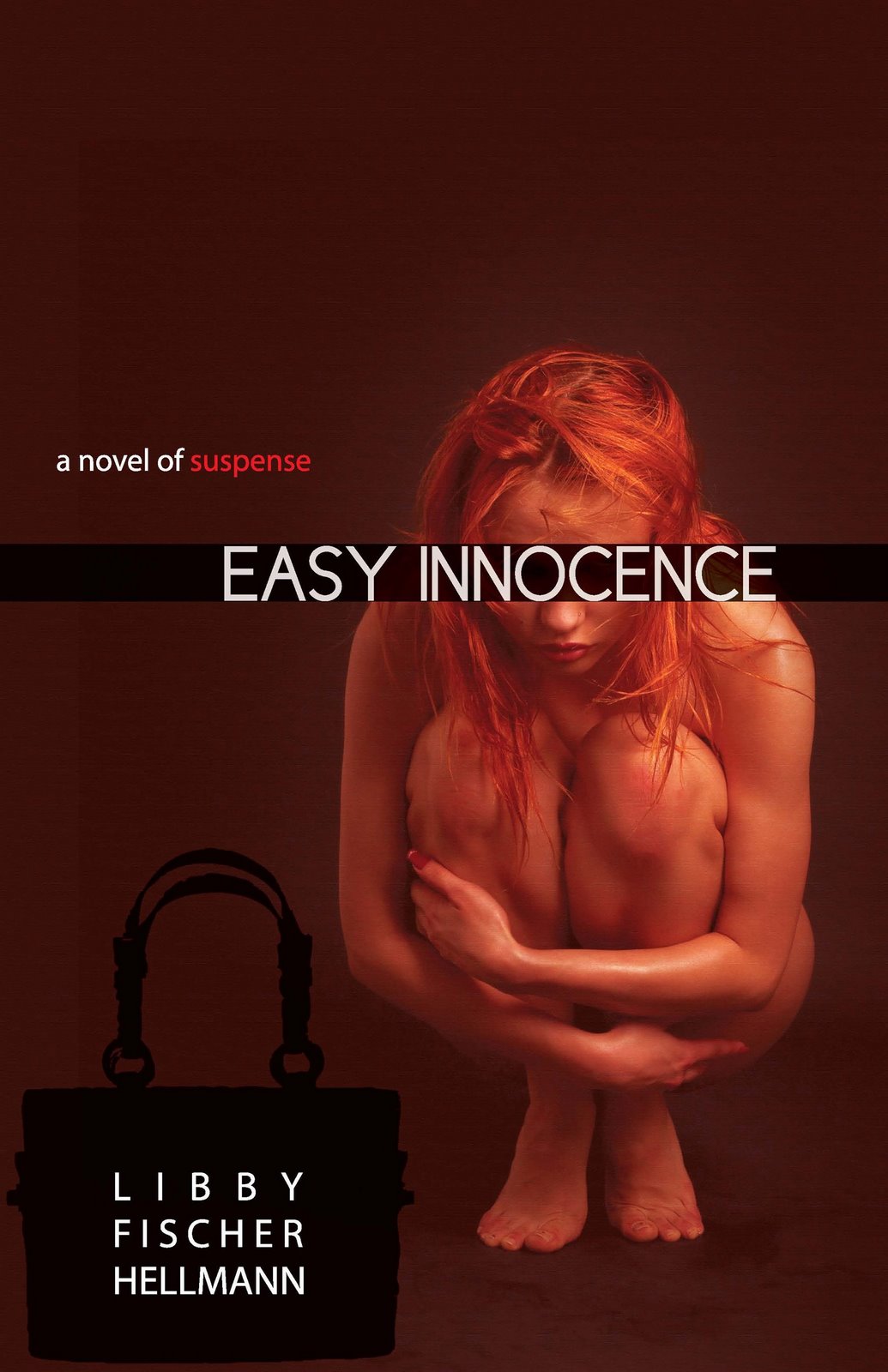
SET THE NIGHT ON FIRE (2010), a stand-alone thriller, goes back, in part, to the late Sixties in Chicago. She also writes two crime fiction series: EASY INNOCENCE(2008), DOUBLEBACK (2009), which was selected as a Great Lakes Booksellers’ Association “2009 Great Read,” and TOXICITY (2011), a police procedural thriller, all feature Chicago P.I. Georgia Davis. In addition, there are four novels in the Ellie Foreman series, which Libby describes as a cross between “Desperate Housewives” and “24.”
Libby has also published over 15 short stories in NICE GIRL DOES NOIR and edited the acclaimed crime fiction anthologyCHICAGO BLUES. Originally from Washington D.C., she has lived in Chicago for 30 years and claims they’ll take her out of there feet first.


Wednesday, September 25, 2013

You Say You Want A Revolution


LUCY BURDETTE: You all know Libby Hellman by now, right?--she's been around as long as I have, LOL. I admire how she's never afraid to stray into new territory, whether it's the subject matter of her books or the way she gets them published. She's got a new novel out that I'm dying to read because I'm insanely curious about Cuba. Libby not only went, she wrote a book about it. So here's Libby with her latest adventure!

LIBBY HELLMANN: Hi, Reds. Thanks for hosting me today. It’s great to be back.
As some of you know, my most recent three thrillers are all set in historical periods of extreme conflict, otherwise known as revolutions, (or in the case of FIRE, as close to a revolution as this country came since the Civil War). So, why did I create a “Revolution Trilogy?”

In fiction, they say, there must be conflict on every page, even if it's only someone wanting a glass of water that he or she can't get. Because I tend to overdo things in general, I asked myself what type of backdrop or setting would provide the most conflict in and of itself. The answer turned out to be  a revolution. Or war. Or strife within a culture. When characters’ lives unfold in an uncertain and potentially violent backdrop, almost anything can—and does—happen.

In fact, I can't imagine a more extreme conflict than a revolution. It affects everything and everyone: from individuals, to families, to neighborhoods, cities, countries, and regions. A revolution can transform a society’s culture and art, its food, education, personal freedoms, literature—the entire Zeitgeist. It affects whether people trust one another. It splits families in two. It makes everyday living dangerous. Essentially, it touches every aspect of life. 

When you superimpose extreme conflict on top of conflicts that already exist in a character’s life, those people become unpredictable. Some become heroes, while others turn into cowards. I love to explore those transformations in a character, and I love when I’m surprised by what happens. Just when I’m convinced a character is about to behave one way, they tak
e a different direction altogether. When that happens, it makes me feel more like an observer than a writer. I’m simply channeling an individual’s inner turmoil and decision-making process.

 Which, hopefully, makes my novels unpredictable as well. In too many crime novels the hero or heroine does the right thing, faultless in their judgement, usually emerging unharmed and victorious at the end. Not so much in my stories. I try to let my characters develop the way they indicate, and they don’t always win their battles. They might not even make it past the first few chapters if that’s the way the revolutionary cookie crumbles.


The ‘revolution trilogy’

My novel An Eye For Murder goes back to World War Two, which, although not technically a revolution, was indeed a period of extreme conflict. An Image of Death deals with the collapse of the Soviet Union, which I’d call a bloodless revolution. Set the Night on Fire took place during the troubled times of the late 1960s in the US. A Bitter Veil explores a family’s life during the Iranian revolution. And Havana Lost, my latest release, is set partially during the Cuban revolution and its aftermath. But there’s also action taking place in Angola – which was and still is an incredibly violent and lawless place— and Chicago, which some people would say is too. In fact, I’m now calling my latest three thrillers a “Revolution Trilogy.”

It doesn’t hurt that I'm a history major and I love research. It’s almost Pavlovian on my part. And I find it curious that although every revolution is different and has been fought for different ideological reasons, many end up being quite similar.

Revolution 101


Take the Russian revolution in 1917 or the French revolution or the Chinese ‘cultural’ revolution. It’s a common theme; people want to be free, but their leaders don't know what to do with that freedom when they get it. So it’s the ordinary people who suffer. Ironically, the only revolution that was different was the American. But that’s another blogpost.

When I put the characters in HAVANA LOST squarely into a revolution, the only thing that is certain is change. The way the characters face up to that change and handle its challenges is what makes writing so much fun. They all have minds of their own, and like the rest of us, they are essentially unpredictable, especially under stress. Also like most of us, their instinct for survival is what drives them to survive desperate circumstances.

So, Reds, that’s why I’m drawn to times of extreme conflict and strife. But what about you?
If you could choose a period of extreme conflict to write about, what would it be and why?

Wednesday, December 22, 2010

Libby Hellmann Sets the Night on Fire


ROBERTA: I've known Libby Hellmann since our first books were

published (almost a decade ago now!) and she's always been deeply

interested in the life-changing events of the sixties. Now she's taken

her interest in and experience with that time period and woven it into

her new thriller, SET THE NIGHT ON FIRE, published by Allium press, a boutique publisher in Chicago specializing in historical fiction. We're delighted to have her here today to talk about the new book.

Libby, let's start with your experience in the sixties. What do you

remember most vividly?


LIBBY: The most dramatic event was probably the assassination of Robert Kennedy. It became the turning point in my political "coming of age." I was in college, but was planning to drop out for the fall semester to work on his campaign - my college boyfriend had been tapped to be the head of the "Youth for Bobby Kennedy" organization. I was at home in DC that June night, and for some reason, I couldn't sleep. I turned on my radio and heard the news that he'd been shot just after winning the California primary. He died the next day, of course. So much for the Youth for Kennedy campaign. But the disappointment, sadness, and rage smouldered. He was the third iconic political figure to be murdered in 5 years, and I felt we were being robbed of men who had great potential to change the country. Clearly, I wasn't alone. The Movement, not all of them Kennedy fans in the first place, nonetheless gathered steam after that.


ROBERTA: It sure did! And now please tell us something about the book and how you wove the drama of the sixties into SET THE NIGHT ON FIRE? (which by the way, none other than bestselling author Lee Child called: "A tremendous book - sweeping but intimate, elegiac but urgent, subtle

but intense. This story really does set the night on fire."


LIBBY: The book came out of two motivations. The first was my desire to write a pure, adrenaline-fueled thriller that keeps readers on the edge of their seats throughout. So I tried to imagine the most terrifying situation a woman would ever face. Barring anything having to do with my children, I decided the idea that someone was trying to kill me, but I didn't know who, and I didn't know why, topped the list. So that's exactly what happens to my protagonist, 30-something Lila Hilliard, who comes home from New York to Chicago for the holidays.


Two thirds of the book takes place in the present, but the middle section begins in 1968 at the Chicago Democratic Convention and goes through 1970 (roughly around Kent State). Which brings up the other motivation for writing FIRE. I've always had unresolved feelings about the late Sixties. We thought we would change the world, but it changed us instead. I still wonder if we'd been less naïve, idealistic, and - yes-arrogant, whether we might have had a more significant impact. So I decided to explore those times by following six young people of varying backgrounds and attitudes who decide to live together in a Chicago apartment, just to see the possibilities. SET THE NIGHT ON FIRE is the result. And, as you might suspect, their actions forty years ago intersect with the woman who's being targeted in the present.


ROBERTA: Libby is always on the cutting edge of publishing trends and

a wizard at promotion. Please tell us about the experience of having

this book published by a small press and whether you've handled its

promotion differently than the other books you've written.


LIBBY: Promotion is changing dramatically, but I wouldn't call myself a wizard. Still, there's no question that the e-book market is growing more rapidly than anyone expected. And now with the entrance of Google ebooks, who is opening their door to independent booksellers, we probably will see even more explosive growth.


As the market goes, so goes the promotion. It's been steadily moving online over the past few years, and I think it will continue to. I love independent booksellers and libraries - they made my career what it is - but I can't help but wonder how long they'll be able to withstand the pressure. I fear that signings in the future will be limited to super-stars who are able to command the type of crowds that booksellers love and need. At the same time, I hope I'm wrong about that.


However, I have found some some good news in all this. First is that a small press like Allium has an equal footing with the big boys on the internet. FIRE is available at all the online retail outlets. And it is garnering some great online reviews. It is not, however, as widely distributed to bookstores and other venues as, say, a Penguin book would be. It's been released in hard cover, trade paperback, as well as ebook formats (all simultaneously, btw, which I think is a logical way to do it these days.) so I will be going on tour later this spring, but I do wonder if it might be one of the last I will do. I'm not sure.


The other good news is that a small press can focus on and support their authors in ways that large publishers can't. I have received more attention from Poisoned Pen, Bleak House, and now Allium, than I ever got from Penguin. Two reasons for that: 1) I'm in a much smaller stable, and 2) promotion now is largely time not money-driven. Because of that, small presses are more flexible when it comes to trying new things as well as forming a "partnership" with the author to do so. Whether it's buying banner ads for various blogsites, targeting specific blog reviewers, or sending targeted e-mail announcements.


Don't get me wrong -- I still believe in going to Book Festivals and libraries. But more and more, I'm noticing what can be done online, and I'm wondering what the next "big viral thing" will be. As I said, most of this takes time and effort more than money. Of course, it can be a black hole, just as traditional promotion is. And there's also that thing about writing the next book...


Anyway, thanks Roberta and Jungle Red! It's always a good time when I visit. (PS, Hank, I had a dream about you the other night...)

I hope your holidays are peaceful, warm, and safe.

Tuesday, October 27, 2009

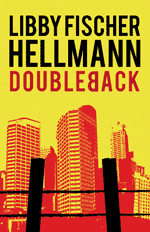
Libby Hellmann on DoubleBack


ROBERTA: Today JRW welcomes Libby Fischer Hellmann, author of six novels including her latest, DOUBLEBACK, featuring PI Georgia Davis. Libby also edited a collection of short stories called CHICAGO BLUES, has written many short stories, and served as the president of Sisters in Crime. Welcome Libby! Please start by telling us where the idea for DB came from.


LIBBY: People who know me well know I’m a little neurotic. (Stop laughing, Roberta). Some of my primal fears are flying, bees, and being trapped in a stalled elevator. So I imagined 6 people in an office building elevator that lurches to a stop. The lights go out, the car sways, and panic ensues – people cry, curse, pray and yell. They think they’re going to die. Suddenly the elevator resumes operating and descends to the lobby as if nothing has happened. The people spill out, and the last man out looks at his watch and says, “Right on schedule.”

That’s the first chapter of DOUBLEBACK. Now all I needed was the rest of the book.

At the time I started writing, Blackwater was all over the news. Eric Prince was saying his mercenaries weren’t exactly military, so they shouldn’t be accountable to military law. Then he said they weren’t really civilians either, so they shouldn’t be accountable to civilian law. It was a Catch-22 and it infuriated me. So I decided to incorporate that into the story. What if mercenaries, who are up to the highest bidder anyway, changed sides? What would happen? How would you detect it? How would you fight it? Those are some of the questions I explore in DOUBLEBACK.


ROBERTA: I'm not laughing, Libby! We love nutty here at JRW:). Why did you mix first person with third person… what’s been the reaction?


LIBBY: I knew from the start that I would be pairing my series protagonists in DOUBLEBACK. My first series features Ellie Foreman, a single mother, video producer, and amateur sleuth. I have always written her in first person, mostly because Ellie wants you to know who she is and how she feels. Georgia, who made her debut in one of the Ellie books, but came into her own in EASY INNOCENCE, has always come to me in third person. That’s because she’s cautious, guarded, and prefers to keep people at a distance. I did try to write Ellie in third person, for consistency’s sake, but it didn’t work. She lost some of her fire. So I bit the bullet and wrote them the way they wanted to be written. I think their voices are distinct enough that readers won’t be confused. At least I hope so.


ROBERTA: Are you going to continue with the dual protagonists?


LIBBY: I don’t know. The next Georgia book looks like it will feature her as the protagonist. However, Ellie will make an appearance. I haven’t started it yet, but in my third Ellie book, AN IMAGE OF DEATH, which, coincidentally, was the book that introduced Georgia, one of the bad guys gets away, and I’m thinking of bringing him back in number 7. So we’ll see how heavily Ellie is involved.


ROBERTA: Will Georgia ever find true love?


LIBBY: Georgia has had a hard time in her relationships, and she’s due for a break. And yes, I know who I’m bringing in to be her love interest. Once again, he’s a character from an Ellie book, but I can’t tell you who or which book-- I’d have to kill you. Or maybe Georgia would.


ROBERTA: Where did your love of suspense come from?


LIBBY: Before I ever thought about writing books, I read thrillers. These were in the salad days of Ludlum, LeCarre, Deighton, Follett, etc.(They were all men back then…) I loved the the sheer inability to put a book down until it’s finished, even though you’re up half the night. Once I started writing, I knew suspense would be a hallmark of my work, and at this point I can’t imagine not building in suspense. I’m just grateful that so many women have broken into the subgenre. More, more!


Libby's on tour with Doubleback right now. You can read more about her books and her tour stops at her website.

Friday, October 17, 2008

Sex, Lies, and Videotape: Where are they now?


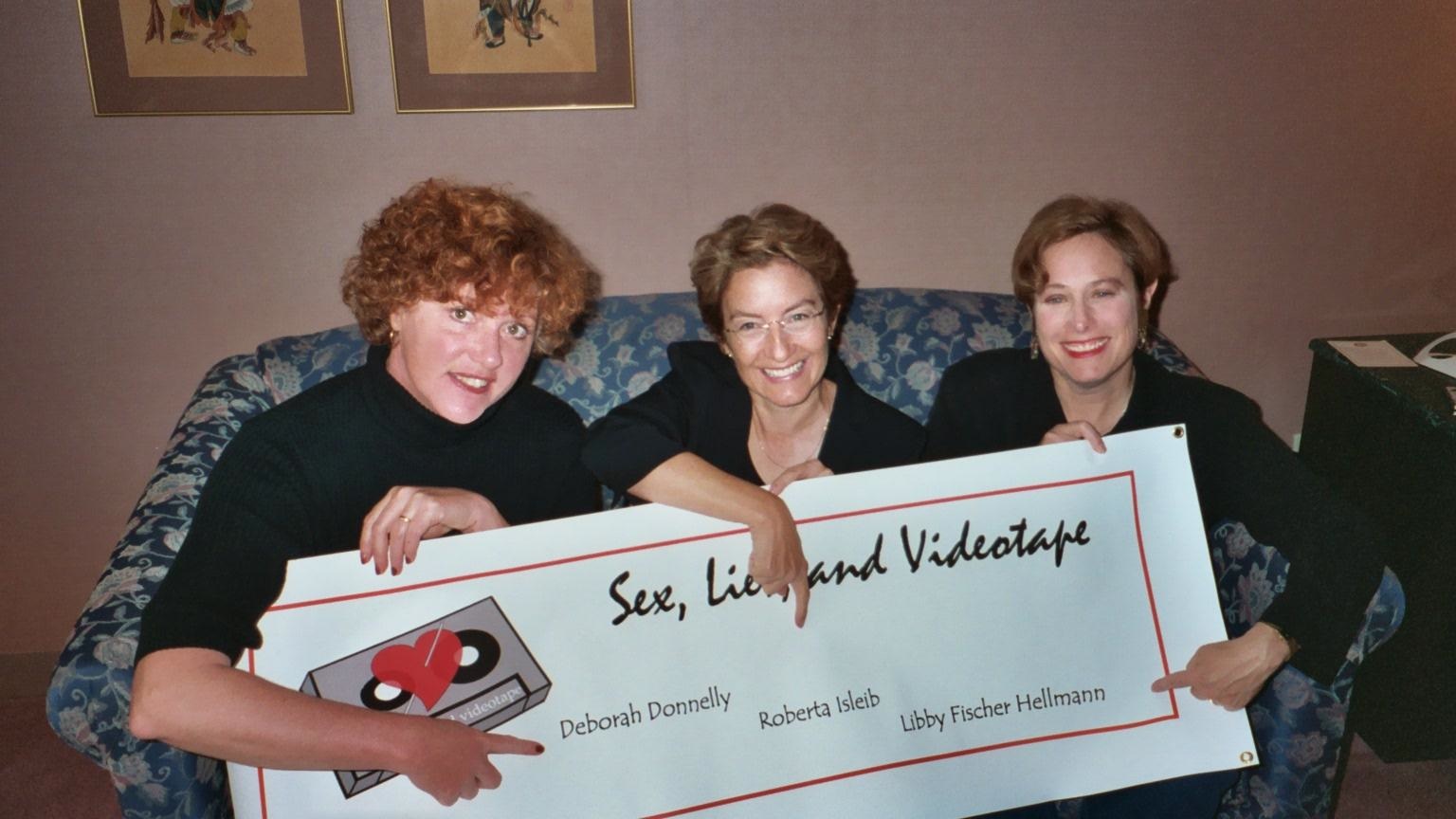
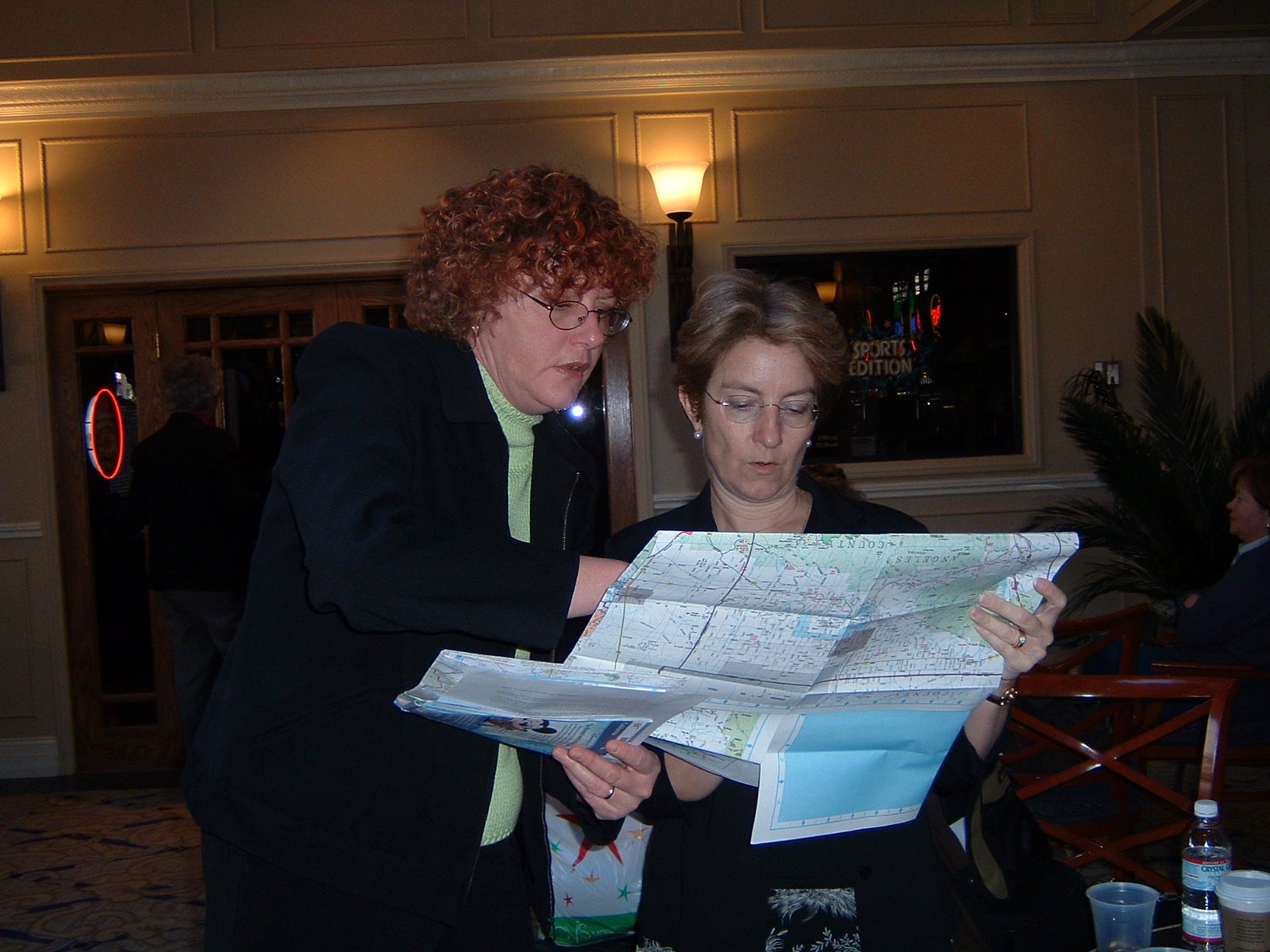
ROBERTA: Shortly after my first book was launched, I met fellow newbie writer Libby Hellmann at an MWA event in New York. She was brimming with ideas about how to get her series out into the world—and looking for partners in crime. Before I knew it, I had signed on for a tour of the California coast in spring 2003, with Libby and another new writer, Deborah Donnelly. We called ourselves “Sex, Lies, and Videotape” in honor of Deborah’s wedding planner, my golfer, and Libby’s videographer. Keeping company with those wonderful women pushed me way past what I might have tried alone. During our trip, we sent letters home from the field—an early group blog. We were ahead of the curve!

I look back on that first year with great fondness, in large part because of Deborah and Libby. Today Jungle Red Writers checks in to see where their journeys have taken them. Welcome Libby and Deborah! Let’s start with talking about that first year after publication. Tell us what you remember best about the trip or that first year following publication.

LIBBY: Touring with you guys was a terrific vacation. It was the first time I’d seen Carmel, Big Sur, the first time I’d driven the 101. I remember getting the opening scene for A SHOT TO DIE FOR at a rest stop, when (for the umpteenth time) I had to stop and I was afraid you’d drive off without me. I also remember Deborah constantly rolling the windows down and up. And how can I forget trading our life stories, and how amazed you both were that I was still on my first marriage? I remedied that.

ROBERTA: I’m pretty sure we helped with that Libby☺.

DEBORAH: One moment I remember vividly is going into a Barnes & Noble and seeing My Book – mine, that I wrote, out of my own head! – there on the shelves with all the others. To paraphrase Annie Lamott, getting published will not heal you (or make you rich, alas) but it is something you can tuck into the back pocket of your mind, to take out once in a while and smile over. What a feeling.

And, of course, there’s the Sex, Lies & Videotape tour. A peak experience, hitting the road with sister authors who soon became friends. At every stop the bookstore people were so gracious, and the fans (or soon-to-be-fans, we hoped) were so open to hearing from these three beginners. From sorting laundry in a small town parking lot, to getting lost and spooked in East Oakland, to zooming through Big Sur with the radio blaring, I treasure every memory.

ROBERTA: I was the designated driver coming home from Oakland, so I didn’t partake when the bookstore offered wine—but my navigators had a blast!

This is a big question, but I’ll ask it anyway. Tell us what you’ve learned over the past six years.

DEBORAH: What did I learn? That it’s a great favor readers bestow on authors, to take the time to come hear them in person. I know that all three of us valued that favor highly.

LIBBY: What did I learn? That promotion is a black hole that can suck you under. That first year, I was unflagging -- I wanted to tour, do events, go to conferences, appear at libraries, get lots of publicity and reviews, exploit the internet (yes, Al Gore had invented it by then); in other words, everything. The problem was I wasn’t sure of the relative weight of each activity. I’m still not, but I’ve learned to marshal my resources more efficiently.

My biggest regret, and this is more a reflection on the past 6 years than year 1, is the demise of so many independent mystery bookstores and independents in general. It makes a difference in terms of support -- and makes it harder for all of us.

ROBERTA: Tell us about what you’ve written in the past 6 years.

LIBBY: My fifth novel, EASY INNOCENCE, came out in April, 2008. The protagonist is Georgia Davis, who first made her appearance in my third novel, AN IMAGE OF DEATH. She was a cop then, now she’s a PI. And I’ve written 4 other novels in the Ellie Foreman series. And in 2007, I edited CHICAGO BLUES, a wonderful anthology of 21 dark crime fiction stories based in Chicago, loosely interpreting the Blues. And over the years I’ve published 14 short stories that have appeared in various magazines and anthologies.

DEBORAH: After my debut with VEILED THREATS, I wrote five more books in my series of Wedding Planner Mysteries, finishing the series with BRIDE AND DOOM.
The first two have come out Spanish, Thai and Portuguese, with more foreign reprints to come in future. That Moscow publisher has been so slow!

ROBERTA: That’s an impressive amount of writing! Libby, which book was hardest and which was easiest for you?

LIBBY: The hardest book for me to write was A SHOT TO DIE FOR. I was distracted by all sorts of things in my personal life, and it had an impact. The book I enjoyed writing most was probably EASY INNOCENCE, followed by AN IMAGE OF DEATH. Both those books ended up saying things I didn’t know I wanted to say.

ROBERTA: And Deborah, after six installments in the wedding planner series, how did you end up feeling about your character Carnegie? And weddings? Anything you would have done differently, looking back?

DEBORAH: I had really grown to love tough-minded, soft-hearted Carnegie. But I have to say I was getting burned out on weddings -- especially the big-budget extravaganzas that are being marketed these days.

Looking back, I would have spent less time worrying about promotion and more time writing -- or maybe sleeping. And I wouldn't have taken everything so seriously. Remember our panicky phone calls? "I can't work my way out of Chapter Nineteen, the book is doomed, my life is over!"

ROBERTA: Yes, I definitely remember that! You saved my sanity a couple of times, Deborah. And it’s not like it’s gotten easier either…last question, and it’s a hard one: What’s next?

LIBBY: I’m just finishing a sequel to EASY INNOCENCE, which brings together both Georgia and Ellie in one novel. The working title is DOUBLE-CROSSED, but I’m sure that will change. It’s been quite a challenge to write both their voices together – they’re so different. I’ve also written a stand-alone thriller, called SET THE NIGHT ON FIRE, which takes place, in part, during the late Sixties in Chicago. I’m keeping my fingers crossed on that.

But, to be honest, I have NO idea what I’m going to do next. None at all. Got any ideas? Maybe it’s time for another trip.

DEBORAH: These days I’m settling in to my new home city of Portland, Oregon, which I love, and working as a website writer while my imagination recharges. I’m not sure what I’ll write next, but the stories are burbling away in there...

ROBERTA: Thanks to you both for stopping by Jungle Red Writers and for being among my first writing friends. Now the floor is open for questions. (Deborah’s out of town but will answer questions and comments when she returns.)