Showing posts with label Liz zelvin. Show all posts

Saturday, September 14, 2019

The Girl on the Cover


-->
You go to the bookstore. 

You see the array of books on the “this just in” or “new releases” shelves—and what might you notice? There’s a certain word that seems to appear again and again.

And Elizabeth Zelvin has one word for that word. She says: Enough. And her new short story anthology is not just an illustration of her frustration—she hopes it’s the beginning of a solution.


The Girl Book Conspiracy


I’ve had a revelation about the spate of Girl books in the crime fiction market: Gone Girl, Girl On A Train, Girl in the Window, The Girl Next Door, The Lost Girls of Paris, gathering momentum ever since The Girl with the Dragon Tattoo. I don’t think it’s simply the marketing ploy that many have called it, with publishers jumping on the bandwagon of one megahit with more of the same. 

As a Second Wave feminist—“Really? I studied you in school!” an awed young person told me recently—I remember how hard we had to kick and scream to get everyone to stop calling those of us who weren’t fifteen and under “girls” and start calling us “women.” Yet all of a sudden, on the covers of books in airport bookstores and big box stores—which as every author knows, means hundreds of thousands of copies sold—they’re calling grown women girls again. 

Oh, but they didn’t mean it that way! They’d never do that! As a brilliant therapist, (not me), once said, unconsciousness is no excuse. So what’s the big deal? For one thing, books are culture bearers, or in the pop-up vernacular, influencers. And the titles of bestselling books have exponentially more influence than the books themselves, because, through word of mouth and the media, they reach so many people who never read the books. 

I’ve never read Gone Girl, because even its greatest admirers assure me I'll dislike the protagonists. I don’t do unlikable protagonists, not if I see them coming. But I’ve heard the book mentioned hundreds of times and participated in dozens of conversations about it, each reinforcing the concept that a grown woman is a girl, girl, girl.

But why does “girl” vs. “woman” matter? What difference does it make? I say it makes a huge difference in our unconscious assumptions and biases, which is why we fought so hard to change it in the first place.  Girls are—supposedly-- immature. They’re naive and weak. They don’t know much. They need things explained to them. They can be dismissed and patronized. They can be manipulated. They need authority figures to make decisions for them. They need to be protected, i.e. controlled “for their own good,” --which I think we figured out fifty years ago was how the patriarchy disempowered us while feeling good about themselves. Some of those generalities may work if the girl is ten years old and the adult responsible and ethical. But it’s not right to make such assumptions about grown women.

I'm not asking anyone to abolish the word “girl,” of course. Just use it when you’re talking about real girls! When I planned Me Too Short Stories: An Anthology, I was looking for stories about women. But girls as well as women showed up. The cycle of abuse is ongoing unless we find ways to break it. Some of the girls whose voices you can hear in these stories have experiences that may seem unimaginable to women who were nurtured and protected during childhood. Yet others may hear such voices and, as in the #Me Too movement, recognize parts of their own experience that they have never dared to examine. These are girls whose stories we need to tell, so readers can hear and believe them.

As a therapist in my "other hat," I know these stories are common in real life. Yet they seldom show up in short crime fiction, even in the darkest e-zines. Maybe they don't realize that young survivors can change the story. When I myself wrote a short story about such girls and the women they grow up to be, I couldn't think where to submit it. So I created a market of my own and invited other women writers to join me.

What do you think when you see “girl” on a cover?  

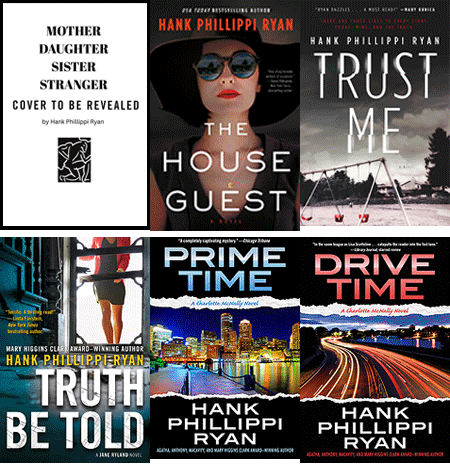
HANK: I will confess to loving my title THE WRONG GIRL—that book came out in 2013.  It is, however, about an infant daughter.

What do you think, Reds and readers? Is "girl" more than a word?

 ******************************************


Me Too Short Stories: An Anthology—crimes against women, tales of retribution and healing—is editor/ author Elizabeth Zelvin's plan to strike a blow for abused and intimidated women and girls in short crime fiction, making them the protagonists of their own stories. Fifteen women mystery and crime short story authors created fictional sisters who take charge of their destiny.


Elizabeth Zelvin, three-time Derringer & three-time Agatha nominee  
OUT NOW!
Crimes against women, tales of retribution and healing
Editor, Where Crime Never Sleeps: Murder New York Style 4 

Wednesday, December 12, 2012

Sisters in Crime New York Holiday party

ROSEMARY HARRIS: So many parties, so little time, but one party I always love to attend is SINC NY's annual holiday party.

This year under chapter prez Catherine Maiorisi there was a change of venue to midtown's Les Sans Culottes restaurant on Second Avenue and 57th Street where the group took over an upstairs room on Tuesday night 

With so many events and meetings  - most of which have excellent guests and speakers so it's hard to chat - it's sometimes difficult to just connect with other members and catch up! To find out what they're reading and writing.

I had a blast reconnecting with members Hilary Davidson, Laura Joh Rowland, Cathi Stoler, Pearl Wolf, Liz Zelvin, Laura Curtis(Kramarsky), Clare Toohey, Peggy Ehrhart, Pam Aherne and others.


Hilary's new book, Evil in All of Its Disguises (great title!) comes out next March, Liz has a new novella, Cathi just started a new novel - so great to hear what everyone is up to! That's one of the terrific things about Sisters in Crime - the camaraderie. Both nationally and in the individual chapters.

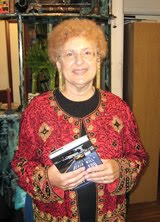
That's Clare and Laura, two of the genre's hardest-working Women of Mystery. And Liz, wearing the scarf  she scored in our holiday gift grab bag. (I got a very cool calendar which was too shiny to photograph well...)
What a  great night! I'm loving my Sisters in Crime and wish us all a happy and successful 2013!

Saturday, May 12, 2012

LIZ ZELVIN--AN OUTRAGEOUS OLDER WOMAN


DEBORAH CROMBIE: Today, the multi-talented Elizabeth Zelvin--writer, singer, song writer, psychotherapist--gives us a much-needed (at least on my part) Saturday boost! Liz's latest mystery is DEATH WILL EXTEND YOUR VACATION. Her short stories have appeared in Ellery Queen’s Mystery Magazine and have been nominated for three Agathas and a Derringer award. As Liz Zelvin, she recently released OUTRAGEOUS OLDER WOMAN, an album of original songs.

Oh, and a bit of business before we turn it over to Liz.  Our winners of advance reader's copies of Charles Todd's An Unmarked Grave are Karen Russell, Ethan, and Diane Hale! Could you three send your mailing addresses to me at deb at deborahcrombie dot com? I'll forward them to the Todds' wonderful publicist at William Morrow.


And now--

LIZ ZELVIN: In a recent discussion of the term “senior citizen” on the Sisters in Crime e-list, everybody had a different idea of how old you have to be to merit that mildly demeaning label. My best answer is the last verse of my song “Creeping Age,” which appears in my new album of original songs, OUTRAGEOUS OLDER WOMAN. (The first version, written twenty years ago, was titled “Middle Age”.)
           
            I never will be elderly, I never will be old
            Though my roots have turned to silver 
            and my molars all to gold
            The woman that I am, my friends, is what I’ll always be
            Getting old? So what! ’cause too damn old 
            is ten years more than me. 

As we’ve all heard, sixty is the new thirty. Seventy is the new forty. To my tennis-playing Aunt Hilda, since her birthday last month, 100 is the new seventy. And although I’m collecting Social Security and a card-carrying Medicare recipient, call me senior at your own risk. When I dive into that phone booth (let’s pretend I can still find a phone booth in 2012) and whip off my trifocals and frilly blouse, I reveal a T-shirt that says “Outrageous Older Woman.”

I actually have the T-shirt. Sometimes I put it on to go for my three-mile run in Central Park, only one long block from my apartment. By the time I reach the park, I’ve usually forgotten what I’m wearing. (Sad to say, Outrageous Older Women suffer from declining memory, just like senior citizens.) It only comes back to me when I notice that a helluva lot of women of a certain age are giving me a big smile as they pass by.

So what’s the matter with “senior citizen”? The term was coined as a euphemism for such epithets as “elderly,” “little old lady” or “little old man,” and the floridly disrespectful “old bag” (female) and “geezer” (male). But sometimes a painstaking attempt to be polite reeks of insincerity, and the recipient takes it for the false compliment it is. My Aunt Marta was in her mid-sixties, younger than I am now, when she ran into a high school classmate she hadn’t seen in decades. When the woman told her she was “looking very spry,” she was so furious that steam came out of her ears when she told me about it.

The up side of being a senior is the half-price bus and subway fare and the discount at the movies. Oh, and the accumulated wisdom of long experience. The down side is everything else, including the fact that we shrink. There’s nothing figurative about that “little.” I’ve lost an inch and a half already and will probably be looking up instead of down at my grandchildren in another ten years.

So what have I done with my golden years? So far, I’ve published three mystery novels featuring recovering alcoholic Bruce Kohler and his friends, world-class codependent Barbara and computer genius Jimmy. DEATH WILL EXTEND YOUR VACATION is just out. In this one, Bruce and his friends take shares in a lethal clean and sober group house in the Hamptons. The first one, DEATH WILL GET YOU SOBER, came out on my sixty-fourth birthday. And in the hiatus between book two and book three (I don’t need to say anything about the current state of the publishing industry, do I?), I wrote a dozen short stories (three nominated for the Agatha for Best Short Story and another for the Derringer) and recorded OUTRAGEOUS OLDER WOMAN.

It’s not so much the mystery plots that I couldn’t have written as effectively when I was younger. But that cumulative life experience I mentioned enables me to create complex characters, breathe life into them with distinctive voices and authentic relationships, and explore such themes as addiction and recovery and the nature of friendship. In the album, I sing about love and family, abuse and healing, and yes, aging. I do my best to make  readers and listeners laugh and cry. In the books, Bruce hits bottom, displays a smart mouth and a lot of New York attitude, and eventually takes an honest look at himself. The songs range from the embellished retelling of a Jewish shaggy dog story to my take on 911, written in New York a day or two after the tragedy.

It seems to me that “senior citizen” is a patronizing term. It implies that once you reach a certain age, your effectiveness diminishes and people have to make allowances for you.
Being an Outrageous Older Woman is all about empowerment: no allowances, no excuses, and a helluva lot of fun.

DEBS: I say "hooray!" How about you, REDS and readers?

Wednesday, November 4, 2009

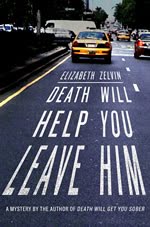
Death Will Help You Leave Him

Today Jungle Red welcomes our good friend Liz Zelvin, Agatha-nominated author whose latest release is Death Will Help You Leave Him. Her books feature amateur sleuth Bruce Kohler, who has substance abuse issues.

JR: Welcome, Liz! Someone recently suggested that - to paraphrase - all the best mystery writers were alcoholics. Needless to say, the speaker got an earful from many who strongly disagreed. That said, there is no shortage of hard-drinking cops and p.i.'s in mysteries these days. How hard was it for you to buck the trend and have a recovering alcoholic as your series protagonist?

LZ: Not hard at all, since all I had to start with were a love for the mystery genre, the title Death Will Get You Sober and a burning desire to write about the amazing courage and honesty of recovering alcoholics and the transformational quality of recovery itself. The roster of writers who were fueled by booze includes Hemingway, Poe, O’Neill, Fitzgerald, Dylan Thomas, Faulkner, Tennessee Williams, Hammett, and Chandler. Most of those were “literary” writers. Some were Nobel Prize winners. But as an addiction treatment professional, I can say they would have lived longer and might have written even better if they’d found sobriety. In fact, there are some wonderful recovering alcoholic protagonists in mystery fiction, notably Lawrence Block’s Matt Scudder and James Lee Burke’s Dave Robichaux. The trend I really bucked was the idea that sobriety is no damn fun. I created a world for Bruce and his friends that I tried to make lighthearted and gritty at the same time. And I got wonderful feedback from recovering people that yep, that’s how it really is. JR: The first book, appropriately, was Death Will Get You Sober. But Death WillHelp You Leave Him doesn't have much to do with drinking. What happened? Without giving too much away, is Bruce Kohler on the wagon for good?

LZ: My first job out of graduate school was in the outpatient alcohol program of a city hospital. It was before managed care, and those programs were very long term. When I arrived at work the first day, I found they wanted me to work in the detox unit instead. If they hadn’t switched me back, I would have quit. The first five days of sobriety are boring, at least for those who have to deal with a detoxing drunk. For the patient, they’re scary and pretty wretched. It’s what happens after that—the whole sky’s-the-limit just-stop-drinking-and-change-your-whole-life process—that’s fascinating and often inspiring.
Bruce isn’t “on the wagon”—a term comparable to “on a diet,” and you know how permanent that is (not!). He’s in recovery, and he’s going to stay sober. In real life, even as a professional, I can’t guarantee that any alcoholic won’t drink again. But I do have that power over Bruce, and I refuse to let him relapse. Once the alcohol is out of the way, all the stuff it’s been covering up surfaces, and that includes feelings and relationships, which aren’t boring at all.

JR: Death Will Help You... includes several bad relationships. What would you call them? Abusive? Addictive? Is there such a thing as relationship addiction?

LZ: People can get hooked on partners who are hurtful, unavailable, or inappropriate on a very deep level that does not respond to reason. “Why can’t she just throw the bum out?” is not helpful for some people in bad relationships, in the same way that “Why can’t he just say no?” is not helpful when you’re dealing with, say, drug addiction.
The idea of relationship addiction works pretty well when you know someone is bad for you but you can’t make yourself leave. Maybe you’re scared of being alone. Or you think the problems, even physical abuse, are your fault, and if only you can do everything right, you’ll get the love and approval you want.
Or there’s a terrific high involved in the roller coaster of passion and then rejection and fighting and making up and passion again. The way Bruce is with his crazy ex-wife Laura in Death Will Help You Leave Him is that kind of addictive relationship. Also, because he hasn’t been sober very long, he’s still used to taking the path of least resistance. It doesn’t come easily to him to fight against the way she turns him on—or the way she needs him when she gets suicidal in the middle of the night and calls him.
Laura’s relationship with her current boyfriend, or the relationship between the murder victim, Frankie, and his girlfriend Luz, who becomes the prime suspect—those are abusive relationships. These are men who hit women, who put them down verbally, who try to control them through possessiveness and jealousy or by walking out and waltzing back in again so the women can’t maintain any equilibrium.
The only way people can maintain these destructive relationships is by being in denial. “He really loves me.” “He’s not lying to me.” “She needs me.” “No one else understands her.” “Nobody else could ever love me.” “I’m not worth anybody being nice to me.” “I’m going to leave soon.” “Maybe he’ll change.” “He didn’t mean it.” “She’ll die if I abandon her.”
And we haven’t even gotten to the C word yet: codependency. That’s when your identity and self-worth depend on someone else—usually someone unavailable, which could mean married to someone else or stoned out of their mind all the time, if not abusive. Codependents confuse having no boundaries or sense of self with love and intimacy. And the popular culture supports that, so having a healthy relationship goes against the grain. As you can see, I have a few opinions about this....

JR: It's no secret that it's taken you many years to publish a novel. How is writing about relationships different at 65 than it might have been when you were 25?

LZ: I’ve learned a lot in the past forty years about the difference between sex and love, or let’s say the difference between passion and intimacy. That lovely weak-in-the-knees stuff is only Chapter One. Durable relationships are complex, and I find that a lot more interesting and authentic than “romance,” especially to write about.

JR: Now for some of the fun stuff. John, Paul, George or Ringo?

LZ: You know, what I found endearing was the whole pack, especially in the early days, the adorable boys of A Hard Day’s Night. My heart didn’t actually throb for any one of them. JR: Basil Rathbone or Jeremy Brett (as Sherlock Holmes)?

LZ: Basil Rathbone—no contest. There’s a mystery writer who’s a Rathbone lookalike: Philip Cioffari, whom I met at Killer Nashville this summer. Man, I’d like to see him in a deerstalker hat.

JR: Blackberry or Iphone?

LZ: Sorry, not there yet. I can take movies with my digital camera and find any address with my GPS. Does that count?

JR: Cheetos or creme brulee?
LZ: Crème brûlée—that’s an accent grave, circumflex over the “u,” and then an accent aigu.
JR: And I think I know the answer to this one.Crocs or Jimmy Choos?
LZ: Crocs all the way.
JR: Thanks, Liz and good luck with the new book. Visit Liz at http://www.lizzelvin.com/, and be sure to stop by tomorrow for a surprise visit from New York Times best-selling author Lorna Bartlett and on Friday for some words of wisdom from Pulitzer-Prize winning writer Carolyn Hart!

Sunday, August 10, 2008

You Can Leave Your Hat On.... Randy Newman

Anyone who remembers the movie Nine and a Half Weeks will have one recollection of that line, but...get your mind out of the gutter! This blog is really about hats. Long ones, tall ones, short ones...crazy ones..as Eric Burdon might say (I guess I'm in a musical mood.) What is it about hats? Who wears them and why? Is it a genetic predisposition like blue eyes or lefthandedness? And what's the difference between those of us who buy hats and those of us who actually wear them?
Maybe I'm inspired by the wonderfully inventive Cha-Poe created by Liz Zelvin for last spring's Malice hat contest. (She won, of course!)


Or our recent pic of Jan in her saucy Norma Shearer-like wedding chapeau.
Or maybe it was my dentist. I may have the coolest dentist on the planet. Not only does she keep my pearly whites, um, pearly, but she is a photographer, a diver, and an adventuress. She's been everywhere, keeps exotic pets and everything in her apartment is from some far flung destination. If this was the thirties, she'd be Jean Harlow singing for her supper on a Chinese junk and engaging in drinking contests with Mongolian warlords. And the winner would get the big furry hat. Because she also has a worldclass hat collection.

This is one she just gave me -


btw...Caroline if you're reading this the butterfly fell off..I didn't take it off! After a few glasses of wine we agreed it looked fabulous. (I thought it was Italian movie star from the 50's ...she thought Lara in Dr. Zhivago. In my dreams...) But will I ever leave the house with this thing on my head? Or will it stay in the box like the $600 Tracey Tooker number that I bought for a wedding and wore only once because I felt like I couldn't move my head all afternoon?


ROBERTA: I'm also in the camp that buys hats and very seldom wears them--except for baseball caps for the sun. Reason why? I look at pix taken after the fact and I look darned silly. Take for instance the straw boater that I bought after much agonizing and wore to my first-ever member-guest golf tournament with my mother-in-law as my guest. The picture is priceless because it marked the beginning of our relationship, but that hat perched on my head like a dying possum. My tennis friends made fun of me for years for wearing a white cap with a big sunflower in front. When the flower fell off, I still wore it with the glob of glue that used to hold it. I did find success with a headdress I created for a toga party during grad school days--it had fake ivy and large plastic dangling fruit. That one was a winner!

RO: We want pix!!

JAN: This is the deal with hats: They are a commitment. You put one on, it flattens the hair underneath, and you are stuck wearing it the entire day or until the next hair wash and dry.
The only time I actually wear hats is when I'm playing tennis in the sun, when I'm on the Vineyard and waiting until AFTER the beach to wash my hair, and on really bad hair days.
My cousin has a terrific boutique in New Jersey. I've bought any number of hats there. Really cool Eric Javits hats.
But after purchase, I generally don't wear them. Why? This is the first time I've really thought about it, but it's probably because cool hats call a lot of attention to themselves. And they tend to be just the tinest bit pretentious-looking when you wear them on your way to, say, the supermarket.

RO: Is that why people were looking at me when I was at the deli counter with this thing on?

HALLIE: Like Jan, I love hats...in principle. But the fact that I had nothing to put on my head at my own wedding (I'd forgotten about it) tells you something. I have an old battered straw hat and some baseball caps but they're just to keep the sun out of my face.
One of my favorite books of all time is "The Five Hundred Hats of Bartholomew Cubbins" in which our hero, when commanded to take off his hat by the King, tries to comply, but another hat even more glorious than the last appears in its place.

HANK: Hats. Bikinis. Not a chance. Up in my off-season closet there's a beauty. A straw sun hat, with a lovely Libery of London fabric band. The front flips up, the back goes down. I wore it in 1972 to my sister's wedding. It still looks good, but the moment I clamped it on my head, as Jan so correctly says, that was it for the hair. (Even when it was long and brown, which it was at the time.) What more, turns out my head is huge. There was the time I was doing an investigative report on fish inspection. Or--how they're not inspected. One day, we were allowed to shoot inside a fish processing plant down by the water front. Pungent, and waterlogged, and fish guts all over. And they demanded we wear hats. Paper baseball caps, you know? Health rules. So they tried to find one that would fit me, and even the largest was too small. Apparently the health rules don't care about fit, so they parked one, precariously, on my head, and called it a hat. I called it ridiculous. The good news: we won a big award for the story. The bad news: guess what they showed in the video clip at the awards ceremony?

RO: What's on your head?