Showing posts with label Magic. Show all posts

Friday, March 24, 2023

The Magic of Writing by Daryl Wood Gerber

Jenn McKinlay: I've known today's guest for years. We burst onto the traditional mystery scene at the same time (we were children) and it's been a blast meeting up with her over the years to talk shop and swap stories. Her latest creation is indeed magical and here she is to tell you all about it.

Daryl Wood Gerber: Writing is hard work. We authors sit down and craft a novel that could take days, weeks, months, or years. We slave over the words, plot, and characters. We attack the rewrite with gusto. Well, I know I do. My first draft is never perfect! 

 So when is it easy? When does writing feel magical and effortless? 

 If I’m honest, starting a paranormal cozy mystery is when writing became magical for me. I was absolutely delighted to sit down and commune with the fairies that populate my stories. Oh, sure, I liked the humans, too. I adored my protagonist, Courtney Kelly, the owner of Open Your Imagination, but the fairies drew me in. I wanted to live in their world. I wanted to flit and flutter as they do. Oh, how I wish I could do a loop the loop in the air. However, even if I can’t do what they can, I can dream about their exploits when I write. Crafting their thoughts and actions brings me joy. 

One of the other delights regarding writing about a fairy garden shop owner is I get to talk about how to make the gardens and how much creativity goes into the process. What is a fairy garden? It’s like doll-housing for your garden, consisting of whimsical stories made up of plants—living or faux—and decked out with fairy figurines and structures like fairy houses or castles or huts, as well as swings and slides and whatever suits your fancy. 
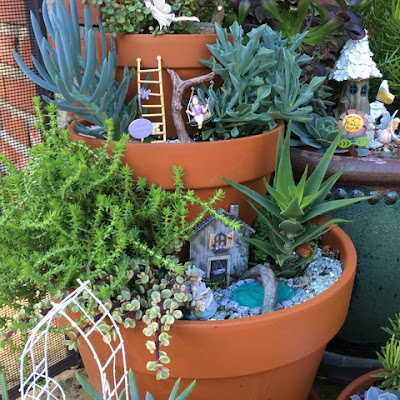

To make sure I had a firm grasp on the art, I decided I needed to make fairy gardens. I used to adore doing heavy-lifting gardening, but those days have passed. My shoulders and elbows and back just won’t cooperate. Before making my first fairy garden, I did a lot of research. And then I jumped in. 


Whenever I do, I find my mood lightening. 

 Another magical thing about writing this particular series is delving into the fairy mindset. I wanted to learn their language and discover what skills they might have. They’re very good at photosynthesis, by the way. They do have ESP, if utilized properly. They can learn spells, but they can’t do wicked spells. That’s a no-no. 


Wouldn’t it be fun to have those gifts? Lastly, I decided to add fairy poetry at the beginning of each chapter. I’ve had such fun finding poetry written through the ages by Shakespeare, Tennyson, Yeats, Laura Ingalls Wilder, Rose Fyleman, and Cecily Mary Barker. 

Hans Christian Anderson wrote, “Life is the most wonderful fairytale.” That about sums it up for me. When writing this series, life is almost magical. 

What about you, Reds and Readers, what inspires magic in your life?

What’s it about? 

 A FLICKER OF A DOUBT 

With a theater foundation tea and an art show planned at Violet Vickers’s estate, Courtney is hired to create charming fairy gardens for the event. It’s not so charming, however, when her best friend Meaghan’s ex-boyfriend turns out to be Violet’s latest artistic protégé. Even worse, not long after Meaghan locks horns with him, his body is found in her yard, bludgeoned with an objet d’murder.


There’s a gallery of suspects, from an unstable former flame to an arts and crafts teacher with a sketchy past. But when the cops focus on Meaghan’s business partner, who’s like a protective older brother to her, and discover he also has a secret financial motive, Courtney decides to draw her own conclusions. Fearing they’re missing the forest for the trees, and with some help from Fiona the sleuthing fairy, she hopes to make them see the light . . . 

“Plenty of suspects, gardening tips, and fairy lore combine for a sweet treat.” ~ Kirkus Reviews 


BIO: Agatha Award-winning author Daryl Wood Gerber is best known for her nationally bestselling mysteries, including the Fairy Garden Mysteries, Cookbook Nook Mysteries, and French Bistro Mysteries. As Avery Aames, she penned the popular Cheese Shop Mysteries. In addition, Daryl writes suspense novels and short stories. Fun Tidbit: as an actress, Daryl appeared in “Murder, She Wrote.” She loves to cook, fairy garden, and read. She has a frisky Goldendoodle who keeps her in line. And she has been known to jump out of a perfectly good airplane. 
You can learn more on her website: httsp://darylwoodgerber.com 

WEBSITE: https://darylwoodgerber.com 
FACEBOOK: https://facebook.com/darylwoodgerber BOOKBUB: https://bookbub.com/authors/daryl-wood-gerber YOUTUBE: https://youtube.com/woodgerb1 
INSTAGRAM: https//instagram.com/darylwoodgerber GOODREADS: https://goodreads.com/darylwoodgerber AMAZON: amazon: https://bit.ly/Daryl_Wood_Gerber_page NEWSLETTER: https://darylwoodgerber.com/contact-media/

Thursday, August 20, 2020

Magic by Lynn Cahoon

JENN McKINLAY: Can you feel it in the air?


Autumn is coming (please, God, it's like 100,000 degrees in AZ) 
and with it, my favorite reads arrive most of which will include 
some sort otherworldliness like today's guest's new series - A 
Kitchen Witch! Here to tell us more is the delightful Lynn Cahoon.

LYNN CAHOON: Magic.  
It’s my go to reading subject. I totally fell in love and bought into the idea of magic as a kid (Phantom Tollbooth – Wrinkle In Time, and as I got older, The Lord of the Rings.)  I love magic on television and movies (Bewitched, Charmed, The Magicians, The Librarians.) As I’ve grown, I’ve continued to seek out magical realism in all content forms like Harry Potter, Harry Dresden, and Practical Magic.) It’s my go to, feel good story. 
Magic is also my favorite subject to write. 
When I was offered a chance to bring Magic Springs, Idaho to life with my local Kitchen Witch, Mia Malone, I jumped at the chance. Why? Now that’s another subject. 
I think I liked the ability to have a secret power, like a superhero without the cape or tights. Witches have a history in our real world. The Salem Witch trials being our historical reference on the question of how we deal with differences.  The answer is not well.  
Going even farther back, healers were suspected of witchcraft by using plants and potions to care for patients’ bumps and bruises. I’m sure for some people, blood letting was a healing proposition, but for most of the patients, it just made them weaker.  By tapping into this rich history, being a kitchen witch, allows my main character, Mia, to help heal others as well as create amazing food to sooth the soul. 
In story, magic is a way for crisis to be averted. Or, if things go completely out of hand, you can use the Christmas wish theme (Family Man, It’s a Wonderful Life) to make things go back to normal for everyone but your main character. He or she has learned their lesson and will be a better person for it.  
It’s something I wish we had in real life. Like the easy button from the commercial. A way to take the bad and turn it into something good.  And with the world events that are occurring recently, that’s a button I wish I’d had. 
But since I don’t own an easy button, I’ll write my Kitchen Witch mysteries. The magic in the books isn’t used to solve the mystery. That would be a short book. All it would take was a session with the Ouija board and ask the question, “Hey, dead guy? Who killed you?” The board answers and case closed. 
In my worlds, using magic for personal gain is a no no. The goddess doesn’t like it when you try to invoke the easy button. Instead, magic for Mia and her grandmother is a way to support the world and their community.  Magic is part of their being. Mia’s love of cooking and her skill as a chef and caterer can be considered magic as well. 
Even in the real world.  So what’s your favorite magical book? 
Lynn

Pre-Order Now

CHILI CAULDRON CURSE
Releases August 25, 2020
Chili Cauldron Curse 
releases August 25th, 2020
New York Times bestselling author Lynn Cahoon introduces a new heroine with her own special brand of culinary magic in this novella to introduce her Kitchen Witch series.

When Mia Malone’s grandmother asks her to take a week away from her restaurant job and come to Magic Springs, Idaho, she’s happy to oblige. Like Mia, Grans has witchcraft running through her veins, and life with her is never boring. Plus, the cause is a good one—helping Grans get the local food bank up and running again. But there’s an unappetizing surprise in store. While Mia is knee-deep in boxes of donated produce, she encounters the body of Dorian Alexander.

Dorian was a warlock, leader of the local coven. He was also her Grans’ new beau. There’s no potion that’ll make this trouble disappear. But if Mia wants to keep her Grans—now a prime suspect—from serving a spell in prison, she’ll have to unearth the real killer fast. . . .


NYTand USA Today bestsellingauthor, Lynn Cahoon, writes the Tourist Trap, Cat Latimer and Farm-to-Fork mystery series. The Kitchen Witch cozy mystery series will release in 2020. No matter where the mystery is set, readers can expect a fun ride Sign up for her newsletter at www.lynncahoon.com


Thursday, December 27, 2018

Len Rosen on writing fiction/making magic: Aha!


HALLIE EPHRON: I am a huge fan of magic (the how-to of it; stories of great magicians and debunkers like and Harry Houdini and James Randi), and also of Len Rosen's crime fiction ever since I read his first, All Cry Chaos. So I was thrilled to have Len's new novel, The Kortelisy Escape, to read over the holiday.

I whipped through it,
a fantastic twisty, heartwarming grandfather-grandaughter tale that mixes magic and mystery. Throw in a set of Russian nesting dolls... perfect for the season.
Kirkus gave it a starred review: "A master storyteller weaves a tale of love, pain, and sleight of hand.... [A] clever and richly enjoyable novel."

I'm thrilled to host Len today, talking about magic and writing.

LEN ROSEN:
In his 1991 essay “The Magic Show,” Tim O’Brien (Going After Cacciato, The Things They Carried) finds in his life-long fascination with magic as metaphor for writing fiction.

Successful fiction¸ he claims, like successful stage magic depends on performers using the tools of their trade to create stunning effects. Onstage, a bottle of wine might appear from thin air; on the page, a character’s plight might evoke pity. Both effects are remarkable in that they’re illusions. Both are impossible, yet the impossible is made real.

Like stage magicians, writers conjure illusions so perfectly that we find ourselves rooting for or against people who don’t exist save for strings of letters on a page.
Where does Jane Eyre live, exactly? In a book? In our minds? In conversations with friends? She’s alive, but then again not. Writers are magicians. When we are in full command of our tricks—point of view, framing, plotting, and so much more—we, too, make the unreal real. We move audiences to belief.

I’ve been thinking a lot about magic and writing. My just-released novel, The Kortelisy Escape, concerns the lives of a fourteen-year-old-girl who apprentices herself to her aged grandfather, an amateur magician who’s scheduled to perform magic shows across New England. Grace Larson is an orphan; Nate Larson is an ex-con running from trouble—characters who have good reason to distrust each other. But with time there comes a thaw and, with more time, trust.

Kortelisy
is a mystery and a coming-of-age story told through a series of increasingly dangerous tricks.

Magic may be a metaphor, but I employed it literally to drive my plot, and this created challenges. How was I going to use words to reproduce for readers the ultimate surprise and delight of magic shows: the “AHA!” moments at the conclusion of great tricks? That “AHA!” is profoundly non-verbal. Audiences may gasp when a full-size bowling ball drops from a thin sheaf of papers. Their jaws may drop. Their eyes may go wide and they’ll definitely laugh and applaud. What they don’t do in their moments of wonder is talk. Yet words are all a novelist has. How was I going to use words to evoke a wordless experience?
I spent five years answering this question, describing magic tricks from the outside—from the audience’s point of view; from the inside—the magician’s point of view; from the deeper inside—the interior monologue all in search of the elusive “AHA!” Could I reproduce on the page what magicians achieve every night, onstage?

As it happened, Kortelisy’s biggest wonder-inducing moments came not through a depiction of stage magic but through human interaction: through affections unfolding between a wounded old man and a doubly wounded child. I used plot, metaphor, misdirection and every other tool in my writer’s kit to deliver “AHA!” moments to readers.

You can’t fake love and you can’t fake the grand “AHA!”, Nate tells Grace as she struggles to learn and perform her own magic. Nor can readers fake engagement with a story. Either the writer pulls off the effect—empathy for characters who exist only on the page—or not. Either jaws drop or they don’t.

When O’Brien suggests that the deepest mystery fiction explores is character, I understand him to mean this: We can’t have one another’s dreams, can’t know one another’s thoughts and emotions.  At the smell of rolls baking in an oven, I can’t recall, as you do, the Thanksgiving dinner five years ago when your daughter announced she was pregnant. The brutal fact of existence is that we’re radically separated from one other even as we spend our lives seeking connection. Fiction helps us bridge the unbridgeable. The biggest mystery of Kortelisy is not how a grandfather and granddaughter use stage magic to outwit people who wish them harm. It’s how, despite every reason to reject each other, a nearly ruined old man and nearly ruined child instead save each other.

I needed to write a novel about a magician to appreciate fully O’Brien’s account of magic as metaphor. Without the deeper mysteries of real human emotions being plumbed, the writer’s tricks—all the techniques of fiction—can take us only so far. To deliver an “AHA!” experience on the page every bit as compelling (and non–verbal) as those magicians deliver onstage, we writers must use our skills to achieve the greatest trick of all: convincing readers to care for people who exist nowhere but in our heads.

If we can get them to care, we’ve got our “AHA!”


HALLIE: By the end of The Kortelisy Escape, I was rooting so hard for Grace and Nate, but by then trusting that Len would manage the magic needed to save them.


What's your relationship to magic? Do you watch the show and happily suspend belief? (READ LEN'S BOOK!) Or do you need to know how the sleight-of-hand is achieved? (READ LEN'S BOOK!

Friday, November 9, 2018

Another Tantalizing Question!


See if you can. 


That Time I Did A Show With Harry Houdini

Thank you for letting me visit today! The third Lila Maclean Academic Mystery, The Spirit in Question, is set in a haunted opera house. For research purposes, my family journeyed up to the famously “active” Stanley Hotel in Estes Park, Colorado, which was the inspiration for Stephen King’s The Shining. 

And there, master magician Aiden Sinclair performs at the Stanley in Illusions of the Passed: A Theatrical Séance. It was a truly remarkable experience.

Before the show began, we were invited to browse a table set up with various historical artifacts which Aiden has collected over time—for example, items from the Titanic and objects from the hotel’s original owners. But as I circled the table, it was Harry Houdini’s playing cards that drew my attention immediately. 

If you read the author’s note at the end of The Spirit in Question, you’ll see that the opera houses in Colorado did in fact host an array of luminaries, such as Harry Houdini, Oscar Wilde, and others. Fascinating stories—and pictures—kept surfacing in my research. And there were Houdini’s cards, right in front of me! Truth be told, I was itching to lift up the glass and touch those cards but managed to restrained myself. Barely.

During the show, we witnessed one amazing thing after another, performed with the help of audience members. (And maybe some ghosts? Seriously, it all remains inexplicable.) At first, we suspected the people in the audience were planted. But then Aiden asked if anyone knew what Harry Houdini looked like. My hand was in the air before I was even aware of moving—it was all that research—because yes, I did know. When he consequently invited me onstage, I immediately regretted it. Stupid hand. But it was too late, so up I went. 

Aiden pulled out the deck I’d seen earlier and reminded everyone that these belonged to Harry Houdini. After a thorough shuffle, he asked me to draw a card and look at it without showing anyone, including him. He gave me the entire deck and instructed me to place the card on top, put both hands around the desk, and think about what I’d drawn. He also told the audience to think of a card—any card—and to concentrate on it.

“Now imagine,” he said to me, while strolling around the room, “that Harry Houdini is standing behind someone and you’re going to tell me who it is. Concentrate on the card and also see him here with us now.” 

Now this part is extra-weird. As I sat there, thinking of Harry Houdini and my card, the deck seemed to generate energy—within moments, my heart was racing and my hands shook, as if I’d been given a shot of adrenaline. 

I am not making this up.

After a few minutes, Aiden asked me to point out the person I saw Harry standing behind. To be honest, I didn’t actually seea figure, but I wascompletely drawn to someone sitting in the middle of the room, so I identified her. Aiden asked her to stand and tell us what card she was thinking of, which she did. It was the king of diamonds.

Then he invited everyone who had chosen the king of diamonds to stand and, out of the hundred or so audience members, only two did. 

When he asked me to reveal my card, the whole room gasped. It was the king of diamonds. 

So, to recap, only three people had the same card in mind as the one that I’d pulled. Three. And I’d led Aiden to one of them on the first try. 

I cannot explain it. And I most certainly was not a plant. 

So...thank you, Harry Houdini.

HANK: Oooh. HOW did that happen?v I always think people are plants (you know what I mean), but Cynthia was not!  Reds and readers, what do you think?  Cynthia, on further reflection, what do YOU think?

----------------------------- 

Cynthia Kuhn writes the Lila Maclean Academic Mystery series: The Semester of Our Discontent, an Agatha Award recipient for Best First Novel; The Art of Vanishing, a Lefty Award nominee for Best Humorous Mystery; and The Spirit in Question. Her work has also appeared in McSweeney’s Quarterly Concern, Literary Mama, Copper Nickel, Prick of the Spindle, Mama PhD, and other publications. She is professor of English at Metropolitan State University of Denver, president of Sisters in Crime-Colorado, and member of the multi-author blog, Chicks on the Case. For more information, please visit cynthiakuhn.net.

The Spirit in Question is now available at booksellers and online:
Amazon:amzn.to/2unzWF9
Barnes and Noble: bit.ly/2NlGFXe
IndieBound: bit.ly/2vH7ChC
Kobo: bit.ly/2NVbi71

Website: cynthiakuhn.net
Twitter: @cynthiakuhn
Facebook: www.facebook.com/cynthiakuhnwriter
Amazon Author Page: www.amazon.com/Cynthia-Kuhn

Blog: chicksonthecase.com

Wednesday, December 14, 2011

Time After Time


HANK PHILLIPPI RYAN: We've been talking about traditions and family rituals and time this week--the end of the year and the holidays always make us a bit nostalgic, and joyful that we can link past and present a future a bit. And maybe it's time to add some new traditions.


Today we welcome the always-fabulous Rochelle Staab--who I met by magic (we'll tell you the story when we see you)--and who continues to have a magical and wonderful rise through mystery world. Talk about a magical mystery tour!


More on that later...but now Rochelle continues this week's theme of tradition and time. (Don't you love it when the theme emerges? As so often happens, it wasn't planned.)


The Comfort of Ritual


One of the benefits of being a writer is the carte blanche we are given to explore wherever imagination takes us. My latest research stack is piled with books and articles on superstitions, magick, taboos, fetishes, and ritual.

Part routine, part habit, and part hope, but never rational—our rituals and traditions generate stabilizing threads of comfort. I’m not very superstitious, but the holidays bring up sentimental rituals I learned to cherish. Simple yearly traditions, like drinking eggnog while decorating my tree, or spending Christmas day at the movies with friends. One of my favorite rituals waits inside a plastic CVS bag tucked in the back of a brass-hinged chest in my living room. In the bag is a dry branch clipped from last year’s Christmas tree. I’ll use the branch to kindle the fire on the night I decorate this year’s tree.

I learned the custom years ago at a Winter Solstice party. Twenty multicultural neighbors gathered to celebrate the coming holidays: Hanukkah, Kwanzaa, Christmas, Epiphany, and the day after Christmas sales. A psychic read Tarot cards in the den, a local witch stirred mulled Wassail punch in the kitchen, the host’s dog Peg trotted through the house wearing felt reindeer ears, and It’s A Wonderful Life played on TV. A typical west coast holiday party? Not really, but it was one of the more interesting.

Winter Solstice is the shortest day and longest night of the year. Our host explained that, centuries ago, there was a fear the nights would continue to grow longer until the sun disappeared completely. Evergreen trees, mistletoe, and holly—the only foliage to remain green through the bleak winter months—epitomized the triumph of life over death and were said to hold special powers. In our first ritual of the evening, to symbolize hope for spring, we joined as a group to bring in the evergreen tree from the local tree lot.

Once the tree was in place in his living room, we gathered to perform rituals established long before Santa, the Macy’s Parade, holiday cards, candy canes, “White Christmas”, and the annual L.A. Lakers Christmas game. First our host burned a clipping from his last year’s tree in the hearth to honor continuity. Then we circled strings of lights on the new tree to light the night and encourage the sun to return, bringing longer days.

Each guest received a red ribbon and a piece of paper. We made a wish for the coming year and tied our ribbons on the “magical” tree. On the papers we each made a list of things from the past year we hoped to leave behind. And in our final ritual, tossing our goodbye lists onto the Yule log burning in the fireplace, we bid farewell to dark days.

The traditions we honored were a mixture of European and pagan customs, and perhaps our host’s imagination, but the symbolism of the evening charmed me enough to carry on burning the previous year’s tree branch and tying a “wish” ribbon on my new tree. Comforting. Hopeful.

The Winter Solstice is December 22 this year. Each day thereafter is a step toward spring. My warmest thanks go to Hank and the Jungle Red writers for inviting me to guest at Jungle Red today. I wish you all long happy days, warm sunlight, lasting traditions, and dreams come true!

HANK: Oh, my dear Rochelle. You are unceasingly amazing. All our wonderful wishes for you in the coming year--and may you revel in your national best-sellerness...and perhaps, have another!

So, Reds, what would you put on your goodbye list? And how about what you would wish? (Rochelle will have to let us know if it's okay to reveal that part...)


A copy of Who Do, Voodoo to one lucky commenter!


************************


Rochelle Staab, a former award-winning radio programmer and music industry marketing executive, blends her fascination with the supernatural and her love for mystery in Who Do, Voodoo? the bestselling first novel in her Mind for Murder Mystery series for Berkley Prime Crime. Who Do, Voodoo? features no-nonsense Liz Cooper, a Los Angeles psychologist forced to embrace the occult to clear her best friend of murder. Bruja Brouhaha, the second novel in the series, will be released in August 2012.
http://www.rochellestaab.com/

Facebook: https://www.facebook.com/rochelle.staab
Twitter: http://twitter.com/#!/rochellestaab
Goodreads: http://www.goodreads.com/author/show/4705211.Rochelle_Staab