Showing posts with label Miss Marple. Show all posts

Friday, March 12, 2021

Agatha Christie and Me @LucyBurdette


 LUCY BURDETTE: I'm participating in a very interesting event tomorrow, a tea time celebration of traditional and cozy mystery writers, sponsored by the SW Florida Reading Festival and Sisters in Crime. (You are all invited, and I'll post the Zoom info at the end.) We were each assigned a well-known writer to discuss and compare to ourselves, and I was given Agatha Christie. (And that made me think of the New England Crimebake in 2015, where we were to dress for the banquet as mystery characters. The photo above is my writers' group, Ang Pompano and Chris Falcone, dressed as Poirot and his Marples. Or was it Poirot is losing his Marples??)

Anyway, this exercise allowed me to realize how little I knew about Agatha Christie. Of course, I know that her tea cozy provides the name for the genre of cozy mysteries, those associated with solving a puzzle without gratuitous sex and violence on the page, usually taking place in a small town with an amateur sleuth at the wheel. This is what I write.

I know I read And Then There Were None and Murder on the Orient Express, but I may have skipped the Miss Marple books altogether--an oversight I'll have to repair. Here are just a few fun facts about what Christie and I have in common, and some we don't...

Her first novel, The Mysterious Affair at Styles, featuring Hercule Poirot, was written in 1916 and published in 1920. So yes, it took each of us four years to get that first book published!

She wrote and published 66 mysteries and another dozen collections of short stories. (Oh rats, by next August, my total will be 19.) Her two most famous characters were Belgian detective Hercule Poirot, and amateur consulting detective Miss Jane Marple of the fictional village St. Mary Mead. Miss Marple appeared in twelve novels and many short stories over the years from 1930 to 1976. Christie was the first writer to receive MWA Grand Master Award. And Then There Were None is the best-selling mystery in the world, with over 100 million copies sold. The plot involves a children’s nursery rhyme, which describes the killing of 10 characters until none are left. (This is the book that scared me death, so not exactly cozy--I couldn't have written this one.)

She used bits and pieces from her real life in her books, such as Abney Hall, the Victorian mansion belonging to her brother-in-law, her experience learning about poisons while working in a hospital pharmacy during WWII, and international train travel, which became the basis of her novel Murder on the Orient Express. Her 1961 novel The Pale Horse used the knowledge of thallium poisoning gained during the war. This we definitely have in common--when I'm writing, I borrow shamelessly from people and places and events in Key West!

Apparently, Miss Marple was known and respected by ex-Commissioner of Scotland Yard, Sir Henry Clithering. He often encouraged the detective in charge of a particular case to take Miss Marple’s advice seriously, when often they were inclined to dismiss her as just another interfering, elderly busybody. Hayley Snow is now married to her Key West detective, Nathan Bransford. He does not encourage her sleuthing. She has a little more luck with her pal, police officer Steve Torrence. (Who is a real pal in my life who helps me with all my police procedure questions.)

I could go on and on, but I'd love to hear from you! Were you/are you big fans of Agatha Christie? Which books were your favorites?

here's the link to join the tea celebration Saturday, 3/13 at 1 pm, plus the very clever trailer they put together!


Sunday, February 21, 2021

Book to screen: Hits and misses

HALLIE EPHRON: I’m sure I’m not the only mystery reader who’s been variously delighted or dismayed by the different actors who’ve portrayed iconic fictional sleuths. My all time favorites include Leo McKern as Rumpole of the Bailey, Helen Mirren as Jane Tennison, and John Thaw as the quintessential Morse. I also love the entire cast of detective on NEW TRICKS. Until they changed up the actors and it went downhill.

Also less than a rousing success was Katherine Heigl’s Stephanie Plum. Tom Cruise felt violently miscast as Jack Reacher. Hopefully Amazon’s new Jack Reacher show will be truer to the character with Alan Ritchson in the role -- at least he’s got the height and he once played a Teenage Mutant Ninja Turtle.

A ton of actors have played Hercule Poirot, including:
- Peter Ustinov
- Albert Finney
- Kenneth Branagh
- David Suchet
- John Malkovich

… and Miss Marple has been portrayed numersouly by:
- Margaret Rutherford
- Angela Lansbury
- Joan Hickson
- Julia McKenzie
- Geraldine McEwan)

And then Sherlock Holmes who has probably been portrayed more times than any fictional character by, among others:
- Basil Rathbone
- Christopher Plummer
- Michael Caine
- Jeremy Brett
- Robert Downey Jr.
- Benedict Cumberbatch)

What have been the hits and misses for you when it comes to seeing an actor play a favorite fictional detective, and what made the difference? I know whom I’d give stars and who’d get raspberries.

Saturday, March 9, 2019

Understanding Agatha

RHYS BOWEN:

When I’m stressed, overwhelmed, overworked, I tend to reach for a comfort read. And often those reads are an Agatha Christie book. I have them all on my shelf. All 81 books/short story collections that she published. I am reading one now (or rather re-reading, as I have read them all several times): After the Funeral. Her books are short, slight and in many ways superficial, so I’m wondering why she is so popular.


These are some observations:
1.She ever engages the reader emotionally. We do not weep for the body in the library!

2.We have multiple points of view so that we are not actually following one sleuth.

3.The book is presented more like a movie: we go from scene to scene, watch different people interacting, rather than following the journey of the sleuth until he or she solves the crime.

4.The sleuth is more vehicle than character. We know little of his or her personal life. We never see the sleuth battling their own demons, trying to make up for past mistakes or finding the crime to be horribly personal. We only know that Poirot  is Belgian, was in the police and, I believe has a brother called something else classical. We don’t know of past mistakes, loves, aspirations. We never see what traumas he overcame to escape to England during WW1. He enjoys the company of Hastings, but is remarkably without need of other people.
Ditto Miss Marple, although she seems to enjoy company more. But we know nothing of her past life (although the TV series has tried to hint at a doomed romance in WWI there is nothing of this in the books.)

5: The books focus only on the crime. We come across it near the beginning or at the beginning of every book and the story is just in service of the solving of the crime. Setting and character are merely hinted at. Houses are only described if it is important to know why slept in which room. The part of England is only alluded to if it is important, near the cliffs, on the bank of a river etc.
The characters are seldom complex. Most can be summed up in one sentence:: the nosy old spinster, the vain young actress, the not-quite-straight younger son who has charm but no conscience.

6: The motives make sense. The clues are clever. The puzzle is all important.(although she does occasionally cheat, when Hercule Poirot knows something the reader can’t, or when the narrator is the murderer and keeps that fact from us!)

7: There is a clear sense of right v. wrong and justice being served at the end of the story.
So why are they popular? For the very reasons quoted above. They do not touch us emotionally. They are terrific books to read without getting involved, depressed, scared or upset. The sort of books one can read while waiting for a flight or trying to sleep in a strange hotel room. As I write this I notice that in her later years her books did show more depth. Curtain, for example, shows a sympathetic Poirot facing his own death. And BY THE PRICKING OF MY THUMBS puts an elderly Tuppence in danger and aware of her own limitations.

So why do I like them? Because I know what I'm going to get. I know there will be no blood and gore. I know I will not be shocked or weep for a character. It's like a pleasant afternoon tea party: satisfying but not too rich and not too long. And I have to confess, when I look at those Agatha teapots on my shelf I give her a little nod of thanks for creating a genre where I have been so happy!

How about you? Are you a Christie fan? Do you think that the evolution of the mystery into a more complex literary form is a good thing?  Do you like to have a sleuth whose personal life is important to the story, who evolves through a series, who actually matters to you? Some of the letters I get about Lady Georgie show that my readers consider her a real person, a friend. Do you want more setting, background, local color? More of what’s going on in the outside world?

I find that I do, most of the time. It’s just when I’m extra tired, stressed, tense that I reach for Dame Agatha and there is a body on the hearthrug in a small English village.

Tuesday, August 11, 2015

Novelist Kwei Quartey, Detectives to Remember, and Creating an Unforgettable Sleuth


SUSAN ELIA MACNEAL: Kwei Quartey is a crime novelist (and physician) living in L.A.—and one of my favorite authors. He's written WIFE OF THE GODS, CHILDREN OF THE STREET, MURDER AT CAPE THREE POINTS, and we can look forward to his forth, GOLD OF THE FATHERS, coming in January 2016. Kwei's blog is is pretty darned amazing, too, and when I read his post on sleuths and archetypes, I had to ask Kwei if we could reprint it here on Jungle Reds. Readers, he said yes! He'll also be stopping by to chat with readers today.


Take it away, Kwei!


KWEI QUARTEY: A memorable detective in crime fiction stays with the reader long after the novel is completed, no matter to which one of the four archetypes the sleuth belongs:
  • The amateur (Miss Marple, Easy Rawlins): Not officially within the criminal investigation system, but having knowledge, curiosity, desire for justice, etc.
  • The private investigator (Holmes, Marlow, Poirot, Wolfe, Millhone): Working professionally in criminal investigations, but outside the official criminal justice system.
  • The police investigator (Dalgliesh, Morse, Wallander): Part of an official investigative body charged with solving crimes.
  • The forensic specialist (Scarpetta, Thorndyke): Contributing specialized forensic knowledge rather than solving the crime as a whole.
There may be some overlap, particularly the amateur and the PI. The examples above obviously don’t comprise an exhaustive list, but they are some of the most recognizable detective characters in crime literature over the decades and centuries. There is nothing new under the sun. Incorporating characteristics or features of these famous detectives into one’s own is not so much stealing as it is learning by emulation.
But one’s emulation must fit your creation. Agatha Christie‘s Miss Marple and Walter Mosley‘s Easy Rawlins are both indomitable in their quests for truth and justice, but they are radically different characters. In The Murder at the Vicarage, someone describes Marple as “a white-haired old lady with a gentle appealing manner,” while another condemns her as always knowing “everything that happens and draws the worst inferences.” Marple is somehow present even when she doesn’t appear to be, and that so-called “gentle appealing manner” belies her remarkable ability to dig up the truth. She solves mysteries within the rather stuffy confines of manners and modesty expected in the docile English village of St. Mary Mead.
Easy Rawlins, on the other hand, operates in the gritty environment of 1940s to 1960s Los Angeles. Mosley’s novels practically crackle with tension on every page, and we fear that the next time Rawlins turns down an alley off Slauson Avenue, he will run into either a cop with a grudge against him, or an equally unsavory gangster who would prefer Rawlins dead. But don’t fear too much. Easy is a tough customer as well.
easyrawlins
Washington as Easy Rawlins in DEVIL IN A BLUE DRESS (Photo: TriStar Pictures)
Just because your crime fiction is set in Iceland or Ghana doesn’t mean Rawlins or Marple are irrelevant to you. From Christie, you can learn the art of misdirection if you’re writing the classic mystery rather than a thriller (more about the distinction in an upcoming blog), and how to manipulate time and alibi in relation to the murder. With Mosley’s novels, study his tense style and the ability to weave multiple characters into a progressively tangled world of crime and corruption. If your detective is an amateur, notice how Easy believably knows many people, both honest and crooked, who can help him out. This is your chance to create a bunch of scary, creepy, slimy, or dangerous folks encountered along the way. Easy Rawlins is charismatic enough to have been played in film by Denzel Washington. When your character gets portrayed in the movies, you are probably doing well.
Sir Arthur Conan Doyle‘s Sherlock Holmes is a transcendent and influential figure among detectives. He’s a singular creation, challenging enough to have been played on screen by multiple actors over decades. In the literary version, because he’s seen through the eyes of his companion Watson, who we sense does not always altogether understand Holmes, we as readers don’t ever get inside the great detective’s head or heart–well, rarely, at least. He is only what Watson reveals to us, and that makes Holmes wondrous in many ways. We want to follow him and his magical set of characteristics: an eerie ability to make deductions from keen observation, a nervous, excitable energy on the one hand, and a predisposition to depression and drug abuse on the other. He solves mysteries through logical, scientific reasoning and doesn’t go by gut feeling. “I never guess,” he says. “It is a shocking habit,—destructive to the logical faculty.”
Benedict Cumberbatch as the modern Holmes
Benedict Cumberbatch as the modern Holmes (Shutterstock)
Sometimes, his inferences can be a little improbable–as when, in The Sign of the Four, he deduced that his companion Watson had been to the post office that morning because Watson’s shoe had a speck of reddish mud found only opposite that post office, where the sidewalk was being dug up–but we are willing to accept these deductions and even marvel at them, no matter how implausible. That is Sherlock Holmes. In many instances, Holmes’s attention to detail foreshadows modern forensics (e.g. as in trace evidence), and it’s interesting that a BBC TV series has successfully portrayed a present-day Holmes.
Your detective can emulate some of Holmes’s powers of observation and deduction, or be as methodical (or not), or perhaps have some of his physical characteristics (unexpected strength for his thin physique), or failings like drug abuse and depression, but even if you use nothing Sherlockian at all, remember one vital principle from the master himself as he declared in The Sign of the Four: “Eliminate all other factors, and the one which remains must be the truth.” Here is the character giving advice to the mystery writer. Perhaps author Raymond Chandler once saw this powerful reflection and took it to heart, because he made a remarkably similar pronouncement in Casual Notes on the Mystery Novel, 1949: “The solution, once revealed, must seem to have been inevitable. At least half of all the mystery novels published violate this law.”
Ouch, Raymond.


SUSAN ELIA MACNEAL: Reds and lovely readers, do you find you have a favorite archetype of detective? I'm a big fan of the amateur, but also adore Sherlock Holmes. What about you? And who's your favorite example?


Kwei Quartey is a crime fiction writer and physician living in Pasadena, California. Having practiced medicine for more than 20 years while simultaneously working as a writer, he has attained noteworthy achievements in both fields. Dr. Quartey balances the two professions by dedicating the early morning hours to writing before beginning a day in his clinic.
Kwei Quartey attended medical school at Howard University in Washington, D.C. In 1990, he began practicing medicine in California with HealthCare Partners. Dr. Quartey later founded the facility’s wound care center while working as an urgent care physician.
As a crime fiction writer, Kwei Quartey made the Los Angeles Times Bestseller List in 2009. The following year, the G.O.G. National Book Club awarded him the title of Best Male Author. Having published Wife of the Gods (2009), Children of the Street (2011), Murder at Cape Three Points (2014), he anticipates publication of the fourth Darko Dawson novel in the series, Gold of the Fathers, in early January 2016. Death at the Voyager Hotel, a mystery e-novella not belonging to the series, was published July 2013. Dr. Quartey is also a member of the Los Angeles chapter of Sisters in Crime, a fiction writers’ organization.
Kwei's web site is here and you can find him on Twitter and Facebook.

Tuesday, April 22, 2014

Rhys's Rules of Mystery Writing

RHYS BOWEN: Beginning writers often ask me if there are rules for writing mystery novels.  If you check online there are all kinds of 10 Commandments for writing mysteries. Ronald Knox and S.S. Van Dine compiled the most famous ones in the late Nineteen Twenties, in the Golden Age of mysteries. They are mostly concerned with the fairness of the plot, no tricks, no other-worldly intervention. But some of them make me smile, including one rule that says "No Chinamen." Oh dear, do you think I should tell them that the whole plot of Bless the Bride, one of my Molly Murphy books, takes place in New York's Chinatown and is teeming with what they refer to as "Chinamen"?

Another rule of theirs that makes me smile is "Absolutely no romance allowed."
Again, I'm a hopeless failure in this respect. All of my books have a romance going through them. Actually I LOVE books with that hint of romance in them. I LOVE characters who fall in love, have heartaches, disappointments, betrayals AND happy endings--don't you?

And when I read lists of rules I realize that I am not good at keeping most of them.  In fact I'd probably get drummed out of the olden day Detection Circle.

Here are some of the most cited rules. See what you think? Do they still apply today? Should they?

1. In mystery writing, plot is everything.

 This is where the mystery has really evolved from the whodunit to the whydunit. No longer just a puzzle, it's more a psychological drama. If I had to sum up a good mystery in one sentence I'd say IT'S ALL ABOUT THE SLEUTH. If we have an interesting, complex, human character to follow we will happily follow her through any twists and turns of plot. We will worry about her, fear for her and rejoice with her. My fans never say "I can't wait for your next complex plot." They say "When is Molly/Georgie coming back?"

2. Introduce both the detective and the culprit early on.

 I agree with the first, since the story is the detective's story. And I do agree that you have to play fair. You can't introduce a character in the last chapter and say "I knew this serial killer was hiding in the neighborhood but I didn't want to scare anyone."  But sometimes we don't meet my villain until later in the book. we may know of him earlier but not always.

3. Introduce the crime within the first three chapters of your mystery novel.

 Sorry. I fail hopelessly at this one. Most of my crimes take place after we have set up a situation, brought characters together, let the reader see them interacting and tensions building. If we start with the crime it becomes the old fashioned whodunit, when I think the sleuth's life and situation is always equally important. However, I have heard of libraries who will not shelve a book as a mystery if there is no murder in the first three chapters.


4. The crime should be sufficiently violent -- preferably a murder.

 Again I disagree. Where most mysteries involve a murder, I shy away from violence on the page, and I love reading books in which the crime is a clever art theft/forgery/bank heist. It's just that that is harder to pull off. It's awfully easy to kill someone.

5. The crime should be believable.

I agree that the aim of the writer should be to create a believable universe. All the same, any series mystery requires the reader to suspend disbelief. How can so many people be killed in Cabot Cove? Or St. Mary Mead? And we know that real police procedure involves weeks of paperwork and few exciting chases. And real CSI folk are not allowed to do any detective work. We create a semblance of reality but it has to feel real. 

6. The detective should solve the case using only rational and scientific methods.

 I would choose Miss Marple over Sherlock Holmes any day, and she uses good old knowledge of human nature.  My sleuths use observation, intuition and a good sprinkling of luck--being in the right place at the right time. Personally I can't stand know it alls!

7. The culprit must be capable of committing the crime.

 We're all capable of killing, physically. Anyone can pull a trigger, put poison in a tea cup. It's the motivation that's important. Would you or I kill if we were in a similar situation? How far must an ordinary person be pushed before he strikes back? For me we must make the villain a real person, believe in his tormented suffering/anger/jealousy so that we can see, when he is revealed, why he killed.

8. In mystery writing, don't try to fool your reader.

 Isn't that what we try to do all the time? Red herrings, clever clues, a multiple list of suspects, all of whom have a good motive for wanting the victim dead? Personally I love it when I come to the end of the book and I have been fooled--but played fair with at the same time. Don't you?


 9. Do your research.

 This is the one that I completely agree with. I have read so many books about Victorian or Edwardian England that make me cringe in the way that characters address each other, or in their lack of basic knowledge of London. If I find one thing wrong, I give up. How can I believe in the rest of the story now? I just started a book in which they say that the fall term hasn't yet started at Oxford. Sorry--it's the Michaelmas term at Oxford. How can I believe that you've been there if you don't know that?

10. Wait as long as possible to reveal the culprit.
,
 Of course. The plot does tend to fall flat after the murderer has been revealed, but in real life would we summon everyone in the story together, including the murderer--who might have a semi automatic weapon hidden in his socks--and say "I have brought you here to name the killer?"
 

So my take is--there are no rules. You play fair. You create terrific characters. You make your sleuth have a hard time, both in the case and his private life. You set the story in a real, vibrant place and time. And apart from that it's up to you.

 AND..you add a little romance if you want to!
 
So Reds and Readers--should there be rules?

Saturday, July 28, 2012

Secrets of the Notebooks!


HANK PHILLIPPI  RYAN: I know, it wasn’t fair. When last we left the wonderful John Curran—knower of all knowledge about Agatha Christie, the first person privy to her secret notebooks and the author of two award-winning non-fiction books about the Queen of Mystery (Secret Notebooks' now out in paperback!)-- I had just asked about his favorite Poirot and Miss Marple, and then, evil me, I said we were out of time. So, now we have more time! 
And John has revealed he will come visit today to tell us some brand new Agatha info---our eyes only. Got to love it.
 (And hey—let’s give away another copy of the Secret Notebooks! (Our last winner was Susan Elizabeth. And the winner of Meg Gardiner’s RANSOM RIVER is: Lexie’s Mom. And the winner of the ARC of THE OTHER WOMAN is: Margarete. Email me with your address, okay?)
And now:
HANK:  Who is your favorite Hercule Poirot and Miss Marple?
JOHN: The best Miss Marple ever was, and remains, Joan Hickson, who, thankfully, filmed all of the novels for BBC television. Actresses, either before and since, never captured the essence of Miss Marple as she did. Some of them have been completely unsuitable and I completely disapprove of the latest idea of ‘inserting’ Miss Marple into books in which she never appeared.
And the best Poirot is, undoubtedly, David Suchet. Later this year he will embark on the last five titles to be filmed and then he will have completed the entire Cases of Hercule Poirot! Although some of the adaptations have not been good (Appointment with Death, The Murder of Roger Ackroyd), overall the standard over the last 20 years has been remarkably high. It will be a remarkable achievement when he finishes the last film.
HANK: We’ve all seen The Mousetrap. (Again and again. And anytime anyone has tickets, invite me, okay?)  But of course there were other plays.
JOHN:  Agatha Christie is the only crime-writer to achieve equal success and fame as a playwright as well as a novelist and short-story writer. Although her first Poirot play, Black Coffee (1930), is not very impressive she enjoyed writing scripts and her first big success on the stage was And Then There Were None in 1943. But she wanted more control over what happened to her books (she was very unhappy with what adapters did to, for instance, The Murder of Roger Ackroyd) so she adapted The Hollow, in 1951, herself. And then she wrote original plays - in the 1950s she wrote The Unexpected Guest, Spider’s Web and Verdict directly for the stage and adapted The Mousetrap and Witness for the Prosecution.
HANK: I could watch that a million times. It’s always a surprise, and always wonderful. Charles Laughton, I mean, how perfect. All this was happening at the same time?
JOHN: Yes! During this period she had three plays running simultaneously in London’s West End, a record for a female playwright that stands to this day. In 1961 three one-act plays, under the title, Rule of Three was her last success; the final play she wrote, Fiddler’s Three, was not considered good enough to reach the West End. The Mousetrap has now been running for almost 60 years and seems likely to run forever. I hope to write about her career as a playwright in my next book in two years time.
HANK: And of course you’ll be here to tell us all about it! Do you read modern crime fiction? (How do you even have time?) Who are your favorites among living writers?
JOHN: Yes, I read and enjoy a lot of modern crime fiction although my main interest is in the writers of the Golden Age – Christie and her contemporaries, Dickson Carr, Sayers, Queen, Marsh etc. I greatly admire P. D. James and Ruth Rendell/Barbara Vine; the American writer Charles Todd, whose books are set in the England of Christie – just after the First World War; Robert Goddard, who creates wonderfully complicated plots; the novels of Colin Dexter, who has now, sadly, retired; the earlier titles of Val McDermid before they became too gory; and Laura Wilson who sets her books during World War II.
HANK:    If you could ask Agatha Christie a question what would it be? 
JOHN:  My problem would be keeping it to only one! It would have to be ‘How did you do it? How did you, a woman with no formal education and no background in writing become the biggest-selling, and most translated, writer in history?’ And I’m pretty sure she wouldn’t be able to answer me.  She would probably look amused and say ‘I really don’t know!’
 HANK: SO Reds, John will be here to discuss…what’s your favorite Christie play? Or movie?  We still haven’t decided who should play Tommy in the Tommy & Tuppence movie—and hey, wasn’t John going to give us the scoop on that. Oh, wait, he said he couldn’t. Shall we keep trying? Meanwhile, shall we cast Tuppence? And who was the young actress who was threatening to play Miss Marple? 
And John also promises some big news. 
Remember, we’re giving away a copy of  SECRET NOTEBOOKS!

Wednesday, July 25, 2012

The Secret Notebooks


HANK PHILLIPPI RYAN:   Rats. I didn't take a photo. But you should have seen John Curran hold the Malice Domestic audience captive with his stories about our goddess and mentor Agatha Christie. He got exclusive access to ALL her notes and notebooks and letters--stayed at her house, Greenway House, and was the very first person to see it all. Can you imagine? What a cache of treasures! And his stories are mesmerizing!
   So of course we had to invite the world's expert on Agatha to come chat at Jungle Red. (And we're giving away a copy of his first book--and a new one! Just answer one little question--see below!)
 
 
HANK PHILLIPPI RYAN: Okay, John. How did this all happen??
JOHN CURRAN:  I have been reading Christie all my life and although I moved on to read lots of other writers I kept returning to Christie as she was/is the greatest exponent ever of the classical detective novel. For some years I edited an Agatha Christie Newsletter and later wrote an online version of it where I reviewed Christie plays and films and new editions of her books.
In 2004 I visited Calgary in Canada to see Chimneys, a play written by Christie in 1930 and never previously performed. There I met her grandson, Mathew, and he invited me to visit Greenway House, his grandmother’s home since 1938. When I read the Notebooks, which were stored there, I asked his permission to write a book about them and he immediately agreed.
HANK: Yikes. That is—amazing.
JOHN:  Yes!  So now, two books later, I hope I have contributed something to Christie scholarship with a glimpse into how she some of the best detective of all time. Mathew and I are also working to establish an Archive of Agatha Christie’s papers for future generations of scholars.
HANK: I keep envisioning you, discovering those treasures. Tell us more!
JOHN:The biggest surprise was how disorganised they were. I had assumed the plotting would be very ordered (as her books are) but the notes that go to make up any of her titles can be scattered over half-a-dozen Notebooks. And there are very few dates included. And the handwriting was very difficult to decipher.
The other big surprise, considering the number of books she wrote, was the number of plot ideas that she scribbled down but never used. I have included many of these in my two books.
Finding the short stories was an added bonus.  It was an unbelievably exciting event for an aficionado to sit in the author’s own home and read a typescript that no-one had even seen for over 60 years. It was the first ‘new’ Agatha Christie since I read Sleeping Murder in 1976. And finding the notes for them in the Notebooks made it even better. I feel very privileged to have been able to bring them to her legions of fans.
HANK: So this must have been a huge job! Were there any obstacles? Other than the obvious?
JOHN: Without doubt the biggest problem was the handwriting especially for the years between 1930 and the mid-50s.
HANK: Uh, oh. Lucky no one is gonna care about MY notebooks… Really?
JOHN: Yes, it took me about 8 months to decipher those notes and then to transcribe them into legible documents, one file for each Notebook. Of course, it must be remembered that no-one other than Agatha Christie was ever meant to read the Notebooks! When it came to deciding which notes would be included and which left out there were difficult choices to be made. I hope I made the right ones...
HANK: But wait, there’s more?   You’re writing a doctoral thesis on Christie?
JOHN: It will deal with the Golden Age of detective fiction between the Wars when Christie and her contemporaries were at the height of their considerable powers.  Apart from the literature itself it will also look at the social conditions that fostered its growth.
HANK: Let’s go back to the beginning. What was the first Christie book you read? Do you remember?
JOHN: I read my first Christie, Peril at End House, while I was at school and I still consider it one of her best – a very clever, totally fair detective story with a very simple plot device. After that I was hooked! And have remained so ever since. 
HANK: So, what do you think is the secret of Agatha Christie? Why does she continue to attract readers?
JOHN: I think it is a combination of a few factors and this combination has never been matched:
·                    Her writing is straightforward and readable and her books are seldom more than 200 pages.
·                    She tells a story that seems complicated but is quite simple when we get the explanation.
·                    People love a puzzle and she gives us all the clues we need to solve the puzzle but we (nearly!) always fail to spot the vital piece of information that makes everything clear.
·                    She can be enjoyed by grandparents and grandchildren – and there are very few writers of whom you can say that.
·                    And, of course, she now has enormous nostalgia value. Which is why updating her stories is a disastrously bad idea.

HANK: I almost burst into tears, winning the Agatha. (Didn't you? The...synchronicity?) (Look how surprised Jonathan is!) What do you see as her legacy to detective fiction?
JOHN:  Her influence is enormous; almost every crime writer today owes her some debt of gratitude. Although the type of story she wrote – the classical detective story –  has almost disappeared today, she also experimented throughout her career – the historical crime story (Death Comes as the End 1945), the serial killer (The ABC Murders 1935), murder in retrospect (Five Little Pigs 1943), murder abroad (Death on the Nile 1937), the psychological crime novel (Endless Night 1967). She wrote detective fiction better, for longer and more often than any other writer; and she made it seem so easy. Although many writers criticize her nowadays, nobody would object to having her fame – or her sales!
HANK:  Maybe unfair, but which Christie novel (or novels) is your favorite and why?
JOHN: My overall favourite is Five Little Pigs (Murder in Retrospect) – a brilliantly clever formal detective story as well as a novel with huge emotional impact. And the story-telling technique – five separate accounts of one day – is masterly. But very close to it are And Then There Were None, her most thrilling novel; Murder on the Orient Express with its wonderfully original solution; and Endless Night, a dark and brooding novel unlike anything else she wrote with a stunning surprise ending. 
HANK: Can’t resist. Who is your favorite Hercule Poirot and Miss Marple?
JOHN: Oh, certainly, it’s…
HANK:  Oh wait--we’re out of time! Come back Saturday for John’s answer--and the Reds will include our recommended summer reads!  And today a lucky commenter will win a copy of  Secret Notebooks!
John will try to come chat--he's in a different time zone! But meanwhile--what's your favorite Agatha? Or your best Agatha experience? Do you remember your first? 


 ***********************


John Curran’s Edgar-nominated Agatha Christie’s Secret Notebooks (2010) won the 2011 Agatha, Anthony and Macavity Awards and his Agatha Christie’s Murder in the Making (2011) was nominated for the 2012 Edgar and the Agatha awards. Both books examined the 73 notebooks used throughout her life by Agatha Christie in the creation of her immortal stories. A life-long crime-fiction enthusiast, he is currently writing a PhD thesis on Christie and The Golden Age of Detection at Trinity College, Dublin where he lives.

Monday, July 6, 2009

On picnics, fireworks, and fire trucks...

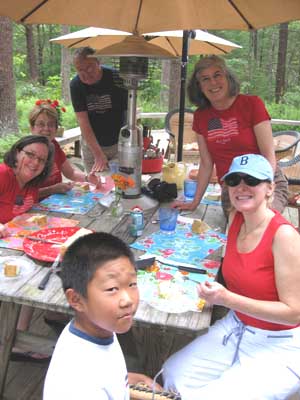
Another July 4. Usually it's the sizzle of barbecues and sun. This year in New England we’ve had the wettest, darkest, dankest June and early July ever. But still we pack up our swim suits and towels and head down to Long Pond in Plymouth where friends own a slice of an old Girl Scout camp situated on Long Pond. They sleep in what was once the camp’s infirmary (there's still a red cross on the door).

Get there early enough (we don't) and you’d be in time to attend the annual flag raising and a reading of the Declaration of Independence, an event that has taken place in a little grassy clearing every July 4 for more than 50 years. It’s an informal affair with maybe thirty people. We walk back after and our friend Joe turns down his outdoor smoker where he's been smoking brisket and ribs for the last 12 hours. Patty-Joe Bakes the world’s best blueberry pie. Lots of grandkids arrive.

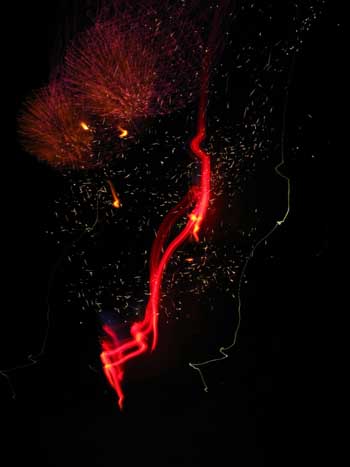
This year we were afraid we be getting another kind of fireworks--thunder and lightning. Turned out to be a spectacularly beautiful night. On the drive home, we enjoyed the splashes of fireworks that erupted from the sides of the road.

What are your July 4 traditions?

JAN: I have a confession to make. I hate fireworks. Mostly because my kids were terrified when they were small and it was always a problem. But also because they just seem like the same loud thing over and over. My poor husband, who loves fireworks, thinks the rest of us are killjoys. Which we are.

We don't have a single tradition, but we either go the (Martha's) Vineyard to barbeque with friends and check out the Edgartown Parade, or go to my sister-in-law's house here, outside Boston, to swim. This year I'll be packing all weekend to leave for France on Monday. That's not very patriotic, is it?

HALLIE: Fireworks scare me, too. If only they didn't go boom. And hanging out on the Esplanade there are always a few idiots who think it's cool to toss cherry bombs into the crowd. But watching a great fireworks display is truly breathtaking. If only you could hit the mute button.

LATE BREAKING BULLETIN - Jan broke down and braved the Esplanade Fourth of July Fireworks, and had a great time. "They were terrific!" Here's her photo.

ROBERTA: Oh I'm so jealous of your trip to France Jan!

As for the holiday, I love living in our small shoreline town where the Fourth is thoroughly celebrated. I started with the farmer's market yesterday (crammed with summer tourists who can sniff out a good thing,) then the fireworks, which we watch from some rocks on the beach nearby. It doesn't provide quite the same oomph as close up, but you can't beat the spot for no traffic and crowds. The mosquitoes were wicked this year because of all the rain. And finally this morning, our town parade. We get everything from Jazzercize to the town selectmen, to the Shriners, to fife and drum bands, to our very own fire engine. We hoot and holler at everyone we know as they go by.

HANK: As a reporter ,there are no holidays. So for years, I worked on the Fourth--but sometime was lucky enough to cover the fireworks (I love them!) on Boston's Esplanade. It's a truly different experience to go as reporter. Instead of waiting on the incredibly crowded lawn for hours and sitting with--what, half a million people? You just zoom up in the news van, park right behind the Hatch Shell (where the performance is) and stand in the front row. Of course, you have to be on the air five or six times, so there's no relaxation! And when the fireworks are over, you're still at work. But I loved it.

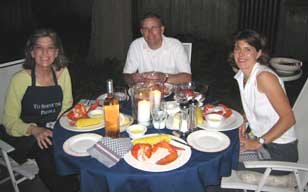
But now, we sit with friends in our back yard, listening to the Boston Pops on the radio, and have lobsters and corn and rose wine and ginger ice cream with raspberries. And--if you look in just the right spot between the branches of the sugar maple--you can see the tops of the Newton town fireworks.

HALLIE: Ooooh, that sounds (and looks) delicious.

RO: I was more of a sparkler kid than a firecracker kid. I just didn't get what was so great about something that sounded like a car backfiring and left little bits of paper all over the sidewalk. (I was a tidy child.)

Serious fireworks on the other hand are pretty nice. I don't go out of my way to see them but I usually watch from my terrace in NY on New Year's Eve. And last week I saw some pretty cool ones when I was on top of the Eiffel Tower.

Nothing but noise this year in Connecticut. And my husband forced me to sit through the movie 1776, which is one of the worst musicals I've ever seen - and over three hours long. That's what I get for making him watch Easter Parade every year.

HALLIE: Ah, yes, sparklers. I loved them, too. And we used to get these little things we called snakes...like a teensy weensy, miniature hockey pucks that you lit and coils of ash erupted from them. Mesmerizing.

On the side, is anyone watching the new Miss Marple on PBS? Last night it was "A Pocket Full of Rye" -- such a clever, intricate plot. The actress playing The Marvelous Miss M (Julia McKenzie) doesn't quite match the standard set by Joan Hickson--but who could?

Independence Day traditions? Any baton twirlers out there? Miss Marple? Where are you this Monday after?