
Showing posts with label anxiety. Show all posts

Tuesday, November 8, 2022

High Anxiety by Sandy Manning


LUCY BURDETTE: Before I introduce our guest today, we here at Jungle Red have an important milestone to crow about:  Rhys is celebrating the release of her Fiftieth book—the sixteenth in the Royal Spyness series, called Peril in Paris. We bow to your amazingly prolific career, Rhys--and we're so proud to claim you as a Red! In PERIL IN PARIS, Lady Georgie looks forward to a fun and relaxing time in Paris with husband Darcy and friend Belinda. But a fashion show at Chanel turns deadly and plunges Georgie into intrigue and danger. (There are signed copies at the Poisoned Pen. Plus you can watch her discussion of the new book at the PP bookstore!)


Next, we’re pleased to welcome Sandy Manning, who has written a post that follows our discussion yesterday quite nicely. Welcome Sandy!


SANDY MANNING: It can be something quite small. An article about the dangers of gas stoves. A new covid strain. A random thought about my son. Suddenly, I feel my stomach tightening and a dread spreading over me, a nameless panic that something terrible is about to happen, regardless of the reality. And yet, I write thrillers where terrible things do happen, sometimes to characters I like. Doesn't that make things worse?


Logically, it should. But it doesn't.
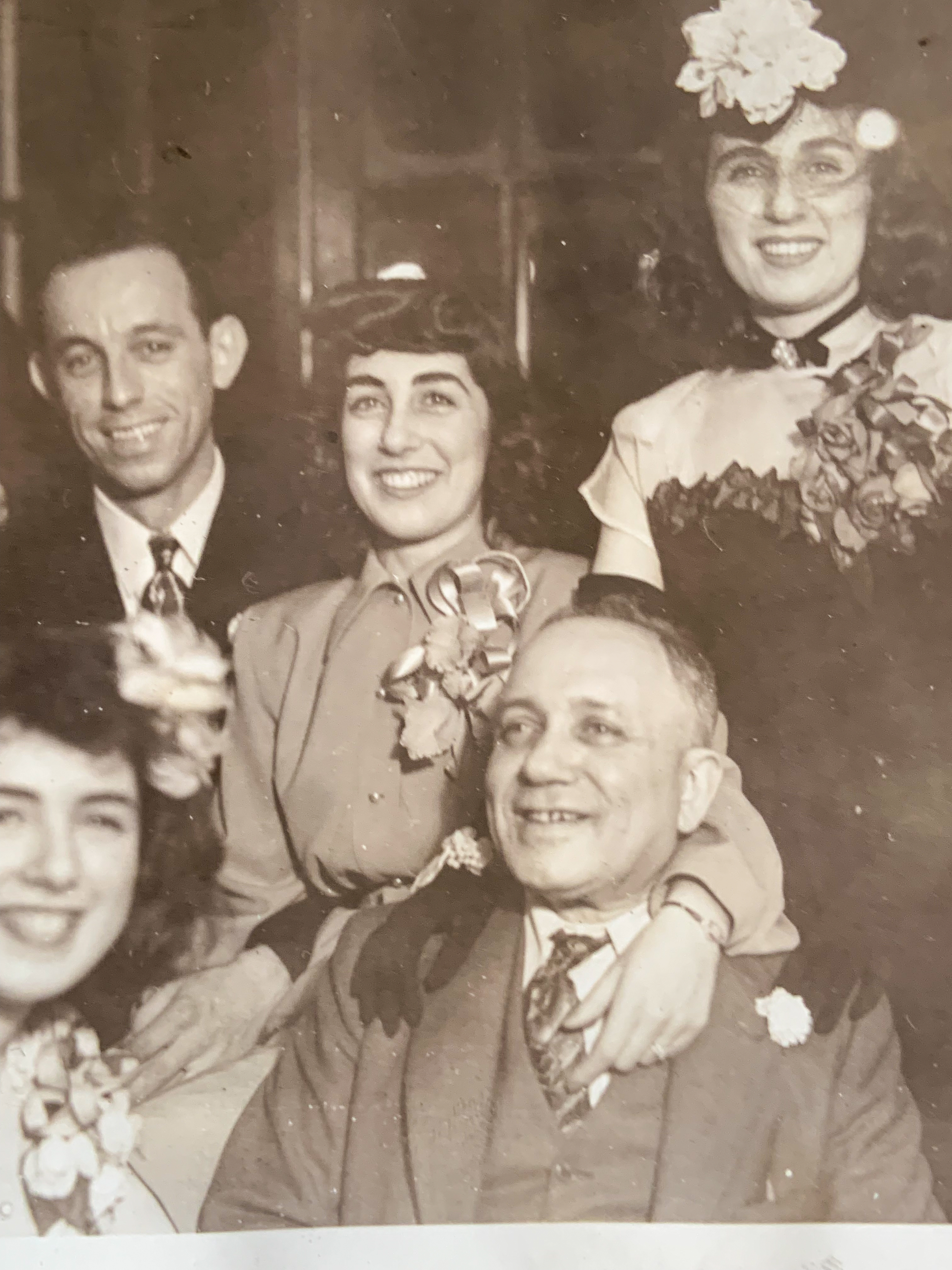


I have an anxiety disorder. I always had it, but it was more manageable. It was in the aftermath of my mother's sudden death fourteen years ago that I began to feel a recurring terror. Suddenly I had trouble driving over bridges. Suddenly I saw the life-threatening possibilities in the most mundane of circumstances. (Photo of Sandy's mother at her wedding.)


It's not that I didn't fear heights or worry about foods causing cancer or strangers accosting my children before my mother's death. But it was different. It was concern, but not panic. Despite my tendency to worry, I could remind myself that things would generally come out okay.


I got that from my mother. We had a weird relationship - she was a little crazy in ways that would be difficult to describe in this blog - but she was my mother, and I loved her. And she always repeated the mantra to trust that all would be well. Sometimes she'd spell it. T-R-U-S-T. God, I hated it when she did that; nevertheless, some part of me believed it.


And then, quite suddenly, that changed. My mother went into the hospital in Cincinnati, Ohio on Friday evening for stomach and back pain and she was dead by 6 p.m. on Saturday while I was searching for a plane flight to get to her from New Jersey. I couldn't eat for three days after she died. The dread settled in and continued. When I went to a therapist, I got the official diagnosis. Anxiety disorder.


I'm not alone, either. I've read estimates that between 20 percent and 30 percent of Americans suffered from an anxiety disorder of some kind before the pandemic. During the pandemic, it may have increased to 50 percent, according to one report. 


I'm better than I was, but I still have moments when the anxiety takes over. And it's never completely gone, always simmering just below the surface.


And still, I write thrillers, where good characters sometimes die.  


I write thrillers because it's my favorite genre. I love stories with strong characters and elaborate plots with surprising twists - books that keep me up reading all night, even though I will admit to sometimes sneaking a peak at the ending to ensure that my favorite character doesn't die. I love crafting them even more. But there is a side benefit to writing my books: relieving my anxiety. 


I draw on my own experience with anxiety in crafting my novels, since it is similar to what my main character experiences. My protagonist in Bloody Soil, Kolya Petrov, a Russian Jewish immigrant who works for American intelligence, suffers from PTSD (post traumatic stress disorder) after the events of my first novel, Trojan Horse. Some of the symptoms of PTSD and severe anxiety are similar: physical effects - racing heart, even trouble breathing; both interfere with sleep and energy; both can generate fear about non-imminent threats; and both can cause intrusive thoughts. PTSD, however, is caused by a triggering and terrifying event, and the intrusive thoughts relate back to that event. (Although my anxiety grew significantly worse after my mother's death, I don't consider myself as having PTSD. My intrusive thoughts tend to be of catastrophic possibilities in everyday events - a good talent for a thriller writer but unpleasant for living. Kolya's thoughts, however, always circle back to the horrific events that he endured.)


While there may be some different treatments for anxiety and PTSD, both disorders can be treated with cognitive behavior therapy, with learning techniques to focus on the here and now. 


Despite on-going symptoms, Kolya manages to perform, using exercises that place him in the moment and not in the past. While writing about Kolya's PTSD, I'm working on my own anxiety disorder. Through my own therapy, I've worked on mindfulness - and writing my novels puts me totally into the moment. It's not the reason that I write my novels, but it does help.


Then there's the issue of control. There are limited aspects of real life that are under our control, and knowing that is part of my problem. But focusing on what I can control does help. (As it helps Kolya in my novels.) And one area where I am in charge is my writing. I decide who dies, who lives, who pays for misdeeds, who escapes. The fates of the people I portray in my novels are all within my power, and that somehow is deeply comforting.   


I may never completely overcome my anxiety disorder, but like Kolya, I have found ways to function.


So how about you? Have you experienced anxiety? What helps you?


In honor of the release of Bloody Soil (and to honor her home state of Vermont), Manning is running a maple syrup giveaway. For more information, check her website www.sleemanning.com. 


About Sandy: A reformed lawyer, S. Lee Manning is the award-winning author of international thrillers, featuring a Russian-Jewish immigrant to the United States working for American intelligence. When not writing thrillers, she occasionally performs stand-up comedy. Manning lives with her husband and fellow author, J.B. Manning, and their cat Xiao in Vermont. 


About the book: In BLOODY SOIL, pub. date November 9, 2022, a mysterious American calling himself “Michael Hall" arrives in Berlin to join Germany Now, a far-right group and must prove himself by shooting a prominent Jewish anti-Nazi activist or face certain death. Michael, though, has attracted the deadly attention of an unexpected enemy. Lisette who infiltrated the group to avenge the assassination of her father years earlier, is eliminating killers in Germany Now one by one and targets Michael as her next victim. But is Michael who she believes him to be?

Monday, November 7, 2022

What to Do When the World's on Fire

 LUCY BURDETTE: Honestly, it feels a tad hard to stay optimistic these days. Covid is still with us although probably less lethal, horrifying wars abound, countries we don’t trust are rattling their nuclear sabers, the climate is warming and our politicians don’t seem to want to take action. Oh and don’t let me forget violence against politicians, and ordinary citizens who deny basic truths. What is wrong with this country?? (Make sure you vote tomorrow if you haven’t already–it’s more important than ever that we all speak up!)

Remember the early days of the pandemic when we were all holed up in our respective caves and terrified? It’s not quite that bad, but it could be. So I thought it might be time to talk about how we’re doing and to share ideas about how we’re handling the stress. 

For me, it’s a combination of keep working (because I have a lot of work that I am happy to have), keep reading (has anybody else tried Colleen Hoover‘s books?), and watch cat videos. See above for the funniest thing I’ve seen in a long time, sent by a friend from college days.

How about you Reds? Tips for staying sane?

JULIA SPENCER-FLEMING: How do I manage stress? Honestly, having my dogs around helps. It’s hard to feel angst when you’re rubbing a furry belly. (Those of you with no dogs but with hirsute spouses can try this as well.) I make sure to spend time outdoors every day, walking the dogs or bringing in wood from the woodpile or just sitting on my front porch.

I also find the more I can stick to my routine, the better I feel. Is this an age thing, or do we all crave order and repetition, but never get the chance when we’re raising kids or working for someone else?

RHYS BOWEN: I certainly find life stressful enough now, having been through Covid, insurrections, lies and rising inflation. I worry how people can survive with the cost of everything soaring up. I’m not sure that I do manage stress that well! I find it hard to get back to sleep if I wake in the middle of the night. 


Certainly being in nature helps. When I’m in Marin I often drive to a nearby beach and listen to the lap of water and watch the sea birds. Now I’m back in Arizona and I love the view from my office window. I like lying on a sun bed and watching palm trees swaying above me. I love to swim, or just lie in the water looking up at those palm trees.

And I love to laugh. British comedies like Miranda (on Britbox) can do a power of good for me.

HALLIE EPHRON: My kids and my grands do a lot to keep me focused on what matters. Laughing a lot helps, too. I find the books and TV shows I watch have to have a strong dose of smart humor and likeable characters.  And trying to get a walk in every day. Lucy, love that cat video!

HANK PHILLIPPI RYAN: This is such a profound question, and  such a personal and complicated answer. My husband has said to me “I have never heard you be this angry.” But that’s where it is, I am so sad, and so angry, and so… 

Astonished.  

I have spent my entire career looking for the truth, and it is jaw-dropping tonthink about how people just don’t care. They just – – don’t care about the truth, the only thing that matters is what they want. And that becomes true. 

Okay, end of rant. It’s such a balance, because we have to care about the big picture, and also care about the little picture—ourselves, and our families, and our little world.


I truly think we simply have to be grateful for what we have. Did we have a wonderful muffin for breakfast? Is our coffee completely delicious? Is there a beautiful bird in our backyard? We saw this woodpecker! Amazing!

 I am so aware that what we have is right now. And we have to love it and embrace it and notice it.

I do my work, the best I can.  I try to enjoy my very very lucky life, and I try to look at the world as if humans are basically good. 

I put my head down, and I work. And I try to count my blessings, and be optimistic. 

DEBORAH CROMBIE: Lucy, the cat video is hysterical! I definitely need to see more things that just make me laugh. It's such a hard balance these days–I feel a responsibility to be engaged with what's going on in the world, but on the other hand it's so terrifying and it makes me so angry that it's impossible to function without some way to shut it out. Routine helps, as Julia says. Concentrating on the joy of small everyday things, friends and family, reading (thanks to Judy Singer for recommending the audio versions of Evie Dunmore's books–an absolute delight, but so meaningful, too.) And, unless, I'm frantically up against a deadline, writing, because once I'm absorbed in my story, it holds the world at bay.

Red readers, how are you doing? Tips for staying sane?


Saturday, April 4, 2020

Words of Wisdom for Tough Times.

RHYS BOWEN: I had planned something quite different for today. A bit of humor. But then I realized what a great resource I had to share. My son is a life-coach and healer and has been giving daily talks to help us get through this horrible time. So I asked him to share some tips today.

DOMINIC QUIN-HARKIN
 The Next Home-Based Gym – Your Journal

Although our days are consumed by hours of “productive” stay-at-home activities—Snipping nose hairs, glaring out the window like an uninterested cat, making snacks out of peanut butter and banana—Who knew you could find so much enjoyment out of these? But then you start to notice a noise. You check the hallway, the kitchen, outside your window, but nothing’s there.

So you pick up your book and read, or you pick up your computer and write. And usually, these activities can behave as a glorious escape from the “Real World”. As you are immersed into another world of murder, fantasy, dystopia, or passion, it all seems to be comforting, relaxing, and sometimes titillating. But then you put down the book, you put down the computer. And in the silence, it starts again.

And you finally close your eyes and start to become completely aware that some of these noises are coming from your chest area… your sinuses, your forehead…and your hands are shaking. This is your emotional body trying to express itself. Tension across your forehead and a pit on your stomach lead the charge, but there are a slew of other emotional states just chomping at the bit to get your attention.

In this extraordinary time, we are being forced to BE indoors, BE with a few other people only, BE alone. And guess who else is with us?? Our thoughts, fears, and worries. We have to finally BE with ourselves, and all of the internal communication our bodies have been doing to get our attention. Our emotions are right there, and they’re begging to be recognized and expressed. Our emotional states right now are one of fatigue and exhaustion.

And what are we doing to recover mentally or emotionally on a daily basis to keep us balanced? What habits or tasks do we have for mental or emotional maintenance? If you look at an athlete, after a long day of practice, he or she ices for 20 min, stretches, rotator cuff exercises, core work, ices again, knowing that this is what is necessary to perform tomorrow at the highest stakes.

And reading about psychoses and syndromes doesn’t help. We’ll spend so much time talking about an emotion to ourselves, our therapist, our friends, and our families, that sometimes we’re just too damn smart for our own good. We talk ABOUT our emotions as though we’re 2 parents talking about a child when the child is sitting RIGHT THERE.

Emotions are like little anxious children in a classroom raising their hands frantically, waiting to be called on. And as we ignore them, they get louder, and louder, and louder. They fill our muscles, our tissues, our organs; and toxic emotion is the source of Dis-Ease in the body.

So, in order to get our mental/emotional states back to a place of strength and calm, we need to create a recovery period, with exercises to do, on a daily basis, in order to maintain and reach an optimal health. Something to do today, so we can feel good tomorrow. Journaling is one of those exercises that will support your mental health, clear some of that emotional sludge that seems overwhelming.


Journaling Techniques –
To form a nightly recovery routine, Journaling can be a very healthy and effective way to manage your emotions, and to release them on a daily basis. Journaling can be a lengthy process if you choose it to be. It can also be a very simple process, consisting of only two sentences: What I liked about today, and how I’d like tomorrow to go. These are very easy ways to get your mindset in a healthy way to recover and be ready for the next morning. But if you'd like to have more in-depth tools to help releasing some of the emotions that have been bubbling and squeaking inside of you, then here are some tools that can focus on releasing the held emotions and mental thoughts that I've just been begging to be recognized and let go.

Write Fears and worries   - What I want instead
When you recognize your fears and worries, in effect you “call” on them to let them be recognized, so they can put their hand down and subside. My mother expressed worry that she never wanted to write her fears at the possibility that they come true. My response was that “In your head, they’re already true.”. Also if you take these BIG FEARs in your head, and write them in very small print, then you can begin to see that they are really nothing more than some squiggly lines on a page. And if they’re still big, crumple up the page. And if they’re still big, then burn it (safely) in your fireplace.
 Writing fears and worries give you a chance to see them and then focus your mind and what you would like instead.
On page 1,
“I am scared that_______________ (the virus will grow, I’ll have no toilet paper, etc.)”
“I worry that _________________ (one of my family members get ill)
On page 2, write how you would like to feel instead.
“I would like to feel _____________ (confident that we’ll get control of the virus / trusting that I’m safe from my sanitation behaviors)”
“I would like to have faith that our family will be taken care of”

I was speaking with my mom on the phone who has never journaled, and after the 1st night, she said she had the best sleep she’s had in a long time. My father chimed in to say “what on earth did you do to your mother for her to sleep so well?” I told him to write his fears, and he said, “I already have 2 beers.” “No, Dad, FEARS. Write your FEARS.” “Why do I need to do that when I can have 2 beers, and I sleep just fine?”

Emotional Piggybank – Withdrawals and Deposits
If you can see your mental/emotional state as a balance in your mind-body, with negative thoughts, people, articles and experiences having a negative value. Then look at the moments of joy, smiles, small victories and abundance, and those have a positive value. At the end of the day, do you have a negative or positive value? The goal is to use the journal to make Withdrawals and Deposits. Withdraw all of the negative thoughts, fears, and experiences from your day. And when you deposit, deposit all of the “Positive Evidence” that was a part of your day.
Withdrawals – “I’m afraid that… I’m worried that…” That interaction with my neighbor, yuck, that news conference made me angry.
Deposits – “I ended up cleaning the yard today. I cooked a good meal. My kid thanked me. I had a great walk with my family. I just love my wife, she’s really being a trooper. I’m so grateful that we have toilet paper and food.”
By doing this, you can get to a positive balance, and day by day, little by little, knowing that each night, you’re withdrawing those negative experiences so you can start the next day with a better balance.

What Ifs? And What would I Do’s? - Writing the Story to the End-
If you are a writer, then you already have a good imagination. I can probably guess that you are some of the best worriers out there. Worry is a waste of a wonderful imagination. It takes real creativity to think I’m not home yet because an oil tanker crossed the center divider and …. “Oh, you’re home…”
 The problem with worries is that you start thinking the worst case scenario, but then you stop. “Oh I shouldn’t think about that.” But you already have. It’s in there. But it’s missing a hero, and an ending.
One of the techniques I use with my clients is to write out the rest of the story.  The following was an interaction I had with my wife going through the process with me.
“I’m afraid that you will get ill with the virus. And then you'll get worse. And then I'll have to take care of you. And then you'll pass away. And then I’ll have to bury you. And then I'll have to be by myself. I'll have to figure it out where you left all the passwords and how to pay the bills.”
And I say, “Would you still have your mother and sister?
“Yes.”
“Would you call them? You would have support through this?”
“Yes I guess I would.”
And I ask, “Is that as bad as you thought it was?”
“No, not as bad.”

IFs and BUTs
This connects to your underlying conditions on being happy, or of being in acceptance of your situation. If we are in a state of resistance where we are, then it's hard to see where we can get to from there. But using If’s and But’s, you're looking at restrictions you have on your happiness. When you say “I would be much more confident that we're going to get through this, but, I just don't have faith in anyone in government.” Just by saying this and putting down your IF’s and your BUT’s down on paper, you allow your conditions to be recognized and release them. And as you release them then you get to more of a state of acceptance of where you are with a direct road toward your happiness, without all the conditions that we as humans can put.

Making Commands

The last thing I’ll talk about today is called Making Commands. When you make commands, you are telling yourself and the universe how you would like your next day to go. By saying, “I command my day to flow with ease and Grace tomorrow,” then you were telling the world that it wouldn't just be a nice option, it means this is something you really want and you want to the universe to know that. Not only that but you're telling yourself that you really want it. Try making a few commands of how you would like to feel the next day, the type of success you'd like to have, how you would like to respond to people who are angry at you or frustrated. Just by putting down on paper how you like the day to go makes it very easy for you actually to achieve that..

In all, these are just tools that can be used any given night as a part of a recovery routine. If we can be so purposeful about when we get up, what we eat, what exercise we do, then we definitely have the ability to be mindful about what words we say, what emotions were holding onto, and how we want our next day to go.   When this happens we can start focusing on our health from an inside-out approach, and not just the physical outside-in view. And then very soon we can look forward to sitting in the silence, and just hear silence.

RHYS: I hope these are as helpful to you as they are to me. Dom and his wife Meredith post a new walk and talk every morning that I share on my Facebook page. Here is his info


Dominic Quin-Harkin is an Energy Healer, Massage Therapist, Life Coach, and speaker. His focus is to bring awareness and coping skills of mental and emotional states, and the psychosomatic effects emotions have on the body. To learn more, you can see his postings and teachings at 


Saturday, July 16, 2016

Alice Bradley on Writing and NFD — Nameless, Faceless Dread


SUSAN ELIA MACNEAL: Writer, blogger, and now podcaster Alice Bradley seems to have gotten inside my head. I'm half-way through THE PARIS SPY and am at that frustrating awful horrible point where nothing is working and I'm starting to panic. I think of it as my old friend, anxiety, but Alice calls it the Nameless, Formless Dread, which perhaps makes it a little less terrifying.

Maybe?

Anyone?

HELP ME!!!


ALICE BRADLEY:  Looking over list of tasks for the day, Alice hears a disembodied voice*. 

?: Ha ha, you’re not going to accomplish any of it. Again. 

Me: Who said that? 

?: Good morning. I am The Nameless, Formless Dread! 

Me: I need to cut down on my coffee.  


While working

Me: Huh. Did I eat something weird? 

NFD: Hello. I am the Nameless, Formless Dread. 

Me: Jesus—get off me! I’m trying to work. 

NFD: I will help. That thing you’re doing is bad. 

Me: How is this a help? 

NFD: How about this? That thing you’re doing is very bad. 

Me: Please unhook yourself from my abdomen. 

NFD: But it’s so soft here. (whispers) Too soft. 


After walking past group of neighbors who don’t seem to notice when Alice smiles hello

NFD: Nameless, Formless Dread, here! Ouch. That was awkward. Boy do they not like you. 

Me: That’s ridiculous. Why would they dislike me? 

NFD: (Shrugs) They have very good reasons that they’ve all agreed on but you’ll never know what those are. 


When the phone rings

NFD: AAAAAAAAAAAAAGH DON’T ANSWER IT HIDE HIDE THE NAMELESS FORMLESS DREAD SAYS HIDE 

Me: What the hell? 

NFD: Someone is dead! Or mad at you! 

Me (looking at number): It’s a telemarketer. 

NFD: Why don’t your friends call? Oh, because you’re… never mind. 


And then later 

Me: (closing laptop) 

NFD: Hey there, Nameless/Formless Dread, blah blah, hello, are you getting up? Where are you going? 

Me: I have a thing I’m supposed to go to. 

NFD: No way. Do you know how many things could happen to you out there? And why are you wearing that? Look, I brought kettle corn! 

Me: This kettle corn is stale. 

NFD: That's an early warning sign of dementia, you know. Thinking, uh, things are stale. I haven't thought this through yet. But don't worry, I will.  


In bed

NFD (clambering atop my head): Oh no, oh no! You forgot! YOU FORGOT! 

Me: What? WHAT? 

NFD: … I can’t remember. Huh. Well, at least now you have all night to figure it out. 

*(Don't worry, not really.)  


SUSAN ELIA MACNEAL: Does the NFD come to you, too, when you're working on something? Trying to sleep? What do you do? 

P.S. And does anyone else now want kettle corn?


Alice Bradley

I'm a writer, and I live in Brooklyn, New York, with my husband Scott, my son Henry, my dog Hazel, and Izzy the cat.

I write short fiction, personal essays, humor, and feature articles. I've created content for all kinds of publications and brands. Here's a selection of my work. 

I've been writing Finslippy since 2004 (back when I thought I could call it a nonsense word I came up with in my dreams, since no one was going to read it). In the beginning I wrote about parenting, but these days I blog about creativity, art, mental health, our surly cat and hilarious dog, and whatever is going in my life. 

I've got a podcast with Deanna Zandt called The League of Awkward Unicorns, It's about mental illness (depression, anxiety, etc. etc.) and emotional wellness (things that help, whether it's medication, exercise, or wrapping oneself up in a Snuggie while binge-watching The Mindy Project). We were called "funny, frank, and accessible" by the Guardian. 

Find us on iTunes here. 

I co-authored a book called LET'S PANIC ABOUT BABIES! with the beloved Eden Marriott Kennedy. It was published by St. Martin's Press, and we're quite proud of it. You can read all about the book (and enjoy our book trailer, excerpts, and reviews) over here.

I'm also a teacher for Gotham Writers Workshop, and often teach online courses in writing and creativity via this very website. Want to be the first to know about upcoming courses? Sign up for the newsletter! 
As of June of 2016, I am officially, unapologetically, calling myself an artist. Want to see my work? For now, it's mostly on Instagram. 
 
I love emails from readers. My favorite comments include the following:

"You write as if you're listening to the voices in my head."

And:

"I usually find things amusing online, but don't always laugh, like with my voice. Today I did."

If you have anything to say, I'd love to hear from you. Thanks.


Monday, March 23, 2015

What, me worry? Pre-launch jitters

HALLIE EPHRON: So my book comes out tomorrow and my stomach is doing flip flops and I can't sleep I am so anxious. I tell myself: Hey, there are people who will love it and people who won't. It's all about personal taste. And besides that, getting reviewed at all is a gift.

But still I read reviews with my eyes squinched, half-closed so I can shut it down if there's a snarky (and probably valid, sadly) remark about me or my lovely characters or my clever plot. You'd think with this being my 9th novel I'd have gotten over it.

And because misery loves company, I was telling Jacqueline Winspear (whose 11th Maisie Dobbs mystery, "A Dangerous Place," debuted last week; USA Today ran a glowing review), how nervous I was, expecting her to be all lah-dee-dah and tell me that yes, it does get better.
 

But no. She said she dreads these before-launch days as much if not more than me. I found this oddly reassuring.

So, dear Reds, does pre-launch give you the jitters? Or is it just an exciting version of "anything can happen days?" And while we're at it, what's your cure for nausea and insomnia?

LUCY BURDETTE: First of all, we can't wait for pub day so everyone can read this great book!

I kind of like the pre-launch days because anything is possible. To me the more stressful time is launch week itself--waiting for those reviews to hit and watching the silly numbers--which truly don't mean much because we don't have access to the whole picture.

But I can't imagine that any writer has a thick enough skin so that they aren't nervous...wouldn't that mean you hadn't put everything you had into it?

RHYS BOWEN: Having had a book out three weeks ago and having returned home from an exhausting three days in Southern Cal last night I'm still in full launch jitters mode. Really manic, swinging between elation and despair.

I saw who had a new book out on the same day and resigned myselt to not making the New York Times list with this book. Then I found that the Huffington Post had done a feature on the seven most suspenseful new books and I was one of them!

So ups and downs. Knowing I shouldn't read reviews, especially Amazon, but doing it anyway. The thrill of seeing my new book on the shelf in one store and the agony of defeat when a Barnes and Noble has never heard of it.

I'm trying to learn never to expect too much and being pleasantly surprised by the good things. But I haven't learned it yet. Probably never will.

So Hallie, enjoy every moment.
Tell yourself that you are luckier than several zillion writers who are dying to have a book published or who have self-published it but nobody will ever know about it. You're in the top tier, the tip of the pyramid. It will be a brilliant success!

HALLIE: As a wise woman once said... well, what you just said, Rhys. And congratulations on the Huff Post call out! Wow!!

DEBORAH CROMBIE: Hallie, I'm excited about your book launch for you!! And I have no doubt that reviewers AND readers will love it. It's a great book.

That said, however, I sympathize with you. I try not to look at numbers (although for the first few days it's impossible not to...) I wish I had never heard of Amazon ranking. I dread reviews, even though over the course of sixteen books the good have certainly outnumbered the bad.

Still, there's always a first time, and THIS one could be the book that is a total flop, right? I try (and mostly succeed) not to read any reviews on Amazon. And I tell myself repeatedly that all I can do is write the best book I can, and then go on to the next one.


Cure for nausea and insomnia?  Read a good book:-)


SUSAN ELIA MACNEAL: Oh, I was a mess at first — a total mess. But with each book, more things seemed to happen, both good and bad in so-called real life.

For my last book launch for THE PRIME MINISTER'S SECRET AGENT,  I was in the hospital with Miss Edna — and, honestly, I really didn't care about reviews or really anything much at all besides her and my family. My book tour that summer was plagued with worries I'd have to fly home at a moment's notice for an emergency or worse.

Which all sounds pretty depressing — except that it give great perspective on the vicissitudes of this business. And I'm grateful for that.
HANK PHILLIPPI RYAN:  Here's what I think.  The only thing worse than prelaunch--is NO pre-launch. Right? AmIright?

So--easier said than done, I know--count your blessings, this is wonderful, your book is wonderful, this is it it IT, and the hard part is over (sort of, except the air travel and smiling)(but that can be wonderful), you've written it, it has a gorgeous cover and a gorgeous inside and everyone is going to clamor for it.

My cure for insomnia and nausea is ..um, well, nothing. I'd say shopping, but you don't do that and it doesn't work anyway, or wine, but that way lies madness and you can't drink during the day.

Exercise?

Really--how about simply TRY to be happy. Your stomach is hurting and you can't sleep because you are EXCITED! Yay.

(And you can do the same for me in October.)​


HALLIE: I AM happy, because while I'm posting this I get a link to a review of my book in the Richmond Times-Dispatch. It's a rave, and ends with:  
"So hooray for Hollywood, hooray for homicide, and hooray for Hallie Ephron, who begins with a seed of truth and grows it into a bumper crop of crime and cynicism."

That helps. In fact, it's probably the best antidote for this version of anxiety.

What do you do to keep quiet butterflies in your stomach and lull yourself into tranquility. I'm listening!






