
Showing posts with label s. lee manning. Show all posts

Tuesday, November 8, 2022

High Anxiety by Sandy Manning


LUCY BURDETTE: Before I introduce our guest today, we here at Jungle Red have an important milestone to crow about:  Rhys is celebrating the release of her Fiftieth book—the sixteenth in the Royal Spyness series, called Peril in Paris. We bow to your amazingly prolific career, Rhys--and we're so proud to claim you as a Red! In PERIL IN PARIS, Lady Georgie looks forward to a fun and relaxing time in Paris with husband Darcy and friend Belinda. But a fashion show at Chanel turns deadly and plunges Georgie into intrigue and danger. (There are signed copies at the Poisoned Pen. Plus you can watch her discussion of the new book at the PP bookstore!)


Next, we’re pleased to welcome Sandy Manning, who has written a post that follows our discussion yesterday quite nicely. Welcome Sandy!


SANDY MANNING: It can be something quite small. An article about the dangers of gas stoves. A new covid strain. A random thought about my son. Suddenly, I feel my stomach tightening and a dread spreading over me, a nameless panic that something terrible is about to happen, regardless of the reality. And yet, I write thrillers where terrible things do happen, sometimes to characters I like. Doesn't that make things worse?


Logically, it should. But it doesn't.
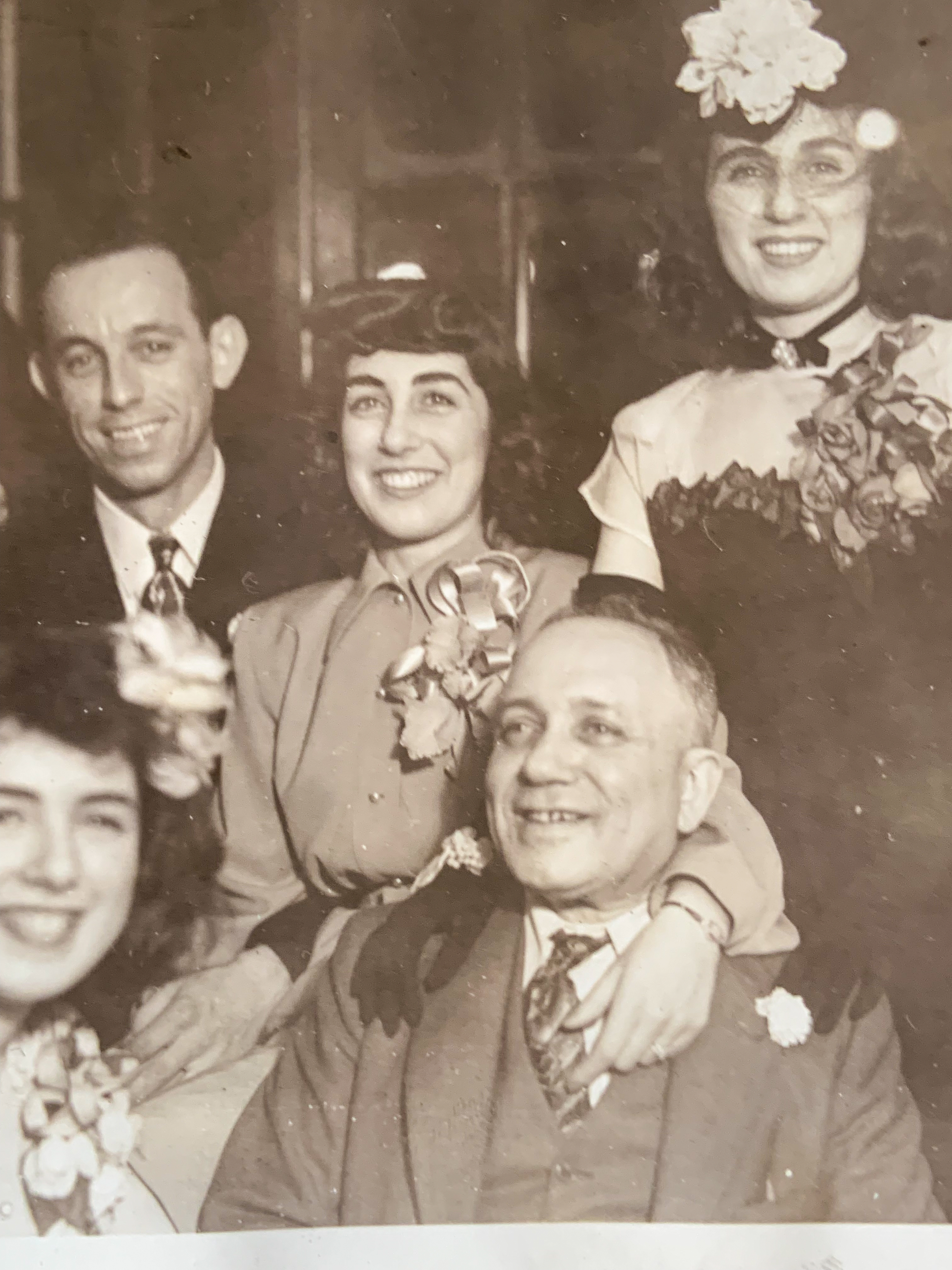


I have an anxiety disorder. I always had it, but it was more manageable. It was in the aftermath of my mother's sudden death fourteen years ago that I began to feel a recurring terror. Suddenly I had trouble driving over bridges. Suddenly I saw the life-threatening possibilities in the most mundane of circumstances. (Photo of Sandy's mother at her wedding.)


It's not that I didn't fear heights or worry about foods causing cancer or strangers accosting my children before my mother's death. But it was different. It was concern, but not panic. Despite my tendency to worry, I could remind myself that things would generally come out okay.


I got that from my mother. We had a weird relationship - she was a little crazy in ways that would be difficult to describe in this blog - but she was my mother, and I loved her. And she always repeated the mantra to trust that all would be well. Sometimes she'd spell it. T-R-U-S-T. God, I hated it when she did that; nevertheless, some part of me believed it.


And then, quite suddenly, that changed. My mother went into the hospital in Cincinnati, Ohio on Friday evening for stomach and back pain and she was dead by 6 p.m. on Saturday while I was searching for a plane flight to get to her from New Jersey. I couldn't eat for three days after she died. The dread settled in and continued. When I went to a therapist, I got the official diagnosis. Anxiety disorder.


I'm not alone, either. I've read estimates that between 20 percent and 30 percent of Americans suffered from an anxiety disorder of some kind before the pandemic. During the pandemic, it may have increased to 50 percent, according to one report. 


I'm better than I was, but I still have moments when the anxiety takes over. And it's never completely gone, always simmering just below the surface.


And still, I write thrillers, where good characters sometimes die.  


I write thrillers because it's my favorite genre. I love stories with strong characters and elaborate plots with surprising twists - books that keep me up reading all night, even though I will admit to sometimes sneaking a peak at the ending to ensure that my favorite character doesn't die. I love crafting them even more. But there is a side benefit to writing my books: relieving my anxiety. 


I draw on my own experience with anxiety in crafting my novels, since it is similar to what my main character experiences. My protagonist in Bloody Soil, Kolya Petrov, a Russian Jewish immigrant who works for American intelligence, suffers from PTSD (post traumatic stress disorder) after the events of my first novel, Trojan Horse. Some of the symptoms of PTSD and severe anxiety are similar: physical effects - racing heart, even trouble breathing; both interfere with sleep and energy; both can generate fear about non-imminent threats; and both can cause intrusive thoughts. PTSD, however, is caused by a triggering and terrifying event, and the intrusive thoughts relate back to that event. (Although my anxiety grew significantly worse after my mother's death, I don't consider myself as having PTSD. My intrusive thoughts tend to be of catastrophic possibilities in everyday events - a good talent for a thriller writer but unpleasant for living. Kolya's thoughts, however, always circle back to the horrific events that he endured.)


While there may be some different treatments for anxiety and PTSD, both disorders can be treated with cognitive behavior therapy, with learning techniques to focus on the here and now. 


Despite on-going symptoms, Kolya manages to perform, using exercises that place him in the moment and not in the past. While writing about Kolya's PTSD, I'm working on my own anxiety disorder. Through my own therapy, I've worked on mindfulness - and writing my novels puts me totally into the moment. It's not the reason that I write my novels, but it does help.


Then there's the issue of control. There are limited aspects of real life that are under our control, and knowing that is part of my problem. But focusing on what I can control does help. (As it helps Kolya in my novels.) And one area where I am in charge is my writing. I decide who dies, who lives, who pays for misdeeds, who escapes. The fates of the people I portray in my novels are all within my power, and that somehow is deeply comforting.   


I may never completely overcome my anxiety disorder, but like Kolya, I have found ways to function.


So how about you? Have you experienced anxiety? What helps you?


In honor of the release of Bloody Soil (and to honor her home state of Vermont), Manning is running a maple syrup giveaway. For more information, check her website www.sleemanning.com. 


About Sandy: A reformed lawyer, S. Lee Manning is the award-winning author of international thrillers, featuring a Russian-Jewish immigrant to the United States working for American intelligence. When not writing thrillers, she occasionally performs stand-up comedy. Manning lives with her husband and fellow author, J.B. Manning, and their cat Xiao in Vermont. 


About the book: In BLOODY SOIL, pub. date November 9, 2022, a mysterious American calling himself “Michael Hall" arrives in Berlin to join Germany Now, a far-right group and must prove himself by shooting a prominent Jewish anti-Nazi activist or face certain death. Michael, though, has attracted the deadly attention of an unexpected enemy. Lisette who infiltrated the group to avenge the assassination of her father years earlier, is eliminating killers in Germany Now one by one and targets Michael as her next victim. But is Michael who she believes him to be?

Friday, September 17, 2021

You've Got a Friend in Me by Sandy Manning

Jenn McKinlay: Good morning, everyone. Our good friend Sandy Manning is back to talk about her latest thriller novel, featuring Kolya Petrov, entitled Nerve Attack. Welcome, Sandy!


BUY NOW


S. Lee Manning: When I started writing my latest novel, Nerve Attack, I had to figure out a way to get my series protagonist, Kolya Petrov - whose agency had betrayed him, setting him up to be kidnapped and tortured - back into the spy game. After all, why would he go back to working for people who had shown such a lack of concern for his life and the life of his fiancee? Yes, he's the kind of person who would feel responsible for preventing the deaths of innocent people, but he's also pretty pissed off after the events of Trojan Horse my award winning debut novel. There would have to be a situation that required his personal involvement to prevent mass casualties, a situation that no other agent could handle. 


I considered various options before deciding to use Kolya's relationship with Dmitri, his childhood best friend but whom he'd put in prison ten years earlier, as the plot mechanism.  What if Dmitri, who appeared in Kolya's dreams and hallucinations in Trojan Horse, had information that could prevent a terror attack but refused to work with anyone but Kolya? 


That choice - using Kolya's tenuous relationship with someone who had been like a brother - made the book. Through their relationship, I could delve into the characters' backgrounds, into their conflicting loyalties, and into the nature of friendship. I'd say more - but I don't want to reveal too much.  


One critic, who gave Nerve Attack a five-star rating on Readers' Favorites, direct messaged me to say how after finishing the book, he couldn't stop thinking about Kolya and Dmitri - how their relationship brought both of the characters to life.


So how important are friendships in real life?


We don't talk as much about the importance of friends as we do about the importance of lovers, and of families, but friends have an enormous influence on our lives.


Friends are how we take our first steps away from our parents. Friends, especially when we are young, shape our values and our worldviews. I have read that soldiers who risk their lives in battle often do so more to protect the fellow soldiers in their unit than out of abstract patriotism. But as we get older, involved in careers and raising families, we sometimes have to let something go. All too often - it's friendships.


I know that it happened with me. Busy with children and my job as an attorney, I lost touch with so many people.


Now, in my post child rearing, post law career life, I am rediscovering the joys of friendship. I have looked up and reconnected with friends from my younger years. My best friend from my teen years and I talk every two weeks, and we've met a few times here in Vermont. I regularly call one of my close friends from the University of Chicago, where I earned my M.A. in English. And I've started chatting periodically with another friend from my time working as a deputy attorney general for the State of New Jersey. There is something so deeply satisfying in reestablishing a relationship with friends who knew me as a young woman.


But I've also made new friends, now that I'm part of the writing world. Back in pre-pandemic days, I met people at conferences who have become some of my closest friends. I have wonderful friends in Florida whom Jim and I met while volunteering on a political campaign. I've connected with people on Facebook. And, oddly, as an Encircle Publication author, one of the side benefits is that I've developed a deep bond with other Encircle writers, with whom I meet at a virtual cocktail hour once a week.


Maintaining friendships in the midst of a pandemic was not been as difficult as I would have thought. Through the magic of zoom, I could see my friends' faces. Telephones still worked. As did email and Facebook. In some ways, the pandemic made keeping in touch easier. People were generally home. And, the pandemic meant talking to friends had never been more important. When the stress and the isolation would start to get to me - I could touch base with friends experiencing the same thing.


Time is still an issue. I am a working writer, with deadlines, with marketing pressures. I have a great husband, grown kids, and a very demanding Tonkinese cat. But even so, even with time pressures, I'm not cutting out my friendships again. My friends make my life so much richer.


Maybe that's why friendship became such a central theme in Nerve Attack, why the friendship between Kolya and Dmitri strikes such a chord with so many people.


How about you? How important are your friendships?


S. Lee Manning


Wednesday, October 14, 2020

Superpower by S. Lee Manning

Todays' topic is superpowers! Awesome, right? Here's S. Lee Manning to tell us more...

S. Lee Manning: You might not realize it if you meet me casually, and I didn’t always realize it myself, but I have a superpower. I can hyperfocus.

Hyperfocus is the ability to concentrate totally on what you’re doing. When I’m in hyperfocus mode, my family can set off bombs in the next room – or under my feet as a matter of fact – and I wouldn’t notice. I don’t notice the time. Phone calls go unanswered. Cats go unfed. Dishes pile up in the sink. 

I do have to be really interested in what I’m doing to go into hyperfocus mode. But when I am in it, bingo. Using my superpower, I aced law school exams and graduated in the top ten percent of my class. It’s also how I wrote my debut novel, Trojan Horse, being published October 16 by Encircle Publications. I fell in love with the story and with the characters – and, boom, superpower activated. What’s not to love? Kolya, a jazz-playing, poetry reading Russian Jewish immigrant to the United States who works for an American intelligence agency, is betrayed by his own office in an effort to stop a murderous neo-Fascist. Kolya is joined by a cast of appealing characters: his attorney fiancee, who puts Kolya in his place when he needs it; his best friend at the agency, a trust fund brat who defied his father to go into intelligence work; a language prodigy who is an annoying but loyal friend; and a host of menacing villains. 


I couldn’t wait to get back to writing the novel, and when I wasn’t writing, I was living in the imaginary world that I’d created, even though it was a pretty scary world with terrible things happening. But it was exciting. And it kept my hyperfocus powers going over the year that it took me to write and edit the first draft. When I finished writing Trojan Horse, I was sad. Not just because I had to leave Kolya’s world, but because I had to return to my non-superpower existence. 

I didn’t always know I had superpowers. In fact, for much of life, I thought just the opposite. Because there’s a catch to my superpower. When not in hyperfocus, I tend to be easily distracted. (Squirrel!) I have trouble finishing projects. I interrupt people. I abruptly switch topics of conversation. Because hyperfocus is one of the characteristics of ADHD – which I realized rather late in life that I have. 

I suppose I should have suspected when I was in school, but it wasn’t a common diagnosis back then. When I was bored in math or science, I sat in the back of the class reading novels. Or I would just daydream about television shows I’d watched or books I’d read. I never thought I had a neurodevelopmental disorder. I assumed that I was lazy. Or just a general screw-up. 

The teachers told me – and my parents – that I was smart. That I should be getting better grades in math and science – especially since I did well in English and history, subjects that interested me (and triggered hyperfocus). No one ever suggested ADHD. 

By the time I graduated high school, ADHD had been recognized as a mental disorder by the medical world. It just wasn’t recognized in me. Maybe because it presents differently in girls than in boys. Boys tend to be hyperactive and disruptive. Girls are more likely to be inattentive with a tendency to daydream. And it affects girl’s self-esteem. 

But then, those of us with ADHD do have that superpower ability to intensely focus on what we’re doing when we’re interested and block everything else out. Unfortunately, though, I don’t have perfect control over when I hyperfocus. Sometimes, I go from intense interest to less interested – and SQUIRREL. 

I also can’t completely control my tendency to wander off when not “in the zone,” but knowing I have ADHD changed everything. There are techniques (and occasionally medication) I can use to keep focus when I’m having problems doing so. I have stopped calling myself names when I do get distracted. And I’ve realized that my focus problem when not in hyperfocus mode is just the price I have to pay for having a superpower. 

And the price is worth it. I’m back in hyperfocus mode, now that I’m writing the next novel in the series, and I’m back in my spy universe. And it’s great to be here. 

So, Reds and Readers, what's your superpower?

S. Lee Manning’s career as an attorney ranged from a top-tier New York law firm to working for the state of New Jersey to solo practice. Now a recovering attorney, she spends her days writing. In Trojan Horse, which debuts this month, Kolya Petrov, a Russian Jewish immigrant working for American intelligence is betrayed by his own agency in a devious plot to thwart possible terrorism by an anti-Semitic neo-Fascist Romanian. Manning, who is working on the second in the series, lives in Vermont with her husband and two cats. Check out her website at https://www.sleemanning.com. 

 Trojan Horse is available through Encircle Publications https://encirclepub.com/product/trojanhorse/, on Amazon amzn.to/3fJdEDk, and through your local independent bookstore.






