Showing posts with label bestselling novel. Show all posts

Wednesday, March 1, 2017

In Celebration of In Farleigh Field--Rhys Bowen is Number One!

“Rhys Bowen is one of the very best fiction writers of the day. With a deep understanding of the wounded human heart, and an uncanny ability to capture the quiet emotions and the grand scale of war, she rises above her contemporaries. This is magnificently written and a must read.”
                             —Louise Penny


HANK PHILLIPPI RYAN:   If it's rites of passage week--and it may be--today's is one any author would want to experience.

Our own Rhys, with her--no exaggeration--blockbuster novel IN FARLEIGH FIELD is number one, number one! on Amazon. NUMBER ONE.  And has been for like, a month. And Rhys herself is NUMBER ONE in author ranking.  And the pub date is today! 

This is difficult even to comprehend. This is--the pinnacle of success. This is what every author hopes for. Rhys, if I may say is the real authentic deal. This is her--how many books? I can't even count. She works non-stop, she's a dear and generous friend, she's brilliantly talented, and incredibly funny. 

Well,  this is bringing tears to my eyes.


Here's my favorite photo of us--taken by the amazing Barbara Peters. I love the connection it shows.

Rhys, all of us, coast to coast, are cheering. Standing ovation.  And all of us have questions. And all of us are hoping your fairy dust will rub off. But mostly--we are thrilled. I remember having dinner at your house--three years ago? And you told me about this. But  truly, how long have you been wanting to write this book? Why?

RHYS: I came up with the idea for this book about the year 2000. I wrote a couple of chapters and approached my then-agent about it. She told me that nobody was interested in WW2, that it was an insult to write about upper class English people when such terrible things were happening in Europe. So I put the idea aside (also waved bye-bye to the agent soon after). But it kept haunting me. And when I felt that I had reached a stage in my career when I could branch out a little I wrote a little more of the book and showed it to my current agent, who, being brilliant, loved it.

I wanted to write about WW2 for several reasons: one was that I was born toward the end of the war and remember the austere times in the post war years. My father and uncles were all fighting abroad. My family talked a lot of scares and excitements of war time. So it was personal to relive this. Also it was the last time that there was a clear case of good versus evil. Everyone in England felt that if they didn't stop evil, it would swallow the world and they were willing to make any number of sacrifices to achieve this.

HANK: The story feels so authentic--the setting, and the motivations, and the relationships, and loyalties and conflicts--is that research? Or where did that come from?  Is that research-or experience? 


RHYS: Some of the material is personal. I was born toward the end of the war. I don't remember anything except having to sleep under the dining table and hide behind a door when I heard planes approaching. And searchlights still freak me out! But I do remember the austere times in the post war years. My father and uncles returning from fighting abroad. My family talked a lot of what they went through. So it was personal to relive this. But I did a lot of research. I read biographies of those who had worked at Bletchley Park and in MI5. I read Churchill's war books. And then I visited Bletchley Park, The Imperial War museum, Churchill's war rooms.

HALLIE EPHRON: I confess, one of the things I loved about this book is it's about sisters (since I'm one of four). Please, tell us about the sisters, and how you made all of them such distinct creatures.

RHYS: I think this started as a homage to the Mitford girls, all so very different. My family, Lord Westerham's daughters all display characteristics of an upper class background but have turned out to be different in temperament. Livvy, the oldest, is the good child who has married well and produced an heir. I suspect she isn't the brightest of them! The next sister, Margot, has gone to Paris to study fashion design with someone a lot like Coco Chanel, has fallen in love with a French count and stayed on to be with him. As we find out more about her it seems that she might be living a dangerous life in Paris! (no spoilers here). 

Pamela is the daughter we focus on: she's highly intelligent but not been allowed to go to university. Now she has found an outlet for her talents working at Bletchley Park as part of the decoding. She's also in love with a glamorous flying-ace. A little naive and a hopeless romantic.  

The fourth daughter, Dido, is angry and frustrated at being denied her season because of the war. She also is smart, inquisitive and wants to do something useful. Instead she is stuck at home in the country, which could be a dangerous thing.

  I think my favorite was twelve year old Phoebe. She's the afterthought (an accident, Dido tells her). She's also smart, inquisitive and into detective novels. I loved writing about her and the evacuated Cockney boy Alfie as they help to put pieces of the puzzle together.

JENN: The librarian in me has to know, what primary resources did you use for your research? Old newspapers? Museum visits? How much did you have to learn about code breaking? What was the one thing you learned that you didn't know before that fascinated you the most?

RHYS: I read a lot of personal experiences of the war, diaries that housewives and soldiers kept. I assembled books that were handed out on making-do, cooking with limited war-time ingredients, using old clothes and turning them into new ones. I have a war-time ration book and patterns for making dresses. Then I did go to the exhibit on WW2 on the homefront at the Imperial War Museum. I spent a couple of days wandering around Bletchley Park. I visited Churchill's war rooms.  And I read a lot about code-breaking. In fact the messages in my book were actual decoded messages from Bletchley.

The one thing that surprised me the most was that debutantes, upper class girls like Pamela, were actively recruited to work at Bletchley, because it was supposed that they were brought up to "do the right thing" and not divulge what work they were doing. Everyone at Bletchley had to sign the official secrets act, promising not to say anything to anyone of their work. So the other thing that surprised me was that this act was not lifted until the 1990s. That meant that parents died never knowing their child had done something brilliant and vital to the war effort, which I thought was so sad. And I was excited to read that Kate Middleton's grandmother was one of the Bletchley girls. I'm sending her a copy of the book!

DEBS: Did you visit Bletchley Park? And is Farleigh based on a real place? I so loved the atmosphere and the sense of authenticity of the settings.

RHYS: I did visit it. I spent two days there, getting a feeling for what it was like to work in those uncomfortable huts. The first impression is the elegant country house, which would have seemed familiar to my girls, but then the huts were so spartan and poorly lit. It took guts to work there.

I have placed Farleigh in Kent, near to my childhood home. So it's an area I know well and suits my story as it is really close to Biggin Hill RAF station and to Churchill's country home, Chertwell. There are two real stately homes in the area, Penshurst Place and Knole Park, both of which we had to visit on numerous occasions with the school and Farleigh is a combination of both.

LUCY: Rhys, I remember you saying that when you sit in front of the computer to write a book in either one of your series, you don't have trouble getting back into the minds of Molly and Georgie. So I wondered how writing this one felt different, with a whole set of new characters to imagine? And how in the world did you have time to do this??

RHYS: I think because it's not written in the first person like Molly and Georgie it's not quite as intimate, but I could certainly identify strongly with Pamela, Ben and Margot. Also with little Phoebe because she is the sort of lonely child that I was.


As for time... I'm a crazy person, I admit. I wrote the first part of the book a couple of years ago and showed it to my agent. She loved it and urged me to write more. So I wrote a little more. Then it was accepted and I was given the go ahead. So the book wasn't all written at once. And I found it went really easily and quickly because I was enjoying it so much and it was fun to jump from one setting to another, setting up clues and building suspense.

INGRID: If you were a Westerham sister (which one?!) in England during WWII, what job would you have chosen to perform to contribute to the war effort?  

RHYS: I wouldn't be Margot, that's for sure. I'm not the intrepid type hiding out in German-occupied Paris. I think I identify most with Pamela. I'd have enjoyed working in code-breaking at Bletchley Park. And I am bilingual in German so I would have been able to help with translation.

INGRID: Also, did you start writing the book with a complete cast of characters in mind or did that evolve as the story unfolded?

RHYS: When I started it I knew I wanted a family of sisters who were very different from each other. Also I wanted the triangle of Pamela, Jeremy and Ben, all former childhood best friends. I have to say that both Margot and Dido took on characters of their own that I hadn't planned at the beginning. It's exciting when that happens.

HANK: So, Rhys? How does it feel?  

RHYS: I think the word is Gobsmacked! The irony is that the moment this book hit #1 on Kindle I was sitting on a hard chair in a hospital waiting room while my husband was undergoing major surgery. So the book was the last thing on my mind. I came home that night to an empty house, opened a can of soup and had to laugh that this was my celebration meal!

Now John is gradually improving and I have to laugh when I check my author rank and see I'm above J.K. Rowling, George Orwell. Quite surreal.


Hank, Lucy, Hallie, Rhys
And dear Hank and dear Reds, thank you so much for giving me this chance to celebrate pub day when the book is finally available in hardcover, paperback and audio. If you live in Arizona, I'll be having a launch party this evening at the Poisoned Pen. Champagne and chocolates! Do come.

HANK: Oh, Rhys! SO fabulous!  HURRAY! And we are giving away one copy of IN FARLEIGH FIELD today--in whatever format the winner chooses.  Just give our dear Rhys a pat on the back in the comments.

(And you can read more--and buy the book-- here.)

Wednesday, June 11, 2014

Small Plates and Big Names


HANK PHILLIPPI RYAN: It’s college reunion time, and so many of my pals are talking about theirs. My college, Western College for Women in Oxford Ohio, doesn’t exist any more, so reunions don’t, either.  (As far as I know. Yikes, maybe they’re not inviting me? )

Anyway. Reunions are not just a way to see how everyone turned out, they’re a poignant and fascinating time to remember, um, the way we were. And think about what we wish we had known and what we wish we had done—or, hadn’t done, ahem—and connect with the women ahead of us and behind us.

The amazing Katherine Hall Page went to her reunion last weekend. And so did some incredibly interesting and high-profile pals of hers, as you will read below. (Whoa.)

Katherine has a book of short stories out, what, today? Which is serendipitous, because according to Katherine, “What are you reading?” was a hot topic among the women at the reunion.  (And KHP was not the only reunion-attendee with a new book….)

You’ll be fascinated to hear who Katherine was hanging out with last weekend. And at the end, KHP she poses a very provocative question. (And we’re giving a copy of her wonderful  SMALL PLATES to one lucky commenter!)


KATHERINE HALL PAGE:  I could talk about my new book, Small Plates (Wm Morrow), which is a collection of short stories and a novella, but instead I’m going rogue. Do please get the book in whatever way you favor: library, online store, bricks-and-mortar store, eBook, audio etc. Small Plates is a book I have wanted to do for a long time and, although I find writing short fiction much more difficult than writing a full-length novel, it was a wonderful experience. Some of the stories do not mention Faith Fairchild, my series sleuth, or even much food at all.
Katherine now

So—I spent the weekend at my Wellesley reunion and the experience is filling my thoughts this morning (plus I am wearing my favorite Wellesley tee shirt: “It’s Not A Girls’ School Without Men/It’s A Women’s College Without Boys.”).

 Women make up 70% of the book buyers in this country, which adds up to a helluva lot of books. Of course we give some of them to the men and boys we know; but mostly we are buying them for ourselves to read. That’s what we do. We read. It may be Nora Roberts or Nora Ephron (one classmate had grabbed an audio book for the drive thinking it was the latter and has now, to her delight, discovered someone new).

Katherine at Wellesley
Books came up often over the weekend. Madeleine Albright  ’59 gave a very funny, very wise talk about her wonderful new book, Read My Pins. My long time friend and classmate, Hillary Rodham Clinton’s Hard Choices went on sale Tuesday (it’s a page turner-fantastic book, get it!) and she was on campus reuning with our class. It was great to see her. And yes, she loved Small Plates, mentioning me as one of her favorite contemporary authors in this Sunday’s “By The Book” in the NYTBR.

The question “What are you reading?” was asked over and over as friends reconnected. The Goldfinch was the clear winner, but many people spoke of their comfort reads. A class of a certain age, as we are, is definitely in need of those. Jane Austen came in first, followed by Dame Agatha—and many childhood favorites: A Secret Garden, and yes—Little Women.

When I got home I looked at the stack on the table next to my bed—I have always read a few books at once, dipping into what my mood, or need, demands. I’m almost finished with Jo Nesbø’s Cockroaches, and well into: The Road to San Giovanni, Italo Calvino; Offshore, Penelope Fitzgerald; another favorite Penelope-Penelope Lively, How It All Began; and a frequent reread: Laurie Colwin’s Home Cooking, and More Home Cooking. I read a ton of chick lit, mostly British chick lit, and I suppose these are truly my comfort reads. Katie Fforde, Sophie Kinsella (aka Madeleine Wickham), Elizabeth Buchan, India Knight, Jill Mansell, Helen Fielding, Jane Green, Marian Keyes—I could go on and on. Just take me to Harvey Nichols to pick out a posh frock or a cottage in the Cotswolds with a handsome stranger down the lane whom you hate at first, but then…and I’m there.

We read. We read to escape. To learn. To imagine. To forget. To remember.
We read for the sheer love of it.

HANK: So—let’s say you were at a college reunion—what would you tell a newbie about what to read? What you wish you had read? Or what didn’t matter? (I came late, and happily, to Edith Wharton. They MADE me read Ethan Frome, which I hated back then. Now, I am Edith’s biggest devotee.)

What didn’t matter in college? Ah. Well, I wasn’t much for actually going to class, but I wouldn’t recommend that.   

What I’m glad I read? Easy. Shakespeare. (And Our Bodies, Our Selves.)

How about you?  And don’t forget…SMALL PLATES to one lucky commenter.
  
AND THE WINNER:  of  TERMINAL CITY  is PlumGaga!  Email me via my  website Http://www.HankPhillippiRyan.com with your mailing address!
  
TOMORROW ON JUNGLE RED: Are you a cat person? Or a dog person? Would anything change your mind? Edgar nominee Steve Ulfelder confesses. 

Katherine Hall Page is the author of twenty-one adult mysteries in the Faith Fairchild series and five for younger readers. She received the Agatha for Best First (The Body in the Belfry), Best Novel (The Body in the Snowdrift), and Best Short Story (The Would-Be Widower). She has been nominated for the Edgar, the Mary Higgins Clark Award, the Macavity, and the Maine Literary Award for Crime Fiction. She has also published a series cookbook, Have Faith in Your Kitchen, which was nominated for an Agatha. A native of New Jersey, she lives in Massachusetts and Maine with her husband.
www.katherine-hall-page.org


Tuesday, April 1, 2014

What We're Writing--Hank's Turn!


HANK PHILLIPPI RYAN:  I love that we're all at different points on the writing road. 

I am in the just-finished-my-copy-edits stage—and had so much fun with the almost-final revisions! I adore revisions, I mean, I truly get goosebumps, sometimes, doing them, because something that was kind of okay and serviceable sometimes can become something that's chillingly good.

Not always, I know. But enough times that it’s fuel to keep me going.
 

So as I close the writing door on TRUTH BE TOLD, I’m fascinated to see what’ll happen as I get into WHAT YOU SEE. It’s about how photos don't lie, but witnesses do. And of course how what you see is not always—well, you get the picture. (Ha!)

Anyway. I'm very early into it, only about 19,000 words.

Here's two cops talking to each other in draft one. Jake and another cop on the scene of a potential homicide. I wanted the arriving detective to query Jake about the situation, but I hadn't quite developed their relationship.

So first-first draft, the cops meet at a crime scene. I had no back story, no connection between the two, so I had officer Barton (turned out there's a reason for her name, who’d a thought?) just ask Jake a question, pure and simple.  

 “Did you take any photos?” 

Which is fine, flabby, but fine. Sometimes you’ve just got to ask a question, with no sub-text. But let’s say Officer Barton is a go-getter, an ambitious climber who might be scheming to get a promotion.  What if she said:

"What photos did you take? If any?" 

Now, see, she’s angling for something. Or maybe even trying to figure out if Jake did his job. This is not only a question, but, if he didn’t take any photos, a potentially circital question. Or--maybe she’s in on the crime, and trying to figure out how much Jake knows. Hmm. That’s a possibility.

 But what if—she’s got a crush on Jake? What if she’s trying to make a connection, or curry his favor, or keep herself on the case?

What if she asks “Could you please you email me any photos you took? I’d love to see them.”

Now that’s a different relationship, right? And you can hear her voice a little now. That’s a character who’s coming to life a bit.

But what if—she and Jake had a past, and not necessarily a good one. I decided – this is early on, remember—that maybe she and Jake had been an item, pre-Jane, and then, when Jake made detective, and she didn’t, she’s never gotten over it. She’s still a cop on the beat, he’s got a gold badge. And she resent it.

“You need to send me your photos,” she says.

Or even “Send me your photos, Detective. You still have my address?”

I still haven’t decided. But this is the interesting part. How are these characters going to  come to life? How will they relate to each other? Each line, every line, makes a difference.

And as for TRUTH BE TOLD, I am so excited! I am so happy with it.

The question in TRUTH BE TOLD—how far would you go to save your home?   The first scene is an eviction, Jane Ryland covering the heart-wrenching scene of a family forced fro their home and the heavy-handed deputies throwing the family’s possessions out the window. Until—uh-oh. They discover…

Chapter 2 is Jake’s point of view. A guy has arrived at the police station, and confesses to a cold case murder. Why would he do that?

Chapter 3, a new character arrives. Meet—well, that’s exactly what she’s deciding.


                                         Chapter 3

       Lizzie McDivitt typed her name, letter by letter, on her new computer. Trying it out. Elizabeth McDivitt. Elizabeth Halloran McDivitt. Elizabeth H. McDivitt. The admin types needed the wording of the nameplate on her new office door, and she had to choose. First impression and all that.
Would her bank customers be more comfortable with her as the crisp and competent Liz? Or the elegant and experienced Elizabeth? Maybe this was the time to become Beth, the friendly-but-competent Beth. The motherly Bess?
Lizzie stared at the computer screen, the cursor blinking at her. Decide.
“Lizzie,” at least, that was a definite no. “Lizzie” was fine for her parents, and even for Aaron, but not here at the bank. “Lizzie” sounded like the new kid, eager to please. Semi-true, of course, but not the image she needed. She needed . . . compassionate. Understanding. Her clients would be the needy ones, the out-of-work ones, the down-and outers who’d once had the assets to get a mortgage from A&A—but now had to scramble for refinancing and loan modifications.
“If you say it, if you portray it, they will believe it,” her father’d always told her. Seemed to work for him. His black fountain pen alone could probably take care of the monthly mortgage tab for a few of her clients. Father was always losing his fancy pens, misplacing them, forgetting them, one after the other. He never flinched at purchasing a new one.
She clicked her plastic ballpoint.
The bank had so much money. Her new customers had so little.
Click. Click.
What would be the bad thing, she wondered, about making it a little more fair?
Click. Click.
Aaron was still out for lunch, she guessed. She thought of him, his curls, and that smile, and what he’d actually said to her that first day back by the old vault. Their “tryst” last night, which ended—way too late—with her finally saying no and cabbing it home. She shook her head, remembering her girlfriends’ advice. You have to stop being so picky or you’ll be alone forever. True, Aaron was more than cute. True, he had a good job. So, okay, maybe. Even though he wasn’t exactly . . .
“Miss McDivitt? You ready for your one-thirty? Mr. and Mrs. Iantosca are here.”
Lizzie jumped, startled at the sound of her own name buzzing through her intercom. She’d started behind the cages in the teller pool, then got promoted to a loan officer’s desk in the lobby, visible every single moment of every single day, like a zoo animal.
Now, finally, she’d been named the bank’s first customer affairs liaison. With her own private office. It was lovely to have a door that closed. And an assistant, Stephanie Weaver, who stayed outside unless invited in.
“Thanks, Stephanie,” she said. She punched up the Iantoscas’ mortgage loan documents: a series of spreadsheets, tiny-fonted agreements, and the decisive flurry of letters stored on the bank’s in-house software. The green numbers that were entered several years ago had gone red last summer, then bold red in the fall, then starting around the holidays, black-bordered bold red. By now, mid-May, Christian and Colleen Iantosca were underwater and in trouble.
So they thought.


HANK: I cannot wait for you to read TRUTH BE TOLD! (Now, um, she mutters under her breath, available for pre-order ….the first time I've ever said that for this book!) And I will show you the cover soon! SO exciting!

But let me ask you…let’s just say that a few bankers in this book at not exactly good guys. Do you think I’ll get bank-loving backlash?  And what would you think if your mortgage was suddenly—paid in full?

Thursday, February 6, 2014

What We're Writing--In which Hank takes a step forward


HANK PHILLIPPI RYAN:  Imaginary transcript of an actual conversation:

HANK: This is never going to work. I’m not kidding. This is the worst thing ever.

HUSBAND JONATHAN: Honey, you always say that. And the books are always wonderful.

HANK: Well, thanks, but this could be the time it actually doesn’t work.

Jonathan: You always say, that, too.

Hank: (considering) I do? (considering again) But this could be the time it actually doesn’t work. I mean, there’s got to be a time that it doesn’t, and it could be this is it.

Jonathan: You always say that, too.

HANK: And he’s right, I know I do, thanks to my Sue Grafton-inspired writing diary. On January 27, 2012, I wrote in that diary: “I GOT NOTHIN’” (Yes, in all caps.)
And nine months later I had THE WRONG GIRL. (An Agatha and LCC nominee!) So, yeah, proof I was wrong. I love to be wrong.

In January 2013, I wrote in the diary:  “What if I can’t do this?”

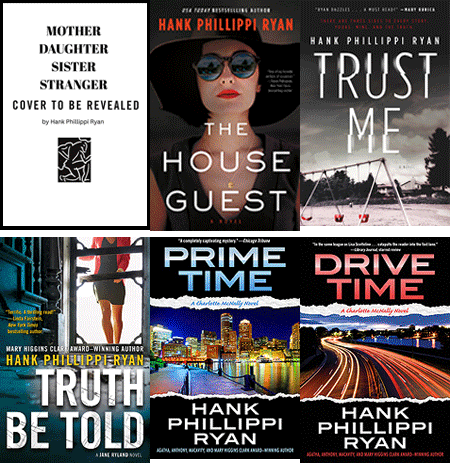
Nine months later, I had TRUTH BE TOLD. (Which I LOVE. And which will be out September 30! I am sure, ahem, you will hear more about this...)
Now, in January 2014, I am 15 pages (hurray hurray hurray!) into WHAT YOU SEE.

 I am trying to balance my terror and my excitement, trying to balance my eagerness to see find the story in this book with my absolute knowledge that I have NO IDEA what happens. Pantser city.

Now, I would never do this, usually, but we are all in this together. So here is a true first draft—no, this isn’t even a first daft. It is the crazy banged out work of a person who is just trying to get the words on the page.

 I will fix it later. And nine months from now, we can talk about it again. 

As for now, Reds:  Can you picture his scene?  Hmmm...I haven’t really described anyone. Do I need the word  "replied"? I don't think I need "replied." “Absurdly?”  How should I replace “visitor magnet”?  “Red and white” seems too easy.

Who knows how much of this part of WHAT YOU SEE—if any!--will be the same, nine months from now.  But that’s the exciting part.

  
                                                      Chapter  1
“Somebody saw something. And most of them took pictures of it.”  Detective Jake Brogan watched the uniforms try to corral the chaos of tourists and brown-bag toting Bostonians as two crime scene units unspooled parallel rolls of yellow tape.  Sirens wailed as three EMTs leaped out of their red and white ambulance, the beeping walk signal insisted clustering pedestrians should cross Congress Street, angry drivers honked their disapproval as newbie police cadets in orange webbing signaled them to stop.
Jake had heard screams through the plate glass front window of the Bell in Hand, left his carry-out roast beef sub on the counter, ran half a block. Found this.  Lunch hour, now placed on hold by murder.  
 “Wall-to-wall spectators, the good news and the bad news.”  Paul DeLuca replied, shaded his eyes with one hand. Scanned the shoulder-to-shoulder circle of onlookers. The two detectives, partners four years now, had split up to grab lunch, D opting for the corner Dunkins. DeLuca still held his iced coffee, third of the day. “Who called 911? Anybody run?”
“What we’re about to find out,” Jake said. “Most cases we catch, nobody saw anything. Here’s the opposite. Almost too many witnesses. That’s a new one.”  
In the center of the sidewalk, in the noontime shadow of the burnished bronze knee of the Mayor Curley statue, some poor soul in a white t-shirt lay face down, his running shoes splayed, a navy blue Sox cap teetering on the concrete, the hilt of a knife protruding absurdly between his shoulder blades.
The medical examiner had radioed Jake she was minutes away. They’d need to dispatch the cleanup team, too. With the fourth of July a month away, the new mayor would go ballistic over the growing puddle of red now staining this concrete pathway along the visitor-magnet Freedom Trail.  So much for the beginning of tourist season.
Across the street, the teeming marketplace behind Faneuil Hall, persistent vendors pushing Sam Adams tri-corns and Boston Strong t-shirts and cheap plastic lobster souvenirs. The visitors who had been unlucky enough to witness this noontime stabbing had just received a souvenir they might want to forget. But not until Jake picked their brains. And their cell phones. 
 “I want names. I want addresses. I want their phones and I want their cameras.” From moment one, Jake knew this would be a mess. Some of these people would lie, some would make stuff up, some would see things that never existed, some would have something to hide. Some would run. Complicating it all, he and DeLuca technically needed a warrant to seize property against a person’s will. If these onlookers knew the law, and gave them grief about it, it’d be even more of a shitshow.  He pointed his partner toward the cadets. “D, you wrangle the new kids. Tell ‘em, don’t let anyone leave.”
“Where’re we gonna put ‘em all?” DeLuca sucked a hit of coffee through a clear straw.  “The Garden? Maybe they can watch Disney on Ice while we get their deets.” 
DeLuca had a point, and even the bleachers of nearby Boston Garden sports arena were not the solution. How could Jake keep fifty or so witnesses, from little kids to one guy in a wheelchair, essentially in custody while a group of inexperienced cadets tried to collect personal information and possessions?  If they’d gone to lunch at Santarpio’s over in Eastie, where Jake had suggested, dispatch might have sent someone else to handle this.


HANK:  SO?  Reds? Does this have possibilities?