Showing posts with label short stories. Show all posts

Tuesday, October 7, 2025

Destination Murders: Inside a Cozy Mystery Anthology


Hello, Jungle Red Readers and Writers!


We’re Cathy Wiley and Karen Cantwell, cozy mystery writers and the editors/publishers behind the Destination Murders short story anthology series. Many thanks to the Jungle Red Writers for inviting us to share a peek behind the scenes at how we put a short story anthology together.

Recently, we sat down for a Zoom chat to talk about how the series began, how it’s evolved, and what we’ve enjoyed along the way.

Karen: So Cathy, if memory serves, I pitched you on this idea of partnering up to publish a cozy mystery anthology.


Cathy: That’s right. I loved the idea because I was starting a new cozy mystery series and wanted to find readers. An anthology seemed like the perfect way to do that—something that could help me find new readers while also giving other cozy writers that same opportunity. It’s a win-win: established authors bring their loyal fans to the collection, and those readers get to discover new voices (and hopefully fall in love with them, too).

Karen: It’s been a while now, but I remember sitting at a coffee shop in the hotel where they held Bouchercon that year, and we listed writers we knew who were established authors with one or more series and/or well-known short story authors.

Cathy: Yes. Next came the theme and title. We wanted something that would hit shelves right before Memorial Day—just in time for beach-read season—so Murder on the Beach felt like the perfect fit. Once we had that nailed down, we started inviting authors, and before long, the plan was officially in motion.

Karen: You found the perfect pre-made cover for it!

Cathy: I love our polka-dot diva, though I still don’t know how she could walk on the beach in those high heels! Plus, even though it was pre-made, our designer kindly added a gun and knife to her purse to give it that perfect murderous vibe. I loved the cover so much I wanted to keep the series going just to see where we’d send her next. Since then, our designer has outdone herself: we’ve had her skiing in a polka-dot snowsuit for Murder in the Mountains, sneaking a knife aboard a yacht for Murder at Sea, and—probably not the safest choice—bringing a firearm in a hot-air balloon in Murder in the Air. And of course, she’s right at home among the tombstones (still in polka dots) for Murder in the Graveyard.

Karen: I really love these covers too.

Cathy: What part of the process do you enjoy?

Karen: As time has gone on, I love the editing job more and more. As you know, the authors submit their stories, then we both put in our editorial suggestions for tightening the storylines, improving sentence structure, etc. I’ve found that to be a really fun task. Working with our authors is very rewarding. They’re committed and professional. Can’t ask for more.

Cathy: The authors are great! While I also love editing, I was excited this time to be the one to format the files for both eBook and print using Atticus, since that can be done on a PC (as opposed to Vellum, which was exclusively Mac-based). Now we have to focus on marketing. Thankfully, the other authors help as well, through their individual newsletters, blogs (like this one!), and social media postings.

Karen: I can’t believe that Murder in the Graveyard is already out! It’s now time to think about the next anthology. I’d love to ask everyone here: What should be the next murderous destination? Let us know!

Saturday, February 25, 2023

Too Long? James R. Benn Goes Short

LUCY BURDETTE: We always love having Jim (aka James R.) Benn visiting to talk about his Billy Boyle series, but I promise you'll love this blog about short stories. It may even bring a tear to your eye, so read on...


JIM BENN: I never thought I’d be a short story writer. As an author, I tend to write long. I don’t mind taking my characters in the Billy Boyle series off on a tangential hunt, as long as I return them safely to the story line. In a world where a “standard” novel runs to eighty thousand words, mine routinely exceed one hundred thousand. I’ve always said I like to give my readers a good bang for their buck, but in truth I do blather on.

And it’s nothing new. In 1963, when I was a freshman in high school, Mr. Gillan — fifth-period English class — thought so too. I recently unearthed a folder of short stories I wrote in his memorable course. What was the first comment I saw, a full sixty years later?

TOO LONG


The saving grace was his next comment: “good description” accompanied by a check. I don’t recall if that was the best mark or if I missed a double check, but I certainly learned the lesson that a good description can overcome excessive length. I also learned a good bit, at the age of fourteen, about movie tie-ins. The Great Escape, the classic WWII prison break film, had premiered that summer. I enjoyed it, and I figured Mr. Gillan would, therefore, enjoy my POW escape story.

Dodging the searchlight, he clambered over the wall . . .

GOOD

In red pencil. I was on to something.

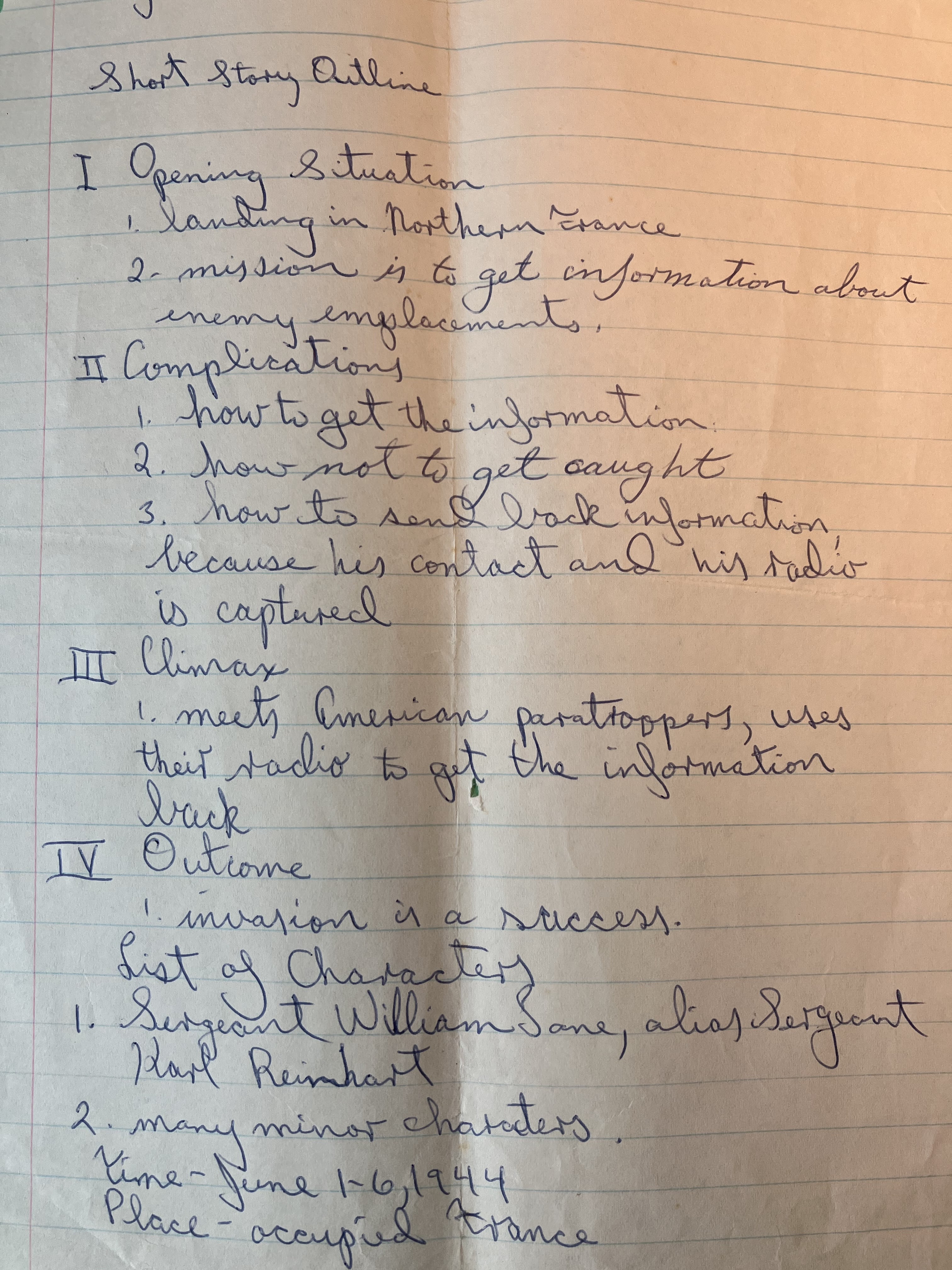
Grabbing inspirations as they fell into my lap, my next piece was Story of a Spy. Snappy titles were still, obviously, in my future. I’d seen The Longest Day the year before, and that film about the D-Day invasion had stayed with me. My version concerned an American soldier sent ashore in advance of the invading troops. Take that, Darryl F. Zanuck.


On the morning of June 6, 1944, Normandy was invaded by Allied Forces. But on the night of June 1, five days earlier, it was invaded by Sergeant William Lane.

GOOD OPENER

Yes! Mr. Gillan was impressed! This story was for a full grade, not just a measly check mark. Looking back after six decades, it isn’t a bad read. I should have edited out “five days earlier,” though. Unnecessary. People can count, after all.

I read on, drinking in his positive comments as the story continued. Our hero scores some vital intelligence about German defenses, and he hooks up with the airborne forces who radio his information to headquarters. He’s a hero, and I thought I was too. Then I turned to the back page.

B+. A PROMISING STORY. POSSIBLY TOO EASY FOR THE SERGEANT — BUT INTERESTING.


B+? Not having been the most studious of high school freshmen, I normally would have been happy with anything above a C. But I was disappointed, except for the fact he had written “but interesting” at the end. However, I have benefitted more from that comment than I could ever have imagined.

I never forgot it. Actually, I’d misremembered it, recalling instead that he’d written “Next time make it harder for the sergeant.” Perhaps that was how I internalized the lesson. There would be a next time, and when that came, it would have to be harder for the sergeant. Obstacles. It was a lesson in obstacles.

The fact that I hadn’t grasped the concept was evident in the outline we’d been assigned to create prior to writing the story. Under Complications, I’d written “How not to get caught.” Brilliant. This is the first and only outline I’ve ever written. After that fiasco, I was going seat of the pants all the way.


The constant flow of stories required by Mr. Gillan demanded creative measures. The Twilight Zone television series was widely popular at the time, and one haunting episode features three astronauts who crash-land on a desert-like asteroid. Short of water, the three fall to fighting over scarce resources. One man murders the other two and takes off with their water. Hiking to the top of a hill, he finds they are still on Earth. Outside of Reno, no less.

Well, if it was good enough for Rod Serling, it was good enough for me. Swap out the spaceship for a B-17, and the story wrote itself. In my version, one of the three survivors of the bomber’s crash gives up hope after wandering in the scorching desert and shoots himself. His comrades climb the next ridge and see their own airbase in the distance.

GOOD CONCLUSION


Whew. Mr. Gillan hadn’t seen that episode.

It was a long time until I took up writing fiction again, but I remembered the lessons from fifth-period English. I began my first novel in 1999, but it wasn’t until 2018 that I submitted my first short story. After being intimidated by the short form, I finally had found a way into that style of storytelling. This time around, the ideas are my own, and I wish Mr. Gillan was still here to thank.


A GOOD STORY — PLOT WELL DEVELOPED. YOU HAVE DONE VERY WELL.


As have you, Mr. Gillan. As have you.


Question: Tell us, is there a favorite teacher who influenced your life?
Give them a shout-out here!


James R. Benn is the Dilys, Barry, and Sue Federer Historical
Mystery-award nominated author of the popular Billy Boyle WWII mystery series and three stand-alone works. His novel The Blind Goddess was long listed for the 2015 Dublin IMPAC Literary Award. Benn is a graduate of the University of Connecticut and has an MLS degree from Southern Connecticut State University. He worked in the library and information technology fields for over thirty-five years before leaving to write full-time. Benn and his wife Deborah Mandel live on the Gulf Coast of Florida.

Saturday, October 29, 2022

Rock on! What Song would YOU Choose?

HANK PHILLIPPI RYAN: The  link between music and mystery is marvelously universal. It's storytelling, isn’t it? For a good story you need a character you care about. A problem that needs to be solved. You need a good guy and a bad guy. You need emotion. You need to lure the reader along until the irresistible end. Just like in a song.

How many stories are written as songs? From the doomed love of Greensleeves (Alas, my love, you have done me wrong) to Miss Otis Regrets (She pulled a gun and shot her lover down, madam); to Frankie and Johnny, when Frankie walks into the bar room, and pulls out her old .44. The Ode to Billy Joe, when Billy Joe McAllister throws something off the Tallahatchie Bridge. In the Cher classic Bang Bang, it’s all about murder. (Isn’t it?) Oh, and in the sprightly Copacabana, right? A murder mystery (and psychological thriller) in three verses and three choruses. And, in my teenage years at least, we learned you won’t come back from Dead Man’s Curve, and understood that if you dated The Leader of the Pack, it would not end well. And poor Teen Angel.

And if you are laughing now, and singing in recognition, that’s exactly the point. No matter when and where we grew up, it was the music that brought us together. And it still does.

That’s why I was so delighted (and incredibly honored) to be asked to write the introduction to the Triangle Chapter of SIsters in Crime’s new short story anthology. It’s about–well… Here's the wonderful Karen Pullen to give you the scoop. 


Rock, Roll, and Ruin Makes Three

by Karen Pullen

A loooong time ago (2014), the Triangle chapter of Sisters in Crime produced our first short story anthology, Carolina Crimes: 19 Tales of Lust, Love, and Longing. Our sex-themed collection. I had the honor of editing it, and even wrote a Jungle Red post about our anthology journey. (Ever notice how every activity is a “journey” these days?) I swore I’d never do it again because it was a lot of work and I am lazy.

In 2017 we produced a second anthology, Need, Greed, and Dirty Deeds (the drugs collection), edited by Nora Gaskin Esthimer, but I stayed out of the fray for that one.

Fast forward a few years, and certain Triangle chapter members (I won’t name them) pestered asked me to do it again. The chapter had, after all, promised a trilogy of anthologies around the three themes of sex, drugs, and rock & roll. I caved; it was now time for our musically-themed anthology.

Write a crime story about rock and roll. That was the guidance we gave to prospective authors, either chapter members or Sisters in Crime members who live in the Carolinas. The rock & roll theme was to be interpreted loosely and could include any form of music. Music is so significant in our lives. It can raise your mood, contribute to relaxation or excitement. It can provide an escape, or increase tension, as in a movie. Most importantly, music like lullabies or romantic ballads or the rock & roll of your teen years will trigger memorable emotions. Music truly is the soundtrack to our lives.


Dozens of writers submitted original, never-before-published stories around a musical theme. A blind judging selected the finalists, and then the fun began: the back-and-forth of revisions. The final result? A collection of twenty-seven musically-themed crime stories around situations as unique as your fingerprints. Carolina Crimes: Rock, Roll, and Ruin, edited by me, with an introduction from the inimitable Hank Phillippi Ryan, published by Down & Out Books on October 3, 2022.

 I wish I had room in this post to include each author’s name, title, and logline. Let me just say that the musical score to murder, malice, and mayhem includes Elvis, church music, tribal drumming, a Broadway show tune, bluegrass, opera, the Stones, Joan Jett, Stevie Nicks, and, of course, the Beatles.

Why does a SinC chapter undertake such a project? For some chapters, it might result in revenue. For ours, an anthology offers a publishing credit and opportunities for fledgling writers. We are particularly proud of three who were brave enough to submit their good work, resulting in their first-ever stories in print:  Pamela Raymond, James Michael McGuffey, and David Goldston. Remember their names!

Tell me in the comments about your first published short story—whether in an anthology, online, or in a journal or magazine. Was it fun to write it, easy to work with an editor, thrilling to see it in print?

In one week, a lucky commenter’s name will be drawn at random, to win a copy of Carolina Crimes: Rock, Roll, and Ruin.


HANK: Or an alternative question: What  song is your anthem? What song changed your life? What song would YOU like to write a short story about? (You don't have to write it, even better!) Right now, I’m going  with Defying Gravity. But wait, that's not rock ‘n roll. Okay–how about–The Waiting?

How about you, Reds and readers?


Karen Pullen is a proud founder of the Triangle chapter of Sisters in Crime, celebrating ten years in 2022. She edited the Anthony-nominated Carolina Crimes: 19 Tales of Lust, Love, and Longing. Her first story in print won a Derringer award; her story collection Restless Dreams was published by Bedazzled Ink. She has also published two mystery novels, Cold Feet and Cold Heart. She lives in Chapel Hill, NC.


Wednesday, November 24, 2021

Taking another plunge: Leslie Wheeler on BLOODROOT short story anthology

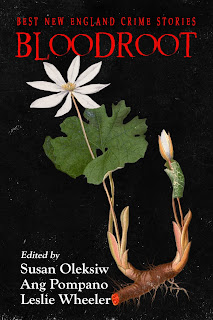
HALLIE EPHRON: It's a labor of love, and the final product is always astonishingly excellent. I'm talking about the short story anthology that is put together every year and makes its debut at the annual New England Crime Bake. This year's anthology, BLOODROOT: BEST NEW ENGLAND CRIME STORIES, is being published by Crime Spell Books.

Today we're thrilled to host Leslie Wheeler, one of the anthology editors, to talk about this terrific annual anthology in its new publishing home, and the power of the short story.
LESLIE WHEELER: “It’s Not Too Late to Back Out.” Those words and the smiley face below have graced my kitchen door for ten years now.

The message came with a hefty stack of mystery short story submissions, delivered to me by Mark Ammons, a member of my writers’ critique group, and a newly minted editor/publisher, along with Barbara Ross and Kat Fast, at Level Best Books, which had been handed off to them by the previous editors. They’d already signed on, but hesitated to ask me because as chair of the Crime Bake-sponsored Al Blanchard Short Crime Fiction Contest, I was already awash in short stories.

Yet, it was an offer I couldn’t refuse. My first published short story had appeared in a Level Best anthology, and during time I’d managed the Al Award, I’d grown to appreciate the power of short stories. My favorites were—and still are—the ones that either make me smile at their wickedly clever humor, or send chills down my spine. The contest also has a longstanding connection with Level Best, in that the award-winning story is published in the anthology for that year. I rejiggered the contest, and happily joined the Level Best team.

For the next six years we had a good run. It was hard work, but also a lot of fun. I enjoyed our often spirited in-person meetings to discuss, select, and edit the stories we’d publish, decide on the cover design, and arrange for publicity and sales at the Crime Bake, where the Best New England Crime Stories anthologies are always introduced. A few nights before Crime Bake, we’d have a book packing party at Mark’s. He’d serve his famous Cincinnati chili, and we’d devour it with side dishes and dessert, before getting down to work.

But most of all, I loved reading the stories and writing my own. For me, short stories offer an opportunity to approach perfection. Every word must matter for the story to become a little gem, in contrast to a novel, which resembles a necklace with strings of scenes, some stronger than others. I also like the way a writer can take something very small—an intriguing remark overheard in a crowd, or the sight of a woman in line who doesn’t look like she belongs there—and build a story around it.

Writing shorts gives me a holiday from the long haul of novel writing. Finally, as a reader of short stories, I’ve delighted in discovering new authors and watching their careers take off.

Still, despite all these positives, I hesitated to take the plunge a second time when the third team of Level Best editors decided to focus on publishing novels instead of anthologies. Was I too old to be doing this again? Could I work successfully with a new team, even though both Susan Oleksiw, a founder of Level Best, and Ang Pompano, an author whose stories we’d published, were well-known to me? And there was that sign on my door, tempting me with the possibility of withdrawal.

In the end, my determination to continue the Best New England Crime Stories tradition overcame my doubts. Things are different now. With the pandemic and the fact that the three of us don’t live nearby, our discussions have mostly taken place via Zoom or e-mail. Even so, the process has had its exciting moments, as when Susan gave us the name of Crime Spell Books for our new imprint. Ang created website before our eyes on Zoom. I came up with the title, Bloodroot, and an image of the plant with its delicate white flower and thick roots packed with orange poison flashed on the screen.

And the finished product is a joy to behold with its striking cover, and mix of stories from light to dark, written by both well-established authors and emerging writers. So, yes, I’m very glad I didn’t back out.

Readers: have you had times when you’ve been torn between moving forward with a project or abandoning it? If so, please share. One of the commenters will receive a paperback of BLOODROOT.

About Leslie Wheeler
Award-winning writer, Leslie Wheeler, is the author of two mystery series, the Berkshire Hilltown Mysteries, (Rattlesnake Hill and Shuntoll Road, with a third book, Wolf Bog, due out in July of 2022); and the Miranda Lewis Living History Mysteries (Murder at Plimoth Plantation, Murder at Gettysburg, and Murder at Spouters Point). Her mystery short stories have appeared in numerous anthologies including The Best New England Crime Stories anthologies, published by Level Best Books, where she was a co-editor for six years. She is delighted to return as a co-editor at Crime Spell Books, which now publishes these anthologies (www.crimespellbooks.com).


About BLOODROOT

Whether it’s an elderly woman facing a scam, a shipwrecked researcher trying to survive, a retired robber invited to join in one last fling, a farmer facing an escaped convict, or a group of kids in over their heads, with Bloodroot, Crime Spell Books continues the tradition of the annual anthology of Best New England Crime Stories by New England Writers.
Buy Link

Wednesday, October 20, 2021

Short (Fiction) Attention Span by Raquel V. Reyes

 LUCY BURDETTE: Today it's my pleasure to welcome Raquel Reyes, who's getting a ton of buzz on her first novel. She even made it into the New York Times! Congrats and welcome Raquel!


RAQUEL REYES: As a debut author, this last month has been something of a promotional tour with guest blog posts, articles, and podcasts. There are two questions that are almost always asked. What are you reading? What are you working on? My answer to both is short stories. Yes, I am, of course, working on book two in my Caribbean Kitchen Mystery series. But when I hit an impasse, I take a breather from the big 80K mountain and write a short story. Short stories are the perfect morsel. They are so satisfying to read and to write. Reading a short story in one sitting is unlike reading a chapter in a novel. The latter leaves you hanging until your next sitting, but the former ties everything up. My leisure reading is usually before bed. I can read for only about an hour before my eyes start to cross. I love that I can have a beginning, middle, and end in that short span of time. And if I don’t fall in love with the characters or setting, no problem. Tomorrow, there will be a new story to try.  

I’ve loved short stories since high school. I remember the weight and punch of The Yellow Wallpaper by Charlotte Perkins Gilman staying with me for a long time. But I suspect my love of the short form might have come from an even earlier time. As a child, I had a subscription to Cricket magazine. The illustration-rich monthly had multiple stories in it along with poetry and games. 

Recently for a library panel, I was asked to recommend a few titles by Latinx writers. I replied with Miami Noir, San Juan Noir, Noiryorican, ¡Pa’Que Tu Lo Sepas!, and Midnight Hour. 


Not all the authors in Midnight Hour are Latinx, but several are, including yours truly. 

My bookshelf doesn’t have enough space for all the anthologies and collections I want. So, I’ve imposed a few thematic requirements (like Florida) for physical book purchases.


And if I’m attending a conference that has an anthology, I’ll always get it. I like meeting the authors and getting their signatures. Writers are fans, too. I was lucky enough to have a short story selected for the Malice Domestic Mystery Most Theatrical anthology. None of us got to go to the conference, thanks to the pandemic. You better believe I’m packing my copy in my suitcase to get it signed at Malice 2022.  

There is another theme that will always tempt me, and that’s a music-themed collection. Murder-A-Go-Go’s edited by Holly West has some treasurers. And then there is The Great Filling Station Holdup which fits both my Florida and music requirement as each story is titled and inspired by a Jimmy Buffet song. Down and Out Books has an incredible catalog of music-themed anthologies, including Trouble No More, a collection inspired by Allman Brothers songs. 


What is your favorite short story or collection of stories?


Comment below for a chance to win a copy of Trouble No More, which has my story Multicolored Lady in it. (USA/PR shipping only) A winner will be drawn at random at the end of the month.  


 Raquel V. Reyes is a 2021 debut novelist. The New York Times said her culinary mystery, Mango, Mambo, and Murder, “executes its mission—with panache.”  Raquel writes stories with Latina characters. Her Cuban-American heritage, Miami, and the Caribbean feature prominently in her work. Her short stories appear in various anthologies, including Mystery Most Theatrical, Midnight Hour, and Trouble No More. 


ABOUT MANGO, MAMBO, AND MURDER: Food anthropologist Miriam Quiñones puts her academic career on hold to move back to Miami. Mix in a new house, an opinionated mother-in-law, and a husband rekindling a friendship with his ex, and Miriam is at her wit's end. Gracias to her BFF, Alma, she gets a  job as a Caribbean cooking expert on a Spanish-language morning TV show. But when a socialite dies, and the finger is pointed at Alma, Miriam must use her culinary knowledge to solve the murder. 

Friday, October 19, 2018

THE DEBATE: IS A SHORT STORY TRULY HARDER TO WRITE THAN A NOVEL? by Gigi Pandian


Gigi: When Jenn learned that my first short story collection was coming out this week, she said, “short stories terrify me!” That got me thinking, why do so many mystery writers fear short stories? They’re such fun! But it’s also true, for the longest time I had no idea how to write one. I had successfully finished writing a novel before I was able to write a good short story. 

JENN: It's true! They do terrify me. Break it down for me, Gigi!

As a reader, I love short stories—you do too, don’t you?—but writing them? I wasn’t sure how to pull it off—until I realized my short story superpower. What clicked for me was that I’ve always adored locked-room mystery stories, the classic puzzle plot stories where it looks like the crime itself is truly impossible. Those puzzles are perfectly suited to the short story form. By keeping a locked-room mystery short, the reader can read it all in one sitting and remember the string of complex clues pointing to the solution and have a satisfying “aha!” moment at the end. I knew if I was going to write a good short story, I should write what I loved: a locked-room mystery.

Locked-room mysteries—also known as impossible crime stories or miracle problems—center around a satisfying puzzle that’s hidden in plain sight, and often with the clues pointing like a supernatural solution is the only possible explanation—think of the TV show Jonathan Creek and Golden Age mystery novels and stories by writers like John Dickson Carr and Clayton Rawson. (Any other Jonathan Creek fans reading? I adored that show!)

Once I’d worked out a twist that would be the solution of the seemingly impossible crime, the rest of my first story flowed out of me. One afternoon at the San Francisco Public Library, I began writing the Jaya Jones story longhand in a paper notebook. I couldn’t stop writing, and I gave myself a hand cramp, but I finished a full draft of the story! While my agent was pitching my first novel to publishers, and I submitted my story to an anthology competition, and a locked-room mystery short story became my first publication. 

That method of writing a short story is what I still follow today—I find my twist that solves a seemingly impossible crime, then ask my characters what would be an interesting way to get there. It can take a long time to work out a clever twist to make such a story successful (I’ve got a few ideas that I’ve been trying to work out for longer than it takes to write a novel), but once the story solution clicks, the process gets easier. 

Because I love to be fooled by clever puzzles steeped in a mysterious atmosphere, I want to give readers the same experience. I’m having a ball writing stories in between novels, and I’ve been thrilled that readers are enjoying them—“The Library Ghost of Tanglewood Inn” won an Agatha earlier this year (eep!), and I’m even more excited about my new novelette that leads this collection of stories: “The Cambodian Curse,” a Jaya Jones story with multiple locked-room mysteries. 

Readers: If you aren’t already a fan of this genre, you’re in for a treat if you pick up a locked-room mystery collection from the Golden Age of detective fiction or one of the many new ones! For a starter list, my Goodreads page has a locked-room mystery list with 100 novels and short story collections. 

And writers: If you want to try writing a short story but don’t know where to begin because it’s so different from a novel, my advice is look at what it is about your favorite short stories you love. Once your particular spin on stories clicks for you, I bet you’ll begin having as much fun as I am. 

Do you have a favorite short story? Or have you thought about writing one but haven’t tried yet? (And seriously, Jonathan Creek fans, I want to hear from you! I dearly miss that show and think it’s time to watch it again.) 


I’m giving away a copy not of the book itself, but something you can’t buy – a comic-style zine of illustrations inspired by the stories in the collection, drawn by my artist mom! I’ll draw a winner a week from today from one of the commenters. 


THE CAMBODIAN CURSE & OTHER STORIES includes nine locked-room mysteries, plus an introduction from Laurie R. King and a foreword from impossible crime mystery historian Douglas G. Greene. Appearing here for the first time is novelette The Cambodian Curse:  When an ancient and supposedly cursed Cambodian sculpture disappears from an impenetrable museum, and the carving’s owner is killed by an invisible assailant while a witness is a few feet away, historian Jaya Jones and her old nemesis Henry North team up to solve the baffling crime. 


Gigi Pandian is a USA Todaybestselling and Agatha and Lefty Award-winning mystery author, breast cancer survivor, and accidental almost-vegan. The child of cultural anthropologists from New Mexico and the southern tip of India, she spent her childhood traveling around the world on their research trips, and now lives outside San Francisco with her husband and a gargoyle who watches over the garden. Gigi writes the Jaya Jones Treasure Hunt mysteries, Accidental Alchemist mysteries, and locked-room mystery short stories.

Connect with Gigi on her website [http://gigipandian.com/] Facebook[https://www.facebook.com/GigiPandian/]
Instagram[https://www.instagram.com/gigipandian/]
And via her email newsletter[http://gigipandian.com/newsletter/]

Saturday, March 25, 2017

Who Wants Wine? 50 Shades of Cabernet!

HANK PHILLIPPI RYAN: Wine? Well, sure. (Somehow I can only drink wine when it’s dark, weird, huh? But I can read about wine any time.)

In vino mysterium is the theme for a wonderful new anthology of short stories, each blending a baffling mystery and a glass (or more) of cabernet. 
When eighteen mystery writers combine their talents, the result is the perfect “flight” of stories that range from light-bodied puzzles to sparkling cozies to darker, heavier tales of deceit and murder. While cabernet is the featured wine, this anthology will appeal to connoisseurs of all varietals—in both wine preference and mystery style.

I mean, yeah. I can be a joy to sip a nice drink when reading about murder and other crimes? Last week Koehler Books published that book, 50 Shades of Cabernet. And today half of the 50 Shades authors are visiting the Reds—and we asked:
Tell us about your story. What makes it different?

“Who’s Wine Is It Anyway?” by Barb Goffman
There’s a funny T-shirt slogan that says, “Be careful or I’ll put you in my novel.” Well, I write short stories, but the same sentiment applies.
In the mid-2000s I was preparing to leave the large Washington, DC, law firm I’d worked at for five years. I often planned events for our department, such as our annual holiday party. Doing so was a nice break from due diligence and reading regulations and other fun stuff like that. Yet I was a bit surprised when the partner with whom I worked most mentioned that he was (and wasn’t) looking forward to my goodbye party that Friday. Had a planned something great?
Now I enjoyed organizing department events, but this still left my jaw hanging open.
“I have to plan my own goodbye party?” I asked wide-eyed.
An uh oh expression came over him as he realized that of course I shouldn’t have to do that. He said he’d make sure someone else took care of it. And he did.
That conversation has stuck in my brain, and in “Whose Wine Is It Anyway?” I finally put it to good use, writing a story of Myra, a law firm secretary. In her final week at her firm, Myra learns that her boss, Douglas, expects her to plan her own retirement party. Myra is already upset with Douglas because he’s hired a bimbo to replace her, so Myra decides to use this party to teach some lessons.
It took me more than a decade, but I finally put my jaw-dropping moment to good use. So let this be a lesson to you: Don’t anger mystery writers or you too may end up in a story, and it may not work out well, either.
“Blown Away” by Nancy Naigle
“Blown Away” is set at Pirates Cove Marina in Manteo where I own a condo. My balcony overlooks the beautiful fishing boats. It’s an inspiring place to write, and imagined a hundred stories there. When I was asked to write a story for 50 Shades of Cabernet I couldn’t wait to use this wonderful setting. I hope you’ll enjoy this story about a heist gone wrong, and revenge taking place years later. Shhhhh, don’t tell anyone that the bad guy is staying right in my condo , and the take-down in the parking garage below.
“Wine, Women, and Wrong” by Maggie King
Wine and sex. That’s how “Wine, Women, and Wrong,” my contribution to 50 Shades of Cabernet, a wine-themed mystery anthology, differs from the ones my talented fellow authors penned.
I emphasize the sensuous aspects of red wine—the taste, how it feels on the tongue. And I suggest a relationship between wine and sex. 
Consider my story opening:
“Ah! Sweet, bursting with berry flavor.” Lanie Jacobs mimicked the sales pitch of the wine merchant who’d poured the Ruby Port.
“Yet firm.” Rhonda Reay sipped and actually moaned in ecstasy. “Powerful.”
Lanie rolled her eyes. Was the woman having a sexual experience in the middle of a wine tasting party? Rhonda was her best friend but she could be embarrassing.
Is red wine an aphrodisiac? Studies suggest that it is. But I won’t get into the dull stuff, like brain activity and amines (organic compounds present in wine). And, when you pair the wine with a tasty appetizer, almost anything could happen! 
“These meatballs are amazing. They’re simply amazing.” Rhonda Reay popped one in her mouth. Tommy interpreted the coy look on her face as inviting. “What’s in this sauce?” she asked.
Tommy tried to remember what Camille had told him. “I believe it’s a pomegranate currant sauce.”
“It’s amazing,” she repeated. “And it pairs beautifully with this cab.” Rhonda drew her shoulders back and lifted her glass, as in a toast. “A graceful cabernet with generous flavors of cranberries, blackberries, and light baking spices. Full in body with a velvety smooth finish that coats the palate in soft tannins and lovely fruit.”
Is it the Cabernet, the gourmet meatballs, or the sexy Tommy that piques Rhonda Reay’s interest? Tommy is investigating the attempted murder of a local wine merchant and is trying to find out what Rhonda knows about it. Will he succumb to her charms and join her in a glass of Cabernet? Or two?
Read “Wine, Women, and Wrong” and find out.
“Friday’s Jewelry” by Ken Wingate
What makes “Friday's Jewelry” unique or different from all the rest of the stories in 50 Shades of Cabernet?
It could be that the Louis M. Martini LOT No. 1 Cabernet Sauvignon featured in the story is the most expensive of all the rest of the wines in the other stories.  It is considered one of the finest Cabernets in the world.
It could be the beloved gift given by a grandmother to her granddaughter, holding a most powerful secret.
It could be the life-long friendship of the two primary characters.
It could be the surprising discovery in which the cork becomes the center of the investigation and the undoing of the thief.
I challenge you to read “Friday's Jewelry” and come to your own conclusion.
“Love the Wine You’re With” by Teresa Inge
“Love the Wine You’re With” takes place at a Virginia Beach wine tasting and includes a romance between Lewis McGehee, a real life, popular Virginia musician and my protagonist, Jules Riley. 
It was fun incorporating Lewis and his music into the story and transporting readers across Virginia’s unique but deadly landscape. 
“Par for the Course” by Heather Weidner
“Par for the Course” focuses on the dynamics among the different generations within a wealthy family, and wine plays a key role as one of the central businesses in their vast portfolio. I write what and where I know, and the Commonwealth of Virginia has over 230 wineries. So, the Blue Ridge Mountains became the perfect location for my fictional vineyard and winery.
In the story, Mona McKinley Scarborough, the family matriarch, doesn’t take no for an answer. When she’s not successful at convincing her granddaughter, Amanda, to make the right choice—to join the family’s winery—she plans a day of golf as a chance to draw them closer together. Their chat reveals some deadly secrets, and they learn that the grape may not fall far from the vine.
The Scarborough family, who can trace their roots back to Jamestown and the colonists, has been a fixture in Richmond’s capital society for more years than anyone can count. Their roots and dirty little secrets run deep. I like mysteries with lots of twists, and “Par for the Course” takes on several meanings throughout this tale, where we learn that some family secrets are as dark as the cabernet.
“And Wine to Make Glad the Heart” by James M. Jackson and Tina Whittle
“And Wine to Make Glad the Heart” is the only cowritten story in the anthology. It features Tina Whittle’s continuing characters Tai Randolph and Trey Seaver and James M. Jackson’s Seamus McCree and his darts-throwing mother. The four combine to solve a mystery involving Civil War antiquities using logic, guile, tarot cards, and the finest boxed cabernet (and other oxymorons).
“Name Your Poison” by Maria Hudgins
Recently an author friend of mine posted a dire notice on Facebook. She was expecting GUESTS. They were coming to stay at her house for several DAYS and she was expected to prepare FOOD. To many people this sounds like a good thing—unless these are guests you don’t like. But if you do like them, this is a good thing. Right?
Not if you’re a writer.
If you are the sort of writer I am, a perfect day is one in which the phone doesn’t ring, the doorbell doesn’t buzz, you have edible food in the fridge, and you have a comfy place to write.
I laughed to read the comments my friend got from other authors. “I feel your pain,” “Oh, I’m so sorry,” and “You can stay in my garage.”
It’s a writer thing.
Of course every writer is different and I do know some who are super-gregarious, but most of us are closet hermits. There’s something wrong with that phrase, closet hermits—a double negative? Anyway, here are the most common traits of dedicated writers:
1.             We observe life like a fly on the wall. It’s interesting but we avoid getting involved.
2.             Everything we say is reworded and reworded again in our heads. This limits how much we can say on any given occasion.
3.             We constantly write stories in our heads.
4.             We are obsessed with our current Work-in-Progress.
5.             We may be inherently messy or neat, but neither tendency concerns us much.
6.             We aren’t procrastinators. At least those who are published aren’t procrastinators.
7.             We are not perfectionists. As Bunter said to Lord Peter: “Perfect, my Lord. That is to say, slightly flawed.”
8.             Sometimes we worry that we aren’t quite normal.
9.             We are introverts. Our idea of hell is a cocktail party where we don’t know a soul.
In the new anthology 50 Shades of Cabernet, my story, “Name Your Poison,” starts with a cocktail party at a mystery conference—the sort of event where I usually drink too much too fast in the hopes that it will loosen my tongue and make me sparkle. Those of you who have attended a mystery conference will recognize the scene, if not the hapless victim of the story.
By the way, every story in 50 Shades uses the word “cabernet” at least once. I challenge you to find them all. 
HANK: Do we get wine while we’re looking? That is a treasure hunt I can completely get behind. Reds, are you wine aficionados? What’s your favorite?

-->
A toast to the authors of this wonderful new anthology!
And you can buy it here! Cheers!

For fun on Facebook and website:
Facebook page: https://www.facebook.com/50ShadesofCabernet/


Website: https://www.50shadesofcabernet.com/

If you want to help out an indie bookstore, here are two possibles:

Mystery Loves Company in Oxford, MD, has the hardcover and trade paperback on their website: http://www.mysterylovescompany.com/search/site/50%20shades%20of%20cabernet