DEBORAH CROMBIE: Last week, an English friend on Facebook posted a link to a video tour of the gardens at Great Maytham Hall in Kent, which is best known as the inspiration for the novel THE SECRET GARDEN by the English/American author Frances Hodgson Burnett.
Burnett lived at Great Maytham for almost ten years, but it was only after she returned to America that she wrote what would become her most famous novel.
I was very intrigued by the fact that just after Burnett left Great Maytham, the gardens were redesigned by the famous Arts and Crafts architect Edward Lutyens, and planted by his friend, the garden designer Gertrude Jekyll. I did a great deal of research on Jekyll when I was writing A BITTER FEAST--the gardens at Beck House are based on Jekyll's designs, and Beck House itself was (fictionally) built at almost the exact time Lutyens was restoring Great Maytham.
Burnett, like Jekyll, was quite the character, eccentric and forward-thinking. She was also prolific, writing more than fifty popular novels, mostly for adults. It's unlikely she would have expected to be remembered for a children's book.
Of course, after seeing the video, I had to hunt up my copy of the book--which turned out to be not mine, but my daughter's, inscribed to her by her paternal grandmother on her 11th birthday. It had been years since I'd read it, and I picked it up more out of curiosity than a real desire to reread it, but after the first few pages I was hooked. I barely put the book down until I finished it the next day.
It's a simple enough story. Ten-year-old Mary Lennox, orphaned by a cholera epidemic in India, is sent to her widowed uncle's grand house on the Yorkshire Moors. Unloved and unloveable, Mary is left to her own devices, but she soon discovers a gate leading to a secret and neglected garden. Mary, her invalid cousin, and a local boy, Dickon, hatch a plan to bring the garden back to life, and in doing so, Mary and her cousin are made whole.
The prose is so lush, evocative, and joyous, and the children's emotional journey so compelling, that I hated for the book to end. My daughter's copy is a bit tattered, so I ordered my own, to read whenever I need a boost and a little escape from the present day woes.
So, dear REDS and readers, are you finding any classics a comfort these days?
7 smart and sassy crime fiction writers dish on writing and life. It's The View. With bodies.
Showing posts with label english garden. Show all posts
Thursday, June 11, 2020
Friday, April 12, 2019
Debs on Writing and Not Writing
DEBORAH CROMBIE: What I have actually been writing this week is this:
It does have a title (Yay!), and a little bit of a plot--but I can't tell you any of that!
What I can tell you is that I think it will be set in London's Bloomsbury, in the dark days of late autumn, and--well, stuff happens. And then more stuff happens. And hopefully it will be gripping and intriguing and I'm dying to get started on it.
My agent is looking at the proposal today, and then we'll talk, so cross your fingers that she likes the idea!!
What I've been working on the last few weeks is this:
First my editor's edits (that's the pile with the stickies) on A BITTER FEAST, then the copy edit. Fortunately, it was the same copy editor I've had for many books and she does a great job.
Here's page 1 of my style sheet (the reference your copy editor makes for names and word usage):
If you were to read through the manuscript, you'd see that I have once again utterly failed at compound words...
Then, today, my page proofs arrive!! These are the typeset pages, and it's the first time you get to see what the finished book pages will look like--and how they will read with all the changes that you made in the copy edit. It's very exciting!
And also very scary, because the only changes you can make at this point are to correct type-setting errors. So if you're not happy with what you wrote, yikes, it's too bad.
And now, because it's spring, and we are all about flowers, here's a little snippet from A BITTER FEAST. Gemma has arrived at Melody Talbot's parents' house for the weekend, and this is her first view of of the fabulous gardens.
The page proofs also mean that ARCs will be coming very shortly, so look out for a giveaway soon!
Kincaid/James #18, coming October 8th, 2019 from William Morrow.
Readers, how good are your copy-editing skills? And can anyone else get compound words right?
It does have a title (Yay!), and a little bit of a plot--but I can't tell you any of that!
What I can tell you is that I think it will be set in London's Bloomsbury, in the dark days of late autumn, and--well, stuff happens. And then more stuff happens. And hopefully it will be gripping and intriguing and I'm dying to get started on it.
My agent is looking at the proposal today, and then we'll talk, so cross your fingers that she likes the idea!!
What I've been working on the last few weeks is this:
First my editor's edits (that's the pile with the stickies) on A BITTER FEAST, then the copy edit. Fortunately, it was the same copy editor I've had for many books and she does a great job.
Here's page 1 of my style sheet (the reference your copy editor makes for names and word usage):
If you were to read through the manuscript, you'd see that I have once again utterly failed at compound words...
Then, today, my page proofs arrive!! These are the typeset pages, and it's the first time you get to see what the finished book pages will look like--and how they will read with all the changes that you made in the copy edit. It's very exciting!
And also very scary, because the only changes you can make at this point are to correct type-setting errors. So if you're not happy with what you wrote, yikes, it's too bad.
And now, because it's spring, and we are all about flowers, here's a little snippet from A BITTER FEAST. Gemma has arrived at Melody Talbot's parents' house for the weekend, and this is her first view of of the fabulous gardens.
From the garden came the Jack Russell’s high-pitched yips,
and Charlotte’s even more shrill squeal of excitement. Gemma realized she’d
left the child in Addie’s care too long. She stacked the breakfast plates in
the sink and headed for the French doors that led to the terrace.
She stepped out into the crisp morning and stopped, her
breath catching at the sight that greeted her. Last night, she’d only glimpsed
the garden through the windows in the fading dusk, and then her gaze had been
caught by the distant hills.
Now, she marveled at the riot of color and symmetry spread
before her. The flagged terrace merged into a smooth expanse of emerald lawn
anchored by a rose-draped pergola. Two long tables had been set up in the grass
on either side.
At the lawn’s edge she could see drifts of flowers bisected
by a shallow flight of steps, and beyond that, more green lawns and steps,
leading her eyes down to the curve of the little river.
On either side of the top lawn, double herbaceous borders
blazed in a profusion of late summer reds and golds. She’d no idea so many
different flowers even existed.
And here's a photo from a very real house near my fictional Beck House. This is the Lords of the Manor hotel, in Upper Slaughter, Glouscestershire.
The borders are lovely but not as beautiful as the ones I made up!
The page proofs also mean that ARCs will be coming very shortly, so look out for a giveaway soon!
Kincaid/James #18, coming October 8th, 2019 from William Morrow.
Readers, how good are your copy-editing skills? And can anyone else get compound words right?
Tuesday, February 7, 2017
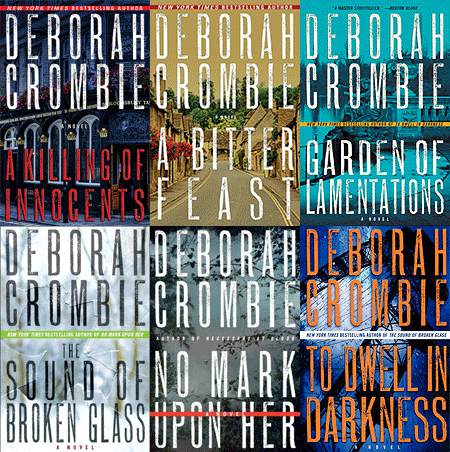
GARDEN OF LAMENTATIONS is out today!
A huge congratulations to Jungle Red's own Deborah Crombie! Today marks the release of the 17th (!!) installment in her critically acclaimed Duncan Kincaid and Gemma James series. I had the pleasure of reading the book, and it's fantastic. Readers old and new will not be disappointed; as the Minneapolis Star Tribune says "betrayal, sacrifice, and forgiveness. It's all here."
The Reds posed some questions to Deb, but first, here's a brief synopsis to get you up to speed:
On a
beautiful morning in mid-May, the body of a young woman is found in one of
Notting Hill’s private gardens. To passersby, the pretty girl in the white
dress looks as if she’s sleeping. But Reagan Keating has been murdered, and the
lead detective turns to Gemma James for help. Gemma has a personal connection
to the case: Reagan was the nanny of a child who attends the same dance studio
as Toby, Gemma and Kincaid’s son.
Gemma soon discovers that Reagan's death is not the first tragedy in the exclusive London park, and when still another of the garden's residents meets with violence, it becomes clear that there are more sinister forces at play.
As Gemma begins to see a solution to her case, she realizes she holds a child’s fate in her hands. Can she do the right thing? And can Kincaid rely on his friends, both inside and outside the Yard, to stand beside him as he faces the deadliest challenge of his career?
On to the questions!
HALLIE EPHRON: Debs, this one grabbed me by the throat, really. Your characters are real and sympathetic, so much so that when they're in danger I really feel for them. This book is really complex. It's got (at least!) three separate plots swirling around one another, all of them exploring trust. Do you write them separately or alternate, the way it lays out in the novel? And do they all come to you at once?
DEBORAH CROMBIE: Hallie, this book gave me a headache, I have to say. (A long headache!) I started out with a very rough idea, then did my usual outline/story-boarding. I eventually ended up outlining three separate timelines because I had to make sure that all the pieces of the puzzle fit together in the right order. The actual writing I did pretty much in the sequence it appears in the book. And of course things changed from the outline a good bit along the way. For instance, I had no idea when I started Denis Childs' backstory exactly what had happened to him in the past. But I was very aware that all the stories dealt with trust in one way or another.
JULIA SPENCER-FLEMING: We know you do a lot of on-site research in England (lucky you!) to get the details of Duncan and Gemma's world right. Where did you go and what did you explore to get the real feel of Notting Hill?
DEBS: Julia, I've stayed in flats in Notting Hill for extended periods over the years, and no matter where I'm staying, I always spend time there. And I ALWAYS go to Portobello Market on Saturdays. I have a huge sentimental attachment to the market. I suppose it sort of embodies London for me. I usually try to visit all of Duncan's and Gemma's usual spots, too, and in this case I peeked into as many private gardens as I could!
JENN MCKINLAY: This series has had a special place in my heart, like its setting Notting Hill, since the very first book. Because I adore Gemma and Duncan, I have to ask what have been some of the challenges of writing about two lead characters, both detectives, who are married with children? Also, have you ever considered killing either of them off (please say no or lie to me)?
DEBS: I was told that if I married off my characters, it would kill the series. Boy, did that make me nervous. But, I thought it would be really tiresome to put Gemma and Duncan in a perpetual will they/won't they situation, and I've always tried to be more true to real life than that. And I thought that a married couple with their jobs and a family would present endlessly interesting and dramatic possibilities. I think that's been true so far, and it has certainly been fun for me to write about.
And, no, don't worry dear Jenn! I have no intention of doing away with any of my major characters. I couldn't bear it.
HALLIE EPHRON: One of my favorite characters is Jess, a boy who's an aspiring dancer. He felt so authentic, I have to ask is he based on anyone?
DEBS: I have a good friend whose middle son was the inspiration for both Toby and Jess, at least in part. He was a very active and very athletic kid without much impulse control. When he was about Jess's age (Jess is almost eleven in the book) he visited a ballet class and he was instantly hooked. He went on to become a very talented and accomplished dancer, although he eventually had to give it up due to knee problems. It's a punishing discipline, and it takes great dedication to achieve success. I think I'm always fascinated by people who are driven to do something difficult.
LUCY BURDETTE: Debs, I have not finished and I refuse to rush through! But really admiring your seamless transitions between Point of View characters. But that's a more technical discussion--maybe Hallie can lead us through us one day? I'll ask this instead...the title GARDEN OF LAMENTATIONS is so fabulous and elegant. And then as I read, I notice that everyone is gardening! So I wonder, did the title come first and then you worked the gardens in, or, were you writing about all these gardens and their meaning for each character and the story, and the title followed?
DEBS: Lucy, that is so funny. That's the first time it's ever even occurred to me that everyone is gardening! It must have been subliminal... And I'm not even sure I could tell you now where the title came from. I don't want to make the book sound gloomy, but for me the all the intertwined stories were permeated with a sense of loss, and "lamentations" seemed to echo that.
HANK PHILLIPPI RYAN: I must know--How do you juggle all the characters' lives? Do you have a timeline, or a history, or an incredible list of lists? There are so many wonderful puzzle pieces that you put together so beautifully… What is your thought process and procedure for doing that?
DEBS: Oh, heavens. I do have timelines and lists of characters and scads of notes. The viewpoint thing is especially tricky, to keep from repeating information when you are seeing roughly the same situation from different characters' perspectives. And trying to make the different timelines end up at the same place! But I want it to be seamless for readers, so that they are just carried along and don't think about those things--at least until the end.
HANK: And before I knew you, I really expected you were British! And even when we first met, I was so surprised that you did not have a British accent. How does your brain work? How do you switch on "American "when you come back home?
DEBS: It's a very weird thing, and something I don't really have answer for. I've not only lived in England and Scotland and spent a lot of time there over the years, but I've read British books as long as I can remember (and watched British TV as long as we've been getting it in the US.) So my brain just clicks over to British voice, and I'm not really conscious of it. Split personality! Or maybe Jekyll and Hyde!
If it's a gift, I'm very grateful for it, because it's given me an enormous amount of joy over the years.
INGRID THOFT: Gemma and
Duncan were navigating some difficult terrain in their relationship this
time around, because of professional and family demands. Did you
enjoy writing that tension or do you prefer when it’s smooth sailing on
the home front?
DEBS: I did enjoy writing it. I think the fact that everyone—not just Duncan and Gemma, but Duncan and Doug, Gemma and Melody, and Melody and Doug—were all at cross purposes through most of the book really increased the story tension. That said, for the next book, I want to put everyone together, working on the same case!
INGRID: I love the supporting characters in the series, and this time around, Doug and Melody played important roles. Have you ever considered doing a spin-off with your secondary characters?
DEBS: I ADORE writing about Doug and Melody. And it has been suggested to me that I write a spin-off series with them, but I really like the dynamic of all the characters together. And as slow as I am, I don't thinking writing more than one series is on my horizon. Especially as this book was original 650 pages in manuscript...
What do you say readers? Any questions for Debs on the new release?
(And if you want to ask her in person, click here for her tour schedule!)
Deborah Crombie is a native Texan who has lived in both England and Scotland. She lives in McKinney, Texas, sharing a house that is more than one hundred years old with her husband, three cats, and two German shepards.

Wednesday, February 27, 2013
Sweet Smell of Success
Roses? Melon? Not so much.
I've worn the same fragrance for years--I still love it every time.
My favorite candles? Vanilla. And cinnamon.
What's your favorite scent? Why do you choose it? And maybe.. there's more to it...
The Healing Power of Aromatherapy
It’s fascinating to discover how aromatherapy works. You see, plants produce essential oils for a variety of reasons to attract pollinators, to protect against bacterial and/or fungal invasion, to deter pests, and to inhibit other plants from growing near them. Through a process of distillation these essential oils are removed from plants.
Essential oils can be extracted from the leaves (eucalyptus), grass (lemongrass), seeds (fennel), fruit/zest (mandarin), flowers (rose), wood/trunk of tree (cedarwood), roots (ginger), resins (frankincense), and herbs (rosemary). Three of my favorite scents are lavender, jasmine and roses, so I thought I’d share a few simple tips on how to use them today.
Lavender
Jasmine
Roses
I love the rich, sweet floral bouquet of roses and the approximately 275 compounds have a myriad of therapeutic uses. For example, if you apply it topically, rose oil can help banish eczema, wrinkles, and acne. If you feel blue, rose essential oil will naturally lift your mood. If you have painful periods, it helps to balance hormones (just put the oil on a warm compress and apply to your lower abdomen). Rose oil also eases nervousness, anxiety, anger, sadness, and grief and can be helpful if you have respiratory problems such as allergies and hay fever. You also use rose oil to help you sleep better and feel happier. For all these conditions, simply put some on your palm and inhale it or put rose essential oil into a diffuser. Your bedroom will smell like an English garden.
To make an aromatic spritzer with any of these scents, just add 10 to 25 drops of essential oil per 4 ounces of water in a squirt bottle. Be sure to shake it each time before you use it.
The effectiveness of aromatherapy depends on the quality and wholeness of the essential oils you use, so it's important to use the very best essential oils possible. You'll want to avoid any synthetics, reconstructions, perfumes, and other adulterated versions. One of my favorite places for essential oils is Floracopia www.floracopia.com.
Start with one essential oil that appeals to you and see how you feel after using it. The wonderful thing about natural remedies like the practice of aromatherapy is that they are usually very safe and easy to use (don’t take internally though, and keep away from children) and the varieties are endless. Enjoy!
HANK: What's your favorite scent? Is there any one you just can't bear? Tell us...for a chance to win a copy of Scent to Kill: A Natural Remedies Mystery!
Here’s the scoop on Scent to Kill: A Natural Remedies Mystery
Willow McQuade, naturopathic doctor, along with her hunky ex-cop boyfriend Jackson Spade, attend a party for a psychic TV show that is filming on Long Island’s idyllic East End. However, Willow is much more interested in visiting the estate’s lavender farm, seeking inspiration for the new aromatherapy workshops she'll be holding at her store, Nature’s Way Market & Café.
After Willow leaves the party, she gets a frantic text from Simon asking for her help. Since Simon had a fight with Roger earlier in the evening, and because of his death is now the primary shareholder in Galaxy films, Willow's ex becomes the prime suspect. Simon begs her to crack the case and clear him of the murder. MJ McClellan, the psychic and star of the show also asks Willow for help. She hires Willow to provide natural remedies, including aromatherapy, massage, acupuncture and yoga to soothe the agitated crew of her show.
To find the killer, Willow has to deal with ghosts in a haunted mansion, a truly dysfunctional family, death threats and “accidents,” while trying to untangle a homicide identical to one committed during prohibition. Thankfully, Jackson has been hired to provide security and is there to watch her back and help Willow solve this spooky mystery.
As a bonus, you’ll find dozens of natural aromatherapy cures throughout the book that can improve your health. I think you’ll be surprised as how much they can help you feel better in mind, body and spirit!
Chrystle Fiedler is the author of SCENT TO KILL, (Gallery Books/Simon & Schuster) the second in the NATURAL REMEDIES MYSTERY series, DEATH DROPS: A Natural Remedies Mystery, the non-fiction title THE COMPLETE IDIOT'S GUIDE TO NATURAL REMEDIES (Alpha, 2009), co-author of BEAT SUGAR ADDICTION NOW! (Fairwinds Press, 2010), currently in its fourth printing, the BEAT SUGAR ADDICTION NOW!COOKBOOK (Fairwinds Press, 2012) and THE COUNTRY ALMANAC OF HOME REMEDIES (Fairwinds, 2011). Chrystle’s magazine articles featuring natural remedies have appeared in many national publications including Natural Health, Vegetarian Times, Better Homes & Gardens and Remedy. Visit www.chrystlefiedler.com.
Subscribe to:
Posts (Atom)