
"...When it comes to killers and other criminals, the best visionaries these days are women, and foreign females in particular."
--Ed Siegel, Boston Globe
[Breaking News: Listen to WAMC, Northeast Public Radio, Tuesday August 7th at 10:07 a.m. to hear Neil Novack (Odyssey Books) talk about his five favorite summer reads (including Jan's "Yesterday's Fatal" or listen at wamc.org. See more at the end of this entry.]
HALLIE: Did anyone see book reviewer Ed Siegel's article in the Boston Globe, "Dial Ms. for Murder"? He extols the work of women(!) crime fiction writers who are bending the rules, writing more psychologically and sociologically complex characters, reaching less often for cliche.
In particular he praises the work of three foreign women authors--Natsuo Kirino, Zoe Heller, and Morag Joss. He says they are "so good that [Ruth] Rendell may no longer even be at the head of the class, even though all three are obviously indebted to her and the writer she's often paired with, the late Patricia Highsmith."
Such a pleasure to read his comments, after having been thoroughly discouraged by Patrick Anderson's "The Triumph of the Thriller," published in February, which devoted a scant 50 or so pages to women authors and classified Sue Grafton a thriller writer (huh?)
Do you think women approach the writing of crime fiction from a fundamentally different mindset than men? Are there American women crime fiction authors worthy of this kind of note? And what about Ruth Rendell, what makes her writing so exemplary? (When I interviewed Ian Rankin earlier this year, he said she's one of the authors he most admires precisely because of the complex characters she writes.)
JAN: I don't know. I've taken some heat from a few critics for my protaganist's dark side and her flawed character. Which, of course, has made me crazy. And another critic, a supporter of my work, told me she thought there was a double standard for mystery protagonists.
In other words, it was okay for male characters to be flawed and complex, but female sleuths had to above reproach. Just like women trying to break through in other fields, I guess. A few superficial flaws might be allowed, but nothing that went to the kinds of issues my poor Hallie Ahern struggles with.
I'm glad to hear someone is trumpeting complex female characters -- even if they are by foreign authors rather than homegrown. But I have to admit, for the most part, the complex mystery characters I've come across have been written by males. This may be because they have been better received. And I don't read the volume of mysteries you do, Hallie, so I (hopefully) am behind the times.
RO: So many issues have been raised here. I'm really not qualified to participate in this discussion (but I'll jump in anyway) because I don't read many thrillers - although we can write a whole other blog on the definition of thriller. We can also debate the definition of complex, and why some reviewers automatically give extra points to foreign writers. (Is it more complex to write "lorry" instead of "truck"? "Mac" instead of "raincoat"? Is Iceland intrinsically more complex than say, the Bronx?)
I write, and for the most part, read traditional mysteries.
In the last few books I've read the writer's focus is on the person solving the crime - professional or amateur - not the twisted SOB commiting the crime. For example, Julia Spencer Fleming does a brilliant job writing Clare and Russ that I feel I'm on a first-name basis with them. They are complex characters, no less complex because they live in a small New England town and aren't ferreting out terrorists, or deranged serial killers.
So is it progress that more women are writing twisted SOB killers? I guess. Does it make them more worthy of note? Maybe..to the guys who think women can only write lightweight yarns. But is there hope for those troglodytes anyway?
HANK: So let's take Lee Child. I've just finished two of his fantastically spare, smart, clever, taut and comandingly interesting thrillers. SO let's imagine you learned "Lee" is actually a woman. (It could happen, you know, like, um, Hank.)
Are you saying: oh, no, no way. Those books are clearly written by a man? I have to admit, don't kill me, just my opinion, I think they are obviously written by a man. (A man who can really write.)
Now let's take, and not only because Ro brought her up, the wonderful Julia. Another of my favorites. Okay, the conceit doesn't work as well here, but let's say you learned her real name was Spencer Fleming. A man. Would you be surprised that a man wrote the Clare and Russ books? I kind of think...you would.
More favorites as examples: If you didn't know the authors, could you think a man wrote the deeply complex The Virgin of Small Plains? Could you think a woman wrote the complicated and surprising The Accidental Spy?
So is there something intrinsically male or female about what comes out on the page? (Come on, I know you can hit me with a million examples of books where you absolutely could not tell. Love to hear them. And why is that?)
There used to be--still are?--people who suggested women should use initials so the male mystery-buying public would not be put off thinking they were going to get "girly" stuff. (Hallie uses G.H. Ephron for her Peter Zak series, but was that because it was a pseudonym to include both you and your co-author?)
On the other hand, my photo is on my book covers. One reason: so buyers will know "Hank" is female.
PS. And yes, Ro, maybe Iceland is more complex than the Bronx. Unless you're from Iceland. Then the Bronx undoubtedly wins.
HALLIE: Interesting point. I wonder if there's anyone out there who can come up with big name male authors whose books could have been written by a female, and vice versa. S. J. Rozan?
Ro asks: Is it progress that more women are writing twisted SOB killers? I agree, that's not the point. But what is true is that the women writers Siegel praises aren't writing puzzle-driven mysteries in which the character seems to be dragging the plot forward. They're writing more complex character-driven stories.
And if we're building a panoply of Americans who are breaking the mold, add Carol O'Connell, S. J. Rozan, and Gillian Flynn.
Breaking News: Neil Novak, owner of The Odyssey Bookshop in S. Hadley, Mass. (The Berkshires) talks up Hallie Ahern and Jan's "Yesterday's Fatal," on WAMC, Northeast Public Radio, Tuesday (August 7th) at 10:07 a.m. when he discusses his five favorite summer reads. You can listen on the web at wamc.org.
Showing posts with label women writers. Show all posts
Showing posts with label women writers. Show all posts
Monday, August 6, 2007


Sunday, June 10, 2007
ON FAVORITES
One’s favorite book is as elusive as one’s favorite pudding.
***E. M. Forster “In My Library” pt. II (1949)
HANK:
There's a discussion going on elsewhere--what's your favorite book? it's asking. And interestingly, although mystery writers/readers could all talk for hours about books we adore, and are thankful to have read, my favorite of all favorites was a winner by a mile. So I typed it in, and said, anyone else love this? I'd love to know. Days went by, and I didn't hear a 'Me, too' from anyone.
There were Jane Eyres (of course) and a lot of To Kill a Mockingbirds (who doesn't love that?) and a Shogun or two. And many more, of course. But I started wondering, if my favorite book is no one else's favorite book, why is that? And then, days later, a reply came in...Carol Shmurak of Connecticut says, she was just about to type in the same book. And I felt--let's have dinner! I just know I'll like her. The book is Winter's Tale by Mark Helprin. And if any of you have read it....
HALLIE:
And doesn't it feel like a betrayal when a best friend hates a book you loved-loved-loved and recommended? I recommended one of my favorite books from last year, Joseph Wambaugh's Hollywood Station to several good friends and their response was tepid.
HANK:
Well, you gave it to my darling husband for his birthday, and he's loving loving living it, I must say. So there's at least one soulmate. But yes, you offer a wonderful book, like a treasure you've discovered and want to share, and part of the fun is sharing the experience, right? Like in a book club. But then they look at you like, thanks but no thanks.
When it was my turn for book group, I chose Custom of the Country, my favorite of my favorite Edith Wharton. I went to the meeting, eager to share in a true reading delight. Instead I was hooted and booed. (Not really, but some of the group thought it was boruing and stilted.) The other half thought--as I do--it was innovative and thought-provoking and revealing and marvelous.
RO:
I've been in a reading group for over a year and a few months ago, I finally got to choose a book. I chose The Egyptologist, which I thought was clever, fun, smart, engaging, and original. Not my favorite book of all time, but a good read, as they say. People didn't get it, some hated it. I sat there and felt like I was from Mars. One of my favorite writers is Robert Hellenga (Sixteen Pleasures, Fall of a Sparrow.) And no one's ever heard of him. I keep waiting to mention his name and have someone say "Omigod, you like him,too!"
JAN:
Everybody brings their own life to a book. Also the mood of the moment. When I was in my late teens I went on an F. Scott Fitzgerald rampage, reading and adoring every single one of his books.
Now I'm reading The Great Gatsby for a second time. Clearly the revered author's most highly regarded book, and a story that intrigued me the first time around. You know what I'm thinking? I'm thinking, geez Scott, this sentence construction is a little pretentious. And man, you could never get away with this melodrama today. In short, now that I've gone through my jazz-age fascination, I have less patience. But other favorites -- and less revered works -- that I've reread have only gotten better as a repeat. Lonesome Dove by Larry McMurtry for one. I could read that book once a year and still enjoy it. And yet one of my very best friends, a writing buddy, couldn't stand it. It's all just all so personal...
HANK:
Yes, going back is always interesting. Maybe it means there's a favoirte for each time of your life. (I read Look Homeward Angel about 6 times.) It means something to you then, lasting, sometimes, but sometimes ephemeral. I had a lavender hot pants suit once, I loved it. It was my favorite. (I will pause now, for the general hilarity.) And when I think about it in that time--I still love it. (I will join in, now, with the general hilarity.)
BREAKING NEWS. (Hank couldn't resist.) Just to remind you all that the pub date for my first novel, PRIME TIME is Tuesday June 12! Reviewers say "it's a perfect comimbination of mystery and romance." Here's a fun photo of some of the (very wonderful) people who came to Book Expo America last week and actually stood in line to get a copy. (That's me in the black and white checks. The chic woman in the ice green jacket is the charming and indefatigible Anita Sultmanis from Harlequin, who kept everything working perfectly.)
 And it makes me wonder--might PT someday be someone's favorite book? At least for as long as they loved their hot pants?
Anyway. I hope you like it.
And looking back at our opening quote--does anyone actually have a favorite pudding?
***E. M. Forster “In My Library” pt. II (1949)
HANK:
There's a discussion going on elsewhere--what's your favorite book? it's asking. And interestingly, although mystery writers/readers could all talk for hours about books we adore, and are thankful to have read, my favorite of all favorites was a winner by a mile. So I typed it in, and said, anyone else love this? I'd love to know. Days went by, and I didn't hear a 'Me, too' from anyone.
There were Jane Eyres (of course) and a lot of To Kill a Mockingbirds (who doesn't love that?) and a Shogun or two. And many more, of course. But I started wondering, if my favorite book is no one else's favorite book, why is that? And then, days later, a reply came in...Carol Shmurak of Connecticut says, she was just about to type in the same book. And I felt--let's have dinner! I just know I'll like her. The book is Winter's Tale by Mark Helprin.
And if any of you have read it....HALLIE:
And doesn't it feel like a betrayal when a best friend hates a book you loved-loved-loved and recommended? I recommended one of my favorite books from last year, Joseph Wambaugh's Hollywood Station to several good friends and their response was tepid.
HANK:
Well, you gave it to my darling husband for his birthday, and he's loving loving living it, I must say. So there's at least one soulmate. But yes, you offer a wonderful book, like a treasure you've discovered and want to share, and part of the fun is sharing the experience, right? Like in a book club. But then they look at you like, thanks but no thanks.
When it was my turn for book group, I chose Custom of the Country, my favorite of my favorite Edith Wharton. I went to the meeting, eager to share in a true reading delight. Instead I was hooted and booed. (Not really, but some of the group thought it was boruing and stilted.) The other half thought--as I do--it was innovative and thought-provoking and revealing and marvelous.
RO:
I've been in a reading group for over a year and a few months ago, I finally got to choose a book. I chose The Egyptologist, which I thought was clever, fun, smart, engaging, and original. Not my favorite book of all time, but a good read, as they say. People didn't get it, some hated it. I sat there and felt like I was from Mars. One of my favorite writers is Robert Hellenga (Sixteen Pleasures, Fall of a Sparrow.) And no one's ever heard of him. I keep waiting to mention his name and have someone say "Omigod, you like him,too!"
JAN:
Everybody brings their own life to a book. Also the mood of the moment. When I was in my late teens I went on an F. Scott Fitzgerald rampage, reading and adoring every single one of his books.
Now I'm reading The Great Gatsby for a second time. Clearly the revered author's most highly regarded book, and a story that intrigued me the first time around. You know what I'm thinking? I'm thinking, geez Scott, this sentence construction is a little pretentious. And man, you could never get away with this melodrama today. In short, now that I've gone through my jazz-age fascination, I have less patience. But other favorites -- and less revered works -- that I've reread have only gotten better as a repeat. Lonesome Dove by Larry McMurtry for one. I could read that book once a year and still enjoy it. And yet one of my very best friends, a writing buddy, couldn't stand it. It's all just all so personal...
HANK:
Yes, going back is always interesting. Maybe it means there's a favoirte for each time of your life. (I read Look Homeward Angel about 6 times.) It means something to you then, lasting, sometimes, but sometimes ephemeral. I had a lavender hot pants suit once, I loved it. It was my favorite. (I will pause now, for the general hilarity.) And when I think about it in that time--I still love it. (I will join in, now, with the general hilarity.)
BREAKING NEWS. (Hank couldn't resist.) Just to remind you all that the pub date for my first novel, PRIME TIME is Tuesday June 12! Reviewers say "it's a perfect comimbination of mystery and romance." Here's a fun photo of some of the (very wonderful) people who came to Book Expo America last week and actually stood in line to get a copy.
(That's me in the black and white checks. The chic woman in the ice green jacket is the charming and indefatigible Anita Sultmanis from Harlequin, who kept everything working perfectly.) And it makes me wonder--might PT someday be someone's favorite book? At least for as long as they loved their hot pants?Anyway. I hope you like it.
And looking back at our opening quote--does anyone actually have a favorite pudding?
Monday, June 4, 2007
(Who's) ON FIRST
"I am born."
"I had a farm in Africa"
"I have never begun a novel with more misgiving."
RO:
Back in the day, novels written in the first person got some respect. When did that change?
I don't know if it's a mystery thing or a "literary" thing, but it seems that writing in third person (or some other variation or combination) gets all the reviews while first person novels are somehow seen as lightweight, anyone-can-bang-them-out yarns. When I started Pushing up Daisies, I wrote in the third person - then when it seemed I would be writing a series I switched to first to put my protagonist right in the action. I had fun writing lines like "I whacked him in the head with the weed whacker", or my foot connected with his nose..."
What do you all think?
JAN:
Books written in the first person seem to be perceived as "small" which bugs me because I love writing in the first person. I also prefer reading first person books and I find I like movies and tv shows where there is a first person voice over (which oddly enough seems to be an increasing trend). What I like about voiceovers and first person novels is the perspective they offer. But I guess the rest of the world wants a more global view. Like everything else in literature, its probably just a passing phase.
HANK:
We all grew up with "Once upon a time..." Think about it. From our first moment of hearing a story, we heard it in the omniscient view, and usually past tense. "There was a beautiful princess, and she went...." "The frog said "But wait, if you..."
What's more, I always feel that a third person, past tense story is one that's over, that's already happened. Which is kind of interesting, isn't it? Because if done properly, a tale told in first person doesn't telegraph that something is over. It brings the reader in at the beginning, to go on the journey with whoever the main character is. (Whomever?)
I mean, Rebecca. Last night, Rebecca dreamt she was at Manderley again. (I guess she had told someone about it?) His name was Ishmael. And how could you possibly third-person-ize Catcher in the Rye ? And why would you want to?
One pal of mine got a review (of a book I thought was hilarious and wonderful) which said something along the lines of: "I can't understand why this is written in first person. I couldn't even read it." Huh?
Don't get me wrong. I'm comfortable either way. If I open the book, and at the end of page one I'm transported into the book's world--fine with me. First, third. I'm happy.
But I agree--I'd love to hear what you all think about why first person is so often vilified. Is it too--self-centered? Does it make the focus too narrow? Does it require too many coincidences?
RO: So let us know what you think.....and anyone know which books those three lines are from? First person to answer gets a Jungle Red gift!
"I had a farm in Africa"
"I have never begun a novel with more misgiving."
RO:
Back in the day, novels written in the first person got some respect. When did that change?
I don't know if it's a mystery thing or a "literary" thing, but it seems that writing in third person (or some other variation or combination) gets all the reviews while first person novels are somehow seen as lightweight, anyone-can-bang-them-out yarns. When I started Pushing up Daisies, I wrote in the third person - then when it seemed I would be writing a series I switched to first to put my protagonist right in the action. I had fun writing lines like "I whacked him in the head with the weed whacker", or my foot connected with his nose..."
What do you all think?
JAN:
Books written in the first person seem to be perceived as "small" which bugs me because I love writing in the first person. I also prefer reading first person books and I find I like movies and tv shows where there is a first person voice over (which oddly enough seems to be an increasing trend). What I like about voiceovers and first person novels is the perspective they offer. But I guess the rest of the world wants a more global view. Like everything else in literature, its probably just a passing phase.
HANK:
We all grew up with "Once upon a time..." Think about it. From our first moment of hearing a story, we heard it in the omniscient view, and usually past tense. "There was a beautiful princess, and she went...." "The frog said "But wait, if you..."
What's more, I always feel that a third person, past tense story is one that's over, that's already happened. Which is kind of interesting, isn't it? Because if done properly, a tale told in first person doesn't telegraph that something is over. It brings the reader in at the beginning, to go on the journey with whoever the main character is. (Whomever?)
I mean, Rebecca. Last night, Rebecca dreamt she was at Manderley again. (I guess she had told someone about it?) His name was Ishmael. And how could you possibly third-person-ize Catcher in the Rye ? And why would you want to?
One pal of mine got a review (of a book I thought was hilarious and wonderful) which said something along the lines of: "I can't understand why this is written in first person. I couldn't even read it." Huh?
Don't get me wrong. I'm comfortable either way. If I open the book, and at the end of page one I'm transported into the book's world--fine with me. First, third. I'm happy.
But I agree--I'd love to hear what you all think about why first person is so often vilified. Is it too--self-centered? Does it make the focus too narrow? Does it require too many coincidences?
RO: So let us know what you think.....and anyone know which books those three lines are from? First person to answer gets a Jungle Red gift!
Monday, May 21, 2007
ON REWARDS
BLUME: Is writing easy for you?
ANGIER: No. Mostly it's a question of trying to quiet the dybbuks--all the voices that tell you you're no good, you can't do it, every kind of criticism you can come up with. You're just trying to shut them up and let yourself go.
*******Natalie Angier interviewed by Harvey Blume in The Boston Globe about her newest book "The Canon"
HANK:
(Forgive me for this before I start, okay? It's somewhat sappy and about my own book.)
I had a once in a lifetime experience this week. Really. A box, actually, two boxes, were on my front porch as I arrived home. They were too big to be my new shoes. And they were too small to be my stuff from Saks.
I know they had to be the advance author copies of PRIME TIME. I ripped the tape of the cartons, and with my (Jungle Red) manicure in jeopardy and putting myself at grave risk for papercuts, I ripped open the flaps. One. Two. And there they were, in all their sleek glory. Forty-eight gorgeous books.

(Stay with me here, I promise this has a point.)
I checked the front, great. I checked the back, great. I checked all the little extra stuff that goes in: bio, thank you page, letter to the reader. All great.
But that's not the end of the once in a lifetime.
I could not go to sleep, I was so thrilled to see the results of my two years of writing and revision, years of worry and delight and of stepping out of the TV world of facts and into the writing world of fiction. And I wondered, would anyone like it?
(Point approaching.)
So I stayed up, almost all night, reading the whole book. Pretending to be someone else, someone else who hadn't done the revisions and changes and who didn't know what I took out and someone who didn't know whether the characters turned out to be good or nefarious and who didn't know whodunnit. Someone who had never met my heroine, Charlie McNally. (I also had to be someone who presumably doesn't need any sleep, which turned out to be a mistake.)
Anyway, I loved it. I laughed. I was interested. I forgot I wrote it, sometimes. And I found things, clues, that I hadn't realized were there. I mean, "were there"--things were only "there" because I put them there, right? So how did they get there without me knowing about it?
So as Natalie (above, you've probably forgotten the quote by now) says, "it's a question of trying to quiet the dybbuks."
Thinking back. There were days, writing PT, where I admit I thought things were going along nicely. But there were certainly days I thought, you know, this ain't gonna work. Now, I see you just have to quiet the dybbuks and if they hush and you just go on, you may power through and wind up with the feeling I just did. My first book. It's real.
HALLIE:
Well, that sent me to the dictionary--dubbuk: In Jewish folklore, the wandering soul of a dead person that enters the body of a living person and controls his or her behavior.
Who knew?
Yes, Hank, it is REAL! And it is wondrous to behold and to be holding that brand new baby book. There's nothing like the first one. Not that it gets old; it just gets, well, tarnished. I'm not going there. But anyone who's interested in why no one has figured how to make money in the book business should have a look at the article in the May 13 NY Times, cover of the Sunday Business Section: "The Greatest Mystery: Making a Best Seller." Apparently book marketing is more about voo-doo than research. ("Most in the industry seem to see consumer taste as a mystery that is inevitable and even appealing, akin to the uncontrollable highs and lows of falling in love or gambling.")
I'm predicting Hank's Prime Time is going to break out because it's got such great heart, it's hilarious, and its smart-smart-smart. And because I have sprinkled good juju upon it.good juju: good energy
(HANK: Oh, Hallie. Thank you. Good ju ju is the sort of thing that comes right back to you.)
JAN:
So a dubbuk is sort of a Jewish vampire, eh? I guess every ethnic group needs its evil spirits.
I've known it as the POS syndrome. (piece of shxx - you get the picture). It's when you've been writing, agonizing, rewriting, mispelling, correcting and getting blurry eyes, and you read whatever you've just written and you say to yourself. Ye GODS! whatever made me think I could be a writer?
This is the WORST drivel I've ever read.
But later, the magic starts to happen. And especially when your book is bound, with a smart, flashy cover and looks like... well hey... this is actually a real book. Then all that drivel disappears and you can see that you weren't kidding yourself. You can write. Tell stories, and even transport readers to a suspenseful, climactic even, scene.
It's wonderful stuff! And Hank, I can't wait to read Prime Time! Enjoy the magic!
RO:
Well, the earth hasn't moved for me just yet. Somehow the uncorrected bound manuscripts I'm squinting at (is that really 5pt type??) haven't had that same effect on me, but I'll take your word for it.Is it easy? Nope. The hardest part for me is getting all the other crap out of my head and sticking with my story. I have been known to be distracted by a good looking bird outside my window. But once it's down on paper I enjoy rewriting...again...and again...and again..
HANK:
Oh, Ro. It's going to be so much fun when Pushing Up Daisies comes out and you're all glowy and bubbly (yes, even you) and we can tease you about how cynical you used to be in your uncorrected maunscript days. (Jan--your Yesterday's Fatal is just new to the stores...is it pushy to point readers to check it out? That's what friends are for, right? And it doesn't happen that often..)
I guess my point--yay! she got there!--is that sometimes we surprise ourselves.
(RO: Hank, you are just like human sunshine.)
ANGIER: No. Mostly it's a question of trying to quiet the dybbuks--all the voices that tell you you're no good, you can't do it, every kind of criticism you can come up with. You're just trying to shut them up and let yourself go.
*******Natalie Angier interviewed by Harvey Blume in The Boston Globe about her newest book "The Canon"
HANK:
(Forgive me for this before I start, okay? It's somewhat sappy and about my own book.)
I had a once in a lifetime experience this week. Really. A box, actually, two boxes, were on my front porch as I arrived home. They were too big to be my new shoes. And they were too small to be my stuff from Saks.
I know they had to be the advance author copies of PRIME TIME. I ripped the tape of the cartons, and with my (Jungle Red) manicure in jeopardy and putting myself at grave risk for papercuts, I ripped open the flaps. One. Two. And there they were, in all their sleek glory. Forty-eight gorgeous books.
(Stay with me here, I promise this has a point.)
I checked the front, great. I checked the back, great. I checked all the little extra stuff that goes in: bio, thank you page, letter to the reader. All great.
But that's not the end of the once in a lifetime.
I could not go to sleep, I was so thrilled to see the results of my two years of writing and revision, years of worry and delight and of stepping out of the TV world of facts and into the writing world of fiction. And I wondered, would anyone like it?
(Point approaching.)
So I stayed up, almost all night, reading the whole book. Pretending to be someone else, someone else who hadn't done the revisions and changes and who didn't know what I took out and someone who didn't know whether the characters turned out to be good or nefarious and who didn't know whodunnit. Someone who had never met my heroine, Charlie McNally. (I also had to be someone who presumably doesn't need any sleep, which turned out to be a mistake.)
Anyway, I loved it. I laughed. I was interested. I forgot I wrote it, sometimes. And I found things, clues, that I hadn't realized were there. I mean, "were there"--things were only "there" because I put them there, right? So how did they get there without me knowing about it?
So as Natalie (above, you've probably forgotten the quote by now) says, "it's a question of trying to quiet the dybbuks."
Thinking back. There were days, writing PT, where I admit I thought things were going along nicely. But there were certainly days I thought, you know, this ain't gonna work. Now, I see you just have to quiet the dybbuks and if they hush and you just go on, you may power through and wind up with the feeling I just did. My first book. It's real.
HALLIE:
Well, that sent me to the dictionary--dubbuk: In Jewish folklore, the wandering soul of a dead person that enters the body of a living person and controls his or her behavior.
Who knew?
Yes, Hank, it is REAL! And it is wondrous to behold and to be holding that brand new baby book. There's nothing like the first one. Not that it gets old; it just gets, well, tarnished. I'm not going there. But anyone who's interested in why no one has figured how to make money in the book business should have a look at the article in the May 13 NY Times, cover of the Sunday Business Section: "The Greatest Mystery: Making a Best Seller." Apparently book marketing is more about voo-doo than research. ("Most in the industry seem to see consumer taste as a mystery that is inevitable and even appealing, akin to the uncontrollable highs and lows of falling in love or gambling.")
I'm predicting Hank's Prime Time is going to break out because it's got such great heart, it's hilarious, and its smart-smart-smart. And because I have sprinkled good juju upon it.good juju: good energy
(HANK: Oh, Hallie. Thank you. Good ju ju is the sort of thing that comes right back to you.)
JAN:
So a dubbuk is sort of a Jewish vampire, eh? I guess every ethnic group needs its evil spirits.
I've known it as the POS syndrome. (piece of shxx - you get the picture). It's when you've been writing, agonizing, rewriting, mispelling, correcting and getting blurry eyes, and you read whatever you've just written and you say to yourself. Ye GODS! whatever made me think I could be a writer?
This is the WORST drivel I've ever read.
But later, the magic starts to happen. And especially when your book is bound, with a smart, flashy cover and looks like... well hey... this is actually a real book. Then all that drivel disappears and you can see that you weren't kidding yourself. You can write. Tell stories, and even transport readers to a suspenseful, climactic even, scene.
It's wonderful stuff! And Hank, I can't wait to read Prime Time! Enjoy the magic!
RO:
Well, the earth hasn't moved for me just yet. Somehow the uncorrected bound manuscripts I'm squinting at (is that really 5pt type??) haven't had that same effect on me, but I'll take your word for it.Is it easy? Nope. The hardest part for me is getting all the other crap out of my head and sticking with my story. I have been known to be distracted by a good looking bird outside my window. But once it's down on paper I enjoy rewriting...again...and again...and again..
HANK:
Oh, Ro. It's going to be so much fun when Pushing Up Daisies comes out and you're all glowy and bubbly (yes, even you) and we can tease you about how cynical you used to be in your uncorrected maunscript days. (Jan--your Yesterday's Fatal is just new to the stores...is it pushy to point readers to check it out? That's what friends are for, right? And it doesn't happen that often..)
I guess my point--yay! she got there!--is that sometimes we surprise ourselves.
(RO: Hank, you are just like human sunshine.)
Monday, May 14, 2007
ON REVIEWERS
"While I'm all for the literary bloggers, and I think the more people that write about books the better, they're not necessarily as regionally focused as knowledgeable, experienced long-term editors in the South or Midwest or anywhere where the most important writers come from."
*****New York Times writer Sam Tanenhaus.
JAN:
As the the New York Times recently noted, the number of newspapers who take the time to review books keeps declining as the number of online book reviews multiplies. The question is not whether this is a tragedy. I think we can all agree that it is both sad and chilling to see more and more newspapers give short shift to the book world.
The question is whether newspaper book reviews are inherently more knowledegable or in any way superior to online book reviews.
I'd have to say from my own experience that I've had at least two book reviews, one online and one in a newspaper, where I suspected that the reviewer hadn't actually read the book. The former because it picked up a factual error made in Kirkus and repeated it verbatim, and the second because it was very vague and could have applied to almost any mystery. And this is not sour grapes, because both those reviews were very positive.
In general, though, I have to agree that for the most part the newspaper or magazine reviews I've received have been detailed, intelligent and insightful. But while I've probably seen a few more "hurried" reviews online, there have been some that have knocked me out with their depth and acuity. And don't forget that many online reviews are written by bookstore owners and librarians.
Okay, let's get our own crime reviewer, Hallie Ephron to weigh in:
HALLIE:
It's like reading a murder mystery -- with newspaper book review sections falling prey to a serial killer. Recent victims:Atlanta Journal-Constitution eliminated job of book review editor; the LA Times merged a standalone book review section with opinion pages, cutting the number of pages devoted to books; last year the San Francisco Chronicle's book review section went from 6 pages to 4. Similar stories from the Raleigh News & Observer, the Dallas Morning News, Orlando Sentinel, Cleveland Plain Dealer. The usual suspects: lack of advertising revenue, competition from online. Let's face it, news pages are shrinking, too.
The National Book Critics Circle has launched a "Campaign to Save Book Reviews." See http://www.bookcritics.org/?go=saveBookReviews.
For authors, if the publisher isn't behind you with a 6+ figure advance, breaking out seems impossible. There's nothing more daunting than that moment, right after your first book comes out, you walk into a big box book store and look around...seeing it as you've never seen it before. SO MANY books chasing so few customers and $$.
Newspapers may be endangered species but the circulation of most regionals swamps most blogs. So in terms of bang for the buck, newspaper reviewers win, hands down. Having said that, blogs and online reviews can generate buzz...if anyone reads them.
RO:
I know I'm supposed to feel distraught about this - and I do in a general, "into what cultural abyss is America descending?" way - but I'm not sure that the decline of newspaper book reviews is going to affect me professionally. Of course it's a drag to think that more ink was spent on Paris Hilton's recent travails than on the thousand or so books published this week - many funny, smart, entertaining, or educational - that writers like us sweated over, maybe for years. But how many of them were going to get reviewed in mainstream newspapers anyway? Maybe newspaper book review pages are shrinking because they'e too busy reliving The Civil War, World War II and the Kennedy administration. And reviewing the umpteenth bio of the same dead white guys.
I confess I do read Marilyn Stasio of The NY Times, and if I had a prayer of getting a review from her I'd walk a hundred miles on broken glass to get it, but seriously, how many books can she review in a week? In a year?
So, I love the online reviewers. They're filling a need. I don't care what their day jobs are, or where they went to school. (Isn't it a little ridiculous to think that someone has to have gone to Yale to review a mystery?) Like anyone else, some reviewers are good and some are less good, but if they know their stuff -mysteries, romances, kids books, whatever - then I'm glad they're doing what they're doing.
HANK:
So how do newspapers decide what to publish? When I was learning about journalism, back in my radio days, we were taught that you gave the public what it "should" want to know about. That somehow, the people who were making the editorial decisions were the ones who were trained to decide what was best and necessary for people to read about. Remember when Michael Dukakis ran for president?(okay, you don't, but trust me on this one) There was discussion about how "eat your peas" he was. In other words, that he would say things you needed to hear, but didnt necesssarily want to. That's what newspapers used to do--decide what was important, and print that.
Now, that in mind. Things have changed. There are 300 cable channels. Newspapers are drying up and dying as people turn to the internet. So, to stay alive, newspapers are printing what they think people WILL read. Want to read. And "they" have decided, apparently, that people don't want to read book reviews. Simple as that. They're selling, we're buying, they've decided we ain't buying book reviews. (Plus, why pay a book reviewer?)
So it's so sad, because a review is so often more than just about the book. It can be writen by someone who offers context, breadth, connections. I'm not saying there's anything less--reliable? educated? insightful?--about on line reviews. It's just another medium, after all.
I don't think that problem is the advent of on-line reviews--you gotta love them. They can be wonderfully smart, they're honest, they're from the heart as well as the brain, and they're free of "the man." It's just too bad that curling up with coffee and the newspaper book review section on Sunday morning could be a thing of the past. Or maybe--it'll just be I'll get cozy with my laptop. (Though that's hard to share with my husband.)
JAN:
I think the bottom line with the continued decimation of the book review page, we all need to be grateful for the online reviewers -- many of whom don't even get paid but review as a labor of book love. Thanks guys!
*****New York Times writer Sam Tanenhaus.
JAN:
As the the New York Times recently noted, the number of newspapers who take the time to review books keeps declining as the number of online book reviews multiplies. The question is not whether this is a tragedy. I think we can all agree that it is both sad and chilling to see more and more newspapers give short shift to the book world.
The question is whether newspaper book reviews are inherently more knowledegable or in any way superior to online book reviews.
I'd have to say from my own experience that I've had at least two book reviews, one online and one in a newspaper, where I suspected that the reviewer hadn't actually read the book. The former because it picked up a factual error made in Kirkus and repeated it verbatim, and the second because it was very vague and could have applied to almost any mystery. And this is not sour grapes, because both those reviews were very positive.
In general, though, I have to agree that for the most part the newspaper or magazine reviews I've received have been detailed, intelligent and insightful. But while I've probably seen a few more "hurried" reviews online, there have been some that have knocked me out with their depth and acuity. And don't forget that many online reviews are written by bookstore owners and librarians.
Okay, let's get our own crime reviewer, Hallie Ephron to weigh in:
HALLIE:
It's like reading a murder mystery -- with newspaper book review sections falling prey to a serial killer. Recent victims:Atlanta Journal-Constitution eliminated job of book review editor; the LA Times merged a standalone book review section with opinion pages, cutting the number of pages devoted to books; last year the San Francisco Chronicle's book review section went from 6 pages to 4. Similar stories from the Raleigh News & Observer, the Dallas Morning News, Orlando Sentinel, Cleveland Plain Dealer. The usual suspects: lack of advertising revenue, competition from online. Let's face it, news pages are shrinking, too.
The National Book Critics Circle has launched a "Campaign to Save Book Reviews." See http://www.bookcritics.org/?go=saveBookReviews.
For authors, if the publisher isn't behind you with a 6+ figure advance, breaking out seems impossible. There's nothing more daunting than that moment, right after your first book comes out, you walk into a big box book store and look around...seeing it as you've never seen it before. SO MANY books chasing so few customers and $$.
Newspapers may be endangered species but the circulation of most regionals swamps most blogs. So in terms of bang for the buck, newspaper reviewers win, hands down. Having said that, blogs and online reviews can generate buzz...if anyone reads them.
RO:
I know I'm supposed to feel distraught about this - and I do in a general, "into what cultural abyss is America descending?" way - but I'm not sure that the decline of newspaper book reviews is going to affect me professionally. Of course it's a drag to think that more ink was spent on Paris Hilton's recent travails than on the thousand or so books published this week - many funny, smart, entertaining, or educational - that writers like us sweated over, maybe for years. But how many of them were going to get reviewed in mainstream newspapers anyway? Maybe newspaper book review pages are shrinking because they'e too busy reliving The Civil War, World War II and the Kennedy administration. And reviewing the umpteenth bio of the same dead white guys.
I confess I do read Marilyn Stasio of The NY Times, and if I had a prayer of getting a review from her I'd walk a hundred miles on broken glass to get it, but seriously, how many books can she review in a week? In a year?
So, I love the online reviewers. They're filling a need. I don't care what their day jobs are, or where they went to school. (Isn't it a little ridiculous to think that someone has to have gone to Yale to review a mystery?) Like anyone else, some reviewers are good and some are less good, but if they know their stuff -mysteries, romances, kids books, whatever - then I'm glad they're doing what they're doing.
HANK:
So how do newspapers decide what to publish? When I was learning about journalism, back in my radio days, we were taught that you gave the public what it "should" want to know about. That somehow, the people who were making the editorial decisions were the ones who were trained to decide what was best and necessary for people to read about. Remember when Michael Dukakis ran for president?(okay, you don't, but trust me on this one) There was discussion about how "eat your peas" he was. In other words, that he would say things you needed to hear, but didnt necesssarily want to. That's what newspapers used to do--decide what was important, and print that.
Now, that in mind. Things have changed. There are 300 cable channels. Newspapers are drying up and dying as people turn to the internet. So, to stay alive, newspapers are printing what they think people WILL read. Want to read. And "they" have decided, apparently, that people don't want to read book reviews. Simple as that. They're selling, we're buying, they've decided we ain't buying book reviews. (Plus, why pay a book reviewer?)
So it's so sad, because a review is so often more than just about the book. It can be writen by someone who offers context, breadth, connections. I'm not saying there's anything less--reliable? educated? insightful?--about on line reviews. It's just another medium, after all.
I don't think that problem is the advent of on-line reviews--you gotta love them. They can be wonderfully smart, they're honest, they're from the heart as well as the brain, and they're free of "the man." It's just too bad that curling up with coffee and the newspaper book review section on Sunday morning could be a thing of the past. Or maybe--it'll just be I'll get cozy with my laptop. (Though that's hard to share with my husband.)
JAN:
I think the bottom line with the continued decimation of the book review page, we all need to be grateful for the online reviewers -- many of whom don't even get paid but review as a labor of book love. Thanks guys!
Saturday, April 21, 2007
And Now for Something Completely Different
"Stop in the name of love, before you break my heart, think it oh-oh-ver...."
******Holland/Dozier/Holland for the Supremes
In the best traditon of mystery and suspense, I should keep you hangin' on for the big finish, but I can't resist going the "picture is worth a thousand etc." route and showing you this first:
******Holland/Dozier/Holland for the Supremes
In the best traditon of mystery and suspense, I should keep you hangin' on for the big finish, but I can't resist going the "picture is worth a thousand etc." route and showing you this first:
Do you recognize who this is? Of course that's me on the right--singing, which is unbelievable enough. But, hilarously and amazingly, that's Mary Wilson on the left. A music icon, a true idol, princess of Motown and the original authentic dreamgirl--a member of the original Supremes.
Here's how it happened. I got a call from the organizers of the Women's Congress. They were putting together a convention in Boston, a series of seminars and workshops for entrepreneurs, women in business, finance--all the hot shot movers and shakers. Women with big ideas and their eyes on success. Anyway, the organizers asked me if I would emcee one of their lunch meetings--they said hearing from a veteran investigative reporter would be interesting to the attendees. (And probably be comforting for them to see someone like me who's been doing my job, happily, for thirty years.)
By the way, they said, the luncheon speaker would be Mary Wilson, one of the original Supremes.
(Luckily this was all on the phone so I could stay casual and nonchalant. But, I thought, Are You Kidding Me? I know every word of every one of their songs. Back in the 60's my sister Nancy and I used to force our sister Nina to stand on the coffee table with us and do 'Stop in the Name of Love,' complete with choreography. Mom put up with our perfomances as long as we had our shoes off. We were Diana Ross, Mary Wilson and Florence Ballard. We wanted their voices, their songs, those dresses!)
Anyway, I said sure, all casual, figuring I could scoot out of Channel 7, no problem, unless there was some huge breaking news.
Which there wasn't.
So the day of the lunch, all goes as planned. We're all waiting in the green room, and in walks Mary Wilson. She's gorgeous. She's what? In her sixties? No way. She's smiling and gracious, chic in a black knit suit trimmed in bugle beads, a full length fur coat (mink, maybe?) and slinky shoes. Glamorous. And charming.
I'm googly but trying to be cool. I tell her I know she's heard it many times but I'm a huge fan, have always been, and I may have even told her about me and Nancy and the coffee table. But maybe not. She's friendly and casual, and asks where I got my suit and who made my shoes.
Chit chat chit chat..and then in walks one of her dear friends...and it's Ruth Pointer of the Pointer Sisters! I'm still attemptng to be cool, but here we are:
So the lunch starts, and I'm introduced to the room of about 1000 women, then I do my little speech to introduce Mary Wilson. She walks on stage, and sort of puts her arm around me. She whispers in my ear: "Are you ready for this?" I thought: ready for what?
And before I could decide "what, " She throws her left arm out in the gesture we all know so well --and starts singing: "Stop! in the...
So what could I do? I knew the moves from coffee table days, so I put my arm out too, and someone took a photo at "bee-fore you break my heart"
And then they took another at "think it oh-oh-ver..."
Hilarious, huh? My little dreamgirl moment. Afterwards, she smiled at me, and said "You know it, girl!" And I thought--well, sure, who doesn't?
She then gave her speech, and then I moderated the audience q and a. When people were shy to ask questions, I asked how she felt when she first heard some of those amazing songs. "You were the first to hear Stop, and You Keep Me Hangin On, and Baby Love, and all those...did you know at that moment they were destined to be hits?"
And she said their first number one hit was "Where Did Our Love Go," and that she and Flo hated the song because Diana sang all the good parts, and she and Flo only got to sing "Baby, baby" about a million times. (Which was so funny. I never thought about music from the standpoint of the backup singer.)
So then she burst into "Bay-bee Bay-bee, where did our love go?" And of course I know that song, too--and (can't resist) here we are--again--singing it.
So. Just another day in the life for Mary Wilson. But I still can't believe I was dreamgirl--if only for a moment.
We now return you to our original programming.

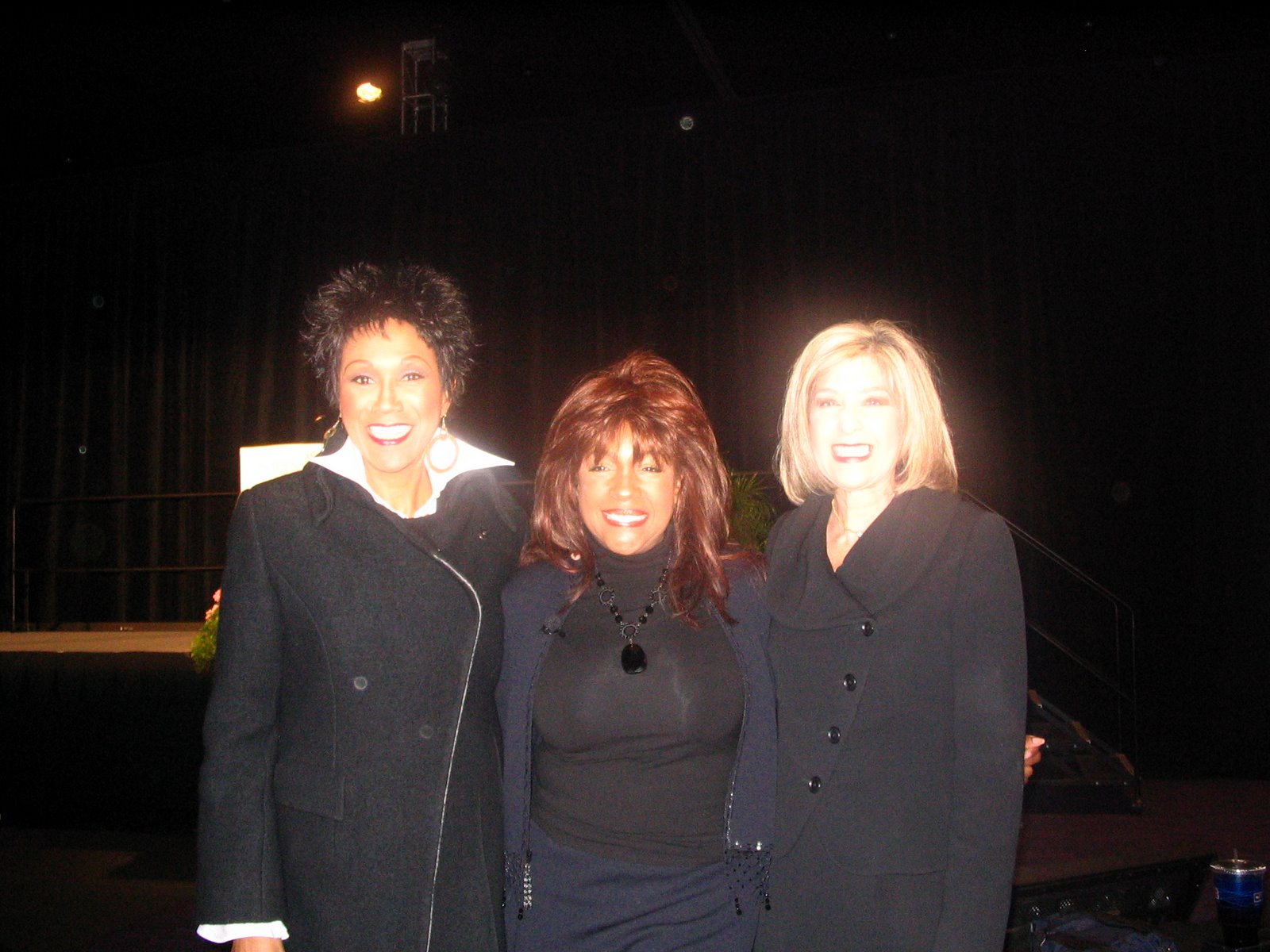


Ro: Oddly enough I just wrote a short story about a backup singer. Coincidence? I think not. Can we all get gowns and big hair and recreate Hank's experience somewhere? I'm game.
Subscribe to:
Posts (Atom)








