Showing posts with label voice. Show all posts

Friday, September 13, 2024

Musing on Voice


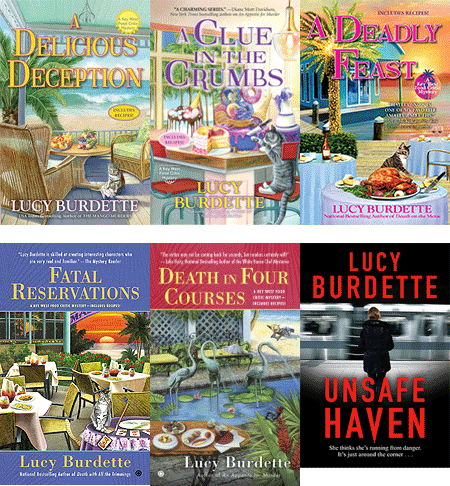
LUCY BURDETTE: A couple of weeks ago during the launch of A POISONOUS PALATE, I was invited by our beloved poison lady, Luci Zahray, to appear on a Zoom call with her book group. (She’s the one who advises all of us writers on how to kill off our characters.) It was a lovely visit with some very dedicated mystery readers. Luci herself might be the most dedicated of all. She told me that in advance of this Zoom meeting, she’d re-read – or re-listened to– my golf lovers mysteries, the advice column mysteries, and also some of the Key West mysteries. (Wonderful music to a writer’s ears!) She said that she would have recognized the Key West books as coming from me, even if she didn’t know that the name Lucy Burdette was also Roberta Isleib. She thought Hayley’s voice was very similar to that of Cassie  in the golf mysteries. (She found the advice column narrator sounded different.) She understood that the narrators in those series would sound different according to how much experience I had as a writer. But this recognition was not about experience. It was voice, my writing voice. We’ve all been writing for quite a while and have written either long series, or many different standalones. I wondered if you’d ever had anyone comment on the change or lack of change in your voice, and how much you’ve noticed it?

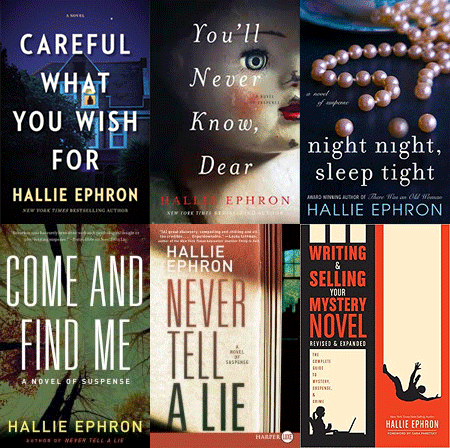
HALLIE EPHRON: When I was researching my mystery writing book, I asked a lot of editors what were they looking for in a manuscript. And the number one answer: A COMPELLING VOICE. When I asked what that looked like, the answer I was most likely to get back was, “I know it when I see it.”

I’m constantly aware of voice in my writing – the voice of the narrator. Every word you choose, the structure of the sentences, every choice you make contributes. When I wrote a forensic neuropsychologist narrator, he needed to sound different from a professional organizer or 90-year-old woman narrator.


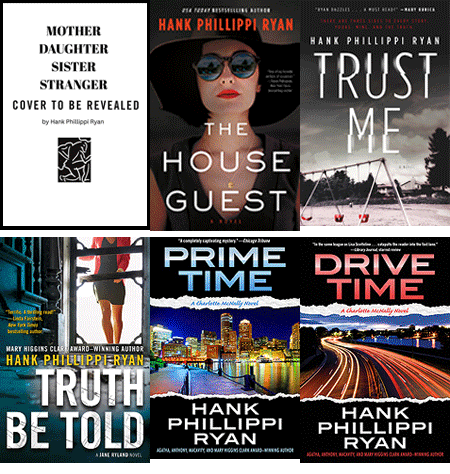
HANK PHILLIPPI RYAN: And attitude. Not just words, but attitude. And confidence. And that the character has a sense of their place in the world. For better or worse. When I wrote the very first draft of my very first book, the main character was neurotic and worried. I was told to rewrite the WHOLE STORY with exactly the same plot, but make the character smart and confident. I did, and that book sold. I think of this all the time.


LUCY: Fascinating, but…My question is slightly different: what about YOUR voices? Do you think readers can pick up any one of your books from any decade, and say, oh, that’s a Hank book or a Hallie book?

HANK: Oh, definitely. I think. Actually, funnily, I write a lot via dictation, so it comes out as sort of casually natural. Hallie’s voice is more elegant than mine, I think, and mine is more staccato but sprinkled with run-on sentences. I have absolutely had people tell me they could recognize my books, and often they use the word “optimistic.”

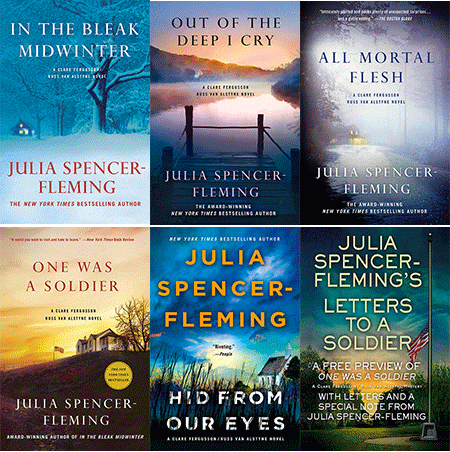
JULIA SPENCER-FLEMING: I believe every writer has a distinct voice, and it can be maddening for people trying to break into the business because it sounds so woo-woo and nebulous. Here’s how I break it down:

Your auctorial voice is like a fingerprint. It consists of the style and type of vocabulary you feel most comfortable with, the way you do or don’t address details, the sentence lengths your prefer, the type of punctuation you use and - here’s the woo -woo - how you interpret a story through your own life/ experiences/ interests. Your voice is shaped by what you’ve read, how you’ve spoken, and what you’ve paid attention to throughout your whole lifetime.

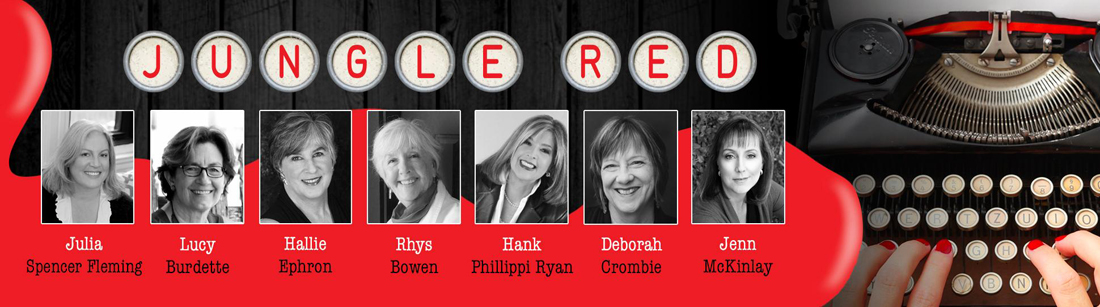
And, yes, editors and readers “know it when they see it.” Think of it - you could give the exact same short story situation to every one of the Reds, and each of us would still write a distinctively different story, and I bet readers could easily guess who penned what without any names attached.

HANK: That would be REALLY fun, Julia. We should try it.

DEBS: Or we could write the same story, but it would sound and feel completely different!

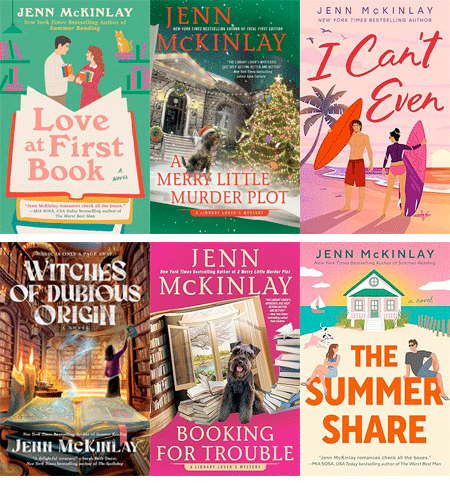
JENN McKINLAY: I like Julia’s analogy of the fingerprint. It’s so true. Every author has a unique and distinct voice. I can tell which Red wrote an email to our group without looking at the name because their author voice is quintessentially them–the way they talk, think, perceive things, relay information, and in my case it’s when I feel compelled to crack a joke because that’s how I cope with virtually everything. I don’t think author voices change over time so much as they become more refined.

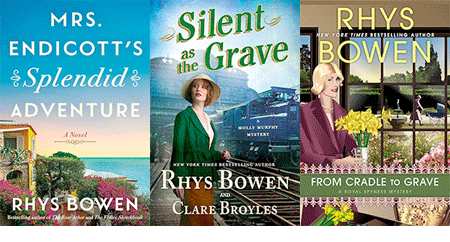
RHYS BOWEN: Both of my current mystery series are all about voice. I started writing in the first person in both series and the main character just took over. I sort of put down as they dictated and knew exactly who Molly and Georgie are. Their voices are quite distinct from each other. Also the voice in my stand alone novels is different again, although I think you can tell a Rhys Bowen novel.

DEBORAH CROMBIE: Lucy, the day I did Luci Zahray's book group, it was a hundred degrees and the library air conditioning had gone out! Bless their hearts, most of the lovely ladies came anyway. True book lovers!

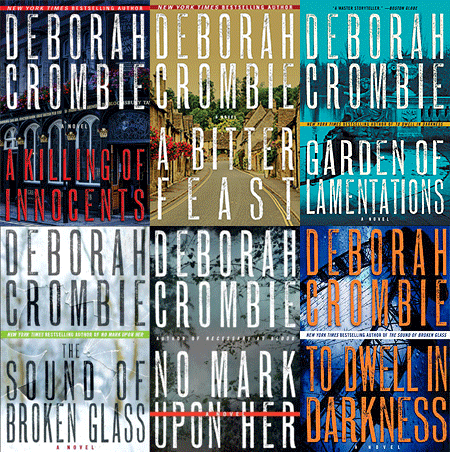
I don't think I can top Julia's explanation of "voice." And I don't think voice can be taught--it has to grow out of who the writer is and how their brain works. Because I write in third person multiple viewpoint, I don't tie mine to particular characters. When we do our "what we're writing" snippets, Hank always says, "I would know that was Debs' writing anywhere!" (But she said it more elegantly than that!)

Red readers: How do you define voice? Do you think you can identify an author’s voice without a name attached?

Thursday, August 5, 2010

Yoga for Creativity


JAN: I used to say I didn’t believe in writer’s block. I was trained as a reporter, after all, and we wrote on deadline, on command. It was all a matter of self discipline.

But that’s because I was defining writer’s block as a long period of time in which you wrote absolutely nothing. Now I define it differently: As certain days, or even a week, when writing is difficult and not all that productive. Now, I suffer from it.

Although I've always loved to practice yoga, up until last week, I wouldn’t have necessarily believed that yoga postures could affect creativity. That unlocking a stuck chakra, or energy field of the body, could affect the mind. But after a full day at a yoga retreat at Easton Yoga Center, with studio owner and yoga instructor extraordinaire Liza Keogh,(pictured above) I’m willing to give it a try.

I also got advice from one of the most creative people I know, Lees Yunits (pictured right). Besides being a yoga instructor, she is a musician and composer who has produced three CD’s of original music, and the author of a memoir about the ten years her husband was mayor of a city facing financial decline. We, The Mayor (available at Wethemayor.com )

So what postures do they believe spur creativity? And why, exactly?

LIZA recommends:

A sun salutation first thing in the morning. A sun salutation is a flow of poses, always beginning and ending in what’s called a mountain pose: standing straight, feet rooted in the ground, hands hanging by your side. You raise your hands over your head, eyes upward “connecting with higher realms for inspiration,” as Liza describes it.

There are a number of variations, but most involve a plank pose (which looks like a pushup), lunges, cobra or some form of backbend, a downward dog, and another forward bend. See the video below.

Liza calls says this fluid motion of poses helps open the body and the mind and gets at two important chakras. The chakra near the throat that can block “the voice,” and the chakra just underneath the sternum that affects. “willpower.”

Liza, who is also a designer and visual artist, says that if you can center yourself through awareness and exercise, it quiets the busy “to do” list maker inside. She says you need to silence this "monkey mind" to go to a deeper level and hear “the voice” that will inspire those brilliant ideas.

LEES recommends: The reverse table top posture, which is a form of bridge. You start in a sitting posture, your feet in front of you, hip distance apart, hands at your sides. You raise your pelvis and back, lifting your belly button to the ceiling so that your abdomen is level with your knees. Your weight is on your hands and feet, your arms are straight, and your knees are bent close to the body. You look like a desktop. Let your head fall backward and breathe.

This posture unblocks the chakra near your throat the affects voice, and also your pelvic area chakra, which represents procreation and thus, creativity.

Lees also recommends “the breath of fire,” which is a very rapid inhalation and exhalation from the diaphram (and through the nose) for three minutes. This kind of breathing is also called skull shining breath – "because you can sense after you’ve done it your brain feels open and alive and refreshed."

Lees suggests this not just before you start writing, but whenever you start to feel stuck.

And for the advanced, there’s the headstand. But that’s another blog.

Monday, June 4, 2007

(Who's) ON FIRST

"I am born."

"I had a farm in Africa"

"I have never begun a novel with more misgiving."


RO:
Back in the day, novels written in the first person got some respect. When did that change?

I don't know if it's a mystery thing or a "literary" thing, but it seems that writing in third person (or some other variation or combination) gets all the reviews while first person novels are somehow seen as lightweight, anyone-can-bang-them-out yarns. When I started Pushing up Daisies, I wrote in the third person - then when it seemed I would be writing a series I switched to first to put my protagonist right in the action. I had fun writing lines like "I whacked him in the head with the weed whacker", or my foot connected with his nose..."
What do you all think?

JAN:

Books written in the first person seem to be perceived as "small" which bugs me because I love writing in the first person. I also prefer reading first person books and I find I like movies and tv shows where there is a first person voice over (which oddly enough seems to be an increasing trend). What I like about voiceovers and first person novels is the perspective they offer. But I guess the rest of the world wants a more global view. Like everything else in literature, its probably just a passing phase.

HANK:
We all grew up with "Once upon a time..." Think about it. From our first moment of hearing a story, we heard it in the omniscient view, and usually past tense. "There was a beautiful princess, and she went...." "The frog said "But wait, if you..."

What's more, I always feel that a third person, past tense story is one that's over, that's already happened. Which is kind of interesting, isn't it? Because if done properly, a tale told in first person doesn't telegraph that something is over. It brings the reader in at the beginning, to go on the journey with whoever the main character is. (Whomever?)

I mean, Rebecca. Last night, Rebecca dreamt she was at Manderley again. (I guess she had told someone about it?) His name was Ishmael. And how could you possibly third-person-ize Catcher in the Rye ? And why would you want to?

One pal of mine got a review (of a book I thought was hilarious and wonderful) which said something along the lines of: "I can't understand why this is written in first person. I couldn't even read it." Huh?

Don't get me wrong. I'm comfortable either way. If I open the book, and at the end of page one I'm transported into the book's world--fine with me. First, third. I'm happy.

But I agree--I'd love to hear what you all think about why first person is so often vilified. Is it too--self-centered? Does it make the focus too narrow? Does it require too many coincidences?


RO: So let us know what you think.....and anyone know which books those three lines are from? First person to answer gets a Jungle Red gift!