Showing posts with label Gone With the Wind. Show all posts

Friday, August 10, 2018

David Corbett and Doc Holliday


DEBORAH CROMBIE: I didn't really grow up watching westerns. Well, I do remember The Lone Ranger (should I even admit that?) And my favorite cousin and I watched Gunsmoke together and then acted out our own plots with what served as action figures in the day. I remember we had a lot of fun hanging Bat Masterson from the stairwell in my house. (Okay, so we were weird. We both grew up okay.) But, that said, there was always a certain allure to the stories of Wyatt Earp--and, of course, Doc Holliday. He was just such a tragic, romantic figure. And, now, thanks to the talent of David Corbett, he's downright haunting. Here's David to tell you about him.


The Gunman and The Nun
By David Corbett

First, it’s a delight to be invited back to Jungle Red Writers. Deborah Crombie asked me to talk a little about how I came by the idea for my upcoming novel, THE LONG-LOST LOVE LETTERS OF DOC HOLLIDAY. In truth, the idea’s been floating around in the back of my mind for decades.

I grew up in the era of the great TV Westerns— Have Gun, Will Travel; Wagon Train; Maverick; Gunsmoke; Rawhide; The Rebel; The Rifleman; The Lone Ranger; and, of course, The Life and Legend of Wyatt Earp, where I first made the acquaintance of John Henry “Doc” Holliday.

I would meet him again in various incarnations: Victor Mature in My Darling Clementine, Kirk Douglas in The Gunfight at the OK Corral, Jason Robards in Hour of the Gun, Stacy Keach in Doc, Val Kilmer in Tombstone, Dennis Quaid in Wyatt Earp. Several of these portrayals proved compelling, but none of them, I’d learn, were all that accurate. (I somewhat sheepishly harbor a certain fondness for Victor Mature’s performance; though certainly the least heralded of the actors named, and the one bearing possibly the least physical resemblance to Doc, he nonetheless comes closest to capturing Doc’s fatalistic desperation. Then again, maybe that’s just because of John Ford’s majestically stark lighting.)

The fact that so many attempts to capture Doc failed to faithfully evoke his essence only made him all the more intriguing to me, through the sheer fact that he proved so elusive.

But what particularly piqued my imagination was the fact that Doc had a life-long correspondence with his cousin, Mattie, who was rumored to have been his sweetheart—a theory made all the more beguiling by the fact that she subsequently entered the convent.

I mean, what about that isn’t fascinating?

Adding to the intrigue is the fact that Mattie destroyed the letters near the end of her life, meaning we’ll never know for sure what they contained—a situation any self-respecting writer of fiction would consider a call to arms. (More on that in a moment.)

In all of my novels, one way or another, I’ve addressed the notion of redemptive love. By that I mean the ability, through loving and accepting that we are loved, we can move beyond our guilt and shame, our fear and weakness, to reclaim a place in the human community. Love grants us both the dignity and the humility to do that, if honestly given and acknowledged.

The trick lies in the honesty. Often the shame and guilt and fear are unrelenting, and we fool ourselves into half measures in order to avoid a full reckoning of what we’ve done and who we’ve hurt. Sometimes love, especially romantic love, can fool us into thinking that since someone sees us in a favorable light, maybe we’re not as weak or scared or guilty as we know ourselves to be. Maybe love can give us a pass, and we can slide by. When that happens, we all too often end up jeopardizing not just the love but the forgiveness, the wholeness we crave.

Doc offers a perfect example. He was clearly heartbroken when his mother died from tuberculosis, and was enraged when, only three months later, his father remarried. Making matters worse, the bride was a young woman a mere seven years old than Doc himself (he was fifteen). Her family lived just down the road, suggesting the elder Holliday had been courting her while his dying wife lay suffering at home.

Doc’s father didn’t merely betray his wife, however. Shortly after the war, dedicated to making the best of post-war circumstances, he became head of the local Freedman’s Bureau, which a teenage Doc, utterly dispirited by the Confederacy’s surrender, saw as little different than consorting with the enemy.

This kindled in Doc a simmering rage that haunted him throughout his life. His Herculean consumption of alcohol only exacerbated that. Before he left Georgia for the West, he was diagnosed with the same disease that had killed his mother, so he knew he would not live to a ripe old age. Trained as a dentist, he also knew that he had two recourses for the pain he would suffer—laudanum and alcohol. He chose the latter, and arduously self-medicated for the rest of his life.

The quickness and vehemence of his temper was legendary, prompting a reputation as “the touchiest drunk in the West.” But as Bat Masterson pointed out, despite Doc’s genius for getting into seemingly endless, desperate scrapes, the irony remained that very few were his own doing. Rough men just thought they could get the better of a frail, natty, tubercular drunk who they suspected of cheating, no matter how keen his intelligence, sharp his tongue, violent his disposition, or true his aim.

That reputation, though inflated or outright fabricated in many of its details, has been handed down from the beginning. What has only been guessed at is why such an irascible, volatile fatalist kept up a life-long correspondence with his saintly cousin?

The most incriminating letters were burned by Mattie, despite her belief that, if people could only read them, they would have a far more generous impression of the kind of man Doc was. This begs the question—if the letters were innocent, and her relationship with Doc was completely Platonic as the family has consistently professed, why destroy them?

It’s been conjectured that the reason Doc and Mattie did not develop their relationship openly was because the Catholic Church forbade marriage between first cousins. This becomes all the more compelling when one learns that the name Mattie chose upon entering the convent—Sister Mary Melanie—references a saint who did in fact marry her first cousin. (Another interesting fact: Margaret Mitchell, who was related to Doc and Mattie, based the character Melanie in Gone With the Wind on her aunt the Sister of Mercy, and it is often conjectured that Rhett Butler owes no small inspirational debt to Doc.)

All of this points to a far more interesting question: if Doc and Mattie were in fact sweethearts, what was the nature of their attraction? And what kept it alive for the rest of Doc’s life?

Mattie helped Doc care for his mother, and no doubt saw in him a profound capacity for affection, devotion, and sacrifice. The more I learned about Doc, the more I came to believe that the bond between them lay in the fact that she knew the man Doc could be, and refused to allow him to forget that. She echoed the angel in his nature that so often got shouted down by the devil in it.

For Doc’s part, I think he truly hoped that Mattie would decide that their love was more important than her Catholicism. His mother, on her deathbed, turned away from Presbyterianism— her husband’s faith, with its harsh Calvinist devotion to the concept of election (predestination)—and converted back to the Methodism of her youth, with its belief in grace through good works. “Deeds not creeds,” was how the distinction was known. Doc’s mother did this as an example to Doc, because she did not want him believing he might be damned with no recourse, or that his deeds meant nothing. If his mother could convert for his sake, why couldn’t Mattie?

This created an unrelenting tension between them. As I came to imagine it, Mattie continued trying to appeal to Doc’s better nature, hoping he would turn away from his nihilistic pursuit of danger and chance and return within the fold of faith and family. Doc, for his part, hoped that his slow-motion self-destruction would lure Mattie west, to save not just his soul but his life, and that once they were reunited he could convince her to stay with him.

I decided against simply writing an epistolary novel consisting of the letters alone, and instead, inspired by A.S. Byatt’s Possession, elected to write a novel with two parallel story lines, one contained in the correspondence, the other a modern-day narrative based on the sudden, unexpected, and questionable reappearance of the letters. Since the letters no longer exist, of course, I would have to do what any honorable writer of fiction would do: I wrote them myself. (One of the most gratifying, if inadvertent compliments I’ve received was from someone who asked, “Where did you find these letters?”)

The key, however, was always the notion that love can somehow make us whole. It’s a very seductive lie. When Mattie entered the convent, effectively ending any hope of her and Doc as a couple, Doc’s life entered the inexorable downward spiral that would end in his lonely death four years later. I think it was only near the end he realized he had lived in the false hope that, with Mattie by his side, he would not have to face his demons directly; they would just magically vanish through the grace of her affection. And conversely, Mattie’s decision to become a nun indicated a long-resisted acceptance on her part that love is not enough—she could not lure Doc back to virtue (or Georgia) simply by using their connection as bait.

This same dynamic—hoping love can absolve us of shortcomings we refuse to honestly admit ourselves—animates the present-day story line of the novel as well. Though the letters serve as a MacGuffin for the characters, and they pursue them relentlessly, even violently, the letters aren’t the real thing of value any of them craves. What motivates them all is the need for validation through love. And several characters endure incredible hardship and suffering in the effort to prove themselves worthy of that love, as though hoping their punishment will finally allow them at last to be forgiven. To her credit, my protagonist, Lisa Balamaro, comes to recognize the bait-and-switch this kind of love represents, but she has to travel a pretty rough road to reach that self-awareness.

DEBS: Although I say I'm not well-versed in westerns, I've actually seen at least half of the films David mentions, and I have to say I'm voting for Dennis Quaid in Wyatt Earp. (But then I always vote for Dennis Quaid.)

The most notorious love letters in American history—supposedly destroyed a century ago—mysteriously reappear, and become the coveted prize in a fierce battle for possession that brings back to life the lawless world evoked in the letters themselves.

Lisa Balamaro is an ambitious arts lawyer with a secret crush on her most intriguing client: former rodeo rider and reformed art forger, Tuck Mercer. In his newfound role as expert in Old West artifacts, Tuck gains possession of the supposedly destroyed correspondence between Doc Holliday and his cousin and childhood sweetheart, Mattie—who would become Sister Mary Melanie of the Sisters of Mercy.

Given the unlikelihood the letters can ever be fully authenticated, Tuck retains Lisa on behalf of the letters’ owner, Rayella Vargas, to sell them on the black market. But the buyer Tuck finds, a duplicitous judge from the Tombstone area, has other, far more menacing ideas.

As Lisa works feverishly to make things right, Rayella secretly enlists her ex-marine boyfriend in a daring scheme of her own.

When the judge learns he’s been blindsided, he rallies a cadre of armed men for a deadly standoff reminiscent of the moment in history that made Doc famous: The Gunfight at the OK Corral.


David Corbett is the award-winning author of six novels, including 2018’s The Long-Lost Love Letters of Doc Holliday, the story collection Thirteen Confessions, and the writing guide The Art of Character (“A writer’s bible” – Elizabeth Brundage). His short fiction has been selected twice for Best American Mystery Stories, and his non-fiction has appeared in the New York Times, Narrative, and Writer’s Digest, where he is a contributing editor. www.davidcorbett.com

David and his wife, Mette


DEBS: Readers, are you western fans? Do you have a favorite Doc Holliday? Stop in and chat with David!


Saturday, July 29, 2017

Book Bingo

INGRID THOFT
Our visit with the librarians from the Seattle Public Library and a comment on Monday’s blog inspired today’s post.  Earlier this week, Ramona talked about the teacher who insisted that she read books that challenge her.  Good advice, no doubt, but how to actually do that with so many books and so little time?

The Seattle Public Library's Book Bingo card


One solution is to play “Book Bingo.”  The Seattle Public Library offers book bingo every summer, as do other libraries.  You can complete the card and be eligible for a prize drawing, but even just reading one selection out of your comfort zone will stretch your mind a bit.  And as Linda and Andrea reminded us on Thursday, you can always “bother the librarian!” for suggestions!


I reviewed the Book Bingo card and was intrigued by square that said, “published the year one of your parents were born.” Hmmm.  I’d never considered seeking out books published in 1936 and 1939 (sorry, Mum!), but Goodreads has lists of the top books published by year.  It turns out those years were treasure troves for great books.


Papa Hemingway

What does 1936 have to offer?  Gone with the Wind by Margaret Mitchell, Agatha Christie’s The A.B.C Murders, or The Snows of Kilimanjaro by Ernest Hemingway.  Should I tackle Finnegan’s Wake by James Joyce?  That’s one of the options for 1939, but that might be too much of a challenge!  How about The Grapes of Wrath by John Steinbeck or Raymond Chandler’s The Big Sleep?

Other squares will be easier to fill.  In the biography and memoir category, Hunger by Roxane Gay is at the top of the list.  I also know what my choice will be in the “author of color” category. I’ve heard amazing things about The Hate U Give by Angie Thomas.  A Separate Peace by John Knowles fits the bill for a book I read in school.

You know what’s going to be tough?  Choosing something for the “genre that is new to you" square.  I don’t generally read science fiction, fantasy, or romance.  I think I’ll have to ask Linda and Andrea for some suggestions!


Our ever-growing TBR piles!


Reds and readers, do you purposely choose books that challenge you?  How would you fill in some of the squares of Book Bingo?

Tuesday, January 13, 2015

Tara Ison: Reeling Through Life

HALLIE EPHRON: Tara Ison is a self proclaimed “child of the movies, a movie freak, a film junkie, a cineaste.” And she’s written the perfect book for those of us who are similarly afflicted. “Reeling Through Life: How I Learned to Live, Love, and Die at the Movies” is part memoir and part a cavalcade of those movies that moved us and taught us essential life lessons like “How to go Crazy,” “How to be a Drunk,” and “How to Lose Your Virginity.”

Publishers Weekly called it “"an innovative blend of film criticism and literary memoir...these essays, combining cultural criticism with deeply personal reflections on love, religion, family, and the nature of art, offer brilliant analysis and food for thought for film aficionados and casual fans alike."


MY movie lessons on losing virginity came from two Natalie Woods movies: “Splendour in the Grass” and “Marjorie Morningstar,” both cautionary tales from a more innocent (or perhaps just more secretive) era. Coming along ten years later (Tara is, ahem, a bit younger than I am) Tara’s choices are… well I’ll let her tell you.
TARA ISON: I love both of those movies! Poor tormented, passionate Natalie Wood - you can see all that longing in those huge brown eyes of hers...  (Although my true connection to Marjorie Morningstar is the novel - my mother gave it to me when I was thirteen, and I reread it every few years.) 
The "loss of virginity" movies that most impacted me are Fast Times at Ridgemont High and Little Darlings. That one scene in Ridgemont High, where 15-y-o Stacy (Jennifer Jason Leigh) has sex for the first time in the baseball dugout with some older guy who doesn't care a thing about her...it's so dreadful and sad. She's doing it for all the wrong reasons, she feels so empty afterward, and can't even admit that to herself.

And Little Darlings is amazing - 15-y-o Tatum O'Neal and Kristy McNichol are at summer camp, and the other girls get a contest going on which of them will "become women" first. Tatum picks gorgeous young Armanda Assante (!), Kristy picks gorgeous young Matt Dillon (!), and they have very different but equally profound experiences.

As I say in the book, both movies are unusual in their focus on the female perspective of sexual awakening - they're both cautionary tales, but neither movie is anti-sex, they both just ask that we appreciate the power and potential of sex. Those two films helped me decide to wait just....a bit longer! (I think they should be required viewing for every 12-y- girl!)

HALLIE: My memories of going to the movies begin with the Saturday afternoon cartoon marathons that my father would drop us off for at "The Beverly,” the movie theatre at Beverly Drive and Wilshire Boulevard that had a sultan’s dome on top of it. First real movie ever was The Wizard Of Oz, only no NOT when it was first released (1939). Tara, do you remember your first?

TARA: Not the actual "first" - those childhood cartoons and Disney movies are a bit of a blur... But one early experience I remember so 
well is Gone With The Wind - I was probably 8 or 9 and my mother dropped me off at a revival (I know, I know...but it gave her a free afternoon. And it was a different era...) 

I was enthralled, enraptured, transported. The mid-point scene
where Scarlett arrives back at the devastated Tara and proclaims "As God is my witness, I'll never be hungry again!" was so thrilling and moving to me - her determination and strength, her transformation from a spoiled, sheltered brat at the beginning.

Then the curtain came down and the lights went up for Intermission. But I'd never been to a movie that had an Intermission - I thought it was the end of the movie! (It isn't a bad ending, after all...) I left the theatre in a daze and waited outside for my mom to pick me up.

I don't know how long I waited - I was busy running moments of the film in my head. Finally a theatre worker saw me outside, and brought be back in for the second half.

HALLIE: What inspired you to write this book, and where do your fantastic categories come from?

TARA: A few years ago someone asked me why I became a writer, or when I knew I wanted to be a writer. And I realized it actually began with the movies: I saw the film Julia, about Lillian Hellman, when I was 13, and fell in love with those images of The Writer: the beach house, the Parisian garret, the red wine, the old plunk plunk plunk manual typewriter. So romantic and glamorous!

And then other "writer" movies, too - Reds, Dr. Zhivago, Rich and Famous - all the writers seem to have thrilling love affairs and wear great clothes and drink martinis at the Algonquin with their editor. I liked the look of being a writer, I liked the label. (Of course, the movies don't show the actual effort involved...grr...)

So, I began writing about that, and wound up with the essay called: "How to be a Writer: The Beach House, The Bathrobe, and Saving the World."  And I realized so many other aspects of my identity, of who I am in the world, have been shaped, influenced, defined by
the movies, the core universal experiences of love, sex, illness, death, faith.

So I kept writing! Hence,  

  • How to be a Jew
  • How to Go Crazy
  • How to be Lolita
  • How to be Mrs. Robinson
  • How to be a Slut
  • How to Die with Style

HALLIE: Any category that you tried to but couldn't write?

TARA: I planned to write a chapter called "How To Love A Poodle," about dogs in films, and how powerful those stories are, how meaningful our connection to animals is: Old Yeller, Benji, those Disney movies about animals crossing the country in the snow to get home, etc. But every time I started writing, well, I would start to cry. I lost my dog about 5 years ago (a little poodle mutt), and the idea of sitting and watching all those scenes again and tapping back into that pain...


I can watch war scenes, illness scenes, depictions of terrible suffering, but you show me the little dog in peril at the edge of a cliff or something, and I just lose it.

But I do keep thinking about other categories that would be fun, other films that illustrate who we might be or how to be in the world:  "How to Wear a Corset," "How to be a Sister/Mother/Friend," "How to be a Californian/Blonde,"  "How to Run the World," etc.

HALLIE: So, yes, let’s play fill in the blank. What movies taught YOU how: "How to Wear a Corset?" 


I'll start: "The Cook, the Thief, his Wife, and her Lover" with an R-rated (or possibly X) Helen Mirren looking amazing what might be a corset.

What else (ahem) fits?

(Continue the conversation here today and find Tara in person in (LA, SF, Tempe...) or meet us January 22 in Boston at Newtonville Books, 7 pm)

Monday, March 4, 2013

Gone with the What?

RHYS BOWEN:
Would you expect a book called All's Well That Ends Well to be a light drawing room comedy or a sweeping international saga? Answer: the latter, if rumor is correct. That was the first title that Tolstoy chose for what became War and Peace.

Would The Strike have been as striking as Atlas Shrugged for Ayn Rand? Or Fiesta instead of The Sun Also Rises for Hemingway? How about First Impressions instead of Pride and Prejudice or Tomorrow is Another Day instead of Gone with the Wind?

These were all original titles for great works and it's reassuring to note that even the great ones had troubles with their titles. I can appreciate that now as I'm in mid title debate for the Molly Murphy book I am currently writing. It takes place in Paris and has to do with the end of Impressionism and the birth of modern art. So my working title had been Lasting Impressions. My editor felt this didn't have the edge necessary for a mystery novel. My agent desperately wanted the word Paris to feature in the title.

So I put it to my Facebook friends, and they went to town with it. There were some serious suggestions but they became more and more hilarious. My favorites were "Plastered in Paris", Monet isn't Everything" (but it's sad Toulouse) "An eye-full in Paris" or "Louvre and Let Die", "Bone jour" I could go on.

You'll be pleased to know we settled on none of the above. We've moer or less chosen City of Darkness and Light. What do you think?

Titles are so important, aren't they? How many times have you picked up a book because the title intrigued you? In this world of super-stores, airports and Amazons sometimes the title and front cover are all we have to sell the book. I love Red Deb's titles, especially the latest THE SOUND OF BROKEN GLASS.  It's intriguing because it isn't the sound of breaking glass. It's already broken. So can it make a sound?RHYS BOWEN:
Would you expect a book called All's Well That Ends Well to be a light drawing room comedy or a sweeping international saga? Answer: the latter, if rumor is correct. That was the first title that Tolstoy chose for what became War and Peace.

Would The Strike have been as striking as Atlas Shrugged for Ayn Rand? Or Fiesta instead of The Sun Also Rises for Hemingway? How about First Impressions instead of Pride and Prejudice or Tomorrow is Another Day instead of Gone with the Wind?

These were all original titles for great works and it's reassuring to note that even the great ones had troubles with their titles. I can appreciate that now as I'm in mid title debate for the Molly Murphy book I am currently writing. It takes place in Paris and has to do with the end of Impressionism and the birth of modern art. So my working title had been Lasting Impressions. My editor felt this didn't have the edge necessary for a mystery novel. My agent desperately wanted the word Paris to feature in the title.

So I put it to my Facebook friends, and they went to town with it. There were some serious suggestions but they became more and more hilarious. My favorites were "Plastered in Paris", Monet isn't Everything" (but it's sad Toulouse) "An eye-full in Paris" or "Louvre and Let Die", "Bone jour" I could go on.

You'll be pleased to know we settled on none of the above. We've moer or less chosen City of Darkness and Light. What do you think?

Titles are so important, aren't they? How many times have you picked up a book because the title intrigued you? In this world of super-stores, airports and Amazons sometimes the title and front cover are all we have to sell the book. I love Red Deb's titles, especially the latest THE SOUND OF BROKEN GLASS.  It's intriguing because it isn't the sound of breaking glass. It's already broken. So can it make a sound?

I think there are certain buzzwords that attract us to mystery novels. Bone/bones, blood, chill, cold are some of them and I think that Darkness or Dark is another. So Reds and writers: do you agonize over titles? Have you ever wished you�d called a book something else? Confession, I really wish I had not given the Evan books clever puns as titles. It made them sound cozier than they were are probably turned off some serious readers.

 What do you think is your most successful title to date? In the Bleak Midwinter was perfect, Julia. Hallie's are so atmospheric, Lucy's and Rosemary's clever, The Other Woman is spot on, as we say in UK and Dreaming of the Bones one of my favorite titles ever (and favorite books too, Debs.}

So readers and writers out there: what kind of title would make you pick up a book? (surely not Plastered in Paris?)

ROSEMARY HARRIS: I'm in title hell right now! I delivered my manuscript to my agent and she loves the title, but I am having second (and third) thoughts. It's the story of five friends, one of whom may have run off with another one's man. It's currently called The Bitches of Brooklyn but I'm starting to think that misrepresents the book - and may sound angrier or more Real Houewives than it is.  I too polled some friends and readers - the funniest one I got was from Rhonda Dossett, the southern half of the writing duo Evelyn David. (Marian Borden Edelman is the northern half.) She proposed this title And Just So We're Clear - Her Prom Dress Was Ugly, Too.
I'm considering it.

LUCY BURDETTE: Rhys, those are hysterical and utterly silly:). Sheila Connolly mentioned on one of my loops recently that her publisher was lobbying for CORNED BEEF AND CARNAGE for her new Irish mystery. Luckily, that one was nixed and replaced with TOP OF THE MOURNING, which I think works so much better.

Ro, I love that new title and subtitle! I have to agree, BITCHES OF BROOKLYN sounds a little like a downer to me.

I know the publishers spend lots of time trying to get this right, because I've gone round and round for almost all of my books. For the last two (#3 and #4) in the Key West series, I lobbied for FATAL RESERVATIONS. Food critic? yes! Murder mystery? yes! The only thing missing was Key West, which is well represented in the cover art. Instead, I've ended up with TOPPED CHEF and coming next year, MURDER WITH GANACHE. I like both of them just fine. I think the key is to have lots of options and sooner or later, the right one rises to the top.

HALLIE EPHRON: I like titles that sound a little bit nursery rhyme, a little bit creepy (THERE WAS AN OLD WOMAN, NEVER TELL A LIE) - because I'm writing domestic suspense. I do remember one of my earliest mystery novels was entitled ADDICTION an sure enough I had people coming to talks thinking they were going to hear about 12 steps.

HANK PHILLIPPI RYAN: PRIME TIME was almost "TIME CODE" because that's the term for the numbers that are burned it to videotape to let you keep track of time. Which I initially loved, than decided it sounded too science fiction. The it was "Story of my Life" because the main character was after the news story that wold save her career. But then--that sounded too--autobiographical. Then one day someone said (about a new reporter)--oh, she's not ready for prime time. And I knew it had been settled.

I'm now working on the title of my (crossing fingers) next book...and I'm wondering whether it should be The (some word that means "wrong or bad") (gender or relationship.)  THE OTHER WOMAN THE WRONG GIRL< and now...any ideas?  Or maybe just go another way altogether.

Rhys, I think your title is wonderful. And the right decision!  (Although I did laugh at Louvre and Let
Die.)

JULIA SPENCER-FLEMING: Hank, I'm glad you went with PRIME TIME. I would have thought TIME CODE was about a group of spies trying to stop a bomb countdown.

DEBORAH CROMBIE: Rhys, I LOVE The City of Darkness and Light!!! So perfect for the book! But the other suggestions are hysterical, and I must confess to a fondness for Louvre and Let Die.

I've only had to change one title. Mourn Not Your Dead was originally One Blood Will Tell, but the sales team at my then publisher didn't like it. My agent and my editor came up with Mourn Not Your Dead, and I still like the working title better.

And you are so right about the buzz words. The title for the book in progress is To Dwell in Darkness, and I hope I get to keep it. I love title with metaphorical layers (at least they are metaphorical to me!) The Sound of Broken Glass refers not only to the ruin of the Crystal Palace, which provides a sort of atmospheric background to the book, but to the shattered relationship that forms the core of the story. And then, since the book revolves around English rock music, there's the the Nick Lowe song, "I Love the Sound of Breaking Glass."

Favorite titles? Hmmm. Maybe The Sound of Broken Glass. Second favorite might be a tie between Dreaming of the Bones and In a Dark House.

JULIA: I can't help but think that cozy titles are the most difficult to get right. There's a convention that there's a pun, and it has to be related to the topic, like Lucy's with Key West and food critic, and it has to reference murder or mayhem, and it can't sound like every other title out there. That's a lot to juggle!

I've had to change a few of my titles. My second book was  JUST AS I AM before it was A FOUNTAIN FILLED WITH BLOOD (I confess it's my least favorite title.) ALL MORTAL FLESH was shortened from LET ALL MORTAL FLESH KEEP SILENCE. And the book that will be coming out this November had the working title of SEVEN WHOLE DAYS, which was greeted by a rousing, "Enh" from every bookseller I tried it out on. They and my publisher liked  THROUGH THE EVIL DAYS much better.

The best part of having hymns as your titles? Free advertising in hundreds of churches every year as they cycle through the hymnal.

Wednesday, November 21, 2012

Barbara Hambly on Naming Names


JAN BROGAN _  Since Barbara Hambly's  first published fantasy in 1982 – The Time of the Dark – she has touched most bases in genre fiction: her most recent vampire novel is The Magistrates of Hell (Severn House, 2012) and her most recent historical whodunnit, Ran Away, continues the well-reviewed Benjamin January series. She also writes historical mysteries as Barbara Hamilton (The Ninth Daughter, and its sequels A Marked Man and Sup With the Devil). In addition – when she can – she writes short fiction about the further adventures of characters from her fantasy novels of the ‘80s and ‘90s.

NAMING NAMES

            How is it that the villain’s evil henchmen are always named things like Ugmush and Weevil?
            Did Mr. and Mrs. Orc, gazing adoringly upon their little hatchling, exclaim, “How cute he is! How dimpled and sweet! Let’s call him Ugmush!”
            Or is “Ugmush” Orcish for “Bright Hope”?
            (How would you tell?)
            I’m as guilty as anyone else in this department. I spend a lot of time over the names of my characters, trying on one after another, as if the names were reflections of – and clues to – their personalities.
            Villains are easy. You can tell Charles Dickens had a lot of fun in that department: names like Skimpole and Krook, Bumble and Scrooge and Dedlock, all reek of petty viciousness. Dickens had a beautiful knack for making extremely English-sounding names that were sly digs at those who labored under them. I try to do the same, with occasional (I think) success. In the Benjamin January series, I generally thumb through my well-worn glossary of archaic colonial English, to find words for vile things which I then make the names of slave-dealers in the stories, names like Gleet (a genital sore caused by venereal disease) or Mulm (the disgusting green amalgam of algae and fish-poo that develops at the bottom of an aquarium if you don’t clean it often enough).
         
   Heroes, sidekicks, and secondary characters (whom I persist in thinking of as “guest stars” thanks to WAY too much television as a child) require a different combination of euphony and likelihood. Though in Real Life people generally receive their names completely at random, in a novel, a hero has to sound like a hero… or at least not sound trivial. For whatever reason, and I’m not sure why, some names sound stronger than others. Not many people would take seriously a spy named Clarence Bond. Or Ted Bond. It could be done, but the writer of the book had better be damn good to carry it off. Yet Clarence, or Theodore, are perfectly good English names (along with such other rejects as Evelyn, Wilf, Howard, and Alfred).  And in fact they’d be fine for a secondary character – a cab-driver, or the friendly shlub that the villain kills in Chapter Two just to prove what a rotter he is.
            But not for the hero.
           
I have a whole shelf of name-the-baby books for this purpose, the best of which is Peoples’ Names, by Holly Ingraham (MacFarland Press), which was written for role-players and divides them up by nationality, gender, and, wonderfully, time-period. In the Middle Ages, nearly everybody was named Henry or Matilda. I’ll admit I’m a perfectionist, but nothing drops me out of a romance quicker than twelfth-century heroines named Brittany. When writing about that time-period, one has to work with a fairly small list of female names, though after the Protestant Reformation you get a slew of Biblicals and with the Renaissance you acquire all sorts of classical Greek and Roman options.
            The book also has typical last names (for those eras that used such things), but often I’ll either comb through research books for the names of contributers or archivists (Guillenormand       sounds, for some reason, a lot more authentically French than the usual fallbacks like LaSalle and Dumonde), or I’ll do what Georgette Heyer did, and look for place-names in an atlas. How much more English can you get than Marden or Kinver? Some people simply use telephone directories. I am frequently reminded of that scene in The Mighty Aphrodite, where Woody Allen and Helena Bonham Carter are trying to come up with a name for their adopted infant: Eric? Groucho? Phileas? Phileas is a guy who forecloses on a mortgage…
            It’s a comfort to me to know that Dickens occasionally did what I do, and named all the major characters in the book names which start with the same letter (my editors are always getting on me for that): Smallweed, Snagsby, Summerson, Skimpole in the same tale. I catch myself doing that and then I have to fumfer around looking for another name that has the same “ring”. (My current project, one of the “guest stars” has gone through about seven different names. Either they just don’t sound quite right, or they’re too similar to somebody else’s in the same story.) (Or else I discover – with the same sort of “unconscious plagiarism” suffered by George Harrison when he wrote “My Sweet Lord” to a tune that turned out to be the old Chiffons hit, “He’s So Fine” – that the name that sounds so right, sounds so right because I’ve heard it someplace else, like Robert Morley or Thomas Wyatt or, famously, Ford Prefect. That’s where a quick pass through Google really helps).
            And of course, once you get into fantasy, all bets are off. Though I will say that random name-generators that simply mash letters, more often than not produce things that don’t sound like names. One can’t – or at least I can’t – imagine anyone’s friends really saying, “Hi, Mrsquipx, how’s it going?” Anyone who hangs out long enough on World of Warcraft is familiar with this phenomenon. Again, it’ll work occasionally for cab-drivers but not for the hero. And anyway, the last time I was putting together ideas for a fantasy, an editor told me that people seem to prefer those sort of almost-English names (like Bilbo, Frodo, Pippin and John Stark) that are easier to remember, rather than Azathoth and Frasticarion.
            Are other writers as OCD about their characters’ names as I am?
            Do other people fret and fuss and try them on and off like sweaters, trying to get them just right? (Margaret Mitchell called her heroine Pansy O’Hara all the way up to the final draft of Gone With the Wind… PANSY???)
            Often when I’m putting together a new story, the first day consists of just writing lists of names: Who ARE these people?
            Pansy O’Hara, meet Wilfred “Skippy” Bond…
*
            Where do you get your character names from? How important are names, anyway?


Barbara's short fiction  can be purchased via download from her website, www.barbarahambly.com. She teaches History part-time, and if you’re interested in her views on the weather, her cats, World of Warcraft, and sometimes writing, you can read her blog at barbara_hambly@ livejournal.com. She also does Twitter. Now a widow, she shares a house in Los Angeles with several small carnivores.

Wednesday, October 31, 2012

Comfort Reads for Uncomfortable Times: a guest blog by Tasha Alexander


JULIA SPENCER-FLEMING: I'm logging in from my local library to post this, since I (as well as several other east-coast Reds) am still without power. Fortunately, I don't have to write anything clever; our friend Tasha Alexander volunteered to take on blogging duties today. 

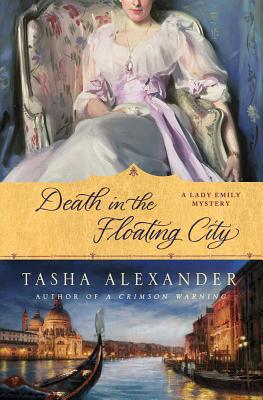
I know Tasha is one of the Reds communities favorite authors. Her Victorian-era Lady Emily novels brings together wicked mysteries and heart-stirring romance in stunning locations like Vienna, Constantinople and Venice. The latest in the series, Death in the Floating City, was a New York Times bestseller. 

Since Tasha and her dashingly handsome husband Andrew Grant live in Chicago and the UK, we're usually the ones consoling her for lousy weather. (If you've ever taken a cross-country flight in the US, you know about Chicago's tumultuous climate.) She knows about the stresses and strains we all come under - and has a wonderful suggestion for easing them.

The pounding given to the East Coast by Hurricane Sandy has put me to thinking about comfort and those things we do when we need it. Most of us are fortunate enough to be assured of basic material comforts--food, shelter, clothing. But that does not mean we don't face challenges, disappointments, and a variety of seemingly unending stresses, and we all need means to cope with them.

Last year when I was here, I talked about books I wished I could read again for the first time. This year, I'm considering those dog-eared volumes that, like the most loyal and steadfast friends, stand by us through every difficulty. I have many, many comfort reads. First come the old favorites. The really old favorites. On the Banks of Plum Creek and These Happy Golden Years from Laura Ingalls Wilder's wonderful Little House series got me through those horrible pre-teen years when I spent most of my time at school dances crying in the bathroom. It probably speaks badly of me, but I took great joy in reading about Nellie Oleson dancing around the creek bank with leeches stuck all over her legs.


As I got older, Gone With the Wind became a favorite. I would get to the end of my enormous hardcover edition (a tenth birthday present) and turn straight back to page one. Until, that is, Scarlett's story was eclipsed for me by Pride and Prejudice.

Sometimes, when I'm stressed, I need a giant heap of books that I can tear through, one after another, to fill loads and loads of time. Elizabeth Peters' Amelia Peabody series could not be better for this. Amelia's wit and intelligence can divert my attention from almost anything.


Then there are the times when what I really want is something more ethereal. That's when I go back to Haruki Murakami's The Wind-Up Bird Chronicle and escape into a bizarre world that is at once magical and disturbing. Not to mention written in some of the most beautiful sentences ever.


Interestingly enough, what I don't turn to for comfort is the book I consider to be my absolute favorite, David Mitchell's Cloud Atlas. Maybe that's because I don't want it tainted by whatever is causing me stress. Maybe it's because I want to keep it separate. I'm not sure. But I am sure about the one book that, no matter what, never ever lets me down when I'm in need. I think we all have a book like this--the one you can never tire of reading, the best dependable friend. For me, that's Pride and Prejudice. What's yours?

Let us know your comfort read, and one luck commenter will receive a signed hardcover of the newest Lady Emily mystery, Death in the Floating City!

You can find out more about New York Times bestselling author Tasha Alexander and read excerpts of her books at her website. You can follow her on Twitter as @talexander, friend her on Facebook, and see some of the actual locations in her novels on Flickr.


Monday, January 25, 2010

The Woman in Red

RO: I'm going to my first RT Booklover's Convention this April and no sooner did I click Send on the registration form than I went out and bought a red dress. Unless you know me, this might not seem like a significant event but ninety-five percent of the items in my closet are black. There's a blue suit and a brown dress and a lilac one-shouldered number that I had to buy because it's Armani and was on sale, and it looked terrific on me eight years ago when I bought it but it's never been worn outside of my closet. (Did I mention it has sequins?) I don't know what possessed me.

I'd gone to Macy's to buy a bra (forget Victoria's Secret Macy's has the best selection on the planet.) Anyway, bras are on the sixth floor and some marketing genius must have realized that by having only escalators (and no elevators) in the building a shopper would have to pass lots of other merchandise they aren't really looking for on the way to the thing they are looking for. There it was, on the fourth floor. Red. Sleeveless. On sale. And calling to me. It's one of those dresses that seems to have a shape even before you slip it on. Does everyone weigh an extra pound or two in January? I was risking a depressing sight in the harsh light of the dressing room, but I had to see what it looked like on.

It was a miracle. The dress held me in where I needed to be held in. It flared out where I did. (I'm no waif.) Was I really going to buy a red dress?
I flashed on the scene in Gone with the Wind when
Scarlett goes to Miss Melly's house in a slutty red
dress that Belle Watling might have worn. ("And put on plenty of rouge, I want you to look the part!")
And Bette Davis daring to wear red to the Olympus ball. (It doesn't help her win back Henry Fonda...look at him, he looks miserable. "I'm thinking of a woman named ...Jezebel!")


Some years back I was sipping a drink at a bar on NYC's upper west side and Christopher Walken told me I would look good in a red dress. Was I finally buying one? (Should I go back and look for him if I do?)

I'd read that attendees at RT (formerly called the Romantic Times Convention) dress with a certain, shall we say, flair? Daring? Did I have enough confidence to pull off a red dress? And in that crowd? What the heck, worst case scenario it will keep the lilac dress company at the back of my closet.I'm pretty sure I've seen Hank in a red dress, and of course she looked smashing.

What about the rest of you? Do you feel powerful in red?

JAN: I don't look good in red, unless its kind of orangey, which is a pretty ugly color. Mercifully, they don't make cocktail dresses in that shade.. But if Christopher Walken (I'm the only woman in the world who ever had a crush on him) told me to put on a red dress, I would.
But you've got the coloring for red. So wear it without apology. No big deal, really, you've just been living in Manhattan too long wearing black.

HALLIE: Red is my color. I love love love it, and over the years have had many red dresses. One was a red chiffon shirtwaist (that's how long ago) cocktail dress. Many Halloweens ago we made its flowy circle skirt into a devil's cape for my daughter.
Red makes you feel powerful. It's like being an exclamation point instead of an elipses. ENJOY!
ROBERTA: I love red, too, Ro. And Jan's right, you've got just the coloring for wearing it. And you must trust me on this: however far out you might feel with a red dress on, you will be dressed conservatively compared to many at Romantic Times! I went once, more as an observer and writer than a participant. It was amazing to see people checking in with scads of luggage and dress bags--different formal gowns and costumes for each night's ball.
Go ahead and wear that red--and take the lilac dress too, just in case.
RHYS: Rosemary, you'll look good in red and you're right. You have to make a statement at RT. You'll be amazed at the way some of the women dress up--sequins, feather boas, not to mention bustiers.
RO: Now...bustiers I can get into...I have quite a collection..this could be fun.
RHYS: Unfortunately I do NOT have the coloring to wear red, or black. I look like La Traviata in the third act in either color. I'm definitely a spring--pastels, beige, maybe a daring mid green or blue. I do have a fabulous red leather blazer--the softest lambskin. That was bought on impulse, and on sale, in Macy's simply because it felt so soft. It is that red in the blue spectrumso it looks okay on me--and I usually wear a white shirt or turtleneck under it.
But I do have several impulse buys in my closet that are totally wrong for me and have never seen the light of day, but I can't admit my failure. I'm currently debating what to wear as toastmaster at Malice this year. Can't upstage Mary Higgins Clark!
RO: Any interest in a lilac, one-shouldered dress? Never worn?
HANK: Oh, yes, red dresses--well, there is a certain something. And not just red dresses. Red anything. You know Helen Thomas used to wear red suits to White House press conferences so she'd stand out. Wasn't it President Nixon who called her the Lady in Red? Something like that. (And how many movies and songs hve The Lady in Red or some such as a title?)
Check out crowd scenes in movies or on T--you can always see the people in red. And RO, I was riveted by Bette Davis in Jezebel. "You can't wear red to the cotillion!" And it completely ruins her life. Luckily, although I saw that movie in my formative years, it didn't affect my grown-up clothing choices.

Can't wait to see the photo of you in your red!

RO: Maybe we all (except for Rhys) should wear red to Malice this year..