Showing posts with label Metropolis. Show all posts

Saturday, October 28, 2023

The Robots Are Coming...For Your Burrito Bowls

JULIA SPENCER-FLEMING: As a science fiction lover from an early age (Star Trek: the Original Series, y’all) I’ve been fascinated by the concept of robots for a long time. The origin of the word, for those of you who might not have taken Early 20th Century Theater in college*, comes from R.U.R (Rossum’s Universal Robots) by Czech playwright Karl Čapek. The Czech word robota refers to the forced labor of serfs or slaves - yeah, think about that the next time you turn on your Roomba.


Most of the robots in popular culture dating back to the 1920s are, well, sexy. Interesting. Dramatic. Think of the famous machine-person in Metropolis, or the menacing Gort in The Day the Earth Stood Still. (“Klaatu barada nikto!”) Rutger Hauer breaking your heart in Blade Runner and Data charming you in Star Trek: The Next Generation. I won’t even get into the vast number of SF films that feature the so-very-not original “beautiful robot girl who will also kill you.” (For an interesting gender twist on the old chestnut, see Ich bein dein Mensch /I’m Your Man on Hulu.)


Sadly, in our world, we are not getting sexy, interesting or dramatic robots. We’re getting burrito bowl makers.


That’s right. Soon, your dinner at Chipotle’s (which dubs itself a “fast casual” restaurant) will be courtesy of Chippy the tortilla chip maker, Autocado, which preps avocados (get it?) and a third robot, sadly without a cutesy name, that assembles salads and burrito bowls. On the one hand, there won’t be much chance of catching e. Coli from our machine friends. On the other hand, goodbye to another swathe of $15/hour jobs.


What’s next? Robby the Robot flipping burgers at Mickey D’s? (“Danger of cholesterol, Will Robinson!”) The Terminator serving you mozzarella sticks at Applebees? (“I’ll be back…with your margaritas.”


What do you think of mechanical meal makers, Reds? And are there any other services you’d rather see robots perform?


*See, Dad, it wasn't a waste of money after all! 


HALLIE EPHRON: Mechanical meal makers seem scary to me. Last weekend I was in the airport watching a worker assemble breakfast sandwiches at a Tim Horton’s and thinking how mind numbingly repetitive the work must feel. But it’s a way to make a living… until the robots take over.


My son-in-law is a robotics engineer and I’m endlessly fascinated by his work. For a while he was working on a robotic arm that could perform colon surgery. They were testing it on a pig. TMI, I know. And he worked on the digger arm of the first Mars lander. I think his company has been acquired by Amazon. Figures.


HANK PHILLIPPI RYAN: I remember reading R.U.R.! I adored it, and tried to look for other plays like it. LOVE that you know it, too! I still think about it.


Welp, I feel bad for the poor salad-making robot with no cute name. The Mixinator? And the burrito bowl maker could be Bowlene. (Bowlene, Bowlene, Bowlene, Bowlene–I'm beggin’ of you, please don't take  my man.) (See? The humans could sing it. It’s the first anti-robot union song.)


 Love it for the practicality, I loathe it for the job-taking. It’s such a quandary in progress and transition. 


Other services. Potato peeling. Laundry. But wow,the advances in medicine and prosthetics are incredible.


RHYS BOWEN:  my grandson is currently doing his masters in robotics and interested in remote surgery. Huge potential there! A robot saves a life in an operation in Africa directed by a surgeon here. And I can see robots doing repetitive jobs, chicken plucking, vegetable planting … but there are humans who need those jobs. 


What will happen when all low end jobs are done by robot?  

When I was young there were hundreds of women who worked the factory production lines. Boring repetitive work but they chatted with each other and made money for their families.  I’m really concerned for the future. 


JENN McKINLAY: Bring on the robots! No one should have to do those boring jobs for a rate of pay that is abysmal. Isn’t the whole point of having mechanical help so that people can pursue even bigger and bolder ideas, innovations, and art? Just think, if robots take over doctoring, then healthcare could be free and people wouldn’t be slaves to jobs they hate just for benefits because the insurance and pharmaceutical industries have made life virtually impossible without benefits. People could be happy pursuing their dreams and not risk bankruptcy over an appendicitis because the family robot could fix them right up. 


Yes, I’m joking, but…am I? I drive past driverless cars every single day now. It’s becoming common. So, bring on the burrito bowl robots. People have better things to do or they would if they didn’t have to make burrito bowls.


DEBORAH CROMBIE: I do worry about the people losing their jobs, and while I'd like to think they could find something better, I'm not convinced that they can. And I worry that every bit of human interaction we lose makes us a little less…human. We are all online orders and phone trees and more and more removed from dealing with other people. I know I sound like a real Luddite here, and I think the scientific and medical uses for robotics are amazing and fantastic. But… Progress marches on, and I do love Chipotle, by the way, so I will check out our local robots at the first opportunity. 


JULIA: How about you, dear readers? Are you in the Luddite camp with Debs, or do you welcome our robotic overlords like Jenn? 


Friday, July 29, 2022

B.A. Shapiro--Metroplis

DEBORAH CROMBIE: I love the writing community. The friends you make in this business are many, and are one of the best parts of getting to make up stories for a living. Today it's my very great pleasure to introduce one of my earliest writer friends, B.A. Shapiro. In our newbie writer days we, along with our friend Steven Womack, organized a couple of book tours together. (We even had t-shirts printed!) 

I was in awe of Barbara's plotting skills, and that certainly hasn't changed! Her newest novel, METROPOLIS, is an absolute can't-put-down-page-turner. How does she do it? you ask. Her answer might surprise you!


WRITING A  NOVEL WITH STATISTICS

B.A. Shapiro

My latest novel, Metropolis, is set in Metropolis, a nineteenth-century self-storage facility in a five-story brick monstrosity resembling a medieval castle—including turrets—that sits across the street from MIT. There are six viewpoint characters who have nothing in common but their connection to this building. The six couldn’t be more different from one another, on completely different paths in life, each with their own separate struggles and secrets. Black, brown and white. Christian, Jew and atheist. Gay and straight. Rich, poor and in the middle. 

So how the hell does one go about writing a novel with such a large unconnected cast and so many intertwining plots? How about Excel spreadsheets, bar graphs, bubble maps, pie charts and scattergrams? Not to mention intersecting and overlapping normal curves. Granted, one of my areas of specialization in graduate school was statistics, and everyone knows that being able to invert a matrix is a prerequisite for a successful literary career. Or not.

The bubble maps came first. Which of the characters know each other? Which don’t? And how does this change over time? Bubble Map 1 shows there’s hardly any interaction between them, but by Map 8, almost everyone knows each other. By the end of the book, some have crushes, some are in love, some are helpers and some are friends. And there are those who knowingly cause the downfall of others. 

Obviously, each person is the hero of their own story, but who are these people? What are their dreams, hopes, problems, backstories? You may not be aware of this—because I made it up—but every plot can be mapped on a normal curve. This is true of all character arcs and subplots, and is exactly what I needed to get Metropolis to work. 

I graphed out each character’s normal curve: their story, with all its obstacles and conflicts and major plot points. Then I did the same for each subplot, along with the overarching plot that ties it all together. When each of these was complete, I combined them into a single graph, with time running across the X axis, the one on the bottom, and the progression of events on the Y axis, along the left. 

How to organize this into a cohesive novel? I used a very sophisticated statistical method: multi-colored file cards. Each character, sub-plot and plot gets a color, and each card represents an individual’s plot point. Rose had about twenty plot points, Jason seventeen and Serge eleven, so I had twenty green cards, seventeen red ones, eleven blue ones, and on and on for each plot and character. 

Then I took all the cards—almost 100 of them—and laid them out on my dining room table. I moved them around for days until I created a structure that had a beginning, a middle and an end. When that was complete, I formed the cards into sequential scenes based on a four-act structure. Then I began to write.

But writing wasn’t the end of statistics and charts. Far from it. Throughout the process, I kept a tension chart for every chapter. The chart includes when, where and who is narrating each scene, but most important is the “tension coefficient” I assigned to each. My coefficients ran from 0.25 through 1.0, reflecting the amount of emotion the events created. 

Obviously, you can’t have a scene with no tension because that would be totally boring, but sometimes you have to do a bit of backstory or buildup or just need to give the reader a break after a high-tension chapter. This type of scene got a tension coefficient of 0.25. It was 0.50 for those with a cliff hanger, 0.75 for those where three or four different colored file cards intersect, and the big 1.0 for the really, really big ones. 

When I finished the first draft, I plotted theses coefficients on graph paper. If there were too many low numbers in a row, I knew I needed to add something to keep the reader reading. And if there were too many high numbers clustered together, then it was clear the reader needed some breathing room. 

But this all this provided just the skeleton. For me, the magic is in the revisions. Where my imagination adds the muscles and skin and faces to the characters, where the themes and plots are deepened, where true connections emerge. This is when my story becomes different from every other story. The right brain and the left brain working together. 

In the case of Metropolis, through eight drafts, almost four years, and many iterations of normal curves, bubble maps and scattergrams. Not to mention those many, many boxes of multi-colored file cards. 


In Metropolis we encounter six unforgettable characters who never would have met if not for their connection to the Metropolis Storage Warehouse. When a harrowing accident—or is it an accident?—occurs in the building, each person is forced to reconsider their life circumstances.
The characters have different backgrounds: they’re white, brown and Black; they’re Christian, Jewish and atheist; they’re gay and straight; they’re young, and they’re not so young; they’re rich, poor, and somewhere in the middle. As they dip in and out of each other’s stories and struggle to salvage their own lives—as well as discover the truth behind the incident—Metropolis traces how their interlocking narratives connect them and tear them apart. B.A. Shapiro has wrapped an ensemble cast around a mystery that thematically explores the myth of “pulling yourself up by the bootstraps” in current day America.


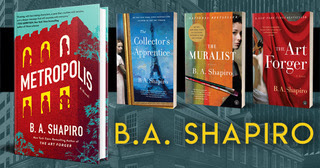
B.A. Shapiro is the award-winning and New York Times bestselling author of nine novels, including Metropolis (May, 2022), The Collector’s Apprentice, The Muralist and The Art Forger, which won the New England Book Award for Fiction, among other honors. Her books have been selected as Community Reads throughout the country and have been translated into over a dozen languages. She holds a PhD in sociology and has directed research projects for a residential substance abuse facility, worked as a systems analyst/statistician, headed the Boston office of a software development firm, and served as an adjunct professor teaching sociology at Tufts University and creative writing at Northeastern University. She likes writing novels the best. Barbara splits her time between Boston and Naples, Florida.

DEBS: Are you in awe yet?? I have seen Barb's multi-colored index card covered walls and they are a marvel--as are her books. If you want to write novels (or improve you craft) and you ever have the opportunity to take a plotting masterclass from her, jump on it. 

(I'm not going to be graphing normal curves any time soon, but I am definitely trying the bubble maps.)

REDS and readers, Barbara will be stopping in to chat, so get your plot questions ready!