
Showing posts with label how to plot a novel. Show all posts

Friday, July 29, 2022

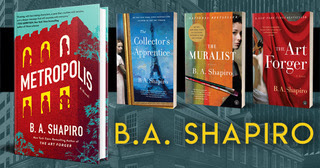
B.A. Shapiro--Metroplis

DEBORAH CROMBIE: I love the writing community. The friends you make in this business are many, and are one of the best parts of getting to make up stories for a living. Today it's my very great pleasure to introduce one of my earliest writer friends, B.A. Shapiro. In our newbie writer days we, along with our friend Steven Womack, organized a couple of book tours together. (We even had t-shirts printed!) 

I was in awe of Barbara's plotting skills, and that certainly hasn't changed! Her newest novel, METROPOLIS, is an absolute can't-put-down-page-turner. How does she do it? you ask. Her answer might surprise you!


WRITING A  NOVEL WITH STATISTICS

B.A. Shapiro

My latest novel, Metropolis, is set in Metropolis, a nineteenth-century self-storage facility in a five-story brick monstrosity resembling a medieval castle—including turrets—that sits across the street from MIT. There are six viewpoint characters who have nothing in common but their connection to this building. The six couldn’t be more different from one another, on completely different paths in life, each with their own separate struggles and secrets. Black, brown and white. Christian, Jew and atheist. Gay and straight. Rich, poor and in the middle. 

So how the hell does one go about writing a novel with such a large unconnected cast and so many intertwining plots? How about Excel spreadsheets, bar graphs, bubble maps, pie charts and scattergrams? Not to mention intersecting and overlapping normal curves. Granted, one of my areas of specialization in graduate school was statistics, and everyone knows that being able to invert a matrix is a prerequisite for a successful literary career. Or not.

The bubble maps came first. Which of the characters know each other? Which don’t? And how does this change over time? Bubble Map 1 shows there’s hardly any interaction between them, but by Map 8, almost everyone knows each other. By the end of the book, some have crushes, some are in love, some are helpers and some are friends. And there are those who knowingly cause the downfall of others. 

Obviously, each person is the hero of their own story, but who are these people? What are their dreams, hopes, problems, backstories? You may not be aware of this—because I made it up—but every plot can be mapped on a normal curve. This is true of all character arcs and subplots, and is exactly what I needed to get Metropolis to work. 

I graphed out each character’s normal curve: their story, with all its obstacles and conflicts and major plot points. Then I did the same for each subplot, along with the overarching plot that ties it all together. When each of these was complete, I combined them into a single graph, with time running across the X axis, the one on the bottom, and the progression of events on the Y axis, along the left. 

How to organize this into a cohesive novel? I used a very sophisticated statistical method: multi-colored file cards. Each character, sub-plot and plot gets a color, and each card represents an individual’s plot point. Rose had about twenty plot points, Jason seventeen and Serge eleven, so I had twenty green cards, seventeen red ones, eleven blue ones, and on and on for each plot and character. 

Then I took all the cards—almost 100 of them—and laid them out on my dining room table. I moved them around for days until I created a structure that had a beginning, a middle and an end. When that was complete, I formed the cards into sequential scenes based on a four-act structure. Then I began to write.

But writing wasn’t the end of statistics and charts. Far from it. Throughout the process, I kept a tension chart for every chapter. The chart includes when, where and who is narrating each scene, but most important is the “tension coefficient” I assigned to each. My coefficients ran from 0.25 through 1.0, reflecting the amount of emotion the events created. 

Obviously, you can’t have a scene with no tension because that would be totally boring, but sometimes you have to do a bit of backstory or buildup or just need to give the reader a break after a high-tension chapter. This type of scene got a tension coefficient of 0.25. It was 0.50 for those with a cliff hanger, 0.75 for those where three or four different colored file cards intersect, and the big 1.0 for the really, really big ones. 

When I finished the first draft, I plotted theses coefficients on graph paper. If there were too many low numbers in a row, I knew I needed to add something to keep the reader reading. And if there were too many high numbers clustered together, then it was clear the reader needed some breathing room. 

But this all this provided just the skeleton. For me, the magic is in the revisions. Where my imagination adds the muscles and skin and faces to the characters, where the themes and plots are deepened, where true connections emerge. This is when my story becomes different from every other story. The right brain and the left brain working together. 

In the case of Metropolis, through eight drafts, almost four years, and many iterations of normal curves, bubble maps and scattergrams. Not to mention those many, many boxes of multi-colored file cards. 


In Metropolis we encounter six unforgettable characters who never would have met if not for their connection to the Metropolis Storage Warehouse. When a harrowing accident—or is it an accident?—occurs in the building, each person is forced to reconsider their life circumstances.
The characters have different backgrounds: they’re white, brown and Black; they’re Christian, Jewish and atheist; they’re gay and straight; they’re young, and they’re not so young; they’re rich, poor, and somewhere in the middle. As they dip in and out of each other’s stories and struggle to salvage their own lives—as well as discover the truth behind the incident—Metropolis traces how their interlocking narratives connect them and tear them apart. B.A. Shapiro has wrapped an ensemble cast around a mystery that thematically explores the myth of “pulling yourself up by the bootstraps” in current day America.


B.A. Shapiro is the award-winning and New York Times bestselling author of nine novels, including Metropolis (May, 2022), The Collector’s Apprentice, The Muralist and The Art Forger, which won the New England Book Award for Fiction, among other honors. Her books have been selected as Community Reads throughout the country and have been translated into over a dozen languages. She holds a PhD in sociology and has directed research projects for a residential substance abuse facility, worked as a systems analyst/statistician, headed the Boston office of a software development firm, and served as an adjunct professor teaching sociology at Tufts University and creative writing at Northeastern University. She likes writing novels the best. Barbara splits her time between Boston and Naples, Florida.

DEBS: Are you in awe yet?? I have seen Barb's multi-colored index card covered walls and they are a marvel--as are her books. If you want to write novels (or improve you craft) and you ever have the opportunity to take a plotting masterclass from her, jump on it. 

(I'm not going to be graphing normal curves any time soon, but I am definitely trying the bubble maps.)

REDS and readers, Barbara will be stopping in to chat, so get your plot questions ready!


Sunday, September 18, 2016

TWENTY REASONS WHY @LucyBurdette #amwriting #Redsonwriting


LUCY BURDETTE: With each of the mysteries I’ve written and had published (15 so far*), I've been required to turn in three chapters and a plot synopsis to my editor toward the beginning of the contract.  (Except for the first book ever, which I had to write to completion.) And it has never failed that my writing comes to a screeching halt somewhere in the middle because I don’t know what’s happening next.

“What does your synopsis say?” my husband always asks.

“Nothing, it says nothing! I’ve got nothing!” I moan in reply.

Then I try all my tricks—whine on Facebook, brainstorm with writers group, attempt to start at the end and work back to the point where I’m stuck. Eventually the ideas do come and the book gets written and this mid-book agony fades.

Since I have all those books under my belt, my agent and I have been hoping that I could provide the same kind of material for a new book, even though it’s in a slightly different genre. The idea would be that she’d try to sell this proposal while I write like mad.

 So I sent her 94 polished pages and a 10-page synopsis that I thought was in pretty good shape. Excellent, in fact. The best so far! Compelling! Full of plot twists and deep character change!

As we had planned, she is sending the proposal around, and I continue to write, referring to the synopsis as needed. I’m broken-hearted to report that the same thing is happening with number 16 as happened with number two: I'm 100 pages in and I’ve run out of plot. The synopsis, it turns out, was a summary of the first 100 pages and the ending. I’ve got precious little to fill the empty space in between those two points…

I'm trying not to panic, trying to follow the characters wherever they take me. After all, Hank and Rhys and Hallie never know quite where they're going with a book in progress and they've done pretty well, right? I even signed up for an online class sponsored by our New England chapter of Sisters in Crime, mostly because Susan Meier, the teacher (who is terrific by the way), promised a technique for generating plot ideas when all the natural ideas have run dry. One of her many good suggestions was pinpointing a plot question, and then giving yourself a very short (1-2 minutes) time to generate a list of possible answers. The thought is that the first few will lack freshness, but as you force your brain to work, some wild ideas are bound to surface. And some of them might even work! Here, let’s try…

Suppose I want to write a suspense book about a psychologist who has had her license to practice suspended. (Then I might imagine moving her to Key West where she might volunteer in some way in the local jail and get in some major trouble.) Of course, I will want the reason for her suspension to echo in the plot later. So in this example, one question is why did the ethics board suspend her license? Here are the first few possibilities I came up with—you can see they aren’t very imaginative—yet…

1. She slept with her patient
2. She bought drugs from her patient
3. She sold drugs to her patient
4. Her patient killed himself and his family has filed a negligence complaint
5. He pretended to kill himself and persuaded…as above
6. She stalked her patient
7. She created false records of patients and billed for them
8. Her patient is able to persuade the review board that she did sleep with him (though she didn’t)

So you get the idea…I haven’t found what I’m looking for yet because while I want her to be troubled in some way, I also want her to be appealing. I know the answer is out there. Somewhere. Anyone want to try?


*I couldn't resist lining them all up for a photo opp:)--aren't they pretty? Though in the night I heard them squabbling over who got the best cover artist....

Saturday, August 20, 2016

Popular Articles About Writing on JRW


LUCY BURDETTE: One of the disadvantages of writing a blog is that perfectly good posts mostly disappear into the ether after the day (or week) they are posted. And last I checked, we'd posted 2724 blogs on this site--kind of mind-boggling, right? So I thought you might enjoy a round-up of some of our most popular posts about writing—feel free to share! Remember that there is often some great info in the comments section, too.


The Agony of Writing by the Jungle Red Writers: The reds admit to their panic mid-book and offer tips about how to keep going.


Are You Branded? By Chris Tieri, who explains the importance of understanding your reading audience--and your books. And PS, Chris will be the Friday keynote speaker at the New England Crimebake this year.


How to Write Fast by Peter Andrews, who shares his tips about writing faster...


Title Clinic by Elizabeth Lyon: The secret to choosing a great book title 


And another brilliant article from Elizabeth Lyon on WritingSubtext


Tips on Productivity by prolific writer Edith Maxwell 


Literary Agent Paula Munier on Plot Perfect: how to build a great story scene by scene


Literary Agent Victoria Skurnick on Top 10 No-no’s for Submissions  


And strictly for fun, because writers and readers need to eat, here’s a post I wrote on how to find good food almost anywhere.


Reds, is there a post I missed that stands out in your mind?






