
Showing posts with label B.A. Shapiro. Show all posts

Friday, July 29, 2022

B.A. Shapiro--Metroplis

DEBORAH CROMBIE: I love the writing community. The friends you make in this business are many, and are one of the best parts of getting to make up stories for a living. Today it's my very great pleasure to introduce one of my earliest writer friends, B.A. Shapiro. In our newbie writer days we, along with our friend Steven Womack, organized a couple of book tours together. (We even had t-shirts printed!) 

I was in awe of Barbara's plotting skills, and that certainly hasn't changed! Her newest novel, METROPOLIS, is an absolute can't-put-down-page-turner. How does she do it? you ask. Her answer might surprise you!


WRITING A  NOVEL WITH STATISTICS

B.A. Shapiro

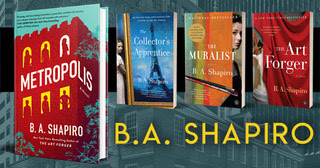
My latest novel, Metropolis, is set in Metropolis, a nineteenth-century self-storage facility in a five-story brick monstrosity resembling a medieval castle—including turrets—that sits across the street from MIT. There are six viewpoint characters who have nothing in common but their connection to this building. The six couldn’t be more different from one another, on completely different paths in life, each with their own separate struggles and secrets. Black, brown and white. Christian, Jew and atheist. Gay and straight. Rich, poor and in the middle. 

So how the hell does one go about writing a novel with such a large unconnected cast and so many intertwining plots? How about Excel spreadsheets, bar graphs, bubble maps, pie charts and scattergrams? Not to mention intersecting and overlapping normal curves. Granted, one of my areas of specialization in graduate school was statistics, and everyone knows that being able to invert a matrix is a prerequisite for a successful literary career. Or not.

The bubble maps came first. Which of the characters know each other? Which don’t? And how does this change over time? Bubble Map 1 shows there’s hardly any interaction between them, but by Map 8, almost everyone knows each other. By the end of the book, some have crushes, some are in love, some are helpers and some are friends. And there are those who knowingly cause the downfall of others. 

Obviously, each person is the hero of their own story, but who are these people? What are their dreams, hopes, problems, backstories? You may not be aware of this—because I made it up—but every plot can be mapped on a normal curve. This is true of all character arcs and subplots, and is exactly what I needed to get Metropolis to work. 

I graphed out each character’s normal curve: their story, with all its obstacles and conflicts and major plot points. Then I did the same for each subplot, along with the overarching plot that ties it all together. When each of these was complete, I combined them into a single graph, with time running across the X axis, the one on the bottom, and the progression of events on the Y axis, along the left. 

How to organize this into a cohesive novel? I used a very sophisticated statistical method: multi-colored file cards. Each character, sub-plot and plot gets a color, and each card represents an individual’s plot point. Rose had about twenty plot points, Jason seventeen and Serge eleven, so I had twenty green cards, seventeen red ones, eleven blue ones, and on and on for each plot and character. 

Then I took all the cards—almost 100 of them—and laid them out on my dining room table. I moved them around for days until I created a structure that had a beginning, a middle and an end. When that was complete, I formed the cards into sequential scenes based on a four-act structure. Then I began to write.

But writing wasn’t the end of statistics and charts. Far from it. Throughout the process, I kept a tension chart for every chapter. The chart includes when, where and who is narrating each scene, but most important is the “tension coefficient” I assigned to each. My coefficients ran from 0.25 through 1.0, reflecting the amount of emotion the events created. 

Obviously, you can’t have a scene with no tension because that would be totally boring, but sometimes you have to do a bit of backstory or buildup or just need to give the reader a break after a high-tension chapter. This type of scene got a tension coefficient of 0.25. It was 0.50 for those with a cliff hanger, 0.75 for those where three or four different colored file cards intersect, and the big 1.0 for the really, really big ones. 

When I finished the first draft, I plotted theses coefficients on graph paper. If there were too many low numbers in a row, I knew I needed to add something to keep the reader reading. And if there were too many high numbers clustered together, then it was clear the reader needed some breathing room. 

But this all this provided just the skeleton. For me, the magic is in the revisions. Where my imagination adds the muscles and skin and faces to the characters, where the themes and plots are deepened, where true connections emerge. This is when my story becomes different from every other story. The right brain and the left brain working together. 

In the case of Metropolis, through eight drafts, almost four years, and many iterations of normal curves, bubble maps and scattergrams. Not to mention those many, many boxes of multi-colored file cards. 


In Metropolis we encounter six unforgettable characters who never would have met if not for their connection to the Metropolis Storage Warehouse. When a harrowing accident—or is it an accident?—occurs in the building, each person is forced to reconsider their life circumstances.
The characters have different backgrounds: they’re white, brown and Black; they’re Christian, Jewish and atheist; they’re gay and straight; they’re young, and they’re not so young; they’re rich, poor, and somewhere in the middle. As they dip in and out of each other’s stories and struggle to salvage their own lives—as well as discover the truth behind the incident—Metropolis traces how their interlocking narratives connect them and tear them apart. B.A. Shapiro has wrapped an ensemble cast around a mystery that thematically explores the myth of “pulling yourself up by the bootstraps” in current day America.


B.A. Shapiro is the award-winning and New York Times bestselling author of nine novels, including Metropolis (May, 2022), The Collector’s Apprentice, The Muralist and The Art Forger, which won the New England Book Award for Fiction, among other honors. Her books have been selected as Community Reads throughout the country and have been translated into over a dozen languages. She holds a PhD in sociology and has directed research projects for a residential substance abuse facility, worked as a systems analyst/statistician, headed the Boston office of a software development firm, and served as an adjunct professor teaching sociology at Tufts University and creative writing at Northeastern University. She likes writing novels the best. Barbara splits her time between Boston and Naples, Florida.

DEBS: Are you in awe yet?? I have seen Barb's multi-colored index card covered walls and they are a marvel--as are her books. If you want to write novels (or improve you craft) and you ever have the opportunity to take a plotting masterclass from her, jump on it. 

(I'm not going to be graphing normal curves any time soon, but I am definitely trying the bubble maps.)

REDS and readers, Barbara will be stopping in to chat, so get your plot questions ready!


Friday, September 28, 2012

B.A. Shapiro: The highs and lows of publishing


JAN BROGAN - This may be one of the happiest interviews I have ever posted on this blog.  Today, I am welcoming Barbara Shapiro, who I first met 23-years ago in a novel writing class.  We were both aspiring authors and we formed a writer's group. In the years that followed, we have beaten up each other up over structure and prose,  drank champagne over successes, (it became a rule) cried over disappointments (involuntary) and stuck together as others came and left our group. 

Barbara was the first to get published, but after five novels, she hit a  dry spell. For eight years, she couldn't get published and even with this last manuscript, The Art Forger, she heard a lot of rejection.  Inexplicable rejection. The book was terrific, which made the rejection worse. Editors kept saying it didn't fit neatly into one of their genres. After being insanely persistent, Barbara started talking about retiring from this crazy, nonsensical industry.  How much rejection, she asked me, can one person take?

But she had a wonderful agent, Anne Collette of the Rees Agency, who wouldn't give up and one day Barbara got the call we all wait for.  Algonquin Books wanted to publish The Art Forger.  Not much later, it became an in-house favorite. They started to view it as a big book. The publishers planned to send her on a 30-city tour.  Publishers Weekly named The Art Forger as  one of Ten Promising Titles of the 2012 BEA (Book Expo of America), Amazon chose it as Editor's Pick for fall;  The Art Forger was named the number 1 Indie Nextpick for November.

 The Art Forger, which Booklist praised as   “an entrancingly visual, historically rich, deliciously witty, sensuous, and smart tale of authenticity versus fakery," is about down-and-out Boston artist, Claire Roth who subsists on painting reproductions until she gets her big break.  Her big break arrives in the form of an offer from a Newbury Street galley owner and kingmaker who will give her her own show, if she agrees to forge a painting for him.  The painting he wants her to forge is Degas' After The Bath - one of the paintings stolen in the storied Isabella Stuart Gardner Museum heist. 


JAN:  How did you come up with the idea for The Art Forger?

B.A. Shapiro: I started with the idea of writing a novel about Isabella Stewart Gardner, which led me to the Isabella Stewart Gardner Museum heist in which $500 million dollars of art was stolen – the largest unsolved art robbery in history – which led me to art theft and art forgery. I suddenly had a book about many things at many different points in time, but no real story nor any idea of how to weave it all together. So I started playing with the idea of a contemporary character who might interact with all of the things I was so fascinated by, and after many iterations I came up with a working outline that became the skeleton for The Art Forger.


 JAN: The novel also interweaves the story of Isabella Gardner's procurement of the Degas painting. How did you handle the  historical and the contemporary stories?

B.A. Shapiro: There actually are three stories in the book: the present story about the eponymous Claire Roth, Claire’s backstory which takes place three years earlier and the story of Isabella Stewart Gardner and Edgar Degas which takes place in the late nineteenth century. I developed each story separately, using charts and diagrams and other such obsessive tools, and then pulled each one apart and put them back together as a whole in which one story pushed the next story forward which pushed the next story forward. It was really fun.

JAN: How much of your own experiences with rejection helped inform the creation of Claire, your struggling protagonist?

B.A. Shapiro: It’s funny, when I was writing the novel, I wasn’t really thinking that Claire’s struggles were mine – I’m a writer after all and she’s an artist – but in retrospect, I’ve got to say that there are strong similarities. So much so that when I was doing the final edits for the book – once it had become clear that my publisher was getting behind it in a major way – I realized that I was experiencing the same emotions Claire had under similar circumstances. I guess I was being a wee bit thick.


JAN: How much do you think moving to Boston from the suburbs may have shaped this novel?

B.A. Shapiro: A lot. In two different ways. The first is that I could suddenly walk to hundreds of museums and art galleries, which I took great advantage of. I visited as many as I could, multiple times, took classes at the MFA and joined a group that wandered museums and galleries with an artist/art historian who opened my eyes to everything art. The second is that we moved to the South End of Boston, home to many artists, which is where Claire lives and works.

JAN: How did you survive the eight years you went unpublished? What kept you going and what advice would you give other authors struggling in this tough market climate?

B.A. Shapiro: The support of my family and my friends as well as a driving desire to tell stories. It wasn’t easy – and I’m not sure “survived” is even the correct term – after five published novels I wrote four more that couldn’t find a home. I was thinking about a career change when The Art Forger was acquired by Algonquin Books after many, many rejections by other publishers. I immediately bagged the change idea and started writing a new novel. As far as advice goes, all I can say is that sometimes – not always – but sometimes when you want something badly enough, it can happen. You’ve just got to get your butt into the chair so that you’re there when it strikes.

JAN: The Art Forger doesn't hit the shelves until mid-October, but you can pre-order it online today.  Barbara will be stopping by to ask any questions you have about the book or how to stay positive in this grueling business. 

One name will be chosen at random from the comments page to receive a free copy of The Art Forger, stop by with your questions or comments for Barbara.

And please come back  tomorrow when John Barylick talks about why he had to write Killer Show, America's Deadliest Rock Concert, a narrative non-fiction account of  The Station Nightclub fire that killed more than 100 people in 2003.  It's like Christmas around here at Jungle Red, three free copies will be given away.






