Showing posts with label audio books. Show all posts

Wednesday, January 11, 2023

A Few Good Voices

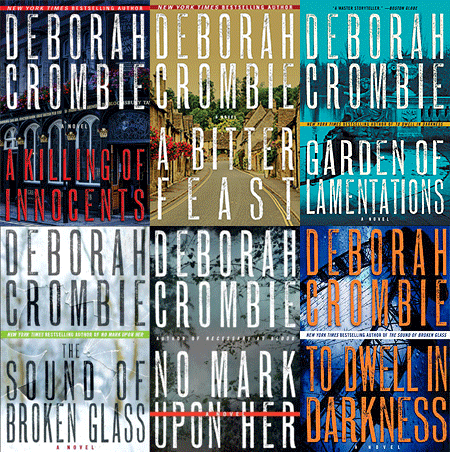
DEBORAH CROMBIE: Audio books have really become the rage in the book world these days, and I am all on board with that. William Kent Krueger, for instance, has a novella coming out in March, THE LEVEE, as an Audible exclusive, and will be here to tell us about it!


Humans have been listening to stories, after all, much longer than we've been reading them, and I think the act of listening satisfies on some basic subconscious level. Some of our readers, however, have expressed reluctance to embrace audio books, and I will confess that it has been a sort of slow blossoming for me, but now I listen as much, if not more, than I read print. If you're just dipping your toes into audio books, you might start with listening to something well-loved, so that you can settle into the rhythm, enjoy the characters, and not feel impatient to get on with the plot. Jim Dale's wonderful narration of the Harry Potter books is a great introduction.


Also, if you're reluctant to add the regular Audible subscription to your monthly expenses, there are other sources that don't require it, including libraries and Chirp, which has great deals daily. 

And then there's the matter of choosing narrators. This is so subjective! A voice that is honey to one person's ears may be vinegar to another's! Good voice acting requires a huge amount of skill. It's not just getting the tone and accents right. For me, one of the biggest factors is whether the narrator can make characters of the other gender sound believable, and some narrators are masters at this. I always listen to the sample before I buy an audio book.

Here are a few narrators that I think are outstanding:

I have to begin with my lovely Gerard Doyle, who reads my books (also as Michael Deehy, so don't be confused) as well as Mick Herron's Slow Horses series and Adrian McKinty's books, among others. Gerard won an Audie (the audio book version of the Oscar) for his reading of my novel IN A DARK HOUSE.

Then there's Kobna Holdbrook-Smith, who reads Ben Aaronovitch's Rivers of London books. I am in love with this man's voice, it's that simple. I could listen to him all day, and often let him read me to sleep. He's a very talented stage and screen actor--you may have seen him most recently as the angel Balthamos in the His Dark Materials series.

James Langton, who reads Charles Finch's Charles Lennox books, as well as Elly Griffith's Midnight Men series (except for the most recent one) is so good.

I've been listening to more female narrators recently, so here are a few I've really liked. 

You cannot beat Julia Whelan, oh my goodness, she is amazing, and her narration of her own novel, THANK YOU FOR LISTENING, was one of the highlights of the year for me.


Elizabeth Jasicki, Evie Dunmore's narrator, is terrific.

Davina Porter reads the Outlander series, brilliant.

Ditto Jennifer Ikeda who reads Deborah Harkness's books.

Victoria Fox is great, too, and I love her narration of Julie Caplin's books.

And at the moment I'm listening to January LaVoy reading Alix E. Harrow's THE TEN THOUSAND DOORS OF JANUARY and she is excellent. She reads Nora Roberts' THE HIDEAWAY (among other Nora Roberts books,) which is about an audiobook narrator and I'm going to have to indulge in that even though I've read the book.

And now I'm turning you over to our wonderful back-blogger Judy Singer, who is just as big an audio nut as I am! 

JUDY: I always listen to the sample before I buy the book. Some voices may be music to someone else’s ears, but I am careful to listen first and decide for myself.

Talented Narrators:

Men:

Shane East: British accent, sexiest voice ever, reads lots of romances especially Louise Bay

Gerard Doyle: Versatile British accents, reads Deborah Crombie’s series

Titus Welliver: American actor in Bosch series, reads a few of Michael Connelly’s Harry Bosch books

Jim Dale: British accent, reads Harry Potter; just a pleasure to listen to him read those books

Scott Brick: American, reads Janet Evanovich-Lee Goldberg Fox and O’Hare

Zachary Webber: American, great voice, reads lots of romances

Andrew Eiden: American, reads Wait for It by Jenn McKinlay. Really good voice!

Jason Clarke: American, great voice

Sebastian York: American, great voice

James Langton: British accent, reads Elly Griffiths’ Brighton Mysteries.


Women:

Andi Arndt: American, reads lots of romances, girl next door voice

Angele Masters: Versatile British accents, great with male voices and distinct voices for different characters, reads Deanna Raybourn’s Veronica Speedwell

Elizabeth Jasicki: reads Evie Dunmore’s series, outstanding voice!

Amanda Ronconi: American accents, New York, New Jersey reads E. J. Copperman’s ghosts series

Barrie Kreinik: American, excels in European and British accents, good male voices; read Rhys’s The Venice Sketchbook.

Allyson Ryan: American, lots of good accents, versatile, reads Jenn’s Library Lovers and her Bluff Point series.

These are just a few of the terrific narrators I have encountered. I am very fussy about an accent if it is one I would recognize, like New York versus Boston. Please don’t mix them up! But generally, I couldn’t tell the difference between the Southern American states’ accents or any of the English accents so that is something you will have to decide for yourselves. If you expect to hear New Orleans and it is Alabama and that bothers you…

DEBS: So many great suggestions, Judy! Readers, do you have any favorite narrators to share? We'd love to expand the listening community!

Thursday, August 9, 2018

David Hewson--Tips on Successful Audio Books


DEBORAH CROMBIE: I've commented a good bit recently on how much I'm enjoying audio books these days, so I was really tickled when I got a notice that my friend David Hewson had a new book in his Nic Costa series available on Audible. But it's not just the audio versions of David's novels that are big hits--he's been enormously successful in writing works directly for audio, as you will see. I asked him to chat with us about that, and about the latest in the world of audio books. This is so fascinating! I've become more and more aware of how my own books are going to translate to audio, so I'm going to be saving David's tips for constant reference.

DAVID HEWSON:  So there I was in the grand surroundings of the New York Historical Society waiting to hear who’d won an Audie, the audiobook equivalent of an Oscar, for the best original work of 2017. Had to be The Handmaid’s Tale narrated by Claire Danes and Margaret Atwood, didn’t it? Or maybe Nevertheless, We Persisted, a timely tale for the Me-Too era with a huge cast of voices.

Well no, actually. It turned out to be me, with no small amount of help from my wonderful narrator/performer Richard Armitage who breathed life into a revisionist adaptation of Shakespeare, Romeo and Juliet: A Novel. (Here's a sample.)


Rarely has my gob been so smacked as we say on this side of the pond. It sits on my mantelpiece now, an imposing and very heavy reminder of how Richard and I took one of the best-known tales in the world apart and retold it in a new and very different fashion. But here’s the odd thing. People, fellow writers even, still look at me askance when I say I love writing audio as much as novels. More so in some ways.

Why, they wonder? Don’t I know that stories come from books not a download from Audible?

Be still my beating heart… how wrong can you get? Audio isn’t just an important financial part of the publishing business these days – and unlike books growing very healthily in audience and money terms each year. Of more immediate interest to me as a writer, it’s at the heart of what we do. If you think that stories come from books you damn yourself as someone of a certain age. For a modern audience they’re as likely to come from a video game, a Netflix series or a movie.

Or, indeed, a tale skillfully told in your ear by a consummate actor like Richard. Because the aural storytelling tradition is where it all began. Remember that chap called Homer? He couldn’t write. He was probably blind for one thing. He recited or perhaps sang his stories to a rapt audience while others wrote them down to save them for prosperity. In fact there are people who believe that this is one reason writing first came into being.

I knew none of this when, largely by accident, I fell into working on audio original projects for audible, first Hamlet and Macbeth, co-written with my fellow author and Shakespeare expert A.J. Hartley, then on my own with Romeo and Juliet. There are more in the works too, not that I can tell you about them at the moment.

I still write books, of course. And I’m delighted to say my popular Nic Costa series has made a return with a new book, The Savage Shore, which has just appeared in the UK. The audio is released simultaneously, thank goodness, and if you’re in the US you’ll find the audio edition is the only immediately available version since the print and ebook versions won’t be out over there until November. See – it is important, isn’t it?


Another crucial thing that needs to be said about audio, too, is that writing to be read aloud tests and improves your technique for book work too. For example… here are some of my simple rules for tackling audio. You may think they work pretty well for books too.

Keep it simple
A physical book has a physical form of navigation built in. We know through the feel of the pages how far we’ve traveled and the distance left to go.

Once stories turn digital, navigation isn’t so simple. Yes there are ever more sophisticated tools that let you skip and navigate around the story. But listeners still crave signposts along the way, an indication, hopefully suggested by the story, where they should stop, rather than abandon something unsatisfactorily mid-scene.

Here are some of the ways I try to achieve this.
-       I write in short scenes. The average scene length in Romeo and Juliet: A Novel is probably around 1,000 words or five minutes or so in listening time. Some may run to twice that but they’re rare and usually important. Short scenes make it easier for the listener to choose when to break. They also tempt them to take on just one more scene when otherwise they might give up.

-       I structure the narrative in parts (or acts). Maybe, as in Romeo and Juliet: A Novel, a story that happens over a few days so it’s broken up by time, with an audio marker to denote the start of each act. Or it’s something thematic that marks a break. Whatever your divider you need to say to the listener… we’re starting a new section of the story now. It’s going to be big so if you want to put it off until you have the time now’s the point to do it.

-       Always, always make it clear at the beginning of the scene where we are and whose point of view is in operation if any. Listeners need to know that. They shouldn’t feel they have to catch up on what’s happening.

-       Make the narrative linear. Time jumps, flashbacks, flash forwards are going to produce speed bumps that will confuse the audience. I’m producing mainstream narrative fiction. Listeners should be engrossed in the story, not thinking about how it’s written or the cleverness of the author. The best writing is the writing that’s invisible just as the best acting doesn’t look like acting at all.

Dialogue
I’m working with world class performers and part of my job is to help them shine. A novel is a work inside itself, the author the cast, narrator, cinematographer and director. An audio project is closer to a film, TV or stage script. The way dialogue is handled is essential in all this. 
-       It must match the character. People speak differently according to class, sex and their role in the story. If they all sound the same it won’t work – and your narrator won’t have good raw material to work with..

-       The horror of ‘he said’ and ‘she said’. God how we all wrestle with that. Look, attribution is necessary from time to time. But mostly I will let the narrator deal with the change in speaker through accent and approach. Too many ‘he said’ and ‘she saids’ in a book can be annoying. In audio they can drive you up the wall. I recently had to give up on a very good book in audio because the writer hadn’t given this a second thought. Tip: always read your work out aloud and listen to it very carefully. That goes for any kind of writing.

-       Speech must be easy to understand and straightforward. One of the key ideas behind these Shakespeare adaptations was that they ran with the heretical idea that his language would go out of the window and they would focus on the story. Shakespeare is difficult, archaic and often open to interpretation even by experts. What I wanted were people from the late fifteenth century speaking in modern, comprehensible English, occasionally with a twist. Anything else and we’d be back producing speed bumps for the reader.

Location
Characters, Narrative and World. It’s essential the first two come out of the last. If anything I write, whether it’s in Scotland, Italy, Amsterdam or Copenhagen, can be easily transferred to a new location I’ve failed to do my job. Making the world of Romeo and Juliet vivid and real, in Verona and during his brief sojourn in Mantua, was essential. I spent a week visiting both in a chilly February before writing a word of the story. If I can’t see the world in my head I can’t reproduce it for readers and listeners. It was particularly gratifying to hear from Richard when we met during the narration that he loved the Verona I’d painted, a new take on a city he’d visited, with aspects he’d never seen while he was there.

That’s what writing location is about: making people see the world with fresh eyes, even if they feel they know the place you’re writing about well already.

When I look back on the new Nic Costa I can see that The Savage Shore has benefited from my audio work. It has a more novel-like structure but I hope there’s a clarity to it that I wouldn’t have found otherwise. And I’m also lucky in having a fantastic narrator here too, Saul Reichlin who’s become the voice of the Nic Costa series. 


If you want to be a storyteller you need to think about audio. Professionally and artistically too. It’s a fast-growing, exciting and dynamic medium reaching a bigger and bigger audience each year. And we’re still playing with what it can do, of which more later when I can tell you about it.

DEBS: That's a hook! And can I just say how fabulous Richard Armitage is reading Romeo and Juliet: A Novel??????? I mean, it's Richard Armitage!! Be still, my heart! The story is so gripping that you won't be able to stop listening.


Romeo and Juliet: A Novel, narrated by Richard Armitage, is available exclusively through Audible worldwide. Juliet and Romeo, the print version, is published in the UK by Dome Press. The Savage Shore is published by Severn House in print and Whole Story Audio in audio, narrated by Saul Reichlin. 

Here's David on David:


David Hewson
 Photo by Dingena Mol


One way or another I’ve spent my entire life earning a crust through the written word. I left school at the age of seventeen to become a cub reporter on the Scarborough Evening News, one of the smallest newspapers in the country. Over the next two decades I worked for The Times, Independent and Sunday Times as a journalist.
But the hankering to write fiction never went away. My first book Semana Santa, now reissued as Death in Seville, appeared in 1995 and was later turned into a movie with Mira Sorvino. Since then I’ve written more than twenty different books in various locations around the world.
In 2011, with my good friend A.J. Hartley, I branched into audiobook adaptations with Macbeth: A Novel, narrated by Alan Cumming. Now we’ve added Hamlet, Prince of Denmark: A Novel to the audio portfolio, this time narrated by Richard Armitage.
After writing eleven books set in Italy, nine featuring the young Roman cop Nic Costa, I went to Copenhagen for the three novel adaptations of The Killing series. After that I turned to Amsterdam with a series set around Pieter Vos, a detective who lives on the Prinsengracht canal. In 2016 I returned to the audio world with Romeo and Juliet: A Novel, once again narrated by the superlative Richard Armitage.
I live near Canterbury in Kent. The photo above is available for general use, but please give a credit to Dingena Mol and Crimezone  who took it in the bar of De Eland in Amsterdam, the fictional Drie Vaten in the Vos books.

David is in Italy, (I hope researching another book) but he'll be checking in today to chat with us and answer our questions. 

And do check out David's website at www.davidhewson.com. He's a very good photographer and if you're not careful, his photos will have you buying your plane ticket to explore the settings of his books in person. 
Tuesday, August 20, 2013

Will E-Books take over the World?

RHYS BOWEN:

When my new book, Heirs and Graces, came out two weeks ago I was surprised to find that it topped the historical mystery bestseller list in its Audible audio format. More people were listening to it than reading it. This also coincided with my reading an article that claimed e-books were not growing nearly as rapidly as predicted. It seemed that the techies of the world had bought their Kindles, Nooks and Kobos when the devices first came out, but the general reading public was not following suit. What's more those original buyers had loaded their devices with lots of cheap and appealing books that were still waiting to be read, thus not encouraging their owners to buy more.

 Real books were not about to lie down and play dead.

So I decided to run a poll on my Facebook page. What surprised me was that 20,000 people came to visit. I have never seen numbers like that before, especially in the space of two days. And as I read the comments one thing became clear  People are passionate about their reading habits. Many people finished their post with one or more exclamation points. "Only real books!!!!"

So having read and digested 1000 comments I can tell you, with scientific accuracy :) , that real books beat out electronic versions by more than two to one. And something interesting emerged from this study: reading from a real book was a sensory experience, involving all five senses.
There was the tactile stimulation of turning pages, feeling a book in one's hand. As one commenter put it, "If it's a mystery I can prolong the suspense by holding the tip of the page between my fingers and waiting in delicious anticipation before I turn it."
Another commenter said that seeing her books on a shelf evoked feelings of pride of ownership and pleasurable memories of past reading.Then there is smell of books, particularly old ones. The book was perceived as part of a  pleasurable experience. As one commenter said, "Nothing like a hard cover on an afternoon with a nice breeze."
Someone else said, "How would you press flowers in an e-book?"

Those who chose e-books liked the convenience, especially for travel, plus the fact that downloads were cheaper. Some commented they had run out of shelf space. Others that they could download out of print books. One commenter admitted she was naturally lazy and it was so easy to have a book delivered to her Kindle with one click.

In the case of audio it also seemed to be convenience and the only way to fit books into a busy lifestyle. One commenter said "If it weren't for audio I wouldn't have a chance to experience books." Audio has the added advantage that one can do something else at the same time. Audiophiles listened during long commutes, during workouts, housework or dog walking.  One of my fans told me last week that her dog walks have stretched to three hours while she listened to my new book.

Two surprising comments came out of my survey. A teacher mentioned that children tired of looking at screens all day and liked real books in their free time, (who knew?) and someone who worked in a college bookstore stated that most college students preferred real books, but that downloads of textbooks were so much cheaper and easier to carry around.

About ten percent of the respondents said that they loved all forms of reading. "E-books, audio, cornflake packets" one woman said. But it is reassuringly clear that real paper books are not going away any time soon! Bookstores--you may breathe a sigh of relief.

So what about you, Reds and Readers, do you still read predominantly electronic books, listen to them or insist on the good old paper versions where you get the added bonus of a workout by turning the pages?

Wednesday, November 28, 2012

The Makings of an Audio Book, with Katherine Kellgren


RHYS: When I heard that the first Royal Spyness book was going to come out in audio I was apprehensive.  American actors have not always been successful with British accents (think Dick Van Dyke and “Oye say, Mary Poppins”) But then I got an email from Katherine Kellgren, telling me that she was going to be reading the book and asking me how I wanted various things pronounced. Then I heard the first recording and I was thrilled.  She got it absolutely right. Other people obviously thought she did too, as the audio got nominated for an Audie award that year.
Since then Katy has been the reader for each book in the series, receiving another Audie nomination for Naughty in Nice. Not only does she get Georgie’s upper class English voice right but is deliciously accurate with all the other characters—Georgie’s waspish sister-in-law Fig, Queen Mary, and the cockney grandfather.
As I celebrate the audio release of the latest book I wanted to introduce our readers to Katy and to show another side to the book publishing industry and one that is growing by leaps and bounds.
So welcome Katy, I’m so pleased to have you as our guest today. Let’s start off with your background. You have to be English to get all those accents so right.
KATY: Well, I was actually born in New York City, but spent a hefty chunk of my life living in London. I was there for 12 years and did quite a bit of my schooling there, including 3 years spent training at The London Academy of Music and Dramatic Art. Hence I record books in both English and American dialects, though I would say the majority of them are still English. I even did a book all in Welsh dialect last year, which was utterly terrifying!

RHYS: Did you always want to be an actress?
 

KATY: I would have to say yes. When I was three years old I remember lobbying to play the Big Bad Wolf in a school production of the Three Little Pigs because I thought that part would present the greatest opportunity to display dramatic range, not to mention have the most stage time!

RHYS: What brought you back to America? 

KATY: An important factor in my final decision to move back to the States was that my father was ill back in New York. In the year before I left the UK though, I recorded my very first audiobook because of him. He was a great fan of the mystery author Freeman Wills Crofts, and at his request I got Crofts' 1929 novel The Box Office Murders out of the library and recorded it for him myself using a hand-held tape recorder. Although I had been working in audio doing numerous radio plays, it wasn't until I moved back to New York that I recorded my first professional audiobook. The idea of really pursuing that line of work was largely spurred by reading to him, both in person and on tape!

RHYS: So how did you move on from reading for your dad to becoming the star book-reader that you are today?
 

KATY: You are really being too kind saying "star" reader (though my actor-ly ego thanks you a thousand times)! It's fair to say that I spent a large part of my teenage years (and ever since then, come to think of it) listening to truly huge stars on audio. I was quite obsessed with old Caedmon recordings of John Gielgud, Edith Evans, Ralph Richardson et al reading plays, poetry and prose, and would spend hours at a time closeted in my room listening to them. When I was older and started reading to my father because he will ill, I began thinking about my ongoing love for those recordings and how important they had been to me growing up, and I determined to try to find work doing audiobooks, - which slowly but surely (with luck) I managed to do. Incidentally, one of my absolute favorite recordings as a child was The Importance of Being Earnest featuring Edith Evans giving her legendary Lady Bracknell, so when you wrote in The Twelve Clues of Christmas that Fig's mother, the formidable Lady Wormwood, utters certain words "in the same tones Lady Bracknell used regarding a handbag in the Oscar Wilde play" the thundering syllables of Evans instantly leapt to mind. Such bliss!

RHYS: What preparations do you make before you read an audio book? What is the hardest thing about doing it? (I was once asked if I'd like to do one of my books. I've read a short story for a pod-cast and that was quite enough for me. It's hard not to let my attention wander, then feel that I want to cough, swallow or choke). 
 

KATY: After carefully reading through the book at home (during which time I make elaborate notes about any descriptions the author has given concerning the characters' voices / dialects, flag words whose pronunciations I must look up & etc.) I go back through the text and highlight the dialogue of each character in a different color of pen. My recording script for The Twelve Clues of Christmas ended up quite rainbow-hued indeed, what with all the various guests at the house party chatting with each other! Then I think about the character voices, trying to get as close to how I imagine the author envisioned them as I possibly can. I draw on all sorts of sources for help and inspiration. For The Twelve Clues I kept up a pretty constant listening diet of Noel Coward recordings since he is a character in the book (luckily I already had lot of them, as he is an old favorite of mine) but of course came to the immediate conclusion that his diction is a thousand times more exquisite than mine could ever hope to be in that regard, so I would just have to make do and hope the listener will be forgiving. I often work with a dialect coach if I feel I need to brush up on anything (I'm working with a brilliant man right now who held my hand through the German and Romanian in A Royal Pain and Royal Blood). Then I'll go through and find the tunes to any songs the characters sing. This happens more than you might think - I do one series that always involves at least a dozen sea shanties per installment! In the case of The Twelve Clues it was easy, as I already knew the Christmas carols in question! I generally do as much specialized research as I can, and each book is different - a while ago I had a single book in which I had to speak in Urdu, French and Italian and sing in Spanish, this year opened with a book in which I had to reproduce the warning cry of an ostrich (actually that was quite fun). The hardest thing about doing audiobooks is also part of what makes working on them so exciting, you don't get to rehearse, and when you go into the studio if you're not ready or you let your concentration waver for a moment it will show in the finished product. I try to do everything I can to prepare, then when I go in to record, I know I have to take a leap of faith and let go and allow the author's words carry me along.

RHYS: Being so much in demand for your audio readings, do you still find time to do acting work?
 

KATY: Well I consider reading a book aloud sort of like being in a play in which I get to do all the parts - a tremendous amount of fun for any actor! Though I did do theatre, some film & etc. after I left drama school, once I started doing audiobooks I became more and more focussed on them alone. As I said before, recordings have always been hugely important in my life, - I think there is an experience you get from being read to that you can get nowhere else. I know I still listen to audiobooks read by great narrators all the time and draw inspiration from them. I'm totally focused on audiobook work now, and I'm so proud and grateful to be in the profession that I'm in!

RHYS: What do you miss about England? And since this is a Christmas book, can you share a favorite English Christmas memory with us?

KATY: Principally I miss all my friends there. I try to keep in close touch with many of the dearest ones, but there's so much you miss in daily life by simply not being there. I miss my old neighborhood in Primrose Hill in North London, where I lived for a good many years. The thought of the grilled halloumi cheese at Lemonia Restaurant there often fills me with a nameless longing... The London Library, Pleasures of Past Times bookshop in Cecil Court, - oh, really too many things to mention! My most distinct memory of Christmas in England is the lazy afternoon sensation of lying on the carpet playing dominoes and eating Quality Street in front of holiday TV after a glorious lunch. Not very picturesque but very comforting.

RHYS: Thank you so much, Katy. Now we are all more aware of all the hard work and background preparation that goes into an audio book. Anything else you’d like to add? 

KATY: Only that it is a true pleasure for me to be able to record your deliciously written books - wonderful writing makes my job as a narrator not only much easier, but also an absolute joy! 

RHYS: I look forward to hearing you read the rest of the series, until Georgie and Darcy are collecting their old age pension one day! 

And dear Reds and friends—Katherine Kellgren doesn’t just read my books. I believe she received seven Audie nominations last year. So if you see her name on an audio recording you know you’ll be in for a treat.

Here’s a link to Katy’s wonderful audio version of The Twelve Clues of Christmas.