The Jungle Red gang recently got a comment on our inaugural blog that was worth a second look...
Jack Bludis said...
When I saw the title, "On First Efforts," I thought it was about our VERY first efforts. At the age of 18, I sent my first story to the New Yorker ... they didn't think I was a genius. It took ten or fifteen more stories and about a hundred rejections before it got through to me that I was just an ordinary person who wanted to write.I suspect there are many others who have had a similar experience, but others who published their first and never looked back.Rosemary? Hallie? Hank? Jan? Or it just us guys who dive into it with ego and come out humble?
Ro: Maybe I shouldn't spread this around but Pushing Up Daisies is the very first thing I've ever written. Granted, I did rewrite it about 10 times - 5 or 6 times on my own and after every rejection by an agent. FYI, I didn't make changes based on any comments the agents had (only one even had anything constructive to say) I just reread and saw how I could make it better. What about the rest of you, JRs and readers? What was your first time like?
HANK:
I just looked back on that first blog--which, of course, was my first blog. Ro had practiced on her personal one, and loved it, but the rest of us were new. Now I look forward to reading it every day, checking the comments, see who's visiting and what everyone is thinking.
Anyway--to answer the actual question. The first thing I ever really wrote that got published was an essay for Rolling Stone magazine. I was the Washington editorial type at Rolling Stone for a column called "Capital Chatter" which was a compendium of cool stuff and insider stories. So I edited and collected items, fact-checked, and also wrote from time to time. (I was--23?)
And the very first was a story/essay about Susan Ford's Prom.I went to the White House, and was in the press pool that got to go to the Prom, interview guests, including Susan, if I can remember correctly, although it was more than 30 years ago. Argh.
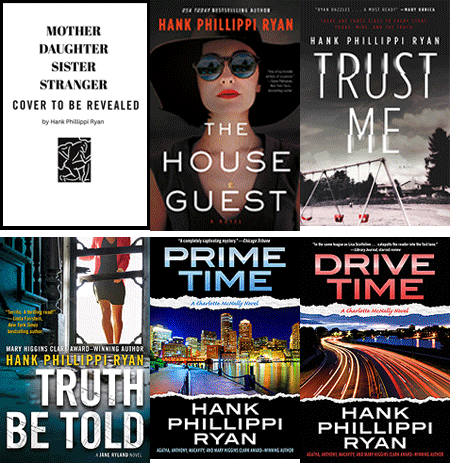
And I remember I loved it. Writing it. Seeing it. I don't even remember who said okay, print it--Jann Wenner supposedly read everything, but we never really knew for sure.My first book is Prime Time (June 2007!!) Even though I started a different mystery in 1991 (more about the unlamented Greeskeeper in earlier posts...) Prime Time is the first I finished. But wow, I'm hunble. It was a much tougher ride than I'd ever imagined.
JAN:
Well Jack, I can safely say I was delusional at any even earlier age than you. In first grade, I wrote my first book, The Cat On the Moon, and dropped it on the street, knowing for certain a publisher would pick it up and make it a bestseller. In second grade, when I found a book on the reading shelf entitled The Cat on the Moon, I was certain I'd been plagiarized. I was too mad to actually read it, but it's a good thing I didn't have a budget for legal or I probably would have sued! Scary, huh?
Saturday, April 14, 2007


Monday, April 9, 2007
ON CLICHES
"Omit the use of a magpie, raven or parrot as an instrument for stealing jewels."
…Carolyn Wells, "The Technique of the Mystery Story" (1913)
HALLIE: Every era has its clichés. In "Murder for Pleasure" (1941) Howard Haycraft inveighed against "secret passages, sinister orientals, and twin brothers from Australia."
Today, we crime fiction writers manage to steer clear of sinister orientals but we have our own raft of clichéd plot devices. Atop my list is the "I-can’t-talk-to-you-now call" – the book opens, the sleuth gets a frantic phone call (or email or text message or…) from a friend (or relative or co-worker or acquaintance or…) who is desperate to talk. No, the person can’t just come out and say what it's all about (because that would make it a very short book). They have to meet.
The sleuth goes to said appointment, waits, and, Zut alors! the friend fails to show up. Sacre bleu! It turns out that the friend has been murdered, or kidnapped, or otherwise mysteriously dispatched.
The only person who’s surprised is the sleuth. Unfortunately, this is a plot device I used in at least one book…before I realized it was a cliché.
Got a cliché to share??
HANK: Merde. Back to the drawing board to erase the twin jewel-stealing parrots from Australia.
Cliches, huh? Don't have to search much farther than a draft of the very first attempt at a mystery I ever wrote, circa 1991, and whoa. It was terrible. (Someday we should talk about point of view. I had, let's say, maybe six in this partial manuscript.) Anyway, the turning point of the whole thing was that someone didn't fall into the trap (I won't even go into it) because they were: LEFT HANDED. And of course, the murderer didn't realize that.
Okay, laugh. But in defense of others, I think a cliche can still work if it's well written. (Mine wasn't, trust me.) A trusty old plot with a touch of writer magic can seem new again. Can't it?
Ah, maybe not. Twins, the secret baby, an anagram name, an opened and critical letter that's left behind, something spelled backwards or mirror writing, the old "I took the wrong beeper because they looked alike and now I'm getting the messages for the murderer..." I guess you'd have to be pretty Agatha to pull those off.
JAN: I think a cliche is only a cliche when it's used as shorthand. The truth is, there are only so many reasons to be murdered, so many ways to murder, and so many ways to find out about a murder. I think when you make anything, from an image to plot point, unique to your story, rich in detail and attitude, you can, for the most part, avoid cliche.
For example, you could definitely say that a popular modern cliche in mysteries is the use of pets, most often cats, to show both the lonliness of the protaganist and his or her ability to love and nurture. And yet, Spencer's devotion to Pearl is witty and specific enough that it generally isn't irritating.
But being known officially as the dialogue police, or the DP, I can tell you that all this supposed tolerence goes out the window when authors let their characters speak in cliches ---even when prefaced by the "I know this is cliche, but...."
RO: I don't know... I love Irish cops, sleazy lawyers, and strippers with hearts of gold, as long as they show up in fast-paced, well-written books. There's a guy in Florida -my idol- who sprinkles characters like these in all of his books, and no one would ever consider his writing cliched. I may resurrect the sinister Asian (more pc) in my next book....
HANK: Hmm. I just asked my husband about the switched-beeper cliche, and he said he's never heard of that. So, I'm taking it back, and using it.
HALLIE: I LOVE the switched-beeper (scratch cliche) scenario...I wanted to claim it.
…Carolyn Wells, "The Technique of the Mystery Story" (1913)
HALLIE: Every era has its clichés. In "Murder for Pleasure" (1941) Howard Haycraft inveighed against "secret passages, sinister orientals, and twin brothers from Australia."
Today, we crime fiction writers manage to steer clear of sinister orientals but we have our own raft of clichéd plot devices. Atop my list is the "I-can’t-talk-to-you-now call" – the book opens, the sleuth gets a frantic phone call (or email or text message or…) from a friend (or relative or co-worker or acquaintance or…) who is desperate to talk. No, the person can’t just come out and say what it's all about (because that would make it a very short book). They have to meet.
The sleuth goes to said appointment, waits, and, Zut alors! the friend fails to show up. Sacre bleu! It turns out that the friend has been murdered, or kidnapped, or otherwise mysteriously dispatched.
The only person who’s surprised is the sleuth. Unfortunately, this is a plot device I used in at least one book…before I realized it was a cliché.
Got a cliché to share??
HANK: Merde. Back to the drawing board to erase the twin jewel-stealing parrots from Australia.
Cliches, huh? Don't have to search much farther than a draft of the very first attempt at a mystery I ever wrote, circa 1991, and whoa. It was terrible. (Someday we should talk about point of view. I had, let's say, maybe six in this partial manuscript.) Anyway, the turning point of the whole thing was that someone didn't fall into the trap (I won't even go into it) because they were: LEFT HANDED. And of course, the murderer didn't realize that.
Okay, laugh. But in defense of others, I think a cliche can still work if it's well written. (Mine wasn't, trust me.) A trusty old plot with a touch of writer magic can seem new again. Can't it?
Ah, maybe not. Twins, the secret baby, an anagram name, an opened and critical letter that's left behind, something spelled backwards or mirror writing, the old "I took the wrong beeper because they looked alike and now I'm getting the messages for the murderer..." I guess you'd have to be pretty Agatha to pull those off.
JAN: I think a cliche is only a cliche when it's used as shorthand. The truth is, there are only so many reasons to be murdered, so many ways to murder, and so many ways to find out about a murder. I think when you make anything, from an image to plot point, unique to your story, rich in detail and attitude, you can, for the most part, avoid cliche.
For example, you could definitely say that a popular modern cliche in mysteries is the use of pets, most often cats, to show both the lonliness of the protaganist and his or her ability to love and nurture. And yet, Spencer's devotion to Pearl is witty and specific enough that it generally isn't irritating.
But being known officially as the dialogue police, or the DP, I can tell you that all this supposed tolerence goes out the window when authors let their characters speak in cliches ---even when prefaced by the "I know this is cliche, but...."
RO: I don't know... I love Irish cops, sleazy lawyers, and strippers with hearts of gold, as long as they show up in fast-paced, well-written books. There's a guy in Florida -my idol- who sprinkles characters like these in all of his books, and no one would ever consider his writing cliched. I may resurrect the sinister Asian (more pc) in my next book....
HANK: Hmm. I just asked my husband about the switched-beeper cliche, and he said he's never heard of that. So, I'm taking it back, and using it.
HALLIE: I LOVE the switched-beeper (scratch cliche) scenario...I wanted to claim it.
Tuesday, April 3, 2007
ON DETAILS
“Love is the hardest thing in the world to write about. So simple. You’ve got to catch it through details, like the early morning sunlight hitting the gray tin of the rain spout in front of her house. The ringing of a telephone that sounds like Beethoven’s Pastoral. A letter scribbled on her office stationery that you carry around in your pocket because it smells of all the lilacs in Ohio.” * Billy Wilder
JAN : As writers we strive for the "telling detail," the one thing that sets a scene or epitomizes a character. And as a reader, I love it when I can't get one of these story details out of my head. When one of these details alters or enhances my perception of the world. Scarlett O'Hara's sixteen inch waist comes to mind. In one vivid image, it reveals the requirements and constraints on women in the Civil War era in the South.
In Gone Baby Gone by Dennis Lehane, it was the nonstop television in Helene McCready's apartment. Helene McCready is the mother of a four-year-old who was kidnapped. When the detectives go to the home weeks later to question Helene, she is watching herself on TV as she is interviewed by a reporter. When she and her friend are introduced to a detective, they are immediately distracted by their own debate about whether or not he looks like "that guy on that show." Even when the TV is turned off, Helene's eyes keep drifting back to the blank screen. The television tells us everything we need to know about Helene's intelligence level and parenting skills. It also shows her anesthetizing herself from the horrors of losing a child. You believe she suffered from the loss, but at the same time, suspect that she might be somehow responsible. So I want to know, what are the details in books that you have read that you can't shake? That linger in your head and make you never forget a book or a story?
HALLIE: Details the reader can't shake... A severed horse's head is surefire. Of course, in “The Godfather.” Also in the Gunther Grass novel The Tin Drum -- Oskar watches a man at the beach, fishing with a clothes line. The man reels the line that turns out to be baited with a severed horse's head. Oskar (and the reader) realize the man has been fishing for green eels, and the description that follows is one I have never been able to get out of my head.It's always hard to know how close to the "edge of ick" you can write your details without turning off your reader. We want to take risks, go for the jugular when it's appropriate, to be real and authentic. But we don't want the reader to feel manipulated or sideswiped. On another level, pick the right detail and you can save a lot of trees, like in Jan's example from Gone Baby Gone. It's all about trusting the reader to 'get it' without having to hit him over the head. And in crime fiction, the details often turn out to be the clues... the red patent-leather, spike-heeled sandal that shows up in Act I turns out to belong to the murderer who's unmasked at the end of Act III.
RO: Most telling detail for me was from a movie, not a book, but it goes right to Jan’s point. Rosebud. (I don’t even have to say what that’s from, do I?)
HANK: Remember in Rosemary’s Baby? When she sniffs the fragrance of—rats, I can’t remember what it was called—and that’s how she realizes everyone is in a conspiracy in the make-the-devil’s-baby plot? I know it’s not Tolstoy, okay, but that really worked. Tannis, that’s what it was.
Edith Wharton. Breathtaking details, without any of the easy-way-out listings that some do. And I will never pass up a chance to offer you one of my favorite favorites: Winter’s Tale, by Mark Helprin. Part of it takes place in 1899. “He was seldom out of sight of the new bridges, which had married beautiful womanly Brooklyn to her rich uncle Manhattan…” Mysteries? Sherlock Holmes—Arthur Conan Doyle--was the master of details, right? The 26 kinds of Turkish tobacco he could recognize. Fibers and fragrances, way before CSI. And Agatha Christie would always just drop a tiny detail-clue in her novels, you’d read it and love it. But you wouldn’t know til much later how important it was. One of her details that’s always bugged me though—and of course I bow to her place in the pantheon of mystery geniuses—but remember in Murder on the Orient Express? ( I think it was called Murder on the Calais Coach when I read it. And if you haven’t read it yet, don’t worry, this won’t matter) There’s a woman in it, Mary Debenham. Poirot realizes she’s using a fake name, because her real last name is the other half of a London department store called Debenham and Something. (Anyone out there? What is it?) And since I relentlessly try to solve the mystery before the author lets us in on the secret, I was so frustrated. I remember thinking –and I was a teenager, I think, when I read it-- how am I supposed to know that? But I guess the divine Miss C. wasn’t writing for 15 year olds from Indianapolis.
JAN: Something to keep in mind when we write our own region-based mysteries??? You never know when you are going to pick up a fan in, say, India or Indiana. Anyway, I must have chosen this topic because I’m especially susceptible to the imagery in novels. Now it’s going to be while before I get the picture of the severed horse head and the smell of dead rats out of my head.
JAN : As writers we strive for the "telling detail," the one thing that sets a scene or epitomizes a character. And as a reader, I love it when I can't get one of these story details out of my head. When one of these details alters or enhances my perception of the world. Scarlett O'Hara's sixteen inch waist comes to mind. In one vivid image, it reveals the requirements and constraints on women in the Civil War era in the South.
In Gone Baby Gone by Dennis Lehane, it was the nonstop television in Helene McCready's apartment. Helene McCready is the mother of a four-year-old who was kidnapped. When the detectives go to the home weeks later to question Helene, she is watching herself on TV as she is interviewed by a reporter. When she and her friend are introduced to a detective, they are immediately distracted by their own debate about whether or not he looks like "that guy on that show." Even when the TV is turned off, Helene's eyes keep drifting back to the blank screen. The television tells us everything we need to know about Helene's intelligence level and parenting skills. It also shows her anesthetizing herself from the horrors of losing a child. You believe she suffered from the loss, but at the same time, suspect that she might be somehow responsible. So I want to know, what are the details in books that you have read that you can't shake? That linger in your head and make you never forget a book or a story?
HALLIE: Details the reader can't shake... A severed horse's head is surefire. Of course, in “The Godfather.” Also in the Gunther Grass novel The Tin Drum -- Oskar watches a man at the beach, fishing with a clothes line. The man reels the line that turns out to be baited with a severed horse's head. Oskar (and the reader) realize the man has been fishing for green eels, and the description that follows is one I have never been able to get out of my head.It's always hard to know how close to the "edge of ick" you can write your details without turning off your reader. We want to take risks, go for the jugular when it's appropriate, to be real and authentic. But we don't want the reader to feel manipulated or sideswiped. On another level, pick the right detail and you can save a lot of trees, like in Jan's example from Gone Baby Gone. It's all about trusting the reader to 'get it' without having to hit him over the head. And in crime fiction, the details often turn out to be the clues... the red patent-leather, spike-heeled sandal that shows up in Act I turns out to belong to the murderer who's unmasked at the end of Act III.
RO: Most telling detail for me was from a movie, not a book, but it goes right to Jan’s point. Rosebud. (I don’t even have to say what that’s from, do I?)
HANK: Remember in Rosemary’s Baby? When she sniffs the fragrance of—rats, I can’t remember what it was called—and that’s how she realizes everyone is in a conspiracy in the make-the-devil’s-baby plot? I know it’s not Tolstoy, okay, but that really worked. Tannis, that’s what it was.
Edith Wharton. Breathtaking details, without any of the easy-way-out listings that some do. And I will never pass up a chance to offer you one of my favorite favorites: Winter’s Tale, by Mark Helprin. Part of it takes place in 1899. “He was seldom out of sight of the new bridges, which had married beautiful womanly Brooklyn to her rich uncle Manhattan…” Mysteries? Sherlock Holmes—Arthur Conan Doyle--was the master of details, right? The 26 kinds of Turkish tobacco he could recognize. Fibers and fragrances, way before CSI. And Agatha Christie would always just drop a tiny detail-clue in her novels, you’d read it and love it. But you wouldn’t know til much later how important it was. One of her details that’s always bugged me though—and of course I bow to her place in the pantheon of mystery geniuses—but remember in Murder on the Orient Express? ( I think it was called Murder on the Calais Coach when I read it. And if you haven’t read it yet, don’t worry, this won’t matter) There’s a woman in it, Mary Debenham. Poirot realizes she’s using a fake name, because her real last name is the other half of a London department store called Debenham and Something. (Anyone out there? What is it?) And since I relentlessly try to solve the mystery before the author lets us in on the secret, I was so frustrated. I remember thinking –and I was a teenager, I think, when I read it-- how am I supposed to know that? But I guess the divine Miss C. wasn’t writing for 15 year olds from Indianapolis.
JAN: Something to keep in mind when we write our own region-based mysteries??? You never know when you are going to pick up a fan in, say, India or Indiana. Anyway, I must have chosen this topic because I’m especially susceptible to the imagery in novels. Now it’s going to be while before I get the picture of the severed horse head and the smell of dead rats out of my head.
Subscribe to:
Posts (Atom)