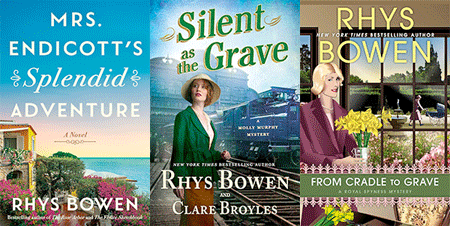
RHYS BOWEN: Best laid plans of mice and men etc...
I had plans for the last week of the year. My Christmas company departed on Sunday morning. I had planned to work with Clare to do the final polish on Molly 24, so that we turn it in on at the beginning of the year.
Actually I had planned to work with Clare while she was with us for a week. But the day before the family arrived I came down with a horrible respiratory infection. Not Covid. Not flu or RSV. But coughing my head off and fatigue. It was all I could do to show up and look joyful all week. John, meanwhile had been battling his own respiratory thing. We got through the holidays. My family was wonderful and did everything. Then on the day they left John ran a fever of 102. I rushed him to emergency and he has pneumonia in both lungs. He's in hospital, having IV antibiotics, breathing treatments etc. And I'm siting in a cold hospital room, not able to do much.
So that's where I am. I have time. I have quet. I could be working more. I have to do final edits on the next Royal Spyness book, but I don't seem to have the energy. So I thought I'd start my new stand-alone, which I've been looking forward to tackling. Then I had to make the decision: do I start it in the present, which is the main story line, or do I put in a teaser from the past, which will give clues to what we are discovering in the present?
The story is about an expert in atiquarian books who has been hired to value a library of an English stately home. She finds a book printed in 1460 which seems to have been written by a nun at the priory which stood on the land of the current house. So we are seeing stories unfold in the present and in 1460.
So how do I write this? Write the whole of the 1460 story and then the other one, which is what I did for the Tuscan Child, or let both unfold as we go, which is what I did for the Venice Sketchbook?
I am asking for feedback. when you start a new book do you like to get a teaser, as I have just done for my upcoming stand alone, which is now called THE CASTLE IN THE GLEN.
OR....
Do you like to plunge straight into the main story and get going with the characters we are going to follow?
Let me know.
And to remind you, this is how the Castle in the Glen begins...
From The Wild Girl, Inspector Melrose’s First Case.
By Iris Blackburn.
The Isle of Skye, autumn 1932
Flora was the name her mother had given her at birth, but her mother had died before the child reached five years, a wee scrap of a bairn, and in the village of Dun Akyn she was known only as The Wild Girl. Her father was a fisherman, out at sea long hours at a time and Flora learned quickly how to fend for herself. She helped herself to eggs from those who kept chickens. She begged a roll or two from the baker. The kind folk in the village left a bowl of soup out for her and their own children’s outgrown clothing. She went to school when she felt like it but was most often seen running barefoot across the heather, or splashing in the tide pools, communing with the wild creatures from seals to roe deer. It was whispered that Angus MacLeod was not her father at all, but that it was one of the fairy folk, or even a storm kelpie. Whatever was true in this regard she stayed clear of the well-meaning village women who tried to take her in hand, made no friends among the village children, and could seemingly vanish in the blink of an eye like the fairy folk.
Either way she was destined to come to a bad end.
And then we move to a young woman in London in 1965.
Both stories unfold throughout the book. Fun but challenging to write as for half the book I'm writing in the style of another writer, and what's more it's not her normal style.
Ah well. Back to work. And please spare a thought for John who is gradually getting over the worst ( and for me).
And I've just realized: it's New Year's Eve. I'd completely lost track of days.
So wishing you all a very happy, healthy New Year!
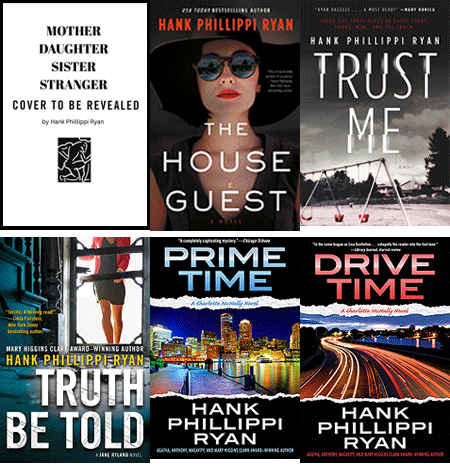
HANK PHILLIPPI RYAN: You know what I’m doing, you all? I am trying to write a synopsis. This is the worst possible project for an author. Especially someone like me who doesn’t really plan or outline or look very far ahead when I’m writing a novel. It is horrible. A complete slog.
(How do I know what's going to happen until it happens? And it doesn't happen until I write it in the book. (And this is a photo of me from a million years ago, and from the look on my face, I definitely think I am trying to write a synopsis. Even though I am on obvs on vacation, lookit that tan.)
ANYWAY. But the consensus seems to be that it would be good for me to have a full idea of the story of my next novel. And so be it. I am completely certain that it'll be worth it.
But the journey is arduous.
I have talked to my colleague Sophie Hannah about this, what a genius she is, and she had such a brilliant insight.
She said she used to feel the same way, that she was “the kind of person who could not write a synopsis. " And then at one point she thought "wait-- if I can think that, why don’t I start thinking about myself as a person who can write a synopsis!" And go from there.
Her theory was if she tried to do something that she was not comfortable doing, and it didn’t work perfectly, well, at least she made a start, and was getting experience, and was figuring out how to do it. And certainly she was better off when she started, since she had taken the chance to do something new and different.
And wow, what if it worked?
So there, Reds and Readers, is where I am now. I am pushing pushing and pushing. And I have to tell you that every day I tell myself: all I need is one more good idea. Just one idea.
I am telling myself--I can write a synopsis.
I have tried all kinds of things to make myself do this. What seems to be the most successful is I make an appointment with myself. Like: "At 1 PM, I will work for one hour, and come up with one good idea." That’s all I need. And so far, that’s kind of working. I have to be finished by this time next week.
And what this does, interestingly, is making me think about things I don’t want to put in my novel.
For instance, my husband – – who has recently come to understand that if you don’t like a book you don’t have to finish it, this is my tutelage, and I wonder what you all think about that? But anyway, he closed a book after a few chapters and said "There are way too many characters in this novel, and I can’t keep them straight."
Good point! I said. That's always annoying.
I remember in my first book, PRIME TIME, in the first draft I had a TV news photographer named Walt, and another news photographer named, I don’t know, let’s say Jimmy, and a third news photographer named let’s say Stan.
My editor said why do you need three different photographers? Why don’t you make them all one person? That will make that one character bigger and more solid and more important. And wow, she was right. And Walt the photographer became a pivotal main character for the entire series.
And, Jonathan went on to say, there are too many points of view. And multiple timelines. It was all way too complicated.
Yes, that's another synopsis question that must be faced. A single point of view? Multiple point of view? One timeline, or a dual timeline? I think about the books I love, and there’s no real pattern – – a well-written book with multiple timelines and multiple points of view can be absolutely fabulous!
As I tell my student students, “Anything can work. You just have to do it well. "
Which sounds really great, and empowering, until you are the one writing the synopsis.
So while I claw my way through this synopsis, what are your pet peeves? What are the things that will make you put a book down? Or do you slog through to the end no matter what?
For instance--I know, anything can work. But a prologue all in italics kind of stops me.
Or a prologue that is completely different in every way from Chapter 1.
Or when the person I assume is the main character because it is written in their point of view dies at the end of the prologue or chapter one. What a ripoff.
Or when a character does not ask the question that ANY reasonable person would ask. (Clearly because the author thinks that's suspenseful. It isn't.)
Pages and pages in italics, my brain wants to skip them.
How about you, Reds and Readers? What are your pet peeves? What would make you put a book down?
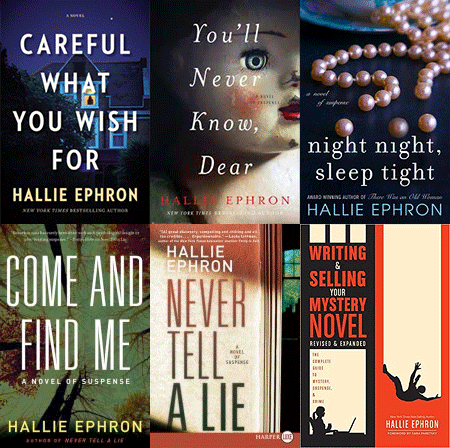
HALLIE EPHRON: Welcome, once again, to WHAT WE'RE WRITING (OR NOT) WEEK on Jungle Red...
Awhile back I started writing a story about three generations of women living in a Brooklyn brownstone. The oldest (a psychic who is in her 70s) lives on the top floor. Her daughter (in her late 40s, a psychologist) is one floor down on the parlor floor. And on the garden level and in her 20s, the granddaughter who is an influencer on social media.
Generational combat ensues.
I opened with writing with the oldest woman narrating. Easy peasy. Next chapter, her daughter, a research psychologist, takes over as narrator. And we were rolling along nicely ...
But when it came to writing the youngest, I hit a wall. What would she sound like? What would she notice, admire, find annoying? What would be her blind spots? Sources of irritation. And what words and phrases would she use to think about that?
The "voice" wouldn't come to me.
So I put the work aside. Realizing I needed to rethink the premise... maybe the two older women live above a cat cafe and a whole host of weirdos, animal and otherwise, live on the garden floor? That, or talk to a whole lot more Gen Z influencers.
The wisdom of this was validated recently as I read the many articles that have been coming out as we approach the new year, cataloguing recently coined turns of phrase and vocabulary of Generation Z. I am... to use a phrase from some past generation... clueless.
So would you be as lost as I am, trying the write convincing Gen-Z-speak?
Here's your quiz... What terms in PART A go with the descriptions in PART B? (Answers are below.) PART A - Terms
1. CHOPPED
2. SHREK - SHREKKING
3. AURA FARMING
4. 6-7
5. BALLERINA CAPUCCINA
6. GEN Z STARE
7. RAGE BAIT
8. LOCKING IN
PART B - Definitions
A. Rude slang term for dating people who are perceived not to be on par with their mates
B. An intense-focus state of someone bent on reaching a goal.
C. Gen Alpha's favorite series of numbers
D. You would not want someone using this term to describe your appearance.
E. A member of the Italian brain rot crew, an absurd group of A.I.-generated characters (in a meme that flooded TikTok)
F. A condescending blank stare that GEN Zers give to comments that they deem unworthy of responding to
G. Someone who does something repetitive to look cool
H. Attention seeking online behavior
For the answers scroll down...
Scroll down..
Scroll down...
Scroll down... ANSWERS
1. CHOPPED (D)
2. SHREK - SHREKKING (A)
3. AURA FARMING (G)
4. 6-7 (C)
5. BALLERINA CAPUCCINA (E)
6. GEN Z STARE (F)
7. RAGE BAIT (H)
8. LOCKING IN (B)
So how'd you do?
And what weird expressions did you grow up with that would baffle today's twenty-somethings?
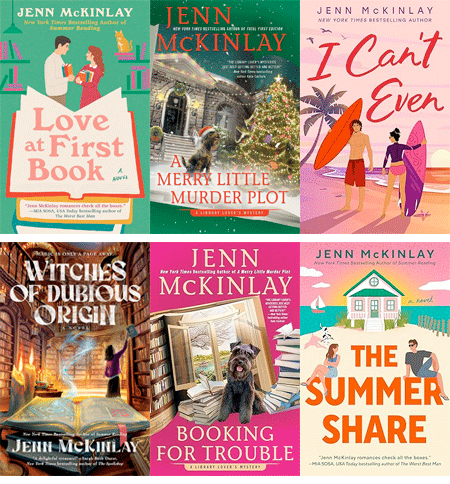
Jenn McKinlay: I have a confession to make. It’s embarrassing. I probably
should keep it to myself but we’re all friends, right? I know you won’t judge
me. So here it is.
*Jenn takes a deep breath*
If you put “Limited Edition” on a food item, I will 100% buy
it. I know, I know, I should have more willpower. I should be stronger and not
so easily manipulated by Madison Avenue and their marketing shenanigans
but…but…what if I miss something truly spectacular? It’s LIMITED EDITION -- what if I
never get to try it and my life spirals into an abyss of sad because I missed
out on the one thing that would make life worth living?
I see you shaking your head. You think I’m being dramatic,
well, let me prove you wrong. Snickers came out with a limited edition pecan
snickers and it was so good I bought the store out. Completely out.
I texted my candy freak
bestie so that she didn’t miss out, because I’m thoughtful like that. Well, yes,
by the time the limited edition disappeared, I did have to pay my dentist an
exorbitant amount of money for some fillings. No, I’m not saying the pecan
Snickers is the reason I am now looking at an implant but I’m not not saying it
either.
Now there have been some real clunkers and you’d think I’d
learn my lesson but how was I supposed to know that ketchup flavored Doritos
would be terrible. Okay, yes, a person with willpower and common sense would
know but that clearly ain’t me.
As I’m writing this I am noshing a package of Selena Gomez
inspired cinnamon Oreos. Yes, they’re limited edition. And, y’all, they are
next level. See? How sad would my Saturday night have been if I hadn’t grabbed them? Wicked sad!
Confess, Reds and Readers, are you a sucker for limited edition? What items have you loved or hated?
JENN McKINLAY: It took me 15 years to finish this %$#@!&^%$# skull scarf for Hooligan 1, but I did it just in time for his 25th birthday. Y'all, I don't think I've ever felt such a sense of accomplishment in my life.
How did I get myself into this, you ask? Maybe you didn't. I'll tell you anyway.
I decided to teach myself to knit in 2008. I made a bunch of simple scarfs, very fun, but then wanted a challenge. While looking through patterns one day, Hooligan 1 saw this one and asked if I'd make it for him. "Sure!" I said WAY TOO CONFIDENTLY. I bought the pattern off the Ravelry website and bought the yarn and set to work. At the same time, Otto our salt and pepper schnauzer entered our lives.
I had gotten a good start on the scarf when Otto got into my yarn basket and as the Hub said when he found him, "I didn't know where the dog started and the yarn began and vice versa." Mercifully, the puppy didn't strangle himself. The destroyed project was ripped out and put on a shelf and promptly forgotten about. A few years later, I found it and started again assured that the puppy who now had his buddy Annie as a playmate would stay out of it. They did.
But here's the thing. THOSE STITCHES ARE TINY.
This frigging scarf took FOREVER!!! I'd pick it up and work on it a little bit through the year and then put it down to work on more interesting projects. It became a running joke between me and H1 as to whether or not I'd ever finish it. Then I was cleaning my office, found it again, and realized I was 30 rows from finishing. Newly motivated I spent the week before his birthday working on it. Maybe four hours of work in total. WHY didn't I get this done years ago? Argh!!!
Needless to say, H1 was surprised and pleased and I was relieved. Seriously, achievement unlocked, as the gamers say, and I will never knit anything with those teeny tiny stitches ever again!
So, fess up, Reds and Readers, what's a project you put off forever and then it took no time to finish?
Jenn McKinlay: During the school break after every holiday, there would come the dreaded day that my mom would pull out the list of gifts we'd received from family, a pack of stationary, and a couple of pens. My brother and I would then take up residence at the kitchen table until every thank you note had been written.
Not gonna lie, when there were snowball fights to be had, our sledding hill was beckoning, and the ice on the lake had just frozen over enough to skate on, being forced to stay inside and write thank you notes was sheer torture. It took us forever!
Now that I'm a full time writer, I laugh at ten year old me. Writing a heartfelt thank you is a no brainer (thanks, Mom!) and I can't believe I was ever so resistant. The Hooligans were given the same task as kids and I'm pleased that while they don't use stationary and stamps anymore, they always text thank you messages to people who've given them gifts or helped them out in some way.
Mostly, any thank yous I get these days are in text or email form. I'm okay with that, I mean, it does save trees but there is something extra special about getting a thank you card in the mail. Frankly, it feels a bit more sincere.
How about you, Reds and Readers, what's your take on thank you notes?
Christmas Tree from books. All the rage, apparently.
Happy Holidays from all of us at Jungle Red! 🎄✨
During this holiday season, we’re sending you warm wishes wrapped in gratitude. Thank you for popping in to spend part of your day with us—for reading, commenting, recommending books, welcoming our visitors, and being the kind of community that makes stories matter even more.
Whether today finds you surrounded by family, sneaking a quiet moment with a book, or enjoying a peaceful day to yourself while enjoying a great read, we hope it brings comfort, joy, and a little sparkle. We’re endlessly grateful for your support, your enthusiasm, and your love of stories in all their cozy, thrilling, and heartfelt forms.
May your coffee or tea stay hot, your books be unputdownable, and your new year be filled with many wonderful stories.
With love and holiday cheer, The Jungle Red Writers ❤️📚
P.S. Does anyone want to attempt to make a Christmas tree from books? I can only imagine what my 5 cats would do to it. Eep!
Jenn McKinlay: There was a long running mystery in my house growing up. My grandparents received a fruitcake--the classic Collin Street Bakery fruitcake in the iconic tin--every holiday season. It was addressed to my grandfather John P. Norris but there was never any indication of who sent it. My grandfather passed away in 1962 (years before I was born) but the fruitcake kept on coming.
My grandmother would bring it to our house every Christmas and so I began to associate this tin and its contents with Christmas. In her later years, my grandmother moved to Arizona, leaving her house to my mom and still the fruitcake kept coming even while the house was empty.
The only person who enjoyed it was my brother so he ate the lion's share. I tried it every year but never warmed up to the taste, although now I'm wondering if I should try it again just for nostalgia's sake.
Eventually, my mom sold her house and downsized into the house her parents had built. And, yes, the fruitcake kept coming.
My mother, being a librarian, naturally tried to solve the mystery of who was sending the fruitcake. She could never track them down. But then, one year in the early 2000's, the fruitcake stopped coming. My brother was the only one who missed the cake while I missed having the holiday mystery of who had been so fond of my grandfather that he/she/they continued to send him a fruitcake every holiday for forty years after he'd passed. May we all leave behind such a positive impression when we depart this mortal coil that our loved ones receive cake for decades after our departure.
How about you, Reds and Readers, any holiday mysteries to share? And what's your take on fruitcake? Thumbs up or down?
JENN MCKINLAY: When I was about seven years old, I remember cornering my dad and asking him point blank. "Is Santa Claus real?"
We were standing in his studio (Pop was an artist) and he cupped his chin and pondered my questions while I quivered in anticipation of his answer. My friends told me Santa was fake, but the dewy eyed child inside of me wanted to believe in magic and kept the story of the "right jolly old elf" clutched in her pudgy little hand. Finally, after what seemed like days in child time but was mere seconds in adult time, my dad met my gaze and said, "If you don't believe, you don't receive."
I was rocked back on my heels. Had Pop just given me the secret? Did the kids who didn't believe stop receiving and that's why they thought they were right? Hallelujah! I hugged him tight and assured him that I most definitely did believe.
Fast forward twenty-eight years when I had my own dewy eyed little hooligans and I'm a guest at a wedding right before the holidays, sitting with a bunch of moms discussing holiday stuff. One mom addresses the group of us and declares that if you LIE to your child about Santa, you're breaking trust with them, they'll never believe you about anything, you're a terrible mother, and your children will abandon you to your throne of lies once they grow up. If her goal was to end the conversation between moms, she did a bang up job. I don't think any of us made eye contact after that judgement grenade and we all quickly scuttled off to find our spouses.
See, here's the thing with Hub and me. We fairy-taled the shizzle out of the boys' childhoods. Not only did we keep the Santa myth going until they were 9 and 10 respectively, no small achievement with the internet and whatnot, but we made up tall tales about everything.
When they came with me to the post office to mail packages, I told them the postal workers attached wings to the boxes and launched them. Then we stood in the parking lot, checking the skies for our packages winging their way to wherever. People thought we were deranged. Hilarious! Hub's classic was to tell the boys we adopted them from monkey island at the Phoenix Zoo but we had to remove their tails so they could leave. Those boys spent a lot of time checking their backsides to see if their tails were growing back. We also told them the piped in music at the grocery store was for people to dance while they shopped and then we had "dance breaks" in the middle of the aisle. And that's just a few of the more memorable ones. Good times!
We never discussed or planned the whoppers we told our kids. It came to us in the moment and we went with it. We both believed that the magic of being a kid and the joy of childhood should be encouraged in every possible way even if it meant...fibbing.
I don't know what happened to that mama or what her relationship with her kids is. I hope it's what she wanted. But I do know that Hub and I are besties with the Hooligans and I like to think it's because they appreciate that we worked really hard to make their childhood something special.
How about you, Reds and Readers? Where do you stand on the magic of believing versus the brutal truth at all times? Did your family have any particular tall tales that you remember fondly?
JENN McKINLAYI married into my hair stylist. I know it sounds weird, but Ben the hair wizard started cutting the Hub's hair when Hub was eighteen. Hub is just shy of sixty now so that's a very long relationship between a man and his hair guy. When I married the Hub, Ben became my hair wizard, too. Naturally, when the Hooligans came along, they got their first haircuts with Ben and remained his clients until they moved away from home.
A few months ago, Ben told us he and his wife Barb, also a hair stylist, were retiring. We were thrilled for them but a bit bereft for us. We have known them for decades. We didn’t even have to explain the cut or in my case the color that we wanted, because they knew. Getting a haircut at Ben and Barb's was like visiting family. I even wrote them into one of my books WAIT FOR IT.
Hub and I had our final haircuts with them last week, and it was a surprisingly emotional experience even though I know we'll see them again at one of Hub's gigs or when we get together at their place up north. Still, it was the end of an hair-a and I'm pretty bummed.
How about you, Reds, have you ever had to say good-bye to a professional that you've known forever -- hairdresser, mechanic, accountant -- an wondered, well, shoot, now what am I going to do?
LUCY BURDETTE: That’s a long hair relationship! I hate when that happens! Here’s the thing I dread the most: losing my dental hygienist. Trudy’s been taking care of my teeth since I moved to New Haven in 1984 and she does the best job. She’s a little older than me, so it wouldn’t be unreasonable for her to retire…but I beg her every time I see her and she assures me all is well. We know all about each other’s families, and we chat about books and Broadway shows, even though it’s not that easy to talk with your mouth full of equipment. She stops in at all my Connecticut booksignings. Oh Trudy, please don’t leave me!
HALLIE EPHRON: Recently my primary care physician retired. My first criteria, aside from competence, was AGE! I wanted someone much younger than me. My new PCP is just a few years out of medical school. Youth was my #1 criteria when I had to be assigned a new editor at HarperCollins. (Sadly, publishing houses are known for laying off their oldest and most experienced editors.) I also miss my mechanics – brothers (Brian and Greg) and before them their dad (Mr. Egan) who owned my local Sunoco station. I’d put them in one of my books and brought over a signed copy. Marching into the future, kicking and screaming.
HANK PHILLIPPI RYAN: Oh, Jenn, this is SUCH a thing! First, my primary care physician retired, she was so great, and we had been together for gosh, so many years? I mean, I know I got older, but she was not allowed to. Think of the history. She’s seen me go from 36 to 76. I mean–that is a process!
The replacement is a version of how the original was, she’s fine. But it’s a different relationship. Although she probably knows newer things–I guess. What’s “standard” is certainly different, for better and for worse.
My dentist recently informed me he was retiring, too, SHEESH. And he is enthusiastic about the person who is taking over the practice. “You’ll love her,” he says. We shall see.
And yeah, even my dermatologist, who is famous and fabulous? Yup, gonzo in three months.
But if my hair guy retires, I’m just going to stay out of the public eye for the rest of my life. Clearly there is no other option.
RHYS BOWEN: I am still in recovery mode from my hairdresser going back to Thailand with no warning after twenty plus years. I’ve tried two people since. Both disappointing. I may have to fly to Thailand! And my doctor is getting on in years too. John’s is retiring at the end of the year and a new, young concierge is double the price. If my house cleaner stops working I’ll be in despair!
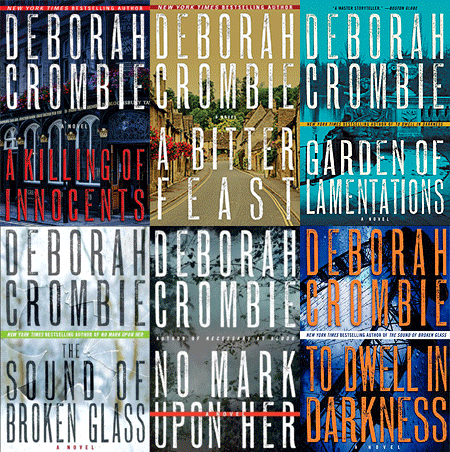
DEBORAH CROMBIE: Jenn, losing your hair person is the worst! Or quitting your hair person. I stopped going to my long-time stylist, who was also a friend, during covid, when she wouldn’t get vaccinated. And then, when I’d cut my own hair for a year (argh) it would have felt really weird to go back, as well as still unsafe. So I found a new stylist, who has since moved to another salon and I drive 30 minutes to get my hair cut!
But the worst is losing your primary care doctor. Ours, who had been our doctor for 18 years, moved to Missouri last year. He was also a neighbor, and he even made housecalls! We miss him so much. The new doctor is very nice but it takes years to build a relationship.
JULIA SPENCER-FLEMING: You may have noticed my hair is always up in a bun these days. I'm hoping it makes me look like a stern Latin professor at a women's college in Oxford, but I fear it really just reads "Granny who makes biscuits." The reason I haven't cut it is because during the pandemic my hairdresser, whom I had found after going from place to place for several years, left the state! The nerve of her, to go get married and move in with her new husband.
I've been waiting for the energy to find a new stylist, but honestly, I found the right place to get my Shih Tzus groomed, and that may be as far as it goes. (The groomer is only in his twenties; I'm hoping the dogs and I will all be in the ground before he retires.)
How about you, Readers? Have you lost any professionals in your life that you can't replace?
JULIA SPENCER-FLEMING: I hope the rest of you are feeling as pleased as I am - presents purchased, decorating sorted (Virginia's doing it) meal planned and festive outing in the works. If you've been very good this year, you undoubtedly deserve some sugar plums this holiday - plus, making them is a delightful activity for you and your friend or nibling or grandchild.
Good morning everyone and I wish you all the Compliments of
this Happy Season! Julia has again invited me to talk about food and my living
experiences here in Sudbury. In fact I have moved, with the help of friends
enough furniture down from Maine that I fear I won’t recognize my home when I
next visit. But let’s get on what has been happening not to mention making some
delicious Sugar Plums.
My Social Media has been full of Nutcracker related photos and
stories beginning with the adorable photos of Debs with her granddaughter at
their local performance of the Nutcracker and how much they had enjoyed the
performance looking at their smiles. Another friend who is of grandfather
status wrote about attending his 1632nd performance of his granddaughter who
has two leading roles this year. One as the Mother Ginger first child and the
second as the porcelain doll in a beautiful costume which made it into our
local paper. I think she isn’t even thirteen yet. But she is totally committed
to her life as a dancer. I wonder she will pursue this dream into
adulthood? But I think I would give her grandfather the longevity prize for
faithful attendance. There is something rather awe-inspiring watching a
group of children completely devoted to their art.
I had that pleasure this past week as a group of middle
schoolers from a local prep school came to bring the musical holidays to my
assisted living space. I can’t get out to go to the many holiday concerts as
Victor and I did in the past, so this was a special treat. I have to admit I
did wonder if we would be treated to a performance of the dreaded Christmas
pops but that was not the case. I sat and listened to trios, quartets, an eight
handed piano piece. I loved watching these teen kids finish their performance
with a rousing rendition of the Trepak dance from the Nutcracker which they
played with considerable brio. What a joy to see their dedication to serious
music. I was asked if I played an instrument.My short answer is No! But I have
another response which is my truth -My role is to be an audience to whichever
muse calls to me. As I told the young musicians, “Every performer needs
an audience”, to which they agreed. So whatever activity appeals to the
child in your life I believe it is most worthwhile to help them achieve
it.
But it is time to address our main topic - Christmas Food.
Last year I introduced you to the sugar plums that we can eat while dancing
should one wish. As I wrote last year I found a recipe hiding among my many
food notes with the heading “Sugarplums”, Courtesy of Eleanor Watson.
“Goodness, Eleanor Watson one of the best loved and remembered
people in Limerick, Maine. We were invited to her Christmas gathering the first
year we moved here. She lived in a beautiful old house, pre Victorian I think.
Would that make it Empire, Revolutionary or Federal? I’m not much good on the
history of architecture. However there were open fire places with burning logs
to warm us, a colonial kitchen and rooms filled with antique furniture which
she showed off to me seeing my interest. She is another person I miss and wish
I had asked her for stories. But on the kitchen table, along with her delicious
food, was this gift of a recipe card for the taking”.
Julia and I agreed that one can never have too many sugar
plums in ones life. So I offer you sugar plums to make and share with friends,
to enjoy through the Holidays or as I love to entertain on Twelvth Night these
make an excellent addition for dessert
Now I had never made Sugarplums before last year, but with a
food processor anything is possible. Eleanor said her recipe made a hundred
pieces of deliciousness, but as Julia and I found Eleanor’s quantities made
many more than one hundred.so I recommend you half the recipe unless you are
making gifts for a crowd. I also did a little research online and adding or
omitting ingredients seems to be par for the course. I plan to measure the
total liquid which will give me an idea of how much liquid is needed for the
amount of dry ingredients. I plan to add some dried cranberries and cherries
too. This recipe doesn’t have any spices in it so I will add a little of my
favorite spices as well.
SUGARPLUMS - Courtesy of Eleanor Watson
1 lb. chopped figs
1 lb. chopped dates
1 lb. chopped raisins - I am using golden raisins or sultanas
(their English name)
1 lb. currents - I am omitting as couldn’t find them but will
add cranberries and cherries here
Chop all finely in the Food Processor - set aside
1 lb. chopped blanched almonds
1 lb. chopped unsalted, shelled pistachio nuts (I will not use
pistachios but make the weight up with other nuts.)
1/2 lb. chopped walnuts
1/2 lb. chopped pecans
Chop nuts in Food Processor - set aside
1/2 lb. shredded coconut
1/2 lb. crystallized ginger
Juice & grated rind of 1 orange
Juice & grated rind of 1 lemon
2 Tbsp - good sherry***
1 oz. - orange or peach brandy
Granulated sugar for rolling - let the deliciousness commence.
MY UPDATED RECIPE
I am weighing my dried fruit based on the total amount in
Eleanor’s recipe which is 4 pounds of fruit. My measurements are not exactly
halved as I changed them while I was prepping.
My ingredients*** are:
2 3/4 lb. mixed dried fruit -approximate weight
1/4 lb. figs
1/4 lb. dates without pits
1 1/2 lb. Mixed raisins and golden raisins (sultanas)
1/2 lb. cranberries
1 oz + dried orange slices (optional)
1/4 lb. cherries
1 1/2 lb. Mixed nuts, walnuts, almonds, pecans - I used what I
had. Just check none of the nuts are rancid not freshly purchased . (Nuts are
best stored in a freezer).
8 oz shredded coconut
4 oz. crystallized ginger
1 tsp. cardamom
1/2 tsp. each nutmeg and mace
Juice and grated rind of one orange and one lemon = about 1/3
cup, just enough to moisten
1/4 Cup Cointreau or other liquor
I shall make some with extra fruit juice as not everyone likes
alcohol but I shall do some with Grand Marnier or Cointreau added in place of
the sherry and fruit brandies.
METHOD:
Measure all the ingredients but keep the fruit and nuts
separate, see below. If you don’t have a scale I suggest you buy the fruits and
use the measurements on the bag to approximate the amounts. I don’t think an
extra oz or so will hurt the recipe
Put the nuts, coconut and crystallized ginger together with
any spices you like in the Food Processor and pulse several times to chop
finely
Scrape into a bowl
Add and pulse the dried fruits and grated orange and lemon
rind in the FP.
Add the chopped nuts and pulse to mix
Even though I have a 12 cup bowel on my FP and my Ninja cup is
a little smaller, I had to half the quantities again before being able to mix
the fruit, nuts mix and liquid together. This is where a digital scale comes in
handy as you can place an empty bowl on the scale, adjust the weight back to
zero then add ingredients. To finish I had two bowls weighing about one and a
half pounds each to role into the sugarplums.
Depending on your quantity, now is the time to divide in half
before mixing together and adding in the liquid through the funnel. I added a
little at a time until the mix gathered on the blade. I don’t think it should
be too wet.
Now for the fun part. Set up a plate with sugar on it and a
plate with waxed paper to place the candies. Wet your hands and take a melon
sized amount or slightly larger and roll into a ball, then roll in the sugar
for that sparkle and set on a plate. If giving as gifts pack into a wax paper
lined box with wax paper between the layers of sugarplums. I bought mini cup
cake holders, which was a good way to present the sugar plums.
The final note: allow to sit in the fridge or a cold place for
several days for the flavors to blend and add to the joy of eating a sugarplum.
Plus, it’s Gluten Free!
I have simplified Eleanor’s process by adding the spices,
coconut and ginger to the nuts, and grating the rind onto the pile of dried
fruit
Did you make sugar plums last year or since you got the
recipe? Do please let me know how they turned out.
Jungle Red Writers has been named one of the top 101 Best Websites for Writers by Writers Digest, one of the top 50 mystery blogs by CourtReporter, and one of the top 100 creative writing blogs by Best Colleges Online


.jpg)