Maycomb was ...a tired old town. In rainy weather the streets turned to red slop; grass grew on the sidewalks, the courthouse sagged in the square. Somehow it was hotter then....men's stiff collars wilted by nine in the morning. Ladies bathed before noon, after their three o'clock naps, and by nightfall were like soft teacakes with frostings of sweat and sweet talcum.
****To Kill a Mockingbird by Harper Lee
RO:
Maybe I'm obsessing about the weather because its May and I'm still freezing, but I can't help but notice how seamlessly some writers weave weather details into their stories. Since my amateur sleuth is a gardener, a certain amount of weather info is integral to the story, but I'm very self-conscious when I do it. As if it's something I learned in Writing 101, "always put the weather in." Without a legitimate narrative reason for it (i.e., story revolves around a storm, flood, etc.)do you generally use weather to help create a mood in your books? And how do you do it, so that it doesn't sound like an interruption, or latebreaking news from The Weather Channel?
HANK:
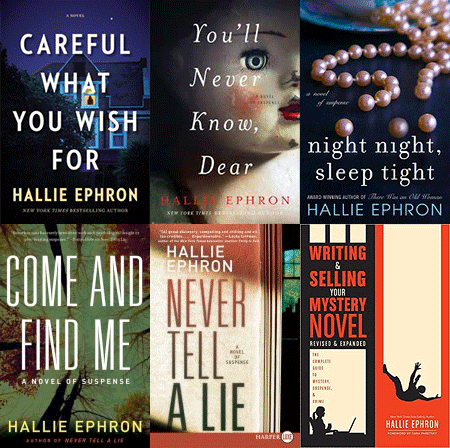
And do people just skip the weather parts? Reporters--like my main character, and (cough) like me--always have to know what the weather is. So she checks to see if it's going to rain during her live shot, making her mascara run and blowing her hair around so it sticks to her lipstick, or if she needs snow boots, or whether the sun is going to be a lighting asset or detriment. Hallie says to plague your characters with discomfort (See Hallie? I use your book every day...)and the weather can be a cold wet stormy windy obstacle. ((And let me just say: if you had the idea for an all-weather channel, say, ten years ago, would you have thought it could possibly work? Do people really sit and watch the weather?))
RO:
That's right..I remember her saying that at her workshop at Crimebake. I did buy the book Hallie...btw I loved that workshop. Really got a lot out of it.
HALLIE:
I think weather is great when it's part of the plot, or when you use it show something about your character (Hank's example) -- in other words, it's there for a reason...also useful for showing the passage of time in an artful way ("the rain had stopped and stars twinkled...") But woe to those who forget Elmore Leonard's writing rule #1: "Never open a book with weather. If it’s only to create atmosphere, and not a character’s reaction to the weather, you don’t want to go on too long. The reader is apt to leaf ahead looking for people." (see http://www.elmoreleonard.com/) On the other hand (there's always one in writing)...for a great weather opening, see Tony Hillerman's "Listening Woman."
It is hard, as Ro points out, to write it so it's not a cliche or a news bulletin.
JAN:
I agree with Hallie. Unless the weather is a part of the plot or critical to character, it's incidental. IE. boring. I struggle to put it in sometimes, too, because I'm trying to make the environment real. But most likely, if it's a struggle, it doesn't belong there.
HANK:
But when it's real, people love weather. What it's going to be like tomorrow? What's the weather where Mom is? I read somewhere they have a computer program that will flawlessly predict the weather. Problem is, its so complicated that by the time it makes the prediction, the weather has already happened. (Off the topic, I know.) But you know, I've edited several books for fellow authors. And I'm always writing in the margin-is it hot? Cold? Raining? Remember, it's July. Or something like that. So we miss it when it's missing.
RO: I'm still cold...maybe I should set my next book in the Virgin Islands instead of Connecticut.
Monday, May 7, 2007


Wednesday, May 2, 2007
ON KILLER BOOKS
"Who better to pick the best mystery books of the month than the people who run mystery bookstores?"
And this just in: today, they picked our Jan! Yesterday's Fatal was named a "Killer Book" for May by the Independent Mystery Booksellers Association. (We've thought YF was a killer book all along, but it's fantastic to have such huge recognition. Check the website above for the whole scoop.)
But first, Jan--take the floor, er, blog.
JAN:
I definitely have too much anxiety when a new book comes out. Sometimes it seems like even childbirth was easier, but that good news today (the day after the book offically came out)that sure helps alleviate the stress.
This means a lot to me since we all know that the only way a mystery author makes it is with the backing of the independent bookstore owners who take the time to read and recommend our books.
I have Robin Agnew, owner of Aunt Agatha's Bookstore in Ann Arbor, Michigan to thank for the nomination.
HANK, RO and HALLIE, interrupting:
Here's a photo of Robin (left) and Jan! Thank you, Robin, for choosing Jan.
Here's a photo of Robin (left) and Jan! Thank you, Robin, for choosing Jan.

Ok, back to you, Jan.
JAN:
My heroine, Hallie Ahern, is terribly flawed, which some people like and some people don't. Lucky for me, Robin liked it. She also pointed out something that was eluding me: Hallie was bumping up against a gender bias in mysteries.
Male protaganists were allowed to have all sorts of weaknesses, but female sleuths were supposed to be perfect superheroes. Yuck, I hate flawless superheroes, male or female. Anyway, if feels good to be appreciated. And I also have to thank my agent, Dan Mandel, for pushing me to travel to bookstores in different parts of the country.
HANK, RO and HALLIE, interrupting: Here's a photo of Dan! Yay, Dan.

OK, back to you, Jan.
JAN:
Mystery bookstore owners can't possibly read all the mysteries that are out there. They sometimes discover your work because you've taken the time to visit.
HANK, RO AND HALLIE, interrupting:
Here's a photo of another great independent book store with a wonderful proprietor Kate Mattes' "Kate's Mystery Bookstore" in Cambridge, Massachusetts. Hank's upper left getting ready to talk (as usual), and Hallie is in the front. That's also Roberta Isleib, Ruth McCarty and Cathy Cairns, all moguls in Sisters in Crime, and all happy for Jan!
JAN:
Anyway, I'm very grateful. And thrilled. And about to go on the road. Check my website for the latest events--and hope to see all of you.
HANK, RO and HALLIE, interrupting:
Congratulations! ( And to find out more, click on Jan's cover--right over there>>>
We now return you to our regular blog.
Tuesday, May 1, 2007
ON PERSUASION
Booksellers usually view the dinners as a grand gesture by the publisher, said Paul Yamazaki, the chief book buyer at City Lights.
“What they’re trying to do is make a statement about the book,” he said. “They want you to go read it, and it gives them another five minutes. But you can’t manufacture these things. If it doesn’t work, it doesn’t work, and the book has to deliver,” he said. “Ultimately it’s about the book.”
*** The New York Times "Pushing A New Writer"
HANK:
Would you buy my book if I bought you dinner? Lunch? A drink? A recent article in the New York Times reveals the latest trend in publishing publicity methods, called "pre-publication tours," where a new author is carted around the country by the publisher and shown off to book buyers at fancy dinners and events. The theory is once the buyers meet the author, they will be so smitten and overcome by the attention that they'll purchase many more books than usual and then promote them to their eager-to-buy customers.
Now let's be clear. As my mother always says: "This is not a criticism. It's an observation." If the wonderful people at Harlequin want to escort me--anytime!-- on a cross-country tour to promote my new book, I'm definitely on board. Maybe after a few glasses of wine and some cherries jubilee, I'm a bestseller. Sounds nice.
But I've got to say--all the book buyers I've talked to ain't gonna be convinced by a couple glasses of Chateau Lafitte or some gingered sea bass.
On the other hand, what if the pre-pub tour really starts the buzz? (Maybe it could work. And there's no question if you meet an author, you feel some connection to them. Can't hurt. And certainly PR works. And ads. And going to bookstores. And I'll be doing all that. And I hope to meet all of you!)
Or do you think it's as the book buyer above says--it's ultimately about "the book"?
Can a flashy promo campaign make a mediocre into a moneymaker?
JAN:
I once heard that in order to become a bestseller, a book has to be "best selling" in its initial few weeks. If that's true, then it's actually impossible for word-of-mouth to do the job and the only WAY a book can get there, unless you are Ross Perot, is if the publisher puts its money, right up front, into making it a bestseller. Whether the publisher does this by buying premium display space at B&N and Borders, or by pre-publicity dinners, it doesn't change the bottom line: The publisher makes it happen. I'm not sure if that view makes me cynical or a realist, but I think that's the book biz.
RO:
As my husband (a 40 yr veteran of the book business) is fond of saying - and I hate it when he does - it's both. There are plenty of mediocre books that are moneymakers, and plenty of great books that not enough people know about (will someone please make the wonderful Robert Hellenga a household name?)
No one is going to buy my book simply on the strength of a party, a drink, or a tcotchke. But, let's face it, with all due respect to those that claim they do, very few retail buyers actually have the time to read all the books they are sent. They couldn't possibly, with hundreds of books being published every day. Given that reality, I'm up for almost anything that helps someone remember me or the name of my book. And I don't expect the publisher to do it all. They're already rolling the dice on me. I'll supplement their efforts anyway I can in the runup to publication. Maybe it'll work and maybe it won't, but I'm a newcomer. For me, it's about surpassing expectations - not necessarily making The New York Times bestseller list. (It should only happen...)
Anyone read JA Konrath's Newbie's Guide to Publishing? http://jakonrath.blogspot.com/. Or Jackie Deval's paperback, Publicize Your Book? Great ideas, and they don't all cost a fortune.
HALLIE:
Ro says: "It's about surpassing expectations." Here, here!
So, the question is, as an author, are you selling yourself or are you selling your book, and is there a difference? Most bookstores that have author events want us to chat, tell amusing stories, share the inside scoop on how we wrote our book, not read from it for 40 minutes straight. Snore. The assumption is if the customer likes YOU, they'll buy your book. Obviously the publishers are taking the same tack with booksellers.
And Hank, in answer to your question, if you buy me lunch or dinner YES I'll buy your book. Do I get to pick the place??
RO: Can I come too?
HANK:
Okay, sounds like fun. Dinner for everyone. Hallie, sure, you can pick. Then everyone buys books. And I promise not to read out loud. (Unless there's a huge clamor to hear the really good parts.) What a great evening that'll be!
PS FROM HANK: Oh, one more thing. Boston's own Grub Street is having a fantastic seminar called "Muse and the Marketplace" May 5-6 with luminaries like Margot Livesey, Gregory Maguire and Sue Miller. www.museandthemarketplace.com Turns out, I'm on a panel about publicizing your book! So hey--we'd love to see you all there. Otherwise, I'm gonna find out all the secrets...
“What they’re trying to do is make a statement about the book,” he said. “They want you to go read it, and it gives them another five minutes. But you can’t manufacture these things. If it doesn’t work, it doesn’t work, and the book has to deliver,” he said. “Ultimately it’s about the book.”
*** The New York Times "Pushing A New Writer"
HANK:
Would you buy my book if I bought you dinner? Lunch? A drink? A recent article in the New York Times reveals the latest trend in publishing publicity methods, called "pre-publication tours," where a new author is carted around the country by the publisher and shown off to book buyers at fancy dinners and events. The theory is once the buyers meet the author, they will be so smitten and overcome by the attention that they'll purchase many more books than usual and then promote them to their eager-to-buy customers.
Now let's be clear. As my mother always says: "This is not a criticism. It's an observation." If the wonderful people at Harlequin want to escort me--anytime!-- on a cross-country tour to promote my new book, I'm definitely on board. Maybe after a few glasses of wine and some cherries jubilee, I'm a bestseller. Sounds nice.
But I've got to say--all the book buyers I've talked to ain't gonna be convinced by a couple glasses of Chateau Lafitte or some gingered sea bass.
On the other hand, what if the pre-pub tour really starts the buzz? (Maybe it could work. And there's no question if you meet an author, you feel some connection to them. Can't hurt. And certainly PR works. And ads. And going to bookstores. And I'll be doing all that. And I hope to meet all of you!)
Or do you think it's as the book buyer above says--it's ultimately about "the book"?
Can a flashy promo campaign make a mediocre into a moneymaker?
JAN:
I once heard that in order to become a bestseller, a book has to be "best selling" in its initial few weeks. If that's true, then it's actually impossible for word-of-mouth to do the job and the only WAY a book can get there, unless you are Ross Perot, is if the publisher puts its money, right up front, into making it a bestseller. Whether the publisher does this by buying premium display space at B&N and Borders, or by pre-publicity dinners, it doesn't change the bottom line: The publisher makes it happen. I'm not sure if that view makes me cynical or a realist, but I think that's the book biz.
RO:
As my husband (a 40 yr veteran of the book business) is fond of saying - and I hate it when he does - it's both. There are plenty of mediocre books that are moneymakers, and plenty of great books that not enough people know about (will someone please make the wonderful Robert Hellenga a household name?)
No one is going to buy my book simply on the strength of a party, a drink, or a tcotchke. But, let's face it, with all due respect to those that claim they do, very few retail buyers actually have the time to read all the books they are sent. They couldn't possibly, with hundreds of books being published every day. Given that reality, I'm up for almost anything that helps someone remember me or the name of my book. And I don't expect the publisher to do it all. They're already rolling the dice on me. I'll supplement their efforts anyway I can in the runup to publication. Maybe it'll work and maybe it won't, but I'm a newcomer. For me, it's about surpassing expectations - not necessarily making The New York Times bestseller list. (It should only happen...)
Anyone read JA Konrath's Newbie's Guide to Publishing? http://jakonrath.blogspot.com/. Or Jackie Deval's paperback, Publicize Your Book? Great ideas, and they don't all cost a fortune.
HALLIE:
Ro says: "It's about surpassing expectations." Here, here!
So, the question is, as an author, are you selling yourself or are you selling your book, and is there a difference? Most bookstores that have author events want us to chat, tell amusing stories, share the inside scoop on how we wrote our book, not read from it for 40 minutes straight. Snore. The assumption is if the customer likes YOU, they'll buy your book. Obviously the publishers are taking the same tack with booksellers.
And Hank, in answer to your question, if you buy me lunch or dinner YES I'll buy your book. Do I get to pick the place??
RO: Can I come too?
HANK:
Okay, sounds like fun. Dinner for everyone. Hallie, sure, you can pick. Then everyone buys books. And I promise not to read out loud. (Unless there's a huge clamor to hear the really good parts.) What a great evening that'll be!
PS FROM HANK: Oh, one more thing. Boston's own Grub Street is having a fantastic seminar called "Muse and the Marketplace" May 5-6 with luminaries like Margot Livesey, Gregory Maguire and Sue Miller. www.museandthemarketplace.com Turns out, I'm on a panel about publicizing your book! So hey--we'd love to see you all there. Otherwise, I'm gonna find out all the secrets...
Subscribe to:
Posts (Atom)