Thursday, July 12, 2012

Captain, My Captain, a guest blog by Megan Abbott


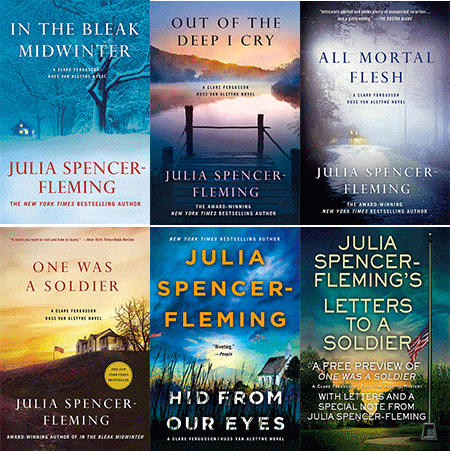
JULIA SPENCER-FLEMING: Thrillers are books involving two-fisted he-men saving the world (and a few women at the same time) right?  Well, sure, if you're Clive Cussler. Not to diss Dirk, but here on Jungle Red Writers, we like smart, subtle crime fiction that keeps us awake at night while slicing us with human insight and razor-fine writing. In other words, we like Megan Abbott.

Megan is an Edgar-Award-winning (and everything-else-nominated)  author whose fiction routinely makes it onto Best Book of the Year Lists. Whether she's writing neo-noir novels like Die A Little and Bury Me Deep, or intensely literary psychological thrillers, like The End of Everything or the upcoming Dare Me, Megan puts women's lives and their relationships with one another at the center of her work. Today, she's going to shed some personal light on the relationship between mentor and  protegee; teacher and student.


When I was in eighth grade, I was obsessed with the movie The Breakfast Club, which seemed to speak to my life in deep, resonant ways. I must have conveyed these feelings with great intensity to my beloved Advanced English teacher, Mrs. B, because somehow it came to pass that she spent one of her Sunday afternoons taking me to see the movie with her—a first viewing for her, a second for me. (It was rated R, so this was a particular coup).

I remember the experience powerfully, remember feeling so flattered by all of it. I guess I’ll never know what made her suggest it. It was not something I’d ever heard of any other teacher doing for a student. It stuck with me. It felt like I had been singled out, was special.

A few years later, while absorbed in all the mysteries and terrors of high school (far more harrowing than The Breakfast Club had warned), I learned that Mrs. B had died from breast cancer. It turned out she had been sick for several years, including when I was in her class, when we went to the movies that day. It seemed impossible—she was very young (my mom tells me now that she was only in her late thirties)—and unspeakably sad.

I vividly remember my parents telling me the news because it was during that same conversation that my dad confided that Mrs. B’s husband had died a few years before. “She’d been unhappy,” he said, probably trying to make me feel better, “for a long time.”

The surprise I felt was acute. Mrs. B was unhappy? I’d never really thought about teachers being unhappy. About grown women’s unhappiness. And I certainly never imagined any of their private struggles. Mrs. B was cool, lively, loved books and paid attention to me. That was all I’d cared about, apparently. What an awful feeling, to realize how self-absorbed you were, or are.

Lately, I’ve been thinking a lot about Mrs. B. My novel, Dare Me, is in large part about the complexities of female mentor-protégée relationship and I guess I’ve been trying to figure out why that subject has always interested me so much, even as far back as age eleven, when I was enraptured by Lois Duncan’s Daughters of Eve (a book whose twisty attitudes towards feminism you could spend a lifetime unraveling), and leading up to Dare Me, which centers on a high school cheerleading squad and their charismatic new coach

All the girls in Dare Me are fascinated by Coach, especially the main character, Addy, who idolizes her. “She was the one who showed me all the dark wonders of life,” says Addy. “Did I ever feel anything at all until she showed me what feeling meant? Pushing at the corners of her cramped world with curled fists, the fists of a little girl, she showed me what it meant to live.”

To Addy, Coach, who is young and pretty but also demanding and aloof, is a mystery she wants to unlock. She wants to be like her, wants to be her. It’s a powerful yearning, almost like a crush—maybe stronger because it’s safer. You never think you’ll get your heart broken. And you never, ever really know her life.

At age 12 or 13, I was too young (at least in the ways that matter) to think of Mrs. B as anything other than this person who gave me books, who encouraged me, who took me to see The Breakfast Club that time. There’s an inherent selfishness, greediness of the protégée, which is, I guess, about being young. Everything is about you: she’s taking me to the movies, she’s interested in me, me, me. And I never thought twice about what her life might really be like, her pains and sorrows and heartache.

But these mentors, they matter so much, don’t they? It’s the way we figure out ourselves, by imagining their lives, imagining ourselves in their lives. And then, eventually, realizing that their lives are not what we pictured, that life isn’t.

A painful revelation, usually. Because it’s one of the moments you first realize how complicated life is, how hard. But we need those moments, like we need these women (and they need us, they need to see us believing in them). It’s how we become ourselves. 


Tell us about your mentor-protegee relationship, and you may be one of two lucky commenters to win an Advance Readers Copy of Dare Me!


You can find out more about Megan Abbott and read excerpts of her books at her website. She also blogs with Sara Gran at the Abbott Gran Old Tyme Medicine Show. You can friend her on Facebook and follow her on Twitter as @MeganEAbbott

Wednesday, July 11, 2012

Gone Missing in Amish Country, a guest blog by Linda Castillo


JULIA SPENCER-FLEMING: What do you think of when you hear the word "Thriller?" International espionage? Terrorist plots? Ticking time bombs threatening thousands of lives?

Whatever you think, it probably isn't The Amish. Which is why Linda Castillo's debut novel, Sworn to Silence, set the crime fiction world on its ear. She took what should have been the coziest of settings: a three-person cop shop in a tiny Ohio town surrounded by hundreds of acres and Amish farmland, and she made it absolutely on-the-edge-of-your-seat terrifying. Four books in - her latest, Gone Missing, came out two weeks ago to rave reviews - Linda is a New York Times bestseller with a Lifetime movie on the way. Obviously, we're not the only ones who find the Amish culture thrilling...   


I love going on tour with the release of a new book. After nine or ten months of being sequestered behind my computer, touring is one of the many highlights of launch week and I look forward to it with much anticipation throughout the year. I particularly enjoy the opportunity to meet and talk with the folks who read and enjoy my books, and chatting with the wonderful librarians and booksellers who sell them.

There’s another reason I love touring. Because my Kate Burkholder series is set in the fictitious town of Painters Mill, which is located in the heart of Ohio’s Amish Country, many of my events take place in that general area. If you’ve never traveled to northeastern Ohio, the region is a stunning collage of rolling hills, deep forests, farms with big red barns and, of course, the iconic horse and buggy. Holmes County, in fact, now boasts the largest population of Amish in the world. Many of my readers have a great interest in the Amish culture. Invariably, during the Q & A sessions, I get a lot of interesting and thought-provoking questions. One question in particular was asked on more than one occasion this year and went something like this: “Do the Amish read your books? If so, what did they think?” It’s a great question; one I’ve pondered myself.

Over the last couple of years, while traveling in and around Ohio’s Amish Country, I discovered the answer to the question. While at an event in Dover last year, the librarian informed me that an Amish man, who was also a member of the local book club, would be attending my event. I was excited by the news. I wanted to meet him and talk to him. I’ve spent years researching the Amish culture, but I still have many questions and welcomed a one-on-one chat. That said, I was also a little nervous. If you’ve read my books, you know there’s a certain level of violence and rough language, and I couldn’t help but wonder how he would respond.

After a wonderful event, I met the Amish man, Mark, and his driver, Denise, who was volunteering at the library at the time. It was such a pleasure meeting them. They had read my books and enjoyed them very much. They took me to the Amish and Mennonite Heritage Center where Mark is curator. Also known as the “Sistine Chapel of the Amish and Mennonites” the Behalt (which means “to keep” or “remember”) is a 10 Ft. tall and 265 ft long mural-in-the-round that illustrates the heritage of the Amish and Mennonite people from the Anabaptist beginnings in Zurich, Switzerland in 1525 to present day. I spent the next hour enthralled as Mark took me through the fascinating and many times violent history of the Amish. It was an enlightening and enjoyable experience—one I’ll never forget.

I was lucky enough to travel to Dover again this year. After another fun and well-attended event, Denise, who is now a librarian, had several excursions planned, including visits with two local Amish families with whom she is acquainted.
 
The first home we visited belonged to Mark (who I had met last year), his wife Salome, and their two children. Denise and I were met with friendly greetings and invited inside. Knowing I’m interested in all things Amish, Mark showed me around the house, pointing out the interior lighting, which is powered by natural gas. It was hot that evening so after a short tour of the house and grounds, we sat on the deck where we ate lemon squares (homemade and awesome) and drank coffee and iced tea. We talked books and local happenings. Later, Mark invited Denise and me for a buggy ride. He pulled his horse, Jim (a Standardbred/Dutch harness cross) from his stall, backed him up to the buggy and quickly harnessed him. Having my own horses at home, I was very interested in how everything worked, and I was particularly interested in Jim. I asked for permission to pick up his hooves so I could take a look at his shoes and Mark explained the horse wears a special studded shoe to prevent slipping on the asphalt. With Mark at the helm, we took Jim for a spin around the neighborhood. On the way back, Mark asked me if I’d like to “drive” and his question was met with an enthusiastic “I’d love to!” The evening was relaxing and fun, but it was also a learning experience and I enjoyed every minute of it.

The next day, Denise and I visited with another Amish family. Ada, her husband, Andy, and their five children live on an 88 acre dairy farm, not far from where we had visited with Mark and Salome the evening before. After introductions were made we stood for a silent prayer and then sat down for homemade lasagna, salad, bread with homemade apple butter, mint tea, and for dessert, date nut pudding, which is an Amish favorite. During dinner, I learned that Andy has a wicked sense of humor after he told a joke that had everyone at the table chuckling. I also learned Ada had her last child at the age of 47. Through Ada’s scrapbooks, I learned some of the history of their family and the farm.

After dinner, Denise and I walked down to the barn and watched Andy bring in the cows and milk them. He showed me the milking machine, which was run off of a generator powered by natural gas. He also introduced me to two new-born calves, which were awesomely cute. We also toured the rest of the farm which was beautiful and included a picturesque pond. 
 
Toward the end of the evening, as I was getting ready to drive to Cleveland for another event, Ada asked me about the books. She hadn’t read them and kindly told me she had no plans to do so. She asked me why I wanted to write such things. I answered honestly, telling her I love writing crime fiction, I’m fascinated by the Amish culture, and I prefer gritty over cozy. She asked me if my books were appropriate for children and I told her no. Ada remained kind and polite, but, unlike Mark from the evening before, I sensed a certain level of disapproval.

I’d wanted to take photos, but out of respect for these two families, I’d left my camera at the hotel. Denise, however, did snap a few shots and was careful to leave our hosts out of the picture. I very much enjoyed my time with these two families and I was thankful for their generosity in opening their homes to me.

In the course of writing the Kate Burkholder series, I’ve done quite a bit of research on the Amish, most of which I gleaned from books or the Internet. But neither of those resources can replace dinner at an Amish home, conversation on the deck at dusk, or driving a buggy and wondering if the approaching vehicle is going to move over in time to avoid causing your horse to shy. Books and the Internet definitely play an important role when it comes to research—but there’s no way you can smell the bleach when the farmer cleans the udders of the milk cows. Or hear the blare of the generator that powers the milking machine. Or smell the earthy scent of the horse and the leather from the harness. Or hear the red-winged blackbirds calling from the trees that grow alongside the pond. Most importantly, you can’t delve into the minds and hearts of the individuals who comprise such an interesting and enduring culture.


You can find out more about Linda, read  excerpts of her books and listen to audio selections at her website. You can also friend her on Facebook and follow her on Twitter as @LindaCastillo11.

Tuesday, July 10, 2012

"Like an Eagle in a Dove-Cote" - Gregg Hurwitz on Thrillers and Shakespeare

JULIA SPENCER-FLEMING:  Today on Jungle Red Writers Thrillerfest edition, we have the internationally bestselling and critically acclaimed author of thrillers like You're Next and They're Watching. We also have a pop-culture expert, a man who's written screenplays for many of the major studios and who pens comics for Marvel and DC. And finally, we have we have a Harvard scholar with a master's in Shakespearean tragedy from Trinity College, Oxford who has published and lectured on Shakespeare and writing in the United States and England.


It's probably not going to be that clever a reveal when I say all three men are Gregg Hurwitz. (Although if he were three separate persons, it would explain a great deal about his prolific output.) Today he's going to answer the burning question:


              “What the Hell’s a Shakespeare Scholar Doing Writing Thrillers?”

Aside from Where do you get your ideas? which is easily answered (I don’t know. Where do you get yours?), the above is the question I’m most frequently asked.

As my master’s degree focused on Shakespearean tragedy and I published a few sleep-inducing essays in scholarly journals, interviewers and interlocutors like to zero in on the perceived disparity between my study of so-called high culture and my production of so-called entertainment. The truth is, the distinction doesn’t hold up.


 Shakespeare was, above all else, trying to put asses in seats and sell out the Globe night after night. He wrote convention-bound, highly plot-driven narratives, tales of lust, greed, murder, and ambition. Sound familiar? And he was always careful to alternate tone and mood within the plays—a philosophical aside for the Queen, a dick joke for the groundlings (thank God for groundlings). Noir has oft been referred to as blue-collar tragedy, depicting not falls from kingly thrones, but from the curb into the gutter (to paraphrase Dennis Lehane). I just watched Body Heat again last night and good God does the parallel hold true there. In fact, methinks this is an essential parallel for every type of good crime narrative.

Tragedy is shaped most often by the tragic flaw of the hero. Something inside him, often the very trait that propelled him to greatness, becomes the very thing to drag him down to his mortal fate. Our blessings become our curses. Our best traits are also our worst. We know this from our own lives, and tragedies show us the same, blown up onto a grander stage and trotted out under the Proscenium arch.
When I’m writing a thriller, I think about a misstep my protagonist makes—or a flaw inherent to his or her personality—that sets the plot into motion and calls forth unforeseeable and often disproportionate consequences. Something in them opens the door to the barbed and torturous journeys I drag them through. In the absence of that, I’d not be writing fiction, I’d be writing stories about bad things happening to good people. And what’s to be learned from that?


The Survivor, my next book (August), opens with Nate Overbay
 standing on an eleventh-floor ledge outside a bank, about to end his life. He a decent guy who—for a variety of reasons—is at the end of his rope. He sets one foot out into the weightless open when he hears gunshots from within. A spray of blood paints the window to his side. Rather than jump, he crawls back through the window, picks up a gun set down on the bank counter by one of the heist men, and—


 You get the picture. But the point for our purposes here is: If Nate wasn’t on that ledge, if he hadn’t decided to commit suicide while leaving some personal matters—matters involved an estranged wife and daughter who he still dearly loves—unresolved, then he wouldn’t have been in (literal) position to go into that bank and face those gunmen. And if he hadn’t done that, then none of the holy hell that faces him over the next four hundred pages would have happened. A tragic flaw or misstep opening a world of unforeseen consequences. That’s what defines tragedy—and thrillers of every stripe.

You can find out more about Gregg, read excerpts, and listen to audio of his books at his website . You can also friend him on Facebook, follow him on Twitter and explore his channel on YouTube.