HALLIE EPHRON: I’ve been
surprised to discover that authors, myself included,
often don't know what kind of book they're writing. It came as a surprise to
me that mine were in the spirit of novels  by Mary Higgins Clark, “Queen
of Suspense.” But after my first totally unexpected nomination for the Mary Higgins Clark Award, I’ve embraced MHC and consciously evaluate every
4-letter word that tries to sneak into my book, asking myself What Would Mary Write?
by Mary Higgins Clark, “Queen
of Suspense.” But after my first totally unexpected nomination for the Mary Higgins Clark Award, I’ve embraced MHC and consciously evaluate every
4-letter word that tries to sneak into my book, asking myself What Would Mary Write?
 by Mary Higgins Clark, “Queen
of Suspense.” But after my first totally unexpected nomination for the Mary Higgins Clark Award, I’ve embraced MHC and consciously evaluate every
4-letter word that tries to sneak into my book, asking myself What Would Mary Write?
by Mary Higgins Clark, “Queen
of Suspense.” But after my first totally unexpected nomination for the Mary Higgins Clark Award, I’ve embraced MHC and consciously evaluate every
4-letter word that tries to sneak into my book, asking myself What Would Mary Write?
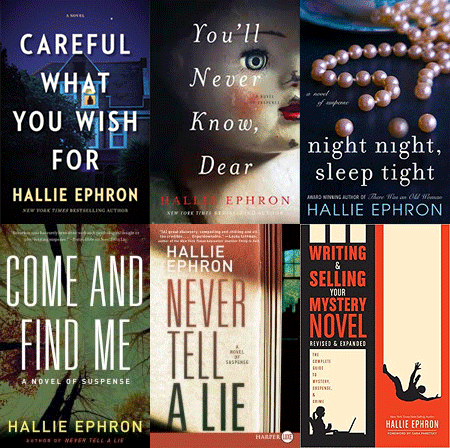
NIGHT NIGHT, SLEEP TIGHT is my fourth
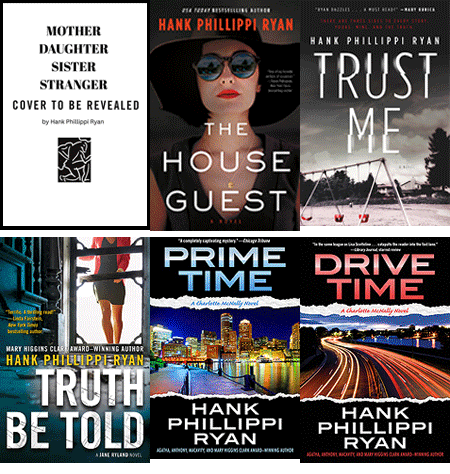
suspense novel nominated for the award (which btw Hank's THE OTHER WOMAN won), and I am in awe of the nominating committee because I have read the other four nominated books and it's stiff competition.
Here are the criteria for the award, supposedly
spelled out by Mary
herself:
- The protagonist is a nice young woman whose life is suddenly invaded.
- She’s self-made and independent, with primarily good family relationships.
- She has an interesting job.
- She is not looking for trouble–she is doing exactly what she should be doing and something cuts across her bow.
- She solves her problem by her own courage and intelligence.
- The story has no on-scene violence.
- The story has no strong four-letter words or explicit sex scenes.
Today I’ve invited my fellow nominees, a
spectacular group of like-minded writers of creepy
(but not icky, per MHC)
suspense novels to share with you their own feelings
about the nomination.
 CATRIONA McPHERSON: You could have fanned
me flat with a flapjack when I saw THE CHILD GARDEN short-listed for the Mary Higgins Clark award. As well as
the unbelievable honour of it, the book has quite a
few f-bombs and – I thought – fell way short of the “primarily good family
relationships” that Mary’s books celebrate (and are hard to write well).
CATRIONA McPHERSON: You could have fanned
me flat with a flapjack when I saw THE CHILD GARDEN short-listed for the Mary Higgins Clark award. As well as
the unbelievable honour of it, the book has quite a
few f-bombs and – I thought – fell way short of the “primarily good family
relationships” that Mary’s books celebrate (and are hard to write well).
I think I worked it out, though. While
Stig swears like a squaddie, Gloria, the heroine,
hates it and nags him. So the reader gets to nod along with her. Also, while
Glo’s relationships with her mum and sister are atrocious, she adores her son
and is a wonderful mother to him. So her primary family relationship is great one. That’s my theory anyway. When the judges reveal their
identities at the Edgars I’m going to ask. Until then, I’m just beaming.
SUSANNA CALKINS: When I first began to write my Lucy Campion
mysteries—historical mysteries set in 17th century England—I had
to make a decision about how dark or violent I was willing to go. After all, my
stories are set in a  period where people’s lives were—according
to philosopher Thomas Hobbes—“nasty, brutish and short.” But I deliberately put
my protagonist Lucy Campion, a chambermaid turned printer’s-apprentice, in
households where she was protected and even educated, as women of her station
often were not.
period where people’s lives were—according
to philosopher Thomas Hobbes—“nasty, brutish and short.” But I deliberately put
my protagonist Lucy Campion, a chambermaid turned printer’s-apprentice, in
households where she was protected and even educated, as women of her station
often were not.
period where people’s lives were—according
to philosopher Thomas Hobbes—“nasty, brutish and short.” But I deliberately put
my protagonist Lucy Campion, a chambermaid turned printer’s-apprentice, in
households where she was protected and even educated, as women of her station
often were not.
While I frequently
allude to the violence around her—death, misfortune and of course murder—I’m
more interested in the impact of violence on the community, not the violence
itself. So, while I did not consciously seek to follow the criteria for the Mary Higgins Clark award, I’m honored that
THE MASQUE OF A MURDERER is included among this year’s nominees.
 FRANCES BRODY:
Now that you mention it, Hallie, I see
connections. Mary Higgins Clark develops the classic theme of a woman in distress:
a likable young woman whose life is turned upside down. In A WOMAN UNKNOWN,
Deirdre Fitzpatrick needs to earn money to care for her sick mother. Philippa
Runcie wants to escape her faithless marriage. Kate Shackleton, widowed
detective, seeks truth and rights wrongs. MHC takes inspiration from real life
events. The title for A Woman Unknown jumped at me from a social
commentary on the period between the two world wars, a time when women’s lives
changed dramatically.
FRANCES BRODY:
Now that you mention it, Hallie, I see
connections. Mary Higgins Clark develops the classic theme of a woman in distress:
a likable young woman whose life is turned upside down. In A WOMAN UNKNOWN,
Deirdre Fitzpatrick needs to earn money to care for her sick mother. Philippa
Runcie wants to escape her faithless marriage. Kate Shackleton, widowed
detective, seeks truth and rights wrongs. MHC takes inspiration from real life
events. The title for A Woman Unknown jumped at me from a social
commentary on the period between the two world wars, a time when women’s lives
changed dramatically.
LORI RADER-DAY: Just
before my first novel THE BLACK HOUR was published, I went through the full  manuscript
and checked every f-bomb like a loose tooth. Could it be pulled? I imagined my
parents reading it; my dad had already announced my forthcoming book to his
church group. I was prepared to leave the words in—I enjoy a fine word bomb in
real life as much as anyone—but I found that none of them were essential.
manuscript
and checked every f-bomb like a loose tooth. Could it be pulled? I imagined my
parents reading it; my dad had already announced my forthcoming book to his
church group. I was prepared to leave the words in—I enjoy a fine word bomb in
real life as much as anyone—but I found that none of them were essential.
manuscript
and checked every f-bomb like a loose tooth. Could it be pulled? I imagined my
parents reading it; my dad had already announced my forthcoming book to his
church group. I was prepared to leave the words in—I enjoy a fine word bomb in
real life as much as anyone—but I found that none of them were essential.
They came out. And then when that book was
nominated for the Mary Higgins Clark Award, I felt vindicated. LITTLE PRETTY THINGS got the same treatment. I’m not anti-That Word, even now, but like every
other word in a manuscript, it has to pull its own weight. Mary Higgins Clark
is the better angel of my editing process, helping me watch my saucy mouth.
HALLIE:
My favorite criterion: She solves her problem
by her own courage and intelligence. I'm 100% onboard. Not so much on good family relationships. My protagonist's are
often complicated by things like alcoholism. Explicit sex and graphic violence
are easy for me to leave out, and four-letter words have always felt like lazy
witing. Unless (BIG exception) it’s in dialogue. Then if there’s a character who cusses, and that’s
just who she is, I need to put her on the page and let her cuss. Sorry. Mary.
Reds and readers, where do you draw the line with sex and violence and 4-letter words? Extra points to anyone who knows what squaddie means.